Reviews

Johnnie Walker Black Label

Posted by: Nick

WW Black Label

Johnnie Walker got one thing right when creating their original premium bottling: the name. Black Label subtly suggests quality. Conclude any mundane product title with it and witness the elevation in esteem it receives. For example, Kellogg’s cornflakes: Black Label. Colgate toothpaste: Black Label. Toyota Corolla: Black Label. Chartered accountancy: Black Label.

The name alone should be enough to convince most discerning whisky drinkers that in comparison to the Red Label, this drop is a step up. And it is – but only slightly.

Black extra Nick Whisky Waffle

Johnnie Walker Black is blended from over 40 whiskies all of which are at least 12 years of age. There is a nice range of flavour in this dram, and the supposedly ‘trademark’ smoky character is even vaguely noticeable! The key to this whisky is balance: balance between enjoyable flavours and downright unpleasant ones.

This principle is demonstrated in the nose, which presents a battleground where pleasing chocolate-orange notes and nasty chemical aromas compete for supremacy. There is a lot to like here, although, conversely many elements I’m not at all keen on. The palate continues in a similar vein – the sickly sweetness from the Red Label makes a return but is partially disguised by more agreeable flavours such as oak, nutmeg, and in particular, peat-smoke. It’s the sort of smoke which is only really noticeable if you’ve just polished off a decidedly unpeated malt, but when discovered, it really gives this whisky a lift.

There is a degree of complexity on the finish that is not found in the Red Label. Despite only being bottled at 40% ABV, it features a small amount of lasting spiciness. Sadly the unpleasant sweetness also makes a return and rather spoils the party.

Johnnie Walker Black Label is a mixed bag of a whisky. For every interesting and enjoyable flavour, there is another objectionable one dragging it down. It seems destined to forever be a mixer for those who prefer a slightly classier Scotch and coke. It is premium only in name, sadly not in nature.

★★

#johnniewalkerweek

Find out about the rest of our multi-coloured adventures:

Johnnie Walker Red Label

Johnnie Walker Double Black

Johnnie Walker Gold Label Reserve

Johnnie Walker Platinum Label 18 Year Old

Johnnie Walker Blue Label

Johnnie Walker Green Label

Johnnie Walker: which is best?

Johnnie Walker Red Label

Reviewed by: Nick and Ted

WW Red Label 2

In theory, blended Scotch whisky should showcase the best elements of the Scottish regions: the mellow sweetness of Speyside, the full bodied character of the Highlands, sexy smoke from Islay and the Islands. Mmm, makes you drool doesn’t it?

Johnnie Walker Red Label manages to showcase none of the above. Instead it somehow picks the worst of these regions: sickly sweetness from the lolly shops of Speyside, industrial air pollution, not from Islay, but Kilmarnock, and what of the character from the Highlands? Well, the only part it manages to keep is the dreadful weather.

Red extra Nick and Ted Whisky Waffle

To look at the Johnnie Red you would not detect anything amiss, but as soon as you give it a nose the questionable quality rears its head. Cloying treacly notes overpower the faint hints of oak desperately trying to claw their way through. Subtlety is not on the agenda here.

The palate is pretty one-dimensional, dominated by a fairly inconsequential caramel that fails to deliver anything of interest. There is a faint hint of maltiness, like cream biscuits where someone has licked out the filling, although admittedly they’re not even the nice kind of biscuits. The finish is lasting in the same way that a glass of cordial lingers at the back of the throat when you haven’t watered it down enough. The burn is not so much from the alcohol but the unpleasant sweetness.

Around the world the Johnnie Walker Red Label is predominantly served as a mixer, and tasting it neat we can understand why. Having said that, millions of litres worth of the stuff is sold around the world every day. In fact it’s the highest selling Scotch whisky on the planet, so basically, what do we know?

#johnniewalkerweek

Find out about the rest of our multicoloured adventures:

Johnnie Walker Black Label

Johnnie Walker Double Black

Johnnie Walker Gold Label Reserve

Johnnie Walker Platinum Label 18 Year Old

Johnnie Walker Blue Label

Johnnie Walker Green Label

Johnnie Walker: which is best?

Caol Ila 12 Year Old

Reviewed by: Mooresy

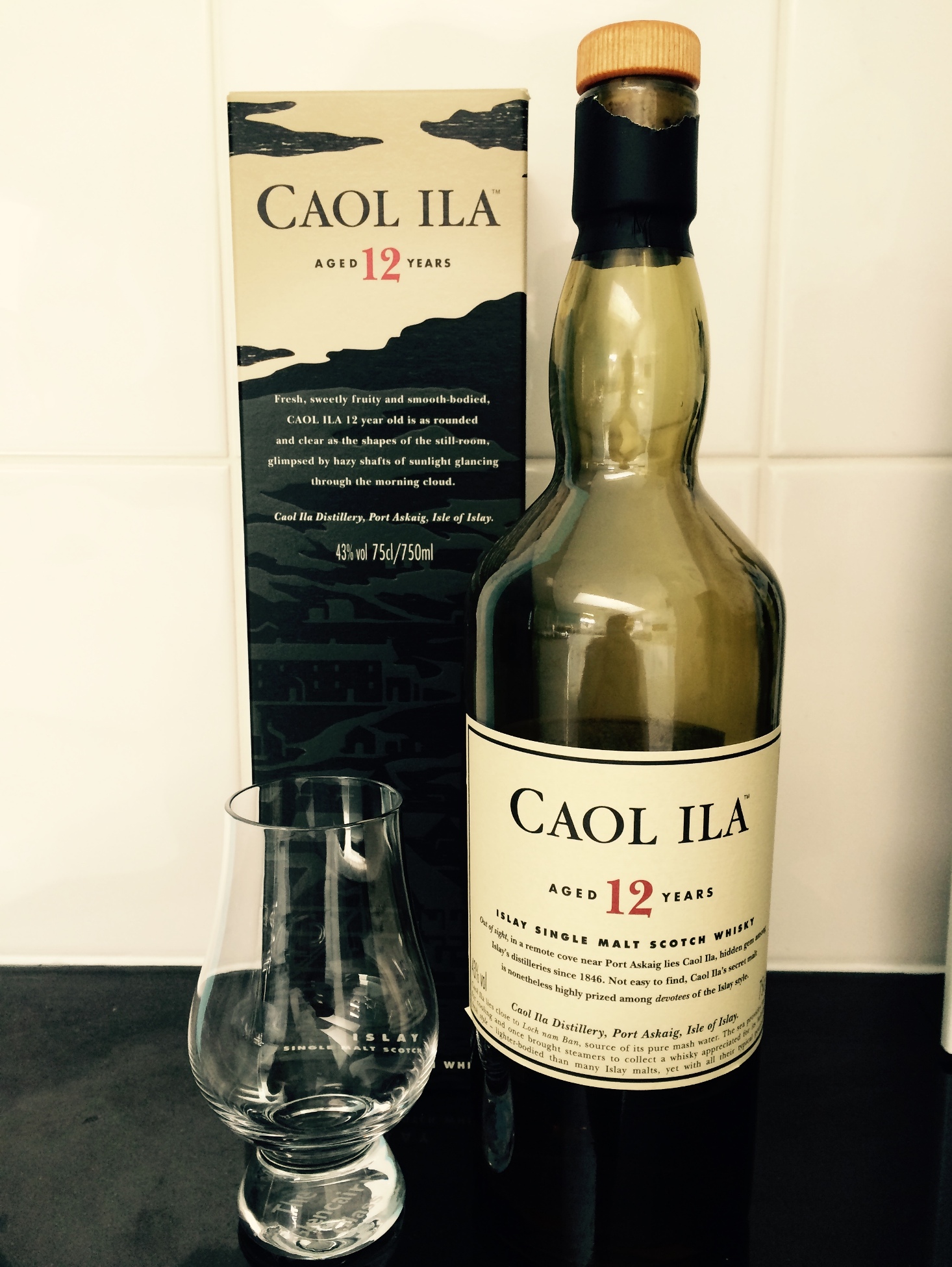
Caol Ila

Caol Ila is a deceptive drop, both in pronunciation and in presentation. The Scots will tell you, aggressively, that there is one way to pronounce Caol Ila and that is “Cull Eel-a” blurred into one word. You’ll be lucky if spellcheck doesn’t turn it into Coal Ikea, but stay well away from that and do not be fooled by your non-Gaelic upbringing.

It is also deceptive on appearance. The box is black, but in particular the bottle is darkened grey glass, as if the Islay smoke itself was swirling inside staining the bottle like the wind lashes coastal cliffs. But once the dram is poured, the liquid is pale as if pulled straight from a virgin oak barrel.

Caol Ila means Sound of Islay but is not one of the best well known of the Islay malts and, despite being the largest Islay distillery, it is not in the Islay triumvirate. I am leaving Bowmore out of the triumvirate if anyone is struggling to narrow it down to the big three.

On the nose, there is the smoky peat smell that makes it quintessentially Islay. There are hints of peppermint and the fresh fruit leaf smell coming through but most surprising is how the brine – more subtle than many an island whisky – adds an intensity without being overpowering.

This translates onto the palate where, combined with a caramelised sugar sweetness, the peak hit comes back for a second round. Despite the colour and viscosity on appearance, Caol Ila is quite an oily whisky and arrives like a malt older than its twelve years but without the punch of those elders. It is disappointingly only bottled at 43%.

The finish is long and the oily quality stays in the mouth for round three of peat hit. But don’t get me wrong, this in not the kind of peat that will clear a room from smell alone. Unlike the infamous (and exceptional) Octomore, you don’t wake up the morning after trying to remember when you smoked a cigar the night before. But it has just enough to be an excellent easy-drinking Islay malt.

Perhaps the most endearing element of the Caol Ila 12 is what, I suspect, it contributed to the now deceased blended malt Johnnie Walker Green Label, but that is a story for a future musing.

★★★

Yamazaki Distillers Reserve

Reviewed by: Nick

Yamazaki Distillers Reserve whisky waffle

Even the most diehard Scotch whisky traditionalists can no longer argue that countries other than Scotland cannot produce top quality single malts. Japan has become one of the leaders in New-World whisky-making and recent awards, such as the number one spot in Jim Murray’s 2015 whisky bible, suggest that the status quo is changing – slightly – but noticeably.

The establishment responsible for the latest-greatest single malt is Yamazaki, Japan’s oldest distillery. Some of their products are undoubtedly spectacular and produce flavours that will stand out in any collection. Others, however, are more content to blend into the background.

The Yamazaki Distillers Reserve features younger spirits matured in ex-red wine casks married with older sherry and Japanese oak (mizunara) casks. The results are pleasant, although certainly not world-beating.

Dark fruits are immediately noticeable on the nose along with some sappier floral notes. There is also a slight dollop of vanilla with subtle hints of wood shavings. It is lively across the palate – spicy and challenging and certainly not smooth. Although far from sweet, it contains notes of stewed apricots and raspberry jam, but these compete for attention with oaky tannins and form an intriguing but overall unbalanced flavour. There is a bitterness to the finish which partially hides the more pleasant fruitier notes and the overall impression is one of ‘so close, but yet so far’.

The Yamazaki Distillers Reserve is far from a bad whisky. It is interesting, challenging and uniquely Japanese. It is, however, far from Yamazaki’s best drop and certainly lacks the balance of flavours found among the distillery’s more accomplished products.

★★

Hellyers Road 12 Year Old

Reviewed by: Nick and Ted

Hellyers Road 12 Year Old whisky waffle

Hobart vs Launceston. Cascade vs Boags. Mount Wellington vs Cradle Mountain. Gagebrook bogans vs Ravenswood bogans. Tasmania is often spoken about by locals as being a very parochial state. We have the North/South divide, with each half of the state engaged in a long running battle about who has the best stuff. In the new game of Tasmanian whisky, the cards are very much stacked on the side of the South, with eight of the nine distilleries in the state residing there.

However, the North cannot be swept off the board that easily, as it has a very impressive golden ace up its sleeve. Hellyers Road, located in the North-West city of Burnie, has officially launched its 12 Year Old whisky, making it the first distillery in Australia to release an expression of this age. In 2012 the company released a 10 Year Old single malt which showed promise of greatness, and now two years later that potential is being realised. Pleasingly the extra years spent sleeping in oak have helped smooth out the edges without compromising the creamy, buttery flavours unique to Hellyers Road.

Compared to the white wine colour palate of the Hellyers Road Original, the longer time in the barrels has imparted a rich golden hue to the 12. The nose opens with vanilla from the American bourbon oak, followed by the creamy nuttiness of macadamias, cashews and almonds. There are also elements of candied citrus peel and melted butter to be found. The overall effect is of vanilla cupcakes coated in orange and poppy seed icing.

On the palate the 12 is smoother and yet more complex than other Hellyers Road expressions, with delicate honeyed undertones that are reminiscent of the lightly burnt sugar on top of a crème brulee. Complementing the sweetness are subtle herbal notes and spice that bring to mind the leaves of the Tasmanian native pepper berry bush. The finish is light and imparts a soft warmth to the back of the throat.

When we asked Hellyers Road head distiller Mark Littler if the 12 was everything he intended it to be, his simple reply was that “it’s more”. Two years may not seem a long time to us, but to this whisky that short period is incredibly significant and adds a high class edge of silk into the mix. The 12 year old is the defining expression of Hellyers Road, and an exciting move forward for Tasmanian whisky. As Northern boys we’re proud to say that the golden ace has been played with style in our end of the state, and taken the game to a whole new level.

★★★★


An evening at Hellyers Road: 12 years in the making

Posted by: Nick and Ted

The Whisky Waffle boys watched with bated breath as Mark Littler, head distiller at Hellyers Road in Burnie, turned to the guest of honour. “What do you see in your glass?” He asked, offering a dram of Australia’s first 12 Year Old single malt.
“I see fluid!” came the rumbled reply.

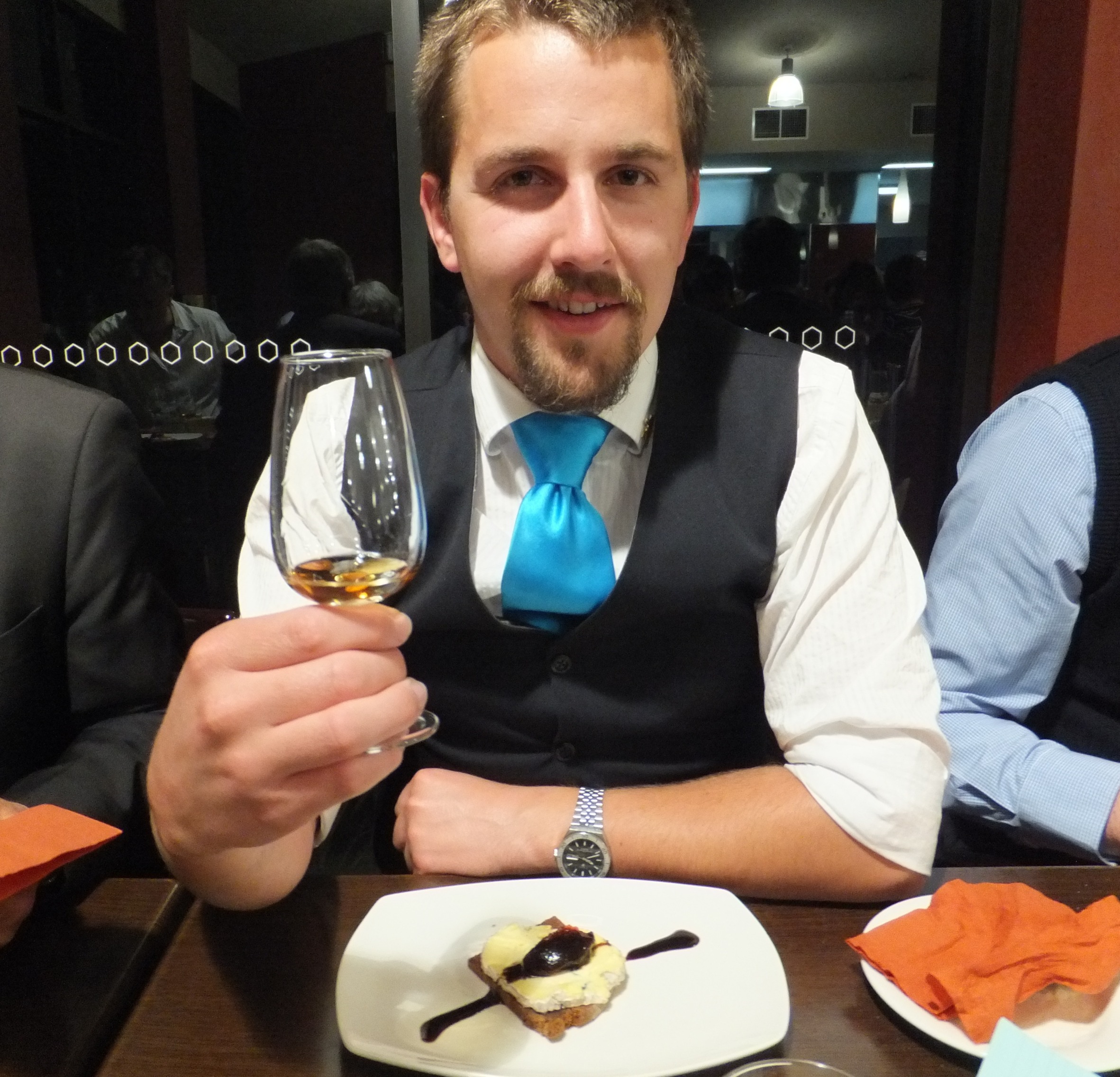
When the guest of honour is Jeff Kennett, former premier of Victoria, recent president of Hawthorn Football Club, current chairman of beyondblue Australia, and whisky fanatic in general, you can be assured of an entertaining night of pithy banter, some of it directed at the crowd (we were dubbed the ‘Blue Ties’ for the striking colour of our neck adornments supporting beyondblue, as the charity was to be the beneficiary of the nights proceeds).

Mark Littler and Jeff Kennett investigating the "excellent leggings" in the glass

Mark Littler and Jeff Kennett investigating the “excellent leggings” in the glass

The Whisky Waffle boys were at Hellyers Road in an official capacity, though to be honest wild Celts could not have kept us from attending. On Tuesday the 28th of October 2014 we were both delighted and proud to have the opportunity to attend the official launch of the distillery’s new 12 Year Old single malt, a milestone achievement for Tasmanian whisky.

The night was hosted by Julian O’Brien, editor of local newspaper The Advocate, although he claimed not to be there as a reporter (Jeff: “But I’ve met journalists before.”). Guests were treated to a five course degustation menu pairing local produce with whisky (Hellyers Road of course!). We must admit to being slightly sceptical about the concept of deliberately pairing whisky with food (surely a good malt goes with anything!) but we were more than willing to be won over. Helping the meal to go down was the stunning view from the Hellyers Road visitors centre restaurant out across the Emu Valley.

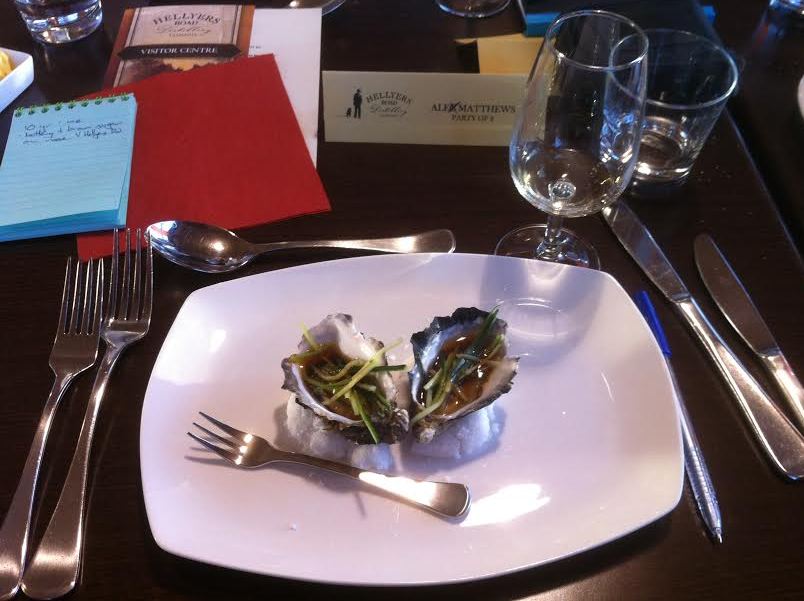
First cab off the rank was Hellyers Road’s only previous age statement whisky, the 10 Year Old, a drop that Mark Littler referred to as “possibly Australia’s number one selling single malt”, and was matched with a delicate dish of natural Tasmanian oysters. On our first attempt at food and whisky pairing we decided that one did not overpower the other, and the saltiness in the oysters accentuated the sweetness in the whisky.
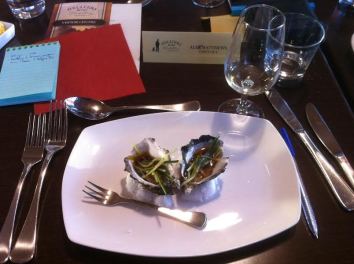
Course 1 whisky waffle

Tasmanian oysters usually come armed with a tiny fork. Naturally.

After the oyster course came the moment that we were all waiting for, the unveiling of the new 12 Year Old. Mark invited his guests to not just taste the whisky, but to ‘chew’ it, claiming they would find greater depths of flavour if they did so. “Are you with me?” he asked.
“Only out of sheer curiosity,” replied Jeff, who had joined him for the tasting.

We are delighted to say that we were very impressed by the excellent quality of the 12 Year Old. Ted thought he could detect a familiar flavour in the scent: “Macadamias?”
“Very astute,” returned Jeff “And most certainly wrong!”
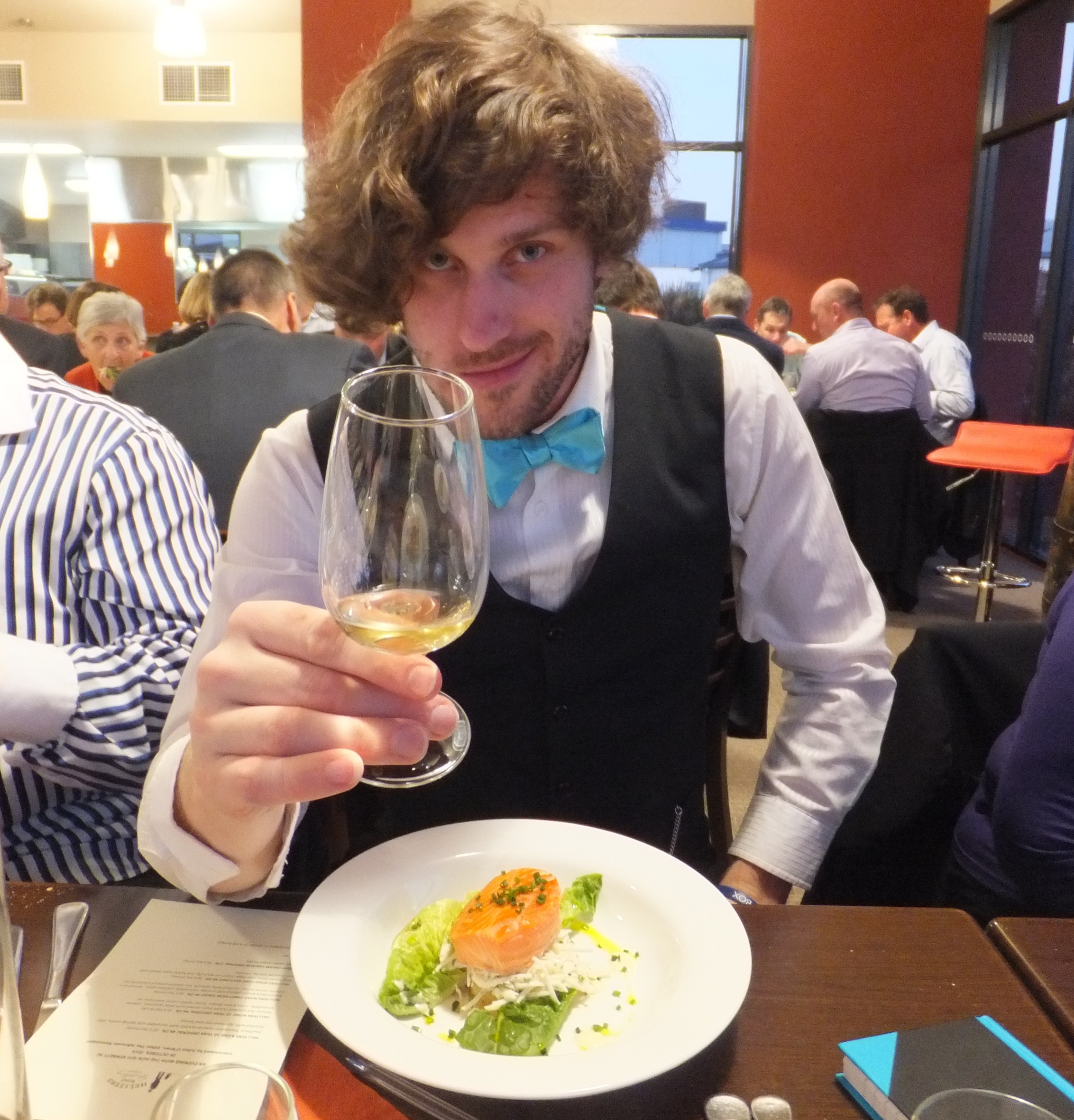
The 12 was paired with a dish of Petuna hot-smoked ocean trout, the whisky’s natural oiliness working well with the fish.

Course 2 and Nick whisky waffle

Nick: a slightly fishy character

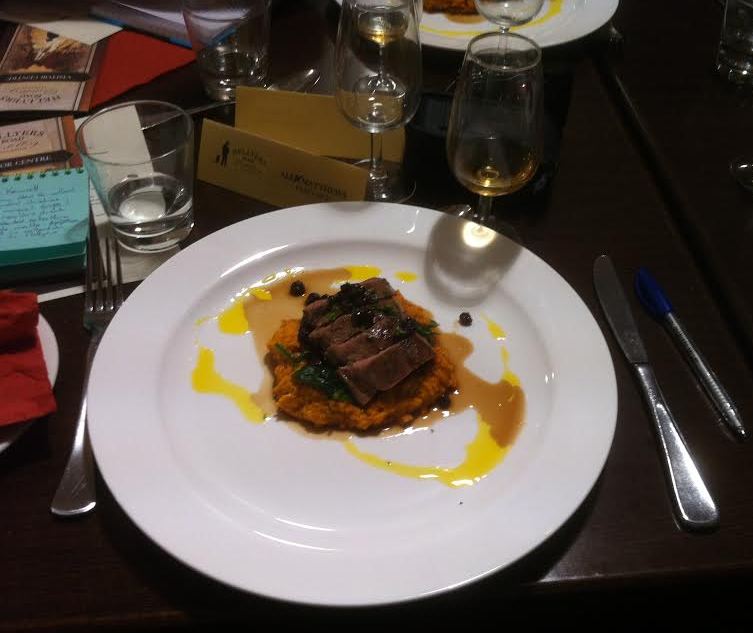
The next course was the Hellyers Road Pinot Noir Finish coupled with a sumptuous dish of duck, however our pairing notes were cut short at this point because the guest speaker began his formal address.

Course 3 whisky waffle

We took to this course like ducks to water

Jeff Kennett began by praising the quality of the Tasmanian whisky industry. He revealed that he had a long time association with Hellyers Road and was pleased they had done so well and come so far, admitting that it was “a hell of a risk for a bunch of dairy farmers to start up a distillery.”

He also regaled us with a number of humorous tales, telling us of his ‘Man Cave’ which contains a large proportion of his 700-odd strong collection of single malt whiskies. Julian then commented that the Whisky Waffle boys might like to pay a visit to the ‘Man Cave’ to sample the wares. “Not wearing those ties!” retorted Jeff.
“beyondblue!” we protested.
“Well in that case you’re definitely invited.” We are pleased to say there were over 50 others present to witness this offer.

Jeff says that beyondblue is by far the thing that he is most proud of and will always be, unless (as he claims) he lives to 150 and something else overtakes it. His one wish is to end discrimination, and if we can do this he feels that we’d be much happier as a society.

Having spent much time in Tasmania he is passionate about the future direction of the state. Julian asked “If you were Premier for the day, what would you do?”
“Well, to be honest it would only take half a day!”
On a more serious note Jeff feels that if the Tasmanian whisky industry is properly supported then it could become a major drawcard for the state, helping to provide much needed money and jobs and raise its global profile.

The fourth course of the night was a curious combination of King Island Dairy triple-cream blue brie with quince paste on honey spice bread. For this dish Hellyers Road brought out their whisky best suited to complement the rich flavours on offer, the excellent Port Cask. We were both very impressed by this single-barrel release, which combined the typical Hellyers Road buttery notes with rich winter fruit flavours.

Course 4 and Ted whisky waffle

Ted: a cheesy character

As we sipped our Hellyers Road whisky cream liqueur and nibbled on our final course: orange vodka fudge tartlets, we mused on our evening. The whisky was definitely a highlight, but perhaps even more so was meeting the people that made it, and the passion and delight they radiated when sharing their craft with others. We hope to continue this friendship, as we all share the same hopes for Tasmanian whisky, and are proud to have a local distillery producing drams of such quality.
course 5 whisky waffle

Cows with guns: at the end of the night, this stuff goes down dangerously smooth

At the end of the evening Mark Littler, and Hellyers Road visitor centre manager Sharon Deane, presented Jeff with a bottle of the 12 Year Old. “One to add to the collection Jeff?”
“Collection? No chance, I’ll have drunk it by the time I get home!”
You certainly couldn’t say fairer than that.

Nant Port Wood 43%

Reviewed by: Nick

Nant Port Wood 43% whisky waffle

One day, Nant is going to take over the world.

It started out as a fairly innocuous venture. Queensland businessman buys small country estate in the tiny country town of Bothwell, Tasmania. But all is not what is seems.

Bothwell as a town is in fact a tribute to Scotland; it is built on the ‘Clyde’ River and, heart-warmingly, features tartan street signs. The Estate’s new owner is the business-savvy Keith Batt, and only ten years after purchasing the property, he has built a distillery, exponentially expanded its output, opened a successful chain of Whisky Bars around the world, and along the way, produced some truly wonderful whisky. This was never going to be a small-scale boutique distillery…

Fortunately for Nant, in this quest for success and recognition they have not compromised the quality of their product; instead producing batches of frequently excellent whisky. While they may not yet be a truly worldwide product, they can count among their fans one Jim Murray, author of the iconic (and egotistically titled) yearly publication: ‘The Whisky Bible’. Surely it is only a matter of time before Nant goes global.

Nant mature their whisky in various cask types, though there is something special about the ‘Port Wood 43%’ release. Lightly amber in colour, it is sweet on the nose with hints of raisins coated in white chocolate. It is gloriously rich on the palate, featuring cloves, nutmeg and other spices. It is still sweet, but also creamy, and has strong notes of citrus fruit; particularly oranges. The finish is warm, pleasant and creamy. The fruit cake characteristics remain, along with cherries and maple syrup. When you drink this whisky not only do you get flavours of Christmas pudding, but brandy butter, too.

While this whisky is complex and interesting, it is also smooth enough to be enjoyed by non-whisky drinkers. It is unique, memorable, and well worth seeking out.

Of course, it is also built upon the most successful business model seen within the Tasmanian Whisky industry. When trying a drop of Nant, you are not only drinking a whisky – you are drinking an empire.

★★★★

Strathisla 12 Year Old

Reviewed by: Ted

Strathisla 12

Some people say that nothing that comes out of a medicine bottle ever tastes good. Well, I would argue that is not always the case, especially when the bottle contains Strathisla 12 Year Old.

Now, I’m not saying that whisky is medicinal (although my dad always had a glass if he felt a cold coming on), but the Strathisla 12 captures the look of a Victorian medicine bottle, with beautiful dark green glass, embossed lettering, several fonts, and a lovely etching of the distillery.

Strathisla is owned by Chivas Brothers, makers of the well known range of Chivas Regal blends. According to the box the distillery itself is ‘The oldest distillery in the Highlands’, although we would debate this fact slightly. Not the age mind, but the location, because when you look on a map you would be forgiven for thinking that Strathisla is smack bang in Speyside.

A sly Speyside imp certainly dances into the character of the Strathisla 12. The nose is light and sharp, with notes of hard fruit, grain, and crushed grass. The taste is crisp and green, with strong bitter herbal flavours that cut across the tongue, leaving a lasting dryness. There’s a raw, untamed edge to this Strathisla that suggests a younger whisky than its 12 years. Perhaps a few more years in the barrel would coax it into bloom.

If you are one of those people that are of the opinion ‘It’s herbal, so it must be good for you’, then you will probably find a better bet in the Strathisla 12 than downing some concoction of random weeds pulled from the garden. The bitterness will definitely be a turnoff for some people, but sometimes that’s just what you want. In fact, come to think of it, the herbal qualities may even make it an excellent component for a cocktail. Take a walk into the leafy green garden of Strathisla and see if it’s just the tonic you’re looking for.

★★

Laphroaig Quarter Cask

Reviewed by: Nick

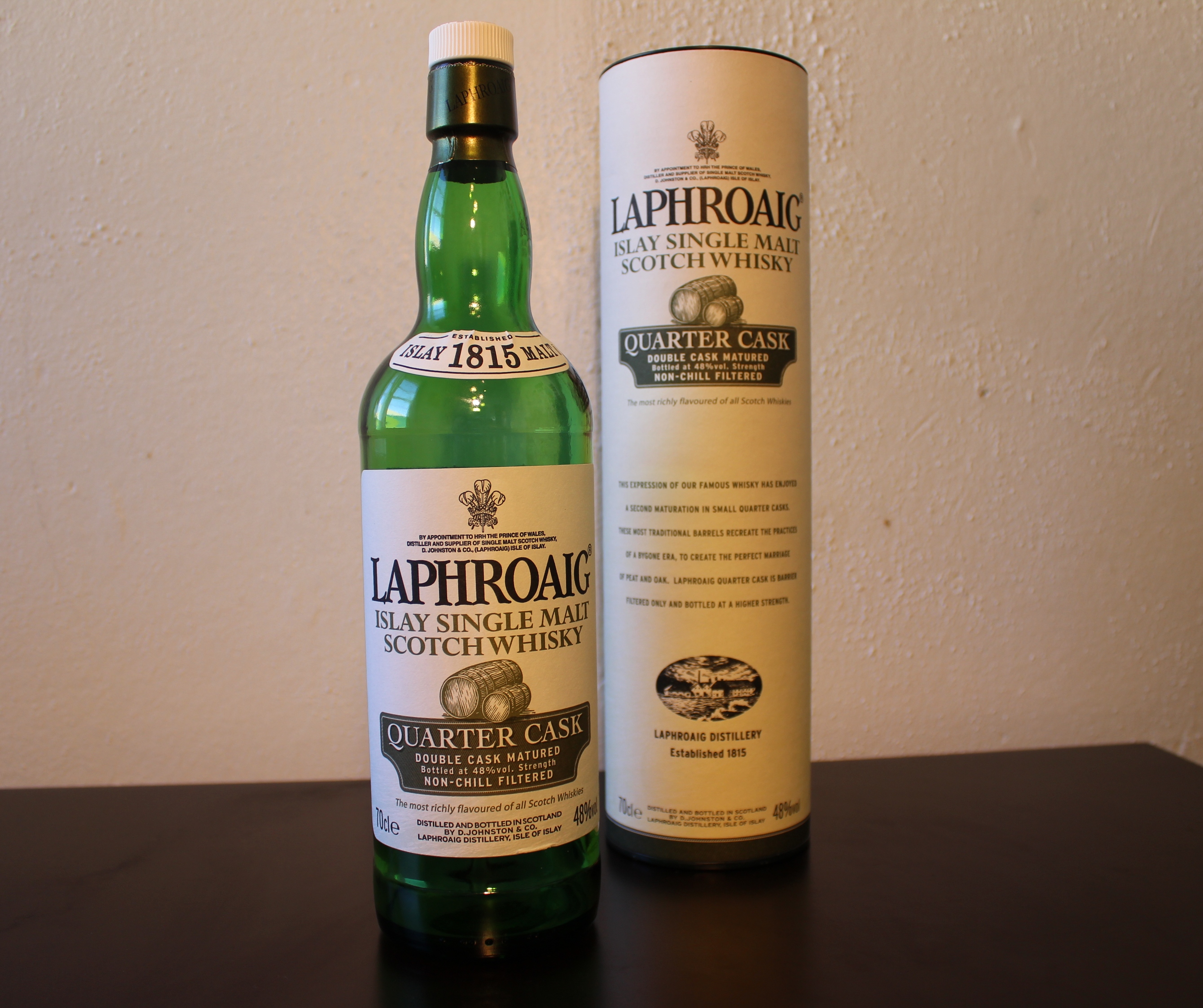
Laphroaig Quarter Cask whisky waffle

At the time, this was the most expensive bottle of whisky I had ever bought. My best friend, co-writer and co-drinker Ted, had just bought a bottle of Lagavulin 16 and I convinced myself I needed to follow suit with something equally special. So I parted with more money than a uni student like me would normally spend in a month, and took the plunge into the world of Islay whiskies. I was not disappointed.

While this whisky may be younger than 10 years (no age statement is provided, so it’s hard to be sure) it has been matured in smaller ‘quarter’ casks, hence the name of the expression. The reduction in barrel size ensures the spirit has had more contact with the wood than it would usually be allowed (Laphroaig claim 30% more!) and suddenly a more complex, more dynamic whisky is born.

There is still plenty of peat on offer here. However, while the 10 Year Old is merely smouldering, the Quarter Cask is burning intensely: it is the whisky equivalent of a blazing bonfire.

Coastal elements are present on the nose; a sea breeze of salt, brine and seaweed. The fire transfers to the palate: the increased bottling level of 48% gives this whisky the kick and spice that the 10 Year Old lacks. Sweeter flavours come through: toffee, treacle, cocoa, even caramel. The finish is lengthy and memorable. Huge gusts of smoke roll across the palate, and linger for minutes afterwards.

Peated whisky is made by many distilleries. But rarely has one got it as right as this. There is without doubt still a sense of rawness about it. In no way can it be described as the smoothest, most elegant, or even the best whisky you will taste. But all these elements, remarkably, work in its favour. This is peated whisky. This is Islay.

★★★★

Amrut Fusion

Reviewed by: Mooresy

Amrut Fusion
Keen not to be left behind, India’s first single malt was launched in 2004 by Amrut Distilleries and has had a meteoric rise to success in the world market over the last decade. Not trying to imitate Scotch, Indian whisky brings its own special something to the field.

True to its name, this variant is a fusion between the traditional methods of the Scots and the experimental, unshackled approach of Indian distillers. Like a child who has moved out of home in defiance but is still keen to impress the parents, Amrut whiskies are a reminder to the world that independence can lead to innovation in a way only ex-colonial powers demonstrate.

For long-time drinkers of Scotch whisky who are yet to stray into the realm of Australian, Japanese or any other countries, Amrut Fusion will be a surprising drop. On the nose there are hints of spice and sweetness, pushing the mind to thoughts of chai and other familiar Indian flavours.

After a short while, the intensity fades and, I for one, was left with the clearest smell of warm cinnamon doughnuts. On a cold night sitting on a balcony somewhere looking over the ocean, one would feel they were right there at a carnival surrounded by cotton candy, caramel popcorn, and of course the doughnuts.

To taste it gets more traditional, the fruitcake and chocolaty flavours, with the vanilla notes almost inescapable in bourbon-matured drams. The Scottish barley has arguably its biggest influence on the palate through the peat it brings to Fusion, giving a nice smoky kickback to whisky’s origins. Nothing overpowering, just enough to affect the finish and push it out that little bit longer.

There’s a moderate finish, but it’s hard to identify the length because once finished there is a strong desire to just top up the glass a little more and keep the sensation alive. Imagine opening a box of 12 cinnamon doughnuts: you never eat just one.

In the same way that Suntory exhibits qualities archetypal to the qualities of the country in which it was made – precision, exactness, and patience – there is something of the same in Amrut. A busyness and complexity that may make it hard to pin down individual flavours at first but given time all come together and paint a picture everyone can enjoy. There are few whiskies where the phrase “the whole is greater than the sum of the parts” is so applicable.

Amrut has several variants including a peated and a cask strength version of their original single malt, but Fusion is delicious, readily available, affordable, and has a hedonic quality that so far differs from all other Indian whisky (not to mention Scotch whisky) in a charming and moreish way.

★★★