smoke

Johnnie Walker Black Label

Posted by: Nick

WW Black Label

Johnnie Walker got one thing right when creating their original premium bottling: the name. Black Label subtly suggests quality. Conclude any mundane product title with it and witness the elevation in esteem it receives. For example, Kellogg’s cornflakes: Black Label. Colgate toothpaste: Black Label. Toyota Corolla: Black Label. Chartered accountancy: Black Label.

The name alone should be enough to convince most discerning whisky drinkers that in comparison to the Red Label, this drop is a step up. And it is – but only slightly.

Black extra Nick Whisky Waffle

Johnnie Walker Black is blended from over 40 whiskies all of which are at least 12 years of age. There is a nice range of flavour in this dram, and the supposedly ‘trademark’ smoky character is even vaguely noticeable! The key to this whisky is balance: balance between enjoyable flavours and downright unpleasant ones.

This principle is demonstrated in the nose, which presents a battleground where pleasing chocolate-orange notes and nasty chemical aromas compete for supremacy. There is a lot to like here, although, conversely many elements I’m not at all keen on. The palate continues in a similar vein – the sickly sweetness from the Red Label makes a return but is partially disguised by more agreeable flavours such as oak, nutmeg, and in particular, peat-smoke. It’s the sort of smoke which is only really noticeable if you’ve just polished off a decidedly unpeated malt, but when discovered, it really gives this whisky a lift.

There is a degree of complexity on the finish that is not found in the Red Label. Despite only being bottled at 40% ABV, it features a small amount of lasting spiciness. Sadly the unpleasant sweetness also makes a return and rather spoils the party.

Johnnie Walker Black Label is a mixed bag of a whisky. For every interesting and enjoyable flavour, there is another objectionable one dragging it down. It seems destined to forever be a mixer for those who prefer a slightly classier Scotch and coke. It is premium only in name, sadly not in nature.

★★

#johnniewalkerweek

Find out about the rest of our multi-coloured adventures:

Johnnie Walker Red Label

Johnnie Walker Double Black

Johnnie Walker Gold Label Reserve

Johnnie Walker Platinum Label 18 Year Old

Johnnie Walker Blue Label

Johnnie Walker Green Label

Johnnie Walker: which is best?

Johnnie Walker Red Label

Reviewed by: Nick and Ted

WW Red Label 2

In theory, blended Scotch whisky should showcase the best elements of the Scottish regions: the mellow sweetness of Speyside, the full bodied character of the Highlands, sexy smoke from Islay and the Islands. Mmm, makes you drool doesn’t it?

Johnnie Walker Red Label manages to showcase none of the above. Instead it somehow picks the worst of these regions: sickly sweetness from the lolly shops of Speyside, industrial air pollution, not from Islay, but Kilmarnock, and what of the character from the Highlands? Well, the only part it manages to keep is the dreadful weather.

Red extra Nick and Ted Whisky Waffle

To look at the Johnnie Red you would not detect anything amiss, but as soon as you give it a nose the questionable quality rears its head. Cloying treacly notes overpower the faint hints of oak desperately trying to claw their way through. Subtlety is not on the agenda here.

The palate is pretty one-dimensional, dominated by a fairly inconsequential caramel that fails to deliver anything of interest. There is a faint hint of maltiness, like cream biscuits where someone has licked out the filling, although admittedly they’re not even the nice kind of biscuits. The finish is lasting in the same way that a glass of cordial lingers at the back of the throat when you haven’t watered it down enough. The burn is not so much from the alcohol but the unpleasant sweetness.

Around the world the Johnnie Walker Red Label is predominantly served as a mixer, and tasting it neat we can understand why. Having said that, millions of litres worth of the stuff is sold around the world every day. In fact it’s the highest selling Scotch whisky on the planet, so basically, what do we know?

#johnniewalkerweek

Find out about the rest of our multicoloured adventures:

Johnnie Walker Black Label

Johnnie Walker Double Black

Johnnie Walker Gold Label Reserve

Johnnie Walker Platinum Label 18 Year Old

Johnnie Walker Blue Label

Johnnie Walker Green Label

Johnnie Walker: which is best?

Whisky Waffle announce: Johnnie Walker Week

Posted by Nick and Ted

The Whisky Wafflers are chuffed to announce their first ever ‘event week’! Over the next seven days they will be sampling each of the main expressions of Scotland’s most famous and renowned blended whisky. I am of course referring to: Walkers Kilmarnock Whiskies!

What’s that? It’s not called that these days? Well what is it then? Oh. I see. I stand corrected.

I am of course referring to: Johnnie Walker!

Whisky Waffle considering Johnnie Walker

If you are a Scotch whisky drinker, it’s likely that at some stage in your life, you will have tried a Johnnie Walker product. If you are not a Scotch whisky drinker, it’s even more likely that at some stage in your life you will have tried a Johnnie Walker product – and it put you off.

Regardless, be sure to tune in over the next seven days for our light hearted and occasionally tongue in cheek opinions of all six main expressions, as well as the story of our darkest whisky drinking day.

With all that and more coming up, be sure to visit the page over the next week and find out exactly what we think of the best selling whisky in the world!

#johnniewalkerweek

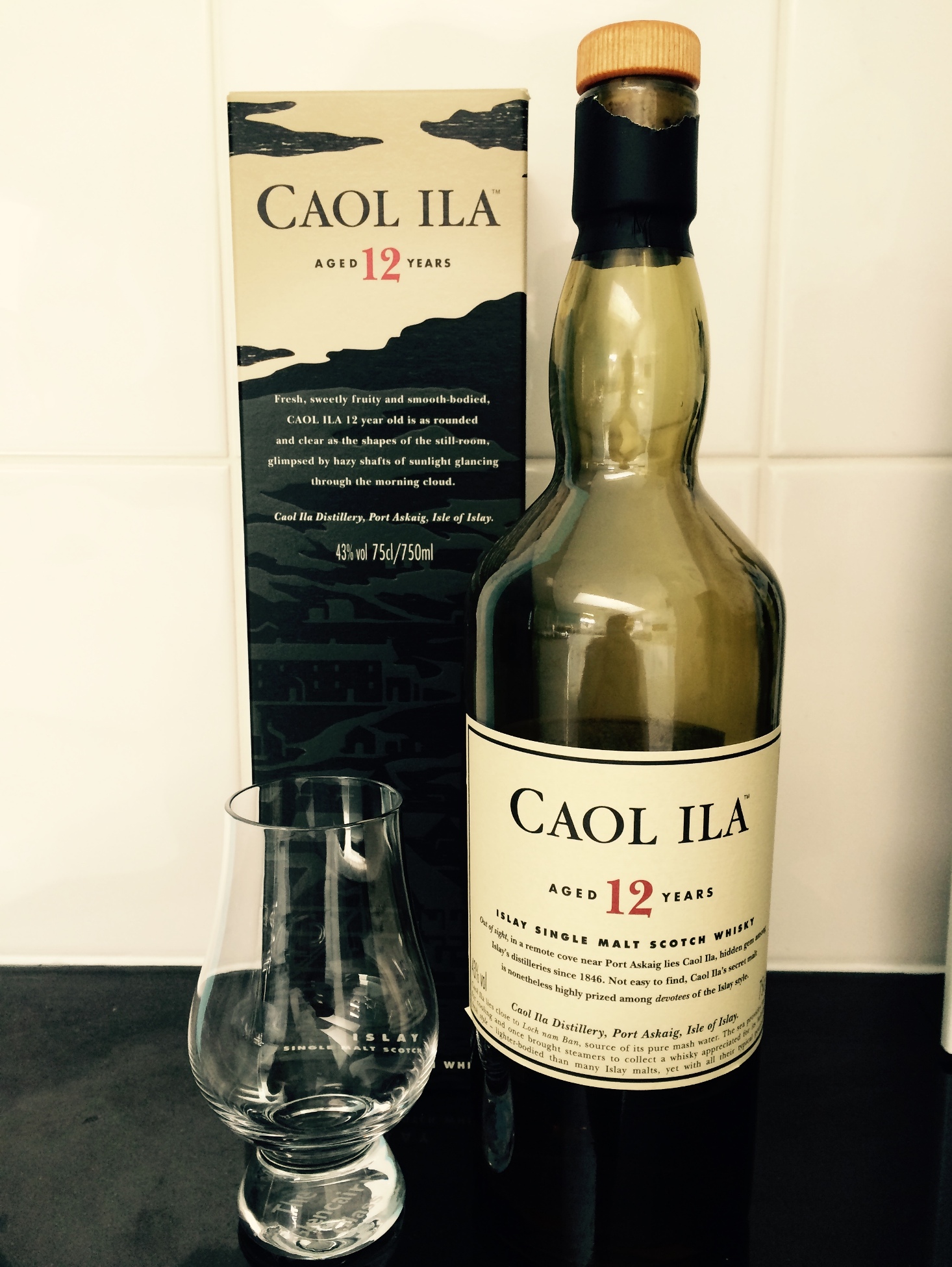
Caol Ila 12 Year Old

Reviewed by: Mooresy

Caol Ila

Caol Ila is a deceptive drop, both in pronunciation and in presentation. The Scots will tell you, aggressively, that there is one way to pronounce Caol Ila and that is “Cull Eel-a” blurred into one word. You’ll be lucky if spellcheck doesn’t turn it into Coal Ikea, but stay well away from that and do not be fooled by your non-Gaelic upbringing.

It is also deceptive on appearance. The box is black, but in particular the bottle is darkened grey glass, as if the Islay smoke itself was swirling inside staining the bottle like the wind lashes coastal cliffs. But once the dram is poured, the liquid is pale as if pulled straight from a virgin oak barrel.

Caol Ila means Sound of Islay but is not one of the best well known of the Islay malts and, despite being the largest Islay distillery, it is not in the Islay triumvirate. I am leaving Bowmore out of the triumvirate if anyone is struggling to narrow it down to the big three.

On the nose, there is the smoky peat smell that makes it quintessentially Islay. There are hints of peppermint and the fresh fruit leaf smell coming through but most surprising is how the brine – more subtle than many an island whisky – adds an intensity without being overpowering.

This translates onto the palate where, combined with a caramelised sugar sweetness, the peak hit comes back for a second round. Despite the colour and viscosity on appearance, Caol Ila is quite an oily whisky and arrives like a malt older than its twelve years but without the punch of those elders. It is disappointingly only bottled at 43%.

The finish is long and the oily quality stays in the mouth for round three of peat hit. But don’t get me wrong, this in not the kind of peat that will clear a room from smell alone. Unlike the infamous (and exceptional) Octomore, you don’t wake up the morning after trying to remember when you smoked a cigar the night before. But it has just enough to be an excellent easy-drinking Islay malt.

Perhaps the most endearing element of the Caol Ila 12 is what, I suspect, it contributed to the now deceased blended malt Johnnie Walker Green Label, but that is a story for a future musing.

★★★

Laphroaig 10 Year Old

Reviewed by: Nick

Laphroaig 10 whisky waffle

Peat. One of the biggest, strongest and most divisive flavours found within a dram of whisky. The smoky, medicinal notes send some people running to the hills with just the merest of whiffs. But to others, there are no better flavours in the entire world of whisky. These flavours are most strongly associated with one place: Islay.

The early Ileach distillers did not set out with the intention of creating such iconically flavoured whisky. The use of peat to smoke the barley was born out of necessity rather than creativity. Islay is as remote as it is boggy, and getting coal to the island on a train was simply not an option. So the locals turned to a resource they had in abundance: peat. It kept them warm in their houses against the wild force of the Atlantic Ocean, so burning anything else in their kilns was never a consideration.

The most famous example of peated whisky is made by the Laphroaig Distillery. As far as standard releases go, nothing is on the same extreme level in terms of the peaty intensity of its flavour.

In their 10 Year Old expression it is immediately noticeable – before it has even come close to your nose. Smoke. Ash. Medicinal iodine notes, all there smouldering together. This is the scent of a bonfire at the beach.

The palate is legendarily akin to licking a burnt log. Maritime notes are present; briny, seaweed flavours ebbing through gently. Other, more obscure elements are there too, such as leather and sawdust. The bourbon cask imparts only small amounts of vanilla; and what comes through is particularly dry and slightly bitter.

The finish is disappointingly short and contains several soapy, chalky notes, before the smoke gently comes rolling back, leaving a warm, lingering ash-like flavour.

While it is not the best Islay, or even Laphroaig has to offer, there is no doubt this dram showcases some amazing peaty flavours. It is, however, something of a one card trick, let down by the flavours that accompany the smoke. This does not disappoint me too much. If this is merely the entry level, how good must their other expressions be?

★★★

Glenlivet 12 Year Old

Reviewed by: Nick

Glenlivet 12 whisky waffle

Some whiskies have absolutely blown me away when I’ve first tried them. Often, the most exciting drams I have ever tried I’ve been unsure if I liked when they first passed my lips. Some whiskies are challenging and different and interesting. But not all of them.

I begin this review as if a whisky that were to lack one or all of these qualities is in some way an inferior drink. However, when the Glenlivet 12 Year Old is concerned, this is just not the case.

Rarely have I found a distillery as reliable as Glenlivet. Nor, where its signature expression is concerned, one as good value. But the 12 Year Old is as dependable a dram as you will find in Scotland. It is the perfect just-got-home-from-work whisky.

It offers sweet oak notes on the nose, leaving you in no doubt you have a malt from Speyside. On the palate it provides an initial hit of honey and some heather before developing into glorious burnt caramel, brown sugar and just a hint of smoke. This makes way for a long vanilla-centric finish that leans towards creaming soda. It all adds up to create a distinctive and memorable, if not perfectly balanced, flavour.

Glenlivet have not produced a world changing whisky here. But that was not what they set out to do. In their 12 Year Old, they have created a dependable whisky, one that you can turn to time and time again without fear of emptying the bottle. Because if it were to run out you would, without hesitation, nip to the bottle shop for a replacement.

★★★

Post script:

Since writing this review the whisky landscape has changed and sadly not for the better. My review’s final claim that when my bottle runs dry I can simply nip to my local store for another no longer rings true. Tonight I downed the last of my trusty Glenlivet 12. It’s been a fun journey, but as they say, all good things must come to an end. Glenlivet 12 – it has been a pleasure having you as my go-to. You will not be forgotten.