Author: Whisky Waffle

Two lads from North West Tasmania who drink way too much whisky and then use way too many words talking about it.

Jim McEwan comes to Tasmania

Jim pours generous nips

Jim pours generous nips

Posted by: Nick

Tasmania is certainly a rising star within the landscape of the whisky world. Evidence of this is the upcoming visit to Hobart by a man who can be aptly described as one of the world’s few ‘celebrity distillers’. This is none other than the incredible Jim McEwan, head distiller for the ground-breaking Bruichladdich Distillery.

Jim McEwan has been in charge of the spirit created at Bruichladdich since its reopening in 2001 and has been instrumental in acquiring the ‘progressive’ reputation of the distillery. Using different barrel types, aging processes and, occasionally, the most heavily peated malt the world has ever seen, he continually creates revolutionary whisky. Jim’s experimentation has not gone unrecognised; he is the only man to have been crowned ‘Whisky Distiller of the Year’ three times.

The event is to be on Thursday the 9th of October and is already sold out; this is to be expected from an event of this nature. But if you’re curious to find out what he has to say, fear not – as Whisky Waffle’s own Nick Turner will be there to learn from the master. Expect a blog post at the end of the week sharing some of the secrets and magic revealed by Jim on the night.

If you have any questions you would like Nick to ask Jim, write them in the comments and he will endeavour get you some answers!

Trappers Hut

Reviewed by Nick and Ted:

TH 1

While the Tasmanian whisky scene is still relatively unknown worldwide, there are some home grown drops that even locals won’t be able to tell you much about. Case in point is the Trappers Hut, a whisky that we hadn’t heard about until recently.

The legend goes that an earlier incarnation of Sullivans Cove produced a number of barrels that fell into the hands of their investors. The investors were left with two options: 1. Throw a massive whisky party for their friends (we may have made that up) or 2. Pay the excise and bottle it under their own label. They opted for number two and so Trappers Hut was born.

Light in colour and on the nose, the Trappers Hut has sweet bourbony characteristics. The initial taste is one of sweet citrus cordial, but it quickly gives way to bitter grassy notes. The finish leaves a strange lasting metallic tang, like sucking on an old spoon.

Whilst an oddity amongst Tasmanian whiskies is a fun thing to try, the result is more an exercise in whisky appreciation than an enjoyable dram. If you ever see it in a bar certainly give it a shot due to its rare nature and its provenance, just don’t set your expectations of the flavour too high.

★★

Rambling at Redlands: our trip to Tasmania’s ninth distillery

Posted by Nick and Ted

If you haven’t worked it out already, we’re not shy to talk about our pride in the fledgling whisky industry in our home state of Tasmania. Currently there are nine operating distilleries and as whisky writers, it is our duty-bound quest to visit each and every one of them.

This quest begins with a distillery so new that we left without even tasting a single drop of their whisky… the reason being that it is currently in oak barrels and will not be ready for the best part of a year!

The distillery in question is of course Redlands Estate, Tasmania’s ninth distillery. As we approached the estate, the elm-lined drive provided glimpses of the red bricks of the 19th century heritage farm buildings. Constructed using thousands of bricks made on-site by convicts, the estate summons up a picture of old world rustic charm.

Vintage beauty... and some old building, too.

Vintage beauty… and some old buildings, too.

Redlands Estate was originally founded as an innovative farming complex, the fields fed by the waters of the Plenty River, which was diverted into a system of canals throughout the property, devised by the very Tasmanian sounding Count Strzelecki. Over the years the estate served many purposes such a hop farm, a dairy, and a granary, before falling into disrepair in the late 20th century.

Fast-forward to 2008 when the new owner, agricultural consultant Peter Hope, was contemplating the future of the property. During a lunch with the godfather of Tasmanian whisky, the great Bill Lark, the idea of creating a distillery on the site was formed. However, this was to be no ordinary distillery: the ambitious minds of Peter and Bill envisaged an establishment that would become Tasmania’s, and possibly the world’s, first true paddock to bottle distillery.

Redlands Estate is perfectly suited to this brief: fertile fields for growing barley, pure water from the Styx Valley flowing down the Plenty River, and striking buildings for housing malting floors, stills, and aging barrels. Bringing these elements together is head distiller Dean Jackson, with whom we had the genuine pleasure of spending an enjoyable afternoon.

Nick pretending to look at the scenery.

Nick pretending to look at the scenery.

We began our tour with a walk around the grounds, taking in the historic buildings, the Plenty river (Dean was keen to get the “there’s plenty of water” joke out of the way early) and the barley fields. The newly emerging shoots were of the Gardener variety, a brewer’s barley rich in oils and flavours. After harvest in late summer, the barley is steeped in an old water trough left over from the estate’s time as a dairy.

When Dean decides the barley is ready, he transfers it to the malting floor. In his own words: “gumboots on, spade in hand, shovel through window”. The malting room is an ex-granary and shearing shed, and due to the lack of underfloor heating, can only be used in the warmer months. Dean then hand turns the grain three times a day for a week until germination reaches the optimal point. After that, it’s into the purpose-built kiln, a large rotating stainless-steel drum, contrasting wildly with the brick chimneys and pagodas found in Scotland.
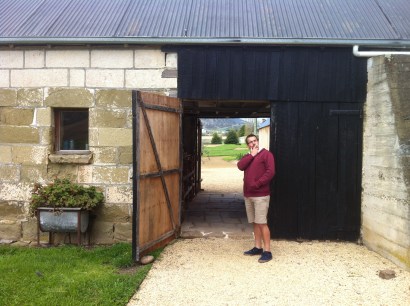
Ted contemplating the precise function of doorways.

Ted contemplating the precise function of doorways.

We wandered back inside to the room which houses the mash tun, the wash back and the solitary still, and embarked on a discussion about the flavours imparted in the earliest stages of the creation of the spirit. Different temperatures in the mash tun create different sugar types: lower temperatures can create honey and floral notes, whereas higher temperatures induce brown sugar and molasses flavours. Too hot, and less pleasant notes can emerge. Dean references this as a crucial process: “Stuff it up and you’ll get bad spirit”.

We were lucky enough to sample some of the wash straight from the wash back: Ted described it as sweet unhopped homebrew, while Nick claimed it was better than actual beer. Next we tried some new make spirit from only the 26th distillation completed at Redlands. In the absence of a single malt, we thought we would provide some tasting notes for the new make:

Redlands Estate New Make Spirit:

Rather unsurprisingly, this spirit was very clear in appearance and had high alcohol on the nose. Once we finished congratulating ourselves on this line, we did discover some other flavours, such as floral and oily notes, with a whiff of match smoke. Rich across the palate with hints of almonds and plums.

The one and only still, with the one and only Dean Jackson.

The one and only still, with the one and only Dean Jackson.

We were then offered the chance to visit the maturation room housing all 42 barrels laid down by Dean to date. Unfortunately we cannot reveal the location of this fabled room, as we were forced to swear on our miserable lives to keep the location secret before being allowed in (blindfolds and top-secret rituals may or may not have been involved too).

Once inside, our noses were immediately greeted with the glorious scent of potential whisky. Dean told us to inhale as much as we could whilst there, to ensure the angels didn’t get too much (greedy sods).

The mission of Redlands Estate is to create a purely Tasmanian whisky, so you won’t find any ex-bourbon or European sherry barrels lying around. Instead, Redlands matures its spirit start-to-finish in ex-Pinot Noir casks sourced from three southern Tasmanian wineries. This is a departure from not just traditional Scotch whisky, but also from fellow Tasmanian distilleries. What effect this will have on the finished product we can only guess at, but Dean tells us that it’s shaping up as something very special.

The newest barrel: number 42. The water of life within the meaning of life.

The newest barrel: number 42. The water of life within the meaning of life.

Our tour concluded with some tastings, not of whisky, but of three apple based products crafted by Dean. It was here that we received an insight into his tasting philosophy:

All the flavours are already in your head from a young age. Practise gives the ability to draw them out and differentiate between them. The flavours that you discover come from your own life experiences, and will vary from person to person.

Therefore he took no offence when Ted describe the brandy on offer as smelling like ‘damp fridge’, having himself described a prestigious whisky at a TWAS tasting event as smelling like ‘wet fish’!

"I also detect notes of burnt shoes and the tears of grown men"

“I also detect notes of burnt shoes and the tears of grown men”

Redlands presents itself as a rustic, idyllic, countryside establishment which provides a true all-encompassing Tasmanian experience. While for some businesses this image would be merely a façade, a means to an end, we were pleased to discover that this was not the case at all; it is every bit as genuine as it claims to be. The ethos of Redlands is shown in the dedication, passion and care taken in every aspect of the whisky making process. We believe that these elements will be expressed in the Redlands single malt when it is finally released, and we will be excited to sample this unique Tasmanian whisky.

Hellyers Road Pinot Noir Finish

Reviewed by: Nick

Hellyers Road Pinot Finish whisky waffle

Tasmania is rapidly becoming known as the ‘Whisky Isle’ of Australia. Not only are distillers here in my home state creating award winning produce, they are also experimenting with new methods to create unique whisky. Hellyers Road Distillery is no exception to this, and perhaps their most interesting expression is their Pinot finish.

The Tasmanian wine industry is already thriving, with cool climate wines such as Pinot Noir being made exceptionally well, particularly in the Tamar Valley. It is from here that Hellyers road sources barrels to transfer previously bourbon-aged spirit into for the final six months of its maturation.

The difference this process makes is marked. One glance tells you that this is a very different whisky to the Original release. Its colour is no longer light and pale; instead it is enticingly golden. The nose is equally varied. There are still the typical buttery notes to be found, but now these are infused with fruits such as raisins and dates. The palate is rather light, but gone are some of the sharper, rougher flavours of the Original. Instead there are dry, almost sour notes, competing intriguingly with the more expected flavours of vanilla and toffee. The finish is spicy, the added kick from the alcohol percentage of 46.2% clearly apparent. Finally, you are left with the trademark Hellyers Road buttery notes that remind me of not so much a cake, but rather uncooked cake batter.

The Pinot Noir cask is a fascinating malt. Undoubtedly more interesting and complex than its cousin, the Original, it is also smoother and easier to drink. While not yet a perfect whisky, it certainly shows that experimentation has more than paid off for Mark Littler and Hellyers Road.

★★★

Hellyers Road Original

Reviewed by: Ted

Hellyers Road Original whisky waffle

We live in Burnie, a small town of around 20000 people on the North-West coast of Tasmania. A somewhat surprising, and pleasing, fact about our little town is that we have our own distillery: Hellyers Road.

Named after Henry Hellyer, one of the first Europeans to explore the NW coast, the distillery is slightly unusual in that it was purpose-built and is still wholly owned by the Betta Milk company located next door (best milk in the world!). The idea of dairy farmers setting up a whisky distillery is very NW Tasmanian. The distillery has certainly benefitted from the technical knowhow from the milk processing plant for setting up its own systems.

As the name suggests, the Hellyers Road Original was the first release from the company. A non-age statement release (Hellyers Road tells us that it is bottled between 7½ – 9 years age), the Original provided a platform for the distillery to build on while waiting for its whisky to come of age. The packaging and artwork is sensational, with a handmade look that is very much part of the ‘City of Makers’ arts-and-crafts vibe that exists in Burnie today.

Thanks to its relatively short time spent in American oak bourbon casks the Original is very light in colour, rather like the clear, crisp yellow of a white wine. The nose is all Hellyers Road, and is like nothing else around. You know it when you smell it. It oozes fat, creamy, buttery tones, very rich and comforting. Very befitting of a distillery that owes its existence to a milk factory.

The taste is where things get interesting for me. Unlike the warm, fuzzy nose, the palate is quite sharp and ‘green’ in flavour, with bitter herbal notes, and a not unpleasant hint of lightly burnt sugar underneath. The 46.2% strength that the Hellyers Road distillers have chosen to bottle at provides a nice sparkle across the tongue.

The Hellyers Road Original is a very curious whisky. Its disjunct nose and palate, and its somewhat sharp flavours suggest an unfinished, uncertain nature. But perhaps we can forgive it of this thanks to its young age and our knowledge that this is only the beginning, and that with time and maturity and experience a truly great whisky may emerge. This is no Scotch, but rather a creation of the new Tasmanian whisky landscape, one that speaks of the rolling green hills of Burnie and the enterprising people that abide there.

★★

Glenfiddich 15 Year Old

Reviewed by: Nick

Glenfiddich 15 whisky waffle

This is more like it Glenfiddich! In my review of the Glenfiddich 12 Year Old, I described it as pleasant but unremarkable. The 15 Year Old release goes some way to rectifying this. If Glenfiddich were a wine, the 12 year Old would be a white, whereas the 15 Year Old would clearly be a red.

This whisky is created using a Solera vatting technique, where various 15 year old expressions are married together in a large ex-wash back. The vat is never more than half emptied meaning a percentage of the remaining whisky that makes up each bottle is very old indeed.

This is immediately a more enjoyable whisky than the 12 year old. Darker in colour and more complex on the nose, various aspects of its mixed-maturation can be found within. There is vanilla from the bourbon casks and green sappy flavours from the new oak. The biggest contributor, however, is the sherry casks. The spirit matured in these barrels imparts dried fruits, toffee, even cola upon the palate and leaves a long, dry and memorable finish.

While the 12 Year Old is the most popular, and the 18 Year Old the smoothest, when taking into account the balance between flavour and value for money, I believe it is almost impossible to go past the 15 Year Old. It is the most complex and interesting by far and crucially, it gives you the most to talk about.

★★★★

Glenfiddich 12 Year Old

Reviewed by: Nick

Glenfiddich 12 whisky waffle

Glenfiddich is undeniably the most popular distiller of single malt Scotch whisky in the world. This is demonstrated in a number ways. Their long history dating back to William Grant himself. Their extensive range of expressions, which includes a fifty year old that is not impossible to come by. Their whopping 28 stills on site. Or perhaps, the simple fact that they sell more whisky than any other distillery in Scotland.

Their top selling bottle is their 12 Year Old. Its distinctive green packaging is synonymous with Scottish whisky. And it is a very drinkable malt. But cannot in any way be described as remarkable.

While the distillery will try and impress upon you a likeness to pears in this dram, the palate and especially the nose are in fact more floral in nature: more akin to a stroll through a florists than a greengrocers. Some spice and oak begin to develop before finally the merest hint of sweet fruit arrives at the very back-end of the finish.

Overall, this is a fairly light whisky in a pleasant and yet slightly disappointing way. After the build up concerning its popularity, the end result is somewhat of an anticlimax. Despite being the world’s best selling single malt whisky it does not convince me that it is also the best representation of Scotland.

★★

anCnoc 12 Year Old

Reviewed by: Ted

anCnoc 12 whisky waffle

During the warmer months a beer drinker will often turn to a lighter, more refreshing beer such as a pale ale. Well, for whisky drinkers that desire likely still holds true, and thus is created the perfect moment for the subject of this review: the anCnoc 12 year old.

Pronounced a-nock (or as we like to say… oh-cock), this summery little number is produced by Knockdhu distillery, found resting in the shadow of Knock Hill in the Highlands of Scotland. A bright clear gold in colour, the nose is light and dusty with a nice scent of grain that brings to mind fields of drying barley waving under the summer sun.

Slightly detracting from the bouquet is the occasional whiff of raw alcoholic notes, particularly when cold, but it isn’t disastrous and doesn’t spoil the overall experience. The taste is light and initially sweet, followed by more of those good dusty grain flavours and a pleasant sharpness that hits you on the middle of the palate and at the back of the nose.

If you find yourself basking in the remains of a warm summer evening and feel like relaxing with a dram, then you will find good company in the anCnoc 12. Drink with friends and with a damn good sunset on the horizon.

★★★

Talisker 10 Year Old

Reviewed by: Nick

Talisker 10 whisky waffle

I will forever be filled with immense amounts of good will towards Talisker distillery and with good reason, as mentioned in this ‘whisky musing’ post. Of course, this could potentially leave me viewing their products through ruby-tinted glasses. However, my love affair with Talisker whisky began long before my visit, and was initially kindled by the quality drop that is their flagship release, the 10 Year Old.

There is something special about the way the Talisker balances smoke with sweetness. In fact, if this review were written on a more succinct whisky review site then it may be summed up in two (conveniently rhyming) words: sweet peat.

It’s there immediately on the nose. It doesn’t hit you over the head with smoke, but you know it’s there. The sweetness is akin to the scent of melting brown sugar. It’s spicy when it first hits the palate; a subtly higher bottling strength of 45.8% gives this whisky an extra layer of complexity. The flavours in the mouth are full and confident with notes of oak and pepper before the smoke makes a welcome return.

The finish is perhaps the highlight of this whisky. It’s lengthy and peaty, full of hints of the distillery’s island location and yet does not lose the toffee caramel notes. It’s memorable and long lasting, and certainly a more than appropriate selection to conclude a night of tasting.

The Talisker 10 year old is a fine whisky. It somehow combines the best elements of Islay and Speyside and assembles them into one impressive drop. I will always think fondly of this distillery, but despite everything, I think the main reason for this is simply the quality of their whisky.

★★★★

My trip to Talisker Distillery

There is a wonderful sense of community associated with whisky. I’ve witnessed it in many forms. A group of revellers at a bar in Scotland. A celebration between good mates. The support offered between establishments in the Tasmanian whisky industry. Talisker distillery.

The Isle of Skye is a breathtaking place full of beautiful scenery and quaint, friendly villages. Sadly, my time there was cut short, including my tour of the distillery Talisker. I was lucky to be afforded a half hour visit to cancel my booking and simply see it with my own eyes. While there, the distillery was able to fulfil my wishes and dreams, despite the shortness of my stay.

At Tallisker

Upon arriving I inhaled the wonderful sea air and hints of peat smoke emanating from the premises, and got a helpful tourist to provide photographic evidence of my presence. Then, upon entering the visitor centre, I told the tale of the unfortunate reasons behind my early departure from Skye and cause of my booking cancellation.

The response was immediate. “Have you got a couple of minutes”, one gentleman asked, and upon my positive reply escorted me into the maturation warehouse usually only seen upon a formal tour of the facility. We discussed their aging of the barrels and the variety of casks used in the process. He was interested in my little state of Tasmania and the whisky being created there. Then a tour group arrived and we quickly scurried back to the tasting area.

“While you’re here, you had better do a tasting”, he proclaimed. I did not protest. “I’ve tried the 10 Year Old,” I confessed “and liked it very much”. “Ok,” he replied “have you had the 18 Year Old?”

Twenty minutes later, and my visiting time elapsed, not only had I discovered my new favourite Talisker expression – but I had done so twice – for after the magnificent 18 Year Old, he produced a ‘Triple Matured’ dram only available to the ‘Friends of the Classic Malts’ several years prior to my visit. And this special Distillers Edition was exceptional. Smoke balanced with sherry, dryness balanced with typical Talisker brown sugar. A wonderful, memorable whisky, given to me at no charge.

Talisker, on this day, really solidified in my mind the community that comes with this great drink. In Scotland, or anywhere around the world where it is created, there is a sense of comradery and good will. In fact, as I write this I sip upon a dram of Talisker 10 Year Old, not belonging to me – my good friend Ross left a bottle here after a pleasant night of catching up and one or two (or more) tastings. He will likely only discover my cheeky nip upon reading this post, though I am confident that will embrace the spirit that I have mentioned here and simply say: “Sláinte”.