Scottish Whisky

Johnnie Walker: the verdict

Posted by: Nick and Ted

Hi Wafflers! Johnnie Walker Week is officially over and we have emerged unscathed and wiser from the other side. Throughout the week we’ve gained an appreciation for blended Scotch whisky – and even more of an appreciation for single malts.

All joking aside (and there were a few of them this week) Johnnie Walker has produced a formidable range of whiskies and we can understand why they are the most popular in the world, even if we respectfully disagree.

Happy Wafflers johnny walker week whisky waffle

So what have we learned throughout Johnnie Walker Week? Let’s pick through the shrapnel:

  • The Red Label is consumed throughout the world as a mixer. And after trying it neat – we understand why;
  • The Black Label likes to think of itself as a step up – and it is – but not nearly enough to consume neat;
  • The Double Black fixes the problems of the previous two with solid flavours and a generous dose of smoke, and in our opinion is the best value in the range;
  • The Gold Label Reserve balances its flavours well, although sadly there are not many of them to balance;
  • The Platinum Label 18 Year Old is beautifully smooth but lacking in soul;
  • The Blue Label is excellent – but very expensive. And when you could buy a Balvenie 21 Year Old for the same price – why would you go for the blend?

So there you have it. Whisky Waffle’s first ‘event week’ has concluded. Thanks for checking it out and we hope you appreciated our ramblings and perhaps you have also broadened your whisky drinking horizons. If anyone has their own opinions or rankings of the Johnnie Walker range, let us know in the comments!

Until next time, keep on waffling,

Nick and Ted

#johnniewalkerweek

Johnnie Walker Green Label

Posted by: Mooresy

Green label whisky waffle

Johnnie Walker Green Label is – or I should say was – a bit of an anomaly in the family. Unlike the others which are all blends including grain and non-malt whiskies, Green was a blended malt made up of only four whiskies, all single malts. This gave it the quality of arriving like a blend then developing on the palate more like a single malt. It’s nose complexity was also more akin to a single malt, and the better noses out there could probably pick the distilleries involved from the smell.

I happen to know what they were, but so as not to spoiler, you’ll have to ask me.


An elegy for Johnnie Green

Though caramel brown, your label was Green

With flavoured malt so crisp and clean

A complex coffee fruity smell

Vanilla and nuttiness went down well

The taste had cereals, chocolate and nuts

Not sharp or heavy but you sure had guts

A finish strong with walnuts and honey

Of Johnnie’s varieties you were worth the money

One day the factory shut you down

Scotch lovers everywhere gave a frown

No more would we have our favourite blend

A standout nip, a lifelong friend

Now we’re confined to Black and Red

That burns our nose and hurts our head

There’s lots of fine drams out there today

And where there’s a Walker there’s a will and a way

But for now we must simply say farewell

You were a classic, a legend and we think that you’re swell


Now a rare and hard to find malt, Green is consigned to the archive of Johnnie Walker’s bond store along with the Gold Label 18 (they’ve removed the age statement for the current variant) and the elusive Johnnie Walker White Label which I have never tasted. If you find a sealed bottle of Green, you may want to hold onto it for its value but I would strongly encourage you to pop the cork and taste a true exception to the rule. If you spot a half open bottle on a friend’s shelf or in a dark musty pub, encourage the friend to crack it at a party or buy it shot by shot from the wizened landlord.

If you are a single-malt snob who sees the word blended and runs a mile from the likes of Green and the very delicious Blue Hanger, thank you. More for the rest of us.

#johnniewalkerweek

Find out about the rest of our multi-coloured adventures:

Johnnie Walker Red Label

Johnnie Walker Black Label

Johnnie Walker Double Black

Johnnie Walker Gold Label Reserve

Johnnie Walker Platinum Label 18 Year Old

Johnnie Walker Blue Label

Johnnie Walker: which is best?

Johnnie Walker Blue Label

Reviewed by: Nick and Ted

Blue Label Whisky Waffle

One of the reasons we like single malts is the variability in character; all the little quirks and oddities that come together to create something exciting and different every time. The experiences they leave with you create a lasting impression, such as the first time Ted tried a 72% ABV Heartwood, all crazy and wild and exhilarating, or the time Nick tried an English single malt in a Scottish bar and nearly poured it down the sink, much to the amusement of the patrons.

In comparison, blends tend to be a lot less individual, which is hardly surprising given that the elements are painstakingly selected for their ability to meld seamlessly together. Very rarely does a blend give you something to talk about and really get your teeth into. Not so the Johnnie Walker Blue Label, the proclaimed pinnacle of the standard Johnnie Walker range. Discovering this came as somewhat of a surprise to we Johnnie Walker sceptics.

Blue Nick and Ted Whisky Waffle

Unlike any of the other previously reviewed releases, there is a great deal more complexity on the nose. There are delightfully interacting elements of oak, chocolate, and fruit such as oranges, pears and peaches, complimented by a light hint of smoke. The overall character is very warm and welcoming.

The mouth is actually relatively sweet, but so completely different to the overbearing, manufactured sickliness of the Red Label that it’s hard to believe that the two are made by the same company. It’s more like the pure sweetness of a really good light honey. The flavour develops through caramel, to sweet orange, and on to slightly bitter cocoa, all the while accompanied by a pleasing gentle smokiness which lingers on the tongue.

The Johnnie Walker Blue Label has certainly not committed the cardinal whisky sin of being boring. It is rare that a blend has this much complexity, and gives us so much pleasure debating its merits. After all, the best whiskies are the most memorable ones. We’re still not entirely convinced it’s worth the $200 price tag, but after a couple of drams we’re much closer to believing it.

★★★

#johnniewalkerweek

Find out about the rest of our multi-coloured adventures:

Johnnie Walker Red Label

Johnnie Walker Black Label

Johnnie Walker Double Black

Johnnie Walker Gold Label Reserve

Johnnie Walker Platinum Label 18 Year Old

Johnnie Walker Green Label

Johnnie Walker: which is best?

Johnnie Walker Platinum Label 18 Year Old

Posted by: Ted

WW Platinum Label

Let us picture a woman: she wears chic white designer clothes, and her platinum blonde hair is perfectly styled. She is beautiful, with flawless ivory skin and delicate features, and yet her pale grey eyes are cold and her face is blank of emotion. She is like an icy white marble statue come to life. Her house is filled with expensive minimalist designer furnishings, all in white, and the effect is striking and elegant. Yet somehow it leaves you feeling empty; it’s too clean, too clinical, lacking in any warmth that allows you to develop an emotional connection.

If you distilled the idea of the white lady and her house, and bottled it, then you would capture the essence of the Johnnie Walker Platinum Label. The Platinum is marketed as one of the top tier bottlings in the standard Johnnie Walker range. It is delicately assembled from a selection of minimum 18 year old single malt and grain whiskies, and was inspired by the private blends created as gifts for the upper echelons of the Johnnie Walker hierarchy.

Platinum extra Ted

On the nose the Platinum is very light and delicate, with hints of dusty oak floorboards, cereals such as bran, oats and barley, chocolate, and coffee. There is no sweetness or fruitiness here, and as such the scent is rather dry and wooden as a result. The mouth is extremely smooth, with subtle flavours of polished oak and walnuts. A flicker of sweetness is allowed, perfectly balanced by a dash of bitterness. The end is dry and provides a grind of black pepper followed later by a sprinkling of ash.

There is a sense that the Johnnie Walker Platinum Label is a stylish drink created for those with sophisticated tastes, and yet in trying to achieve this they somehow miss the point. Yes, the flavours all work together superbly, but as a whole it’s too refined, polished to the point where there is no spark left to bring it to life. The white lady is beautiful to behold, but be warned, her heart is cold and she will not give you the love and warmth you crave.

★★

#johnniewalkerweek

Find out about the rest of our multi-coloured adventures:

Johnnie Walker Red Label

Johnnie Walker Black Label

Johnnie Walker Double Black

Johnnie Walker Gold Label Reserve

Johnnie Walker Blue Label

Johnnie Walker Green Label

Johnnie Walker: which is best?


Caol Ila 12 Year Old

Reviewed by: Mooresy

Caol Ila

Caol Ila is a deceptive drop, both in pronunciation and in presentation. The Scots will tell you, aggressively, that there is one way to pronounce Caol Ila and that is “Cull Eel-a” blurred into one word. You’ll be lucky if spellcheck doesn’t turn it into Coal Ikea, but stay well away from that and do not be fooled by your non-Gaelic upbringing.

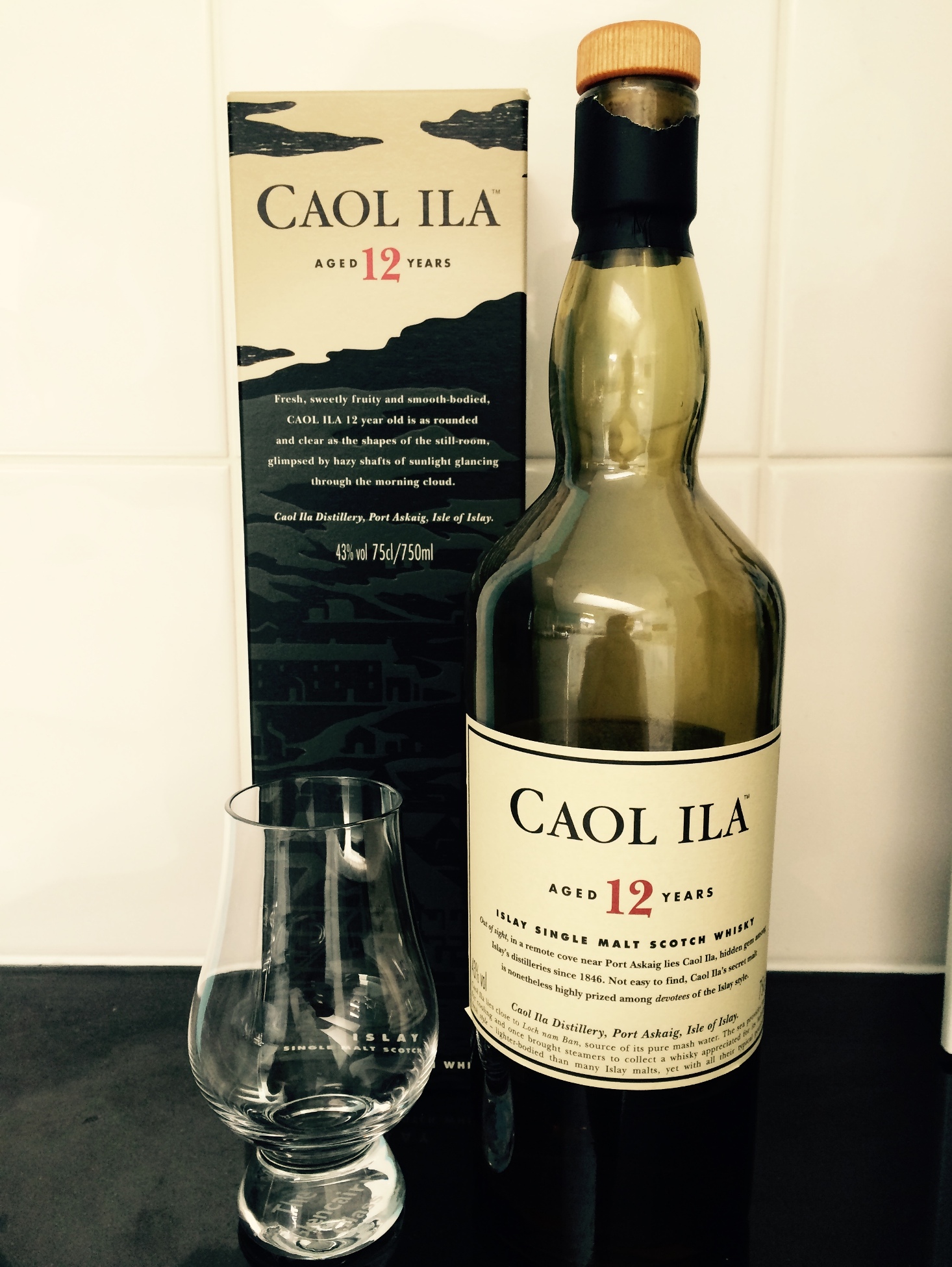
It is also deceptive on appearance. The box is black, but in particular the bottle is darkened grey glass, as if the Islay smoke itself was swirling inside staining the bottle like the wind lashes coastal cliffs. But once the dram is poured, the liquid is pale as if pulled straight from a virgin oak barrel.

Caol Ila means Sound of Islay but is not one of the best well known of the Islay malts and, despite being the largest Islay distillery, it is not in the Islay triumvirate. I am leaving Bowmore out of the triumvirate if anyone is struggling to narrow it down to the big three.

On the nose, there is the smoky peat smell that makes it quintessentially Islay. There are hints of peppermint and the fresh fruit leaf smell coming through but most surprising is how the brine – more subtle than many an island whisky – adds an intensity without being overpowering.

This translates onto the palate where, combined with a caramelised sugar sweetness, the peak hit comes back for a second round. Despite the colour and viscosity on appearance, Caol Ila is quite an oily whisky and arrives like a malt older than its twelve years but without the punch of those elders. It is disappointingly only bottled at 43%.

The finish is long and the oily quality stays in the mouth for round three of peat hit. But don’t get me wrong, this in not the kind of peat that will clear a room from smell alone. Unlike the infamous (and exceptional) Octomore, you don’t wake up the morning after trying to remember when you smoked a cigar the night before. But it has just enough to be an excellent easy-drinking Islay malt.

Perhaps the most endearing element of the Caol Ila 12 is what, I suspect, it contributed to the now deceased blended malt Johnnie Walker Green Label, but that is a story for a future musing.

★★★

Strathisla 12 Year Old

Reviewed by: Ted

Strathisla 12

Some people say that nothing that comes out of a medicine bottle ever tastes good. Well, I would argue that is not always the case, especially when the bottle contains Strathisla 12 Year Old.

Now, I’m not saying that whisky is medicinal (although my dad always had a glass if he felt a cold coming on), but the Strathisla 12 captures the look of a Victorian medicine bottle, with beautiful dark green glass, embossed lettering, several fonts, and a lovely etching of the distillery.

Strathisla is owned by Chivas Brothers, makers of the well known range of Chivas Regal blends. According to the box the distillery itself is ‘The oldest distillery in the Highlands’, although we would debate this fact slightly. Not the age mind, but the location, because when you look on a map you would be forgiven for thinking that Strathisla is smack bang in Speyside.

A sly Speyside imp certainly dances into the character of the Strathisla 12. The nose is light and sharp, with notes of hard fruit, grain, and crushed grass. The taste is crisp and green, with strong bitter herbal flavours that cut across the tongue, leaving a lasting dryness. There’s a raw, untamed edge to this Strathisla that suggests a younger whisky than its 12 years. Perhaps a few more years in the barrel would coax it into bloom.

If you are one of those people that are of the opinion ‘It’s herbal, so it must be good for you’, then you will probably find a better bet in the Strathisla 12 than downing some concoction of random weeds pulled from the garden. The bitterness will definitely be a turnoff for some people, but sometimes that’s just what you want. In fact, come to think of it, the herbal qualities may even make it an excellent component for a cocktail. Take a walk into the leafy green garden of Strathisla and see if it’s just the tonic you’re looking for.

★★

Laphroaig Quarter Cask

Reviewed by: Nick

Laphroaig Quarter Cask whisky waffle

At the time, this was the most expensive bottle of whisky I had ever bought. My best friend, co-writer and co-drinker Ted, had just bought a bottle of Lagavulin 16 and I convinced myself I needed to follow suit with something equally special. So I parted with more money than a uni student like me would normally spend in a month, and took the plunge into the world of Islay whiskies. I was not disappointed.

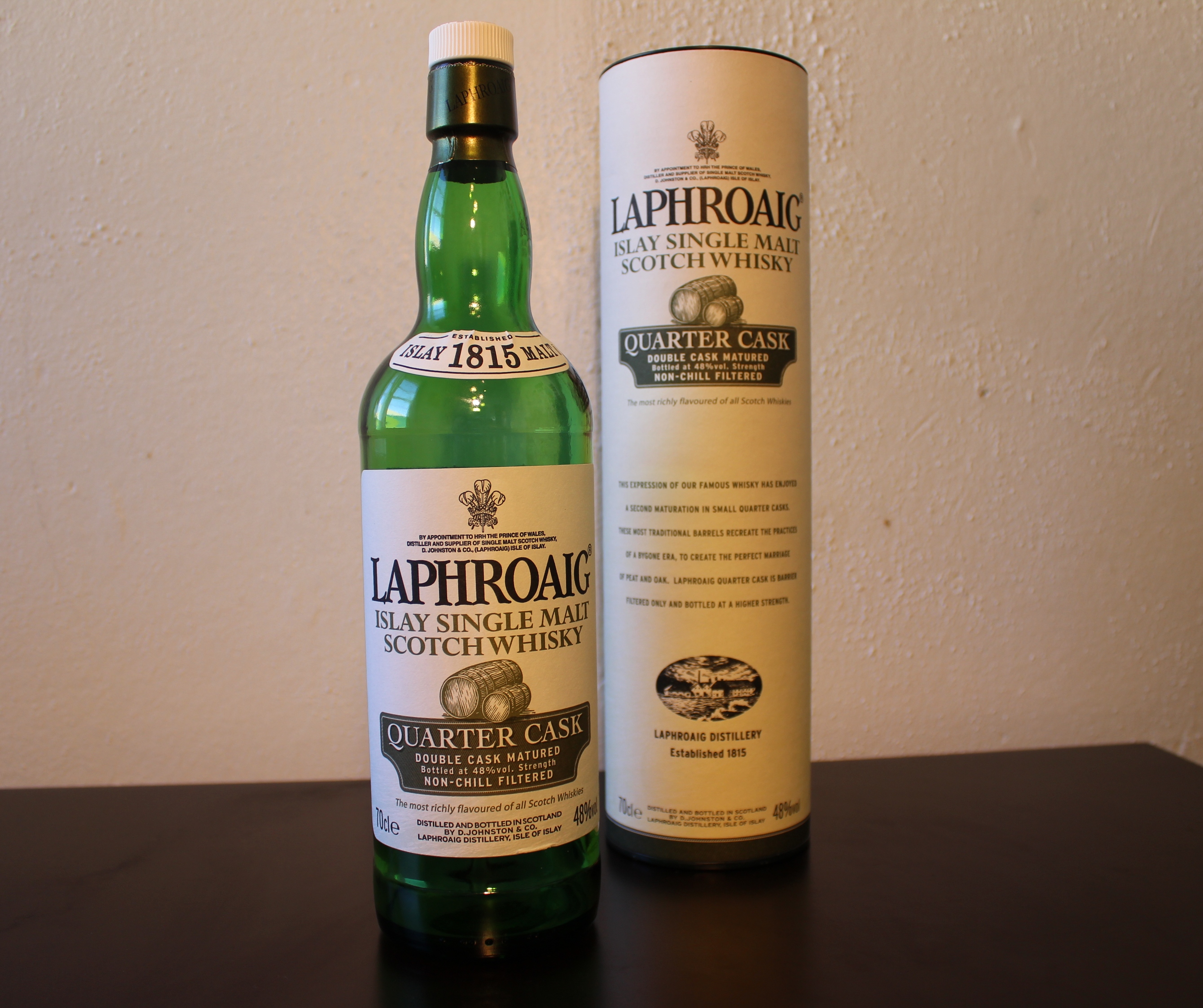
While this whisky may be younger than 10 years (no age statement is provided, so it’s hard to be sure) it has been matured in smaller ‘quarter’ casks, hence the name of the expression. The reduction in barrel size ensures the spirit has had more contact with the wood than it would usually be allowed (Laphroaig claim 30% more!) and suddenly a more complex, more dynamic whisky is born.

There is still plenty of peat on offer here. However, while the 10 Year Old is merely smouldering, the Quarter Cask is burning intensely: it is the whisky equivalent of a blazing bonfire.

Coastal elements are present on the nose; a sea breeze of salt, brine and seaweed. The fire transfers to the palate: the increased bottling level of 48% gives this whisky the kick and spice that the 10 Year Old lacks. Sweeter flavours come through: toffee, treacle, cocoa, even caramel. The finish is lengthy and memorable. Huge gusts of smoke roll across the palate, and linger for minutes afterwards.

Peated whisky is made by many distilleries. But rarely has one got it as right as this. There is without doubt still a sense of rawness about it. In no way can it be described as the smoothest, most elegant, or even the best whisky you will taste. But all these elements, remarkably, work in its favour. This is peated whisky. This is Islay.

★★★★

Laphroaig 10 Year Old

Reviewed by: Nick

Laphroaig 10 whisky waffle

Peat. One of the biggest, strongest and most divisive flavours found within a dram of whisky. The smoky, medicinal notes send some people running to the hills with just the merest of whiffs. But to others, there are no better flavours in the entire world of whisky. These flavours are most strongly associated with one place: Islay.

The early Ileach distillers did not set out with the intention of creating such iconically flavoured whisky. The use of peat to smoke the barley was born out of necessity rather than creativity. Islay is as remote as it is boggy, and getting coal to the island on a train was simply not an option. So the locals turned to a resource they had in abundance: peat. It kept them warm in their houses against the wild force of the Atlantic Ocean, so burning anything else in their kilns was never a consideration.

The most famous example of peated whisky is made by the Laphroaig Distillery. As far as standard releases go, nothing is on the same extreme level in terms of the peaty intensity of its flavour.

In their 10 Year Old expression it is immediately noticeable – before it has even come close to your nose. Smoke. Ash. Medicinal iodine notes, all there smouldering together. This is the scent of a bonfire at the beach.

The palate is legendarily akin to licking a burnt log. Maritime notes are present; briny, seaweed flavours ebbing through gently. Other, more obscure elements are there too, such as leather and sawdust. The bourbon cask imparts only small amounts of vanilla; and what comes through is particularly dry and slightly bitter.

The finish is disappointingly short and contains several soapy, chalky notes, before the smoke gently comes rolling back, leaving a warm, lingering ash-like flavour.

While it is not the best Islay, or even Laphroaig has to offer, there is no doubt this dram showcases some amazing peaty flavours. It is, however, something of a one card trick, let down by the flavours that accompany the smoke. This does not disappoint me too much. If this is merely the entry level, how good must their other expressions be?

★★★

Glenfiddich 15 Year Old

Reviewed by: Nick

Glenfiddich 15 whisky waffle

This is more like it Glenfiddich! In my review of the Glenfiddich 12 Year Old, I described it as pleasant but unremarkable. The 15 Year Old release goes some way to rectifying this. If Glenfiddich were a wine, the 12 year Old would be a white, whereas the 15 Year Old would clearly be a red.

This whisky is created using a Solera vatting technique, where various 15 year old expressions are married together in a large ex-wash back. The vat is never more than half emptied meaning a percentage of the remaining whisky that makes up each bottle is very old indeed.

This is immediately a more enjoyable whisky than the 12 year old. Darker in colour and more complex on the nose, various aspects of its mixed-maturation can be found within. There is vanilla from the bourbon casks and green sappy flavours from the new oak. The biggest contributor, however, is the sherry casks. The spirit matured in these barrels imparts dried fruits, toffee, even cola upon the palate and leaves a long, dry and memorable finish.

While the 12 Year Old is the most popular, and the 18 Year Old the smoothest, when taking into account the balance between flavour and value for money, I believe it is almost impossible to go past the 15 Year Old. It is the most complex and interesting by far and crucially, it gives you the most to talk about.

★★★★

Glenfiddich 12 Year Old

Reviewed by: Nick

Glenfiddich 12 whisky waffle

Glenfiddich is undeniably the most popular distiller of single malt Scotch whisky in the world. This is demonstrated in a number ways. Their long history dating back to William Grant himself. Their extensive range of expressions, which includes a fifty year old that is not impossible to come by. Their whopping 28 stills on site. Or perhaps, the simple fact that they sell more whisky than any other distillery in Scotland.

Their top selling bottle is their 12 Year Old. Its distinctive green packaging is synonymous with Scottish whisky. And it is a very drinkable malt. But cannot in any way be described as remarkable.

While the distillery will try and impress upon you a likeness to pears in this dram, the palate and especially the nose are in fact more floral in nature: more akin to a stroll through a florists than a greengrocers. Some spice and oak begin to develop before finally the merest hint of sweet fruit arrives at the very back-end of the finish.

Overall, this is a fairly light whisky in a pleasant and yet slightly disappointing way. After the build up concerning its popularity, the end result is somewhat of an anticlimax. Despite being the world’s best selling single malt whisky it does not convince me that it is also the best representation of Scotland.

★★