Speyside

The Macallan Fine Oak 12 Year Old

Reviewed by: Nick

macallan-fine-oak-12-year-old

I just can’t get my head around (The) Macallan. While I can very clearly visualise and appreciate the ranges of, say, Glenfiddich, Glen Moray or Glendronach, trying to form a coherent picture of what Macallan is about is as likely to give me a headache as drinking way too much of the stuff. And not just because it doesn’t start with the word Glen…

The contradictions are plentiful: many an old-time whisky drinker will cite Macallan as their go-to drop. Yet the distillery spent a fortune to get a bottle of 50 Year Old in a Bond film. And for some reason they recently ditched age statements in favour of… colours? And yet not too long ago there was also Macallan’s ‘Fine Oak’ range, one such bottle being the subject of today’s review.

I don’t get the point of the ‘Fine Oak’ series. As far as I can tell, it takes its name from the many “exceptional quality” oak casks the whisky was matured in. But… does that mean their older range was dumped into low quality barrels? Somehow I doubt it. It seems to be another rebranding dead-end left by the wayside by an impatient marketing team.

Despite all this, the whisky itself is great to drink. The nose is light, vibrant and contains finely balanced notes of vanilla and lime. The palate is sweet without being sickly and flavours of honey and malt take centre stage. The finish is short without being unsatisfying, with a creamy nuttiness that gently lingers: it’s Kellogg’s Crunchy Nut in whisky form! All up, it’s a brilliantly balanced dram, and one that you could confidently pour to a hesitant whisky drinker.

The biggest disappointment is that this bottle is no longer available – if I were to seek something similar I would have to try a different bottle in the Macallan range. As much as I enjoyed this particular drop, I’m wary to spend up on something else from the distillery. Macallan seems to be undergoing somewhat of an identity crisis and I’m probably unlikely to go and buy a bottle until they sort it out – that is unless I get some pretty convincing recommendations in the comments!

★★★

Glen Moray Port Cask Finish

Reviewed by: Nick

Glen Moray Port Cask

As an out and proud fan of Glen Moray distillery and a waffler known to be partial to a little port matured whisky, the Glen Moray Port Cask Finish sounded like the perfect dram for me. Combining the sweet elegant Speyside flavour with a rich wine-infused layer – what could possibly go wrong? As it turns out: quite a lot.

Upon its arrival at my door, I eagerly whipped the bottle out of its box and was greeted with the most peculiarly coloured whisky I had ever seen. I’ve observed variations of the (hilariously unintentionally poetic) “burnt crimson” theme before, but this whisky was – and there’s no more accurate description – orange. It was the kind of radioactive-peach hue normally reserved for fake tan. Alarm bells were ringing – but I didn’t want to fall into the trap of judging a book by its colour. There was only one thing to it – I had to try some.

After the first sniff it was clear that I was not trying a regular Speysider here. There was a lot of fruit – by which I mean a veritable orchard’s worth – and it was overripe, perhaps on the turn and ready for the compost heap. There were some bitter dark chocolate notes as well as equally bitter notes of wet grass. All in all, it was… shall we say memorable.

Surely the palate would be an improvement. And it was, albeit slightly. It was sweet and sticky with strong winey notes combining to form something reminiscent of strawberry jam. Don’t get me wrong, I love me some strawberry jam. Just this particular fruit spread was more Woolworths brand rather than homemade by my Grandma. The sweetness was more of a sugar syrup than a caramel and the vanilla more essence than extract. The finish started strongly with some nice blackberry flavours but descended into a rough spicy alcohol burn, surely a product of its youthful non-age statement nature.

Wow.

I did not love this whisky nearly as much as I expected. All things considered it was more than a little, well, rubbish. However, I can’t say I’m unhappy that I bought it. Scotland is hugely diverse in its drams and this is as far removed from an elegant Speyside drop as an Islay peat monster. Unfortunately in this case – the differences are not for the better.

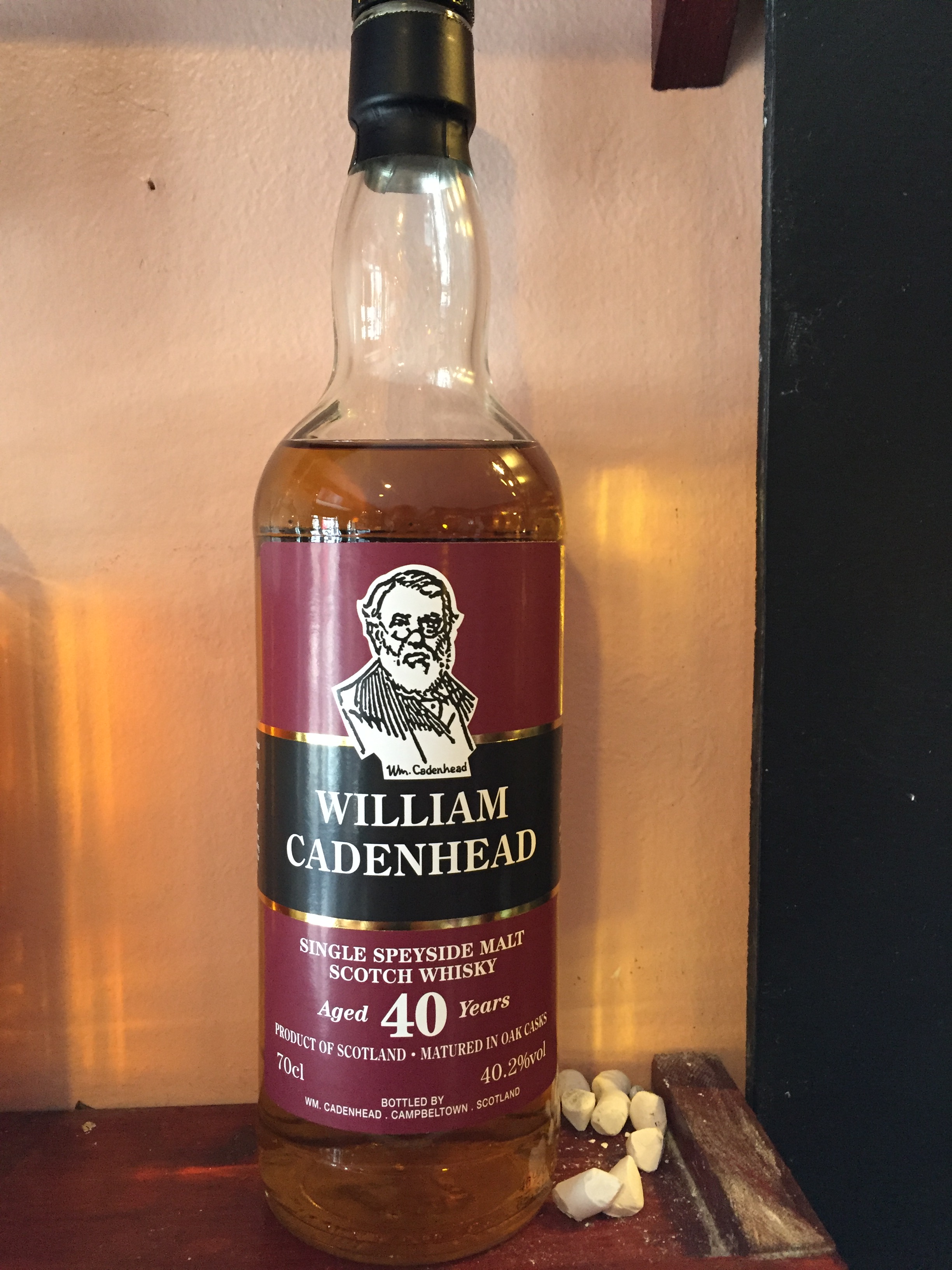
William Cadenhead Single Speyside Malt Scotch Whisky Aged 40 Years

Reviewed by: Ted

William Cadenheads 40 YO

The art of independent bottling is a fascinating one, taking the product of a distillery and aging it oneself in a new and interesting way. If performed successfully, the end product should hark back to it’s origins and yet metamorphose into something beguiling and delightful. A whisky butterfly if you will.

WM Cadenhead Ltd is Scotland’s oldest independent bottler, established in 1842. As such, they have had some time to perfect the art and their releases tend to command considerable respect.

The William Cadenhead Single Speyside Scotch Whisky that I was fortunate enough to try was a mere 40 years old! While the bottle did not reveal the origin of the spirit, I have been told that it allegedly contains spirit from Glenfarclas, a family-owned distillery steeped in tradition.

On the nose the William Cadenhead 40yo is like timber polished to the smoothness of glass using the finest vanilla and caramel scented beeswax.

In the mouth the spirit is what I imagine drinking satin would be like, rippling folds of cool smoothness sliding over the tongue and susurrating down the throat. The flavour is the lightest touch of honey, tree spices and dried fruits.

If you are ever fortunate enough to come across the William Cadenhead 40yo I would highly recommend taking the opportunity to try it. This is independent bottling at its most elegant.

★★★★★

The Glenlivet Founders Reserve

Reviewed by: Nick

Founders Reserve n waffle

In 2015 we farewelled a Whisky Waffle favourite son, the Glenlivet 12. It was there to share the laughs when we held cards nights, to comfort us when we’d had a rough day at work and raised high when we rung in the New Year. Sadly Glenlivet, in their ultimate wisdom, have retired the 12 for the foreseeable future. But fear not – they have introduced a direct(ish) replacement! It comes in shiny blue packaging so it must be good, mustn’t it? Ladies and gentlemen, I present to you the Glenlivet Founders Reserve.

It would be so easy to do a straight comparison of the two whiskies, but I decided to sample the new kid on the block on its own to see how it stood up. It turns out ‘stood up’ was possibly the wrong analogy. Sat down maybe? Perhaps slouched…

On the nose, I found the Founders Reserve has plenty of caramel and some dry malty notes. An acceptable, if not auspicious start. So I took a sip. This turned out to be an error. There’s an unpleasant sweetness in there – a sugary, treacly flavour lacking in any complexity. It’s not bad per se, but there is a distinct manufactured, home-brand quality about it which is hard to enjoy. The finish is warm and spicy, almost tangy on the back of the tongue. Finally there is the merest hint of raisins, a cameo appearance that leaves you wishing there was more to be found.

I cannot say that the Founders Reserve is particularly offensive in its flavour. But I can (and do) claim that it is all a bit bland and inconsequential, bordering on boring, which disappoints me greatly. Glenlivet are truly great makers of Scottish whisky and it saddens me to think that a generation of whisky drinkers will discover the distillery via this disappointing bottle.

★★

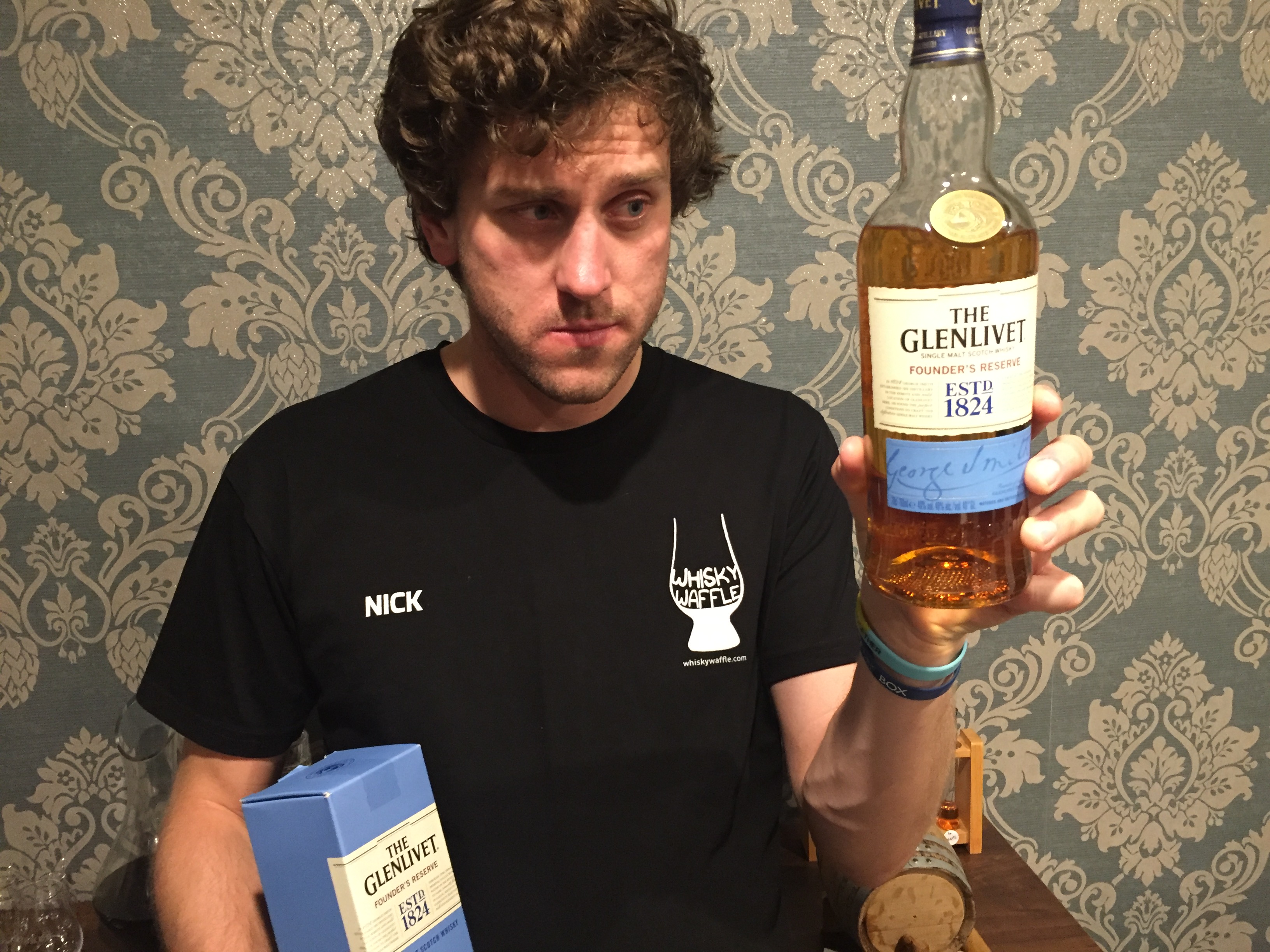
Nick and the Glenlivet Founders Reserve

How it compares:

Without doubt there are similarities in flavour between the Founders Reserve and the 12 Year Old – they are both obvious Speysiders full of caramel and honey. But the 12 Year Old has so much more going on than the NAS bottle. There are subtle complexities to be found throughout the 12 which the Founders lacks. The Founders Reserve is the Coke Zero to the 12’s Coca-Cola.

Cragganmore 12 Year Old

Reviewed by: Nick

Cragganmore 12 Year Old

Summer is a time for barbeques and dreams; it is a time for long evenings spent irreverently with friends. And, of course, it is a time for summer romances.

I met the Cragganmore 12 Year Old shortly before Christmas and knew, without being able to define why, that this was to be my summertime dram. It glistened, a deep gold on the shelf, almost calling to me with promises of what was to come. How could I resist?

The following weeks I enjoyed the gloriously sunny evenings with the Cragganmore by my side. We were thick as thieves, spending time at post-Christmas drinks, New Years Eve – even on the annual camping trip. All my whisky-drinking friends approved. There was no doubt, the Cragganmore was a worthy addition to our summer festivities. And the flavours? Extraordinary.

The nose of honey and butterscotch. The palate of vanilla and lemons. And the finish… Oh that delicate and yet spicy linger I feel I will never truly forget.

Inevitably, the sun began to set on a glorious January, and the contents of the Cragganmore dwindled. As with all summer flings, it ended all too suddenly. It was time to say farewell to this golden bottle. While it was a friendship only recently acquired, it seemed the bonds we had formed would last a lifetime. As we said our goodbyes, I thanked it for its companionship over such a memorable time. I can now only leave it in the hands of fate as to whether we meet again on another, seemingly endless, summer afternoon.

★★★

The Glenlivet 18 Year Old

Reviewed by: Nick

Glenlivet 18

The banks of the river Spey in Scotland’s north east are fertile ground indeed. Nearly half of the country’s distilleries are located in this region which has come to be known, rather appropriately, as ‘Speyside’. Upon my criminally short drive through the area my head continuously moved side to side reading road signs pointing towards yet another famous distillery. It must have looked like I was watching a grand-slam final between Nadal and Djokovic! This abundance of whisky excellence could be found nowhere else on earth.

Speyside whiskies are known for being the smoothest, the richest, and the most elegant drams that Scotland has to offer, a reputation well deserved. Perhaps the best example of a Speyside malt is the Glenlivet 18 Year Old. It is one of the classiest single malts going around – and at a price that practically every other 18 year old whisky cannot come close to.

The whisky’s colour alone is enticing: a golden amber which glints in the sunlight. The nose is better: full of caramel, vanilla and orchard fruits. It is a pleasantly balanced aroma, not favouring one flavour over another. The palate is rich – full of flavour without being heavy. There is honey, oranges and malty biscuits, along with the faintest hint of sherry. The finish is light and not as sweet as the initial flavours suggest, with plenty of oak imparted from its 18 years in barrels.

There are literally thousands of whiskies made within a few miles of the river Spey. But if you were only able to try just one – then you could make a pretty strong case for this one.

★★★★


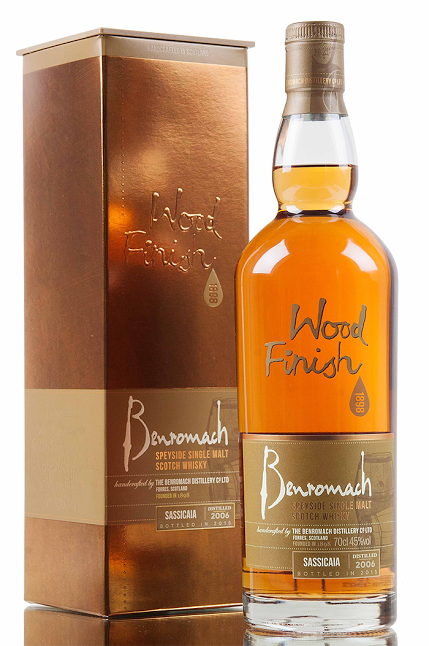
Benromach Sassacaia Wood Finish

Reviewed by: Richard

Benromach Sassacaia Wood FinishThis one was recommended to me by a friend who knows my fondness for sweeter whiskies… So first up – a little bit about the distillery:

Benromach is a Speyside distillery founded by Duncan McCallum and F.W. Brickman in 1898 and currently owned and run by Gordon and Macphail of Elgin. It is situated near Forres in Morayshire and is fed with spring water from the Chapelton Springs in the Romach Hills beside Forres.

And now – on with the review:

This has been matured in a Sassacaia barrel, so an introduction to the wood is in order!
Sassicaia is one of the most sought-after Cabernet Sauvignon wines in the world and made history recently, being the first single wine to be granted its own DOC (Denominazione di origine controllata – quality assurance label for Italian food products, especially Italian wine and cheese)
The Sassicaia estate is located at Bolgheri and lies in the Province of Livorno in Tuscany, Italy.

So, shut up, tell us about the whisky…

This is a 2006 distilled expression and bottled this year – there’s an older 2005 release, a 2004 release and a few older bottlings.
All I can find out is that it’s put in an ex bourbon barrel for around 7 years, and then put in a Sassacaia barrel for around 29 months – just over 2 years.
The colour is golden pink! Well lightly pink – if the sun hits it just right…

Nose: It’s got a real soft nose – dry toasted oak, vanilla, fruity, toffee, nutmeg, and that definitive wine note.
The nose is right up my alley – really sweet and bold, but not sickly…
Now to stick it in my mouth!

Palate: Cherries, raspberries & vanilla, spices, subtle smoke, malty toffee, and wine!
The palate is quite dry, which I find a lot with red wine finishes for some reason… tannic influence maybe? I find they make my mouth water a bit…

Finish: A medium-long finish with hints of fruit and another whiff of smoke.

This is a session whisky (if there’s such a thing) for sunny afternoon, sitting under a tree, in the shade, with some olives, sourdough, semidried tomatoes, cheese and some good friends…I’m amazed at the influence the wine has made, the light smoke and the fruit notes. I’ve tried the standard 10yo Benromach, which is one of my favourites – this is better, not by a lot, but still, better, and juicier…
A bloody fine whisky to add to any collection!

★★★

Glenlivet Nàdurra 16 Year Old

Reviewed by: Ted

Glenlivet Nadurra 2

We are quite fond of The Glenlivet. The 12yo is a dependable drop that hits straight down the middle, perfect for when you just want to sit back and have a dram (although the introduction of the Founders Reserve may change all that). So what happens if you knock things up a notch?

If you think that your glass of Glenlivet needs a bit more punch, then look no further than the Nàdurra. Gaelic for ‘natural’, the Nàdurra is a cask strength release from the Speyside distiller. Glenlivet claims that it is a traditional 19th century style dram, evoking the character of the whiskies originally created by founder George Smith.

Using first-fill American oak casks, the Nàdurra is aged for 16 years and then bottled between 54-55%. My particular example stands at 54.7% and was bottled 06/13 from batch 0613X. As you would expect from a bourbon-aged whisky, the colour is fairly light, although the strength keeps it at a weak amber rather than straw-like.

The nose is fat and rounded, with melted brown sugar, vanilla, cinnamon, cloves, cocoa, peach, malt biscuits and apricot jam. It’s fairly direct on the nostrils too thanks to the strength, but the sweet, gooey nature means that it oozes seductively, like the smell of pudding wafting from the kitchen on a cold night.

On the mouth the Nàdurra is hot and slightly dry, with a nice spiciness. When you take a sip it zooms straight to the roof of the mouth before plonking down onto the back of the tongue. A bitter caramel finish lingers around the mouth, although I suspect it would be rather shorter at a lower strength.

The Glenlivet Nàdurra is no everyday dram to knock back after work. Instead it’s perfect for snuggling down on the couch at the end of the evening, or, and I speak from personal experience, keeping warm while gazing up at the stars on a perfectly clear night. If you’re looking for a friendly companion cask-strength dram, then the Nàdurra is a natural choice.

★★★

Glen Moray 12 Year Old

Reviewed by: Nick

Glen Moray 12 Year Old

It is quite often the case in the whisky world that what you pay for is what you get. It is usually a safe assumption that a $40 bottle will be inferior to one costing three figures. However, there are so many exceptions to this rule that I begin to wonder why us whisky fanatics spend the money we do.

Case in point is the Glen Moray 12 Year Old, a bottle that first caught my eye when I was a uni student and therefore always on the lookout for an alcoholic bargain. The Glen Moray was, quite simply, the cheapest single malt I could find in Australian bottle shops. However I was quick to discover it held a certain charm that saw it rise above many of the blends I could also afford.

There is no denying that it is a simple dram, bearing all the hallmarks of Speyside. On the nose there are notes of sweet biscuits and honey. Predictably from a whisky matured entirely in bourbon casks, there are also elements of vanilla. The palate is sweet, almost syrupy, with toffee, banana and heathery floral notes. The finish contains more vanilla, spice and Werthers-esque caramel.

The Glen Moray 12 Year Old is never likely to rack up a high score at any whisky awards shows. But in my opinion there’s absolutely nothing wrong with that. It is simply a straightforward and inoffensive whisky that punches above its weight against the larger players.

★★

The Glenrothes 1995, 1998 and Select Reserve Box Set

Reviewed by: Ted

Glenrothes trio

Vintage. It’s not really a word that you associate with whisky. For the overwhelming majority of drams the process is to lay down some spirit in a barrel, let it age for a pre-determined number of years and then bottle it as, say, a 12yo or an 18yo. The whole concept of releasing the product of one particular year, a vintage, is smack bang within the realms of the wine makers, hence generally seeing wines labelled with the year they were made.

However, there is one whisky maker that has very firmly gripped the concept of vintaging by the proverbial horns and run like mad with it. The Glenrothes distillery, founded in 1878 and located in the Speyside whisky region (and not in the Scottish Lowlands town of the same name), has carved out a niche for itself by taking this unusual approach to aging whisky. Perhaps we should not be too surprised by this as The Glenrothes is owned by Berry Bros. & Rudd, one of the oldest and most respected wine merchants in London.

While only around 2% of its stock actually goes towards the making of vintages, with the majority of production helping to create blends such as Cutty Sark and Famous Grouse, The Glenrothes distillers make no bones about the fact that the single malt range represents the apex of their art. One of the inherent problems with releasing product from a single year is that it can lead to inconsistency, as one release in all likelihood will taste different to the next. Not necessarily a negative, just that it’s not like purchasing a 12yo and then buying another later on and knowing that what you get will be exactly the same regardless of the year of production.

The Glenrothes counters this idea by claiming that whisky is in reality just like wine and should be allowed to mature at its own rate, with bottling only occurring when the spirit has reached, in The Glenrothes own words, its ‘peak of perfection’ rather than at a pre-selected age. As you might imagine, The Glenrothes crew take a very active approach to checking their casks, determining the readiness of a vintage by looking for a unified ‘personality’ across a range of casks from that year.

Speaking of casks, The Glenrothes has a very strong wood policy and the deepest of respect for their barrels. They say that the effect of the wood on their spirit is far more important that the length of time it spends aging, and that the careful selection of cask sizes and timber types is vital for achieving perfection. The Glenrothes use a mixture of first and second fill bourbon and sherry woods, and carefully marry them together to create the unique flavour profile for a vintage.

For this review we will be sampling not just one, but three releases from The Glenrothes! Their marketing team has very helpfully created a box set containing 100ml bottles of three of their more accessible drams: the 1995 and 1998 vintages, and their Select Reserve, a vatting of casks from different years created to be the holotype of The Glenrothes flavour profile. But wait, there’s more! The box set also contains three mini Glencairns monogrammed with The Glenrothes logo, a handy set of info booklets and cards describing the range, and of course the box itself, elegantly crafted from sturdy buff and copper coloured cardboard.

Glenrothes SR

All three expressions are quite light and spicy on the nose, which is probably in part thanks to the very tall stills and long distillation times used by The Glenrothes. The Select Reserve is quite broad and fat, with notes of fudge, old leather (from a classic car say), orange and almonds. In comparison the 1998 (bot. 2014) has caramelised pear, boiled caramel sweets and, rather oddly, perhaps a touch of engine grease (that’s not a bad thing. It’s a nostalgic smell that reminds you of your father working on a car when you were young). Finally, the 1995 (bot. 2013) is filled with hot, spicy and slightly sour grain mash, clover honey and curiously, a bit of melon.

Glenrothes 95

The very first touch of the Select Reserve on the lips is creamy, and then it bursts in a big ball of heat and spice inside the mouth, probably helped by the 43% used for all three of the drams. There is a hit of marzipan on the follow-through, while the finish is tangy and lingers gently on the tongue. In contrast the 1998 is smooth and creamy, and slides evenly across the tongue. The finish is fairly short and has a slight floral air to it. Again, the 1995 is sour and fruity, with green apples, pears and plums, finishing up with a nice fresh herbal zing at the end.

Glenrothes 98

The ‘ready when it’s done’ approach works out well for The Glenrothes. Each of its vintages is skilfully crafted and captures some special quirk that entered the distillation for that year. The clever and considered use of barrelling no doubt also helps to imbue each expression with its own character. Drinking a dram of The Glenrothes is a bitter-sweet thing; a happy encounter, but all the time you know that one day the vintage will run out, and never again will you meet that particular personality. So go, find that experience and capture it in your memory before it is too late.

1995 ★★★

1998 ★★★

Select Reserve ★★★