Reviews

Miyagikyo 12 Year Old

Posted by: Ted

Nikka Miyagikyo whisky waffle

More Japanese whisky? Bring it on! For your delectation (or mine rather, seeing as I’m the one drinking it. Go find your own) we have another drop from Nikka, one of the two big players in the Japanese whisky market.

Because Japan is a collection of islands, Nikka and its rival Suntory each own a bunch of distilleries scattered around the archipelago, with each providing its own special character and techniques.

Miyagikyo distillery is based in Sendai on Honshu, the largest of the islands. The distillery was founded by the legendary Japanese whisky maker Masataka Taketsuru. Quite unusually, Miyagikyo apparently makes both single malts and grain whiskies at their site.

The peculiarities don’t stop there. According to Nikka, Miyagikyo uses steam heat distillation to create their product, a process where steam is introduced into the distillation apparatus to carry the volatised compounds into the condensation flask. Whether this changes the flavour in any significant way I will leave up to you.

On the nose the Miyagikyo has that hot and sour Japanese vibe, like honey and lemon tea with a hint of ginger. As it first enters your mouth the spirit is silky smooth, quickly turning dry and dustily spicy. Pepper, caramel, metal, sour plum (which seems to be a common factor in Japanese drams) and lemon drops crawl fuzzily across the tongue. Tartness and sweetness make well balanced bed-fellows.

The Miyagikyo is a very laid back Japanese drop. Probably something best drunk while contemplating the universe in a garden of falling cherry blossom.

Rising Sun spirit/

Tranquil Miyagikyo flows/

The zen of amber/

★★★
Glen Moray 10 Year Old Chardonnay Cask

Posted by: Nick

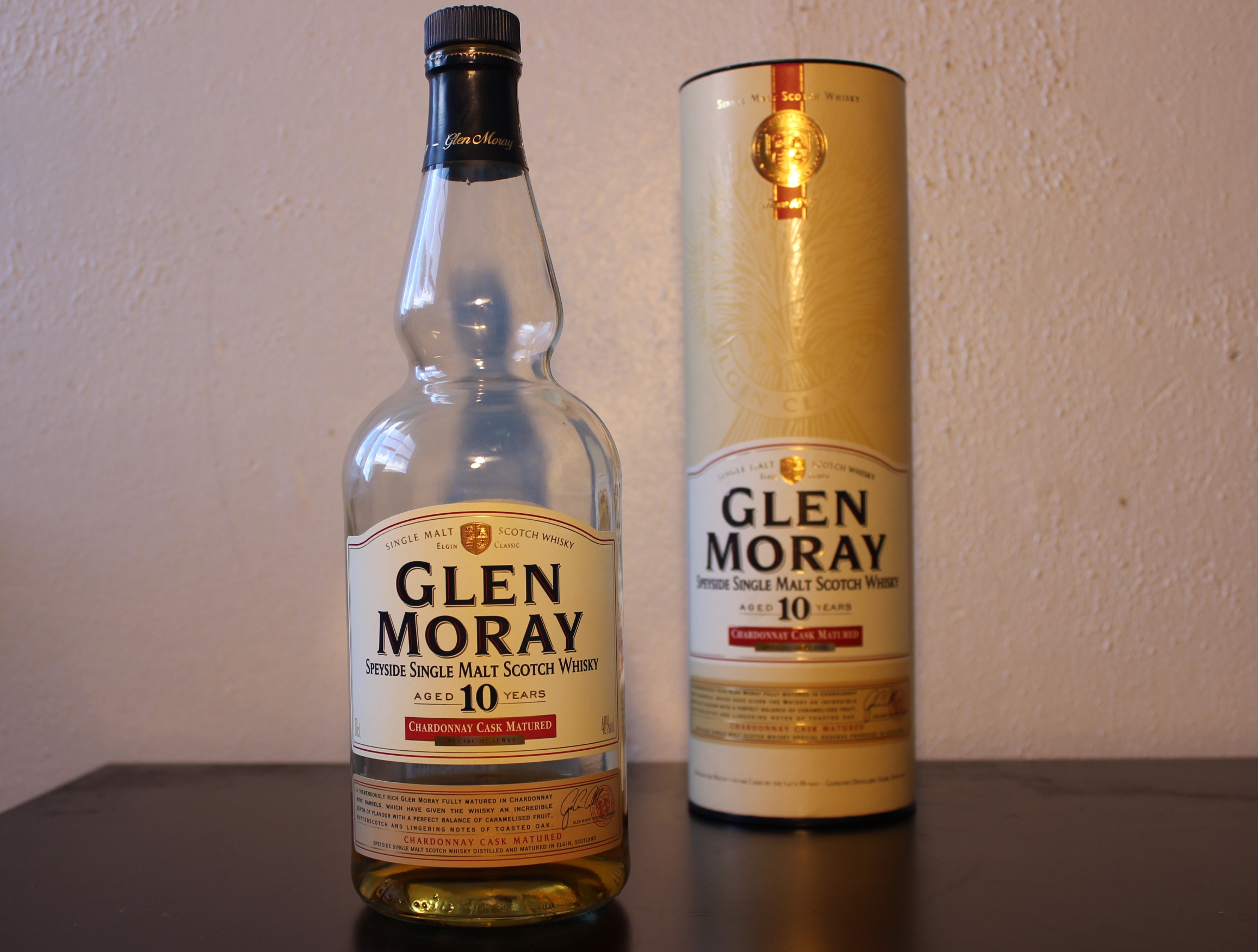
Glen Moray 10 Year Old Chardonnay Cask

Finished in ex-Château Rayas casks: sounds impressive. Six years in French Oak Bordeaux wine barrels: sounds fancy. Maturation spent in Margaret River Shiraz casks: ooh I’d like to try me some of that! Ten years in Chardonnay barrels: wow, that sounds… wait did he just say Chardonnay?

When you consider all the premium ex-wine casks left behind by wineries across the world, maturing whisky in humble Chardonnay barrels seems like an incongruous thought. But that’s exactly what Glen Moray have done, producing a dram with flavours which live up to the curious nature of its creation.

The Glen Moray 10 Year Old Chardonnay Cask (or as we Australians at Whisky Waffle chose to label it: ‘Cardy Cask’) spends its entire 10 years of maturation in white wine barrels. And the flavours imparted certainly sets it aside from other Glen Moray expressions.

The first and perhaps biggest clue is on the nose. It is creamy and sweet – more fudge than caramel – and contains a hint of vanilla, giving it the impression of creaming soda. There is also a strong hit of acidity, reminiscent of not so much pineapple, but pineapple cream desserts.

With many drams, it is easy to predict the whisky’s taste after smelling it, but this is not the case with the Chardonnay Cask. The palate is vastly different to the nose; it is darker, with nutty elements immediately present: hazelnuts, pecans, even marzipan. More can be detected when the spirit is swirled in the mouth including notes of honey and a certain degree of woodiness.

The finish packs a surprising punch: sour citrus notes linger well after the liquid is gone, leaving a tangy, spiciness to contemplate.

Glen Moray has long held a reputation for providing reasonable whisky at a more than reasonable price. The Chardonnay Cask is no exception, and while it is easy to drink, it comes with the added bonus of containing many intriguing flavours to muse over. And all of this from a humble ‘Cardy Cask’!

★★★

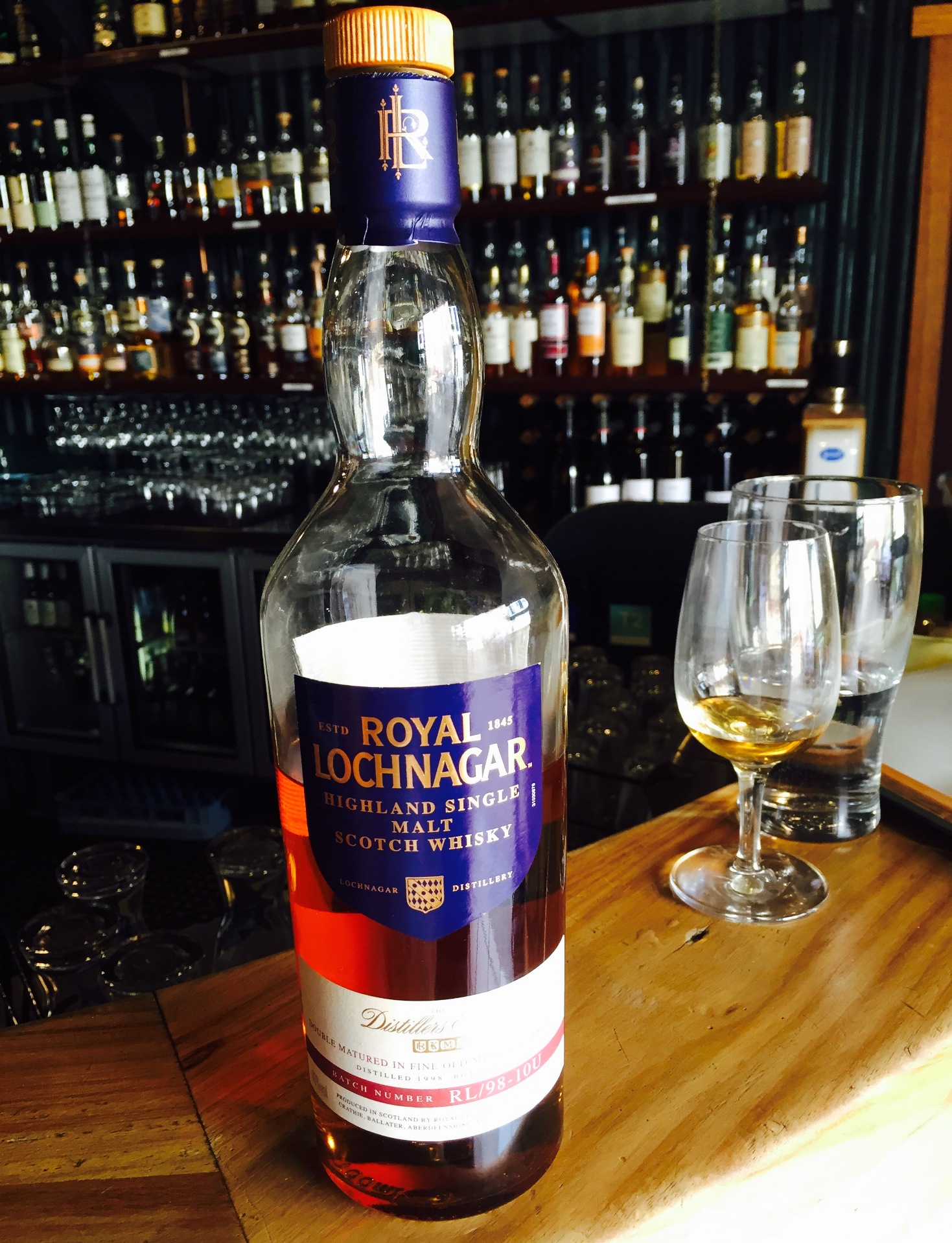
Royal Lochnagar Distillers Edition

Reviewed by: Nick

Royal Lochnagar Distillers Edition

Every now and then what you really look for in a whisky is one that you can drink. I realise that this may sound a ludicrous statement for something which is, undoubtedly, a liquid, but bear with me and I shall explain.

I’m always on the lookout for interesting and unusual new drops to challenge me and set me off waffling about the subtle complexities that can be discovered from dram to dram. However, if every dram I consumed affected me in such a way then, apart from having no friends, I would risk straying too far from the very essence of whisky; that is: it is made to be drunk (with the possible exception of the Macallan Cire Perdue).

With this in mind I believe there is no better candidate for the position of ‘drinkable whisky’ than the Royal Lochangar Distillers Edition. A rather underrated distillery, Lochnagar got it’s ‘Royal’ tag by impressing Queen Victoria on a visit, although the scale of this achievement is questionable as it was reportedly very easy to please Queen Victoria with whisky. Nevertheless the title stuck and it is now the smallest of Diageo’s 28 distilleries.

The Distillers Edition is aged for a period in ex-Muscat casks, adding a layer of silk and sweetness without making it overly-sugary or syrupy. The extra maturation seems to round off some of the sharper edges, making the whisky smoother and easier to drink, though this does not take away from the overall flavour; there are still many appealing elements to discover.

This is immediately apparent on the nose, which is heavy with alluring caramel. Citrus notes follow as well as a dash of rose essence. It has a smooth and creamy mouth feel, retaining the caramel elements and adding flavours of almonds coated in layers of honey and chocolate. There are also the faintest hints of berries to be discovered, lingering in the background. The finish is light and short but the butterscotch theme continues until the end. The overall effect is that of the sauce to sticky date pudding. And those who know me understand what a large compliment I am paying it.

The Royal Lochnagar Distillers Edition is certainly not the most complex or intriguing whisky going around. Nor is it in any way dull. It is a very easy drinking whisky, and this is in no way bad thing. In fact, I believe that it is this dram’s biggest strength.

★★★

Balvenie 14 Year Old Caribbean Cask

Reviewed by: Nick

Balvenie Caribbean Cask 14 Year Old

The Caribbean. What does it make you think of? Beaches? Palm trees? Sunshine? Johnny Depp movies?

The flavour of the Balvenie 14 Year Old Caribbean Cask certainly shows the power of suggestion because I can’t help but noticing this whisky tastes rather… tropical!

Balvenie are one of the leaders in Scotland for maturing their spirit in multiple barrels, often, as is the case with the Caribbean cask, for only the final few months of the aging process. This imparts another layer of flavour on the whisky without removing characteristics that are already present. Often this ‘finishing’ process is conducted in sherry or even port casks. In the case of this Balvenie however, it spends its final few months of aging in ex-West Indian rum barrels, hence the moniker: Caribbean Cask.

The rum influence certainly adds a new dimension to the whisky. The overriding flavour in the nose is, would you believe it, bananas; and I’m not just saying this because of the Caribbean image in my head. Honestly! There are also the vanilla and honey notes expected of a Speyside whisky, however these couple with fresh floral scents. It’s sweet and light, but pleasingly complex.

On the palate the mouth feel is thick and syrupy with malty, biscuity notes present. However, these rapidly give way to fruits such as pineapple, passionfruit, mango and yet more banana. Tropical fruits! The finish is gentle and sweet, with more traditional honeycomb and toffee.

Whether or not I would have picked out these tasting notes if this whisky had been given a less suggestive name is an interesting point. However, as far as this dram is concerned, the marketing and the flavour go hand in hand. The image that ‘Caribbean Cask’ conjures in my head is now inseparable from the whisky itself and I can only describe it in one way: this is the tropical punch of whisky!

★★★

Nikka from the Barrel

Reviewed by: Ted

Nikka from the Barrel

I’ve been at it again! For those who remember my Akashi review, I seem to have picked up a habit of reviewing Japanese whiskies at a particular bar that I occasionally habituate. Not a bad vice I must admit.

This visit’s subject is Nikka from the Barrel, which comes in an intriguingly plain, stubby little 500ml bottle. The labelling is sparse to say the least, and not particularly useful if, like me, you cannot read Japanese.

It’s not only the bottle that has limited information. The little that I could find out about this drop is that it is a blend (or as Nikka claims, a marriage) of matured malt and grain whiskies from re-casked barrels.

Bottled at 51.4%, the Nikka has a robust, gutsy nose. Dark honey, peach, apricot and orange jump on to the old scent receptors, although m’colleague swears blind that he could smell corned beef (odd man).

On the palate the Nikka is rich and syrupy, with notes of burnt sugar, oak, sultanas and honey, followed up by a pleasant herbal bitterness that reminds me of Speyside. I would take an educated guess that sherry barrels have played a part in the blend, as something of that quality seems to shine through.

The Nikka from the Barrel is a fantastic Japanese blend. It’s bold, gutsy, fun and will put a grin on your dial. Definitely give it some attention if you come across a bottle.

★★★

Lark Double Sherry Cask Limited Release

Reviewed by: Nick and Ted

Lark Double Sherry Cask Limited release

We make no bones about the fact that we are ardent lovers of Lark. We will go to our graves swearing blind that our superlative wafflings are not just a bunch of old guff (in fact, many top whisky critics agree with our views). For those willing to make the journey, proof of Lark’s greatness can be found at their cellar door.

If you are one of the lucky acolytes to enter Larks lair, you will be met with a sherry monster of epic proportions. The Lark Sherry Double Cask Limited Release is matured for most of its life in a first-fill barrel, and then transferred for the last six months into another first-fill barrel. Apparently the transfer process causes high amounts of evaporation, helping to intensify the flavours.

Our first impressions of this whisky were huge. This is, without a doubt, one of the biggest, boldest noses we have ever come across; something that makes the entire cast of Asterix look like Tintin. This is Pinocchio if he embarked on a career as a lawyer. As soon as the glass enters the vicinity of your nostrils you are enveloped by a huge, warm blanket woven from raisins, figs, chocolate, golden syrup, honey and oak.

The first sip instantly hits you with a warm lively glow. Thanks to the 59.2% alcohol the mouth rapidly dries, leaving a satisfying bitterness across the back of the palate. This is a complex and challenging dram to be sure. Each sip reveals more layers of flavours, both subtle and bold.

Sadly for those with no immediate plans or means to travel to Tasmania, the Sherry Double Cask Limited Relase is only available at the Lark cellar door. For those who are within reach (hooray!), make sure you have a taste before the very finite number of bottles evaporate like the angels share (or before the Whisky Waffle boys drink it all!) Sitting at Lark’s bar, sipping double sherry matured whisky can only be described as pure ‘Larksherry’!

(Cheers to Dave at Lark for coining that one after mishearing a comment)

★★★★

White Oak Akashi + 12yo

Reviwed by: Ted

White Oak Akashi vs White Oak 12 Year Old

Akashi White Oak

Just a quick review hastily scribbled down at the bar about two whiskies out of Japan. Founded in 1888, White Oak Distillery is one of the lesser known distilleries outside of its home country, only selling to the local market until 1984. Apparently though, White Oak was the first distillery in Japan to gain an official license, pre-dating Suntory and Nikka, the two major players in the Japanese whisky scene.

White Oak releases are less common in Australia, particularly aged releases. Luckily the bar that I am currently at had the presence of mind to have not one, but two of them hiding on the top shelf, prompting this on-the-spot review. The two White Oak examples perched on the bar before me are the Akashi Non Age Statement (NAS) and the 12 Year Old.

I cannot provide much more background to the two bottles as all the information is (unsurprisingly) written in Japanese, but I can reveal that the Akashi is much lighter in colour than the 12yo, which has a nice amber tone. On the nose the Akashi is fairly insubstantial, with only a light sweetness coming through. In comparison the 12yo has a strange sulphuric tang. It’s almost smoky at first, but quickly turns chemical.

The chemical vibe continues on the palate, with a smoky sulphuric quality that tastes like the water could have been drawn from a mineral-rich hot volcanic pool on the side of a Japanese mountain. Against this the Akashi tastes lightly bitter/sweet, not venturing too far in either direction.

In conclusion, the Akashi, while pleasant, is a bit of a non-event, showing a rather bland personality. In complete contrast the 12yo is full of character, but unfortunately the sort of unpleasant character that you might meet down a dodgy alley on a dark night. While curious to try, the 12yo definitely won’t be to everyone’s tastes, and the Akashi certainly won’t turn any heads down the street. It seems that White Oak is more miss than hit, but whether it’s older releases can redeem it will have to wait for another day.

Akashi: ★

12 Year Old: ★★


Glenfarclas 105

Reviewed by: Nick

Glenfarclas 105

You never forget your first time. The insecurity as you take the plunge, the fire in your belly, the lasting satisfaction afterwards. I am of course referring to the first time you tried cask strength whisky.

Most whiskies sold commercially have been diluted down to an ABV deemed acceptable to public consumers of alcohol, usually 40-43%. This is undoubtedly a good thing, or us whisky drinkers would be permanently sloshed and unable to string multiple sentences together, let along write eloquently worded whisky blogs. However, there’s just something a bit special about trying a whisky as it can be found in the barrel.

These whiskies are called ‘cask strength’ and usually sit somewhere in the mid to high 50s percentage alcohol wise, although can rise as high as the low 70s. Trust me, when you are drinking one of these, you know about it.

Glenfarclas are a wonderful family-owned Speyside distillery who use mainly Sherry barrels to mature their spirit in. They release a range of (impressively affordable) age statements as well as the 105, their cask strength, which is bottled at a nice round 60%. And it’s an absolute monster. Although a monster in the vein of King Kong, in that it can be brought under control (at least temporarily, before storming off to climb the Empire State Building).

On the nose the sherry influence is prominent, notes of grapes, raisins and other dried fruits coming through along with several sweeter aromas of treacle and iced tea. It’s pleasant, although if your nose ventures too far into your Glencairn, you will receive an eye-watering whiff of the alcohol to come.

The palate is where you first notice the power of the whisky. Hot, spicy, tangy and sharp, it’s far from the smoothest drop you are likely to try. But once past the shock there are plenty of pleasing flavours to be found, such as oak, marmalade and stewed fruits, such as apricots and quinces. The finish of a cask strength whisky is often the highlight and the 105 is no exception. It is dry, long lasting and ever so warming. Not just in your mouth, but after you have swallowed it, within your entire chest. This whisky is a viable alternative to paying heating bills.

Many advocate the need to add water to cask strength whiskies. In a lot of ways they are right. With only a few drops of water, the Glenfarclas 105 becomes immediately smoother and presents new floral aromas and flavours of honey and cloves. But it also loses the fire contained within its 60% self. That wonderful warming sensation is gone, along with some of the magic of the drop.

The Glenfarclas 105 is a fantastic dram, and a great example of a cask strength whisky. It is certainly not for the faint hearted, but is well worth it if you can make it back for a second sip.

★★★★

Scapa 16 Year Old

Reviewed by: Mooresy

Whisky n Chocolate dram 1

There is something utterly unique about the Scapa 16. The distillery is one of two located on the Orkney Isles and doesn’t have a huge number of variants compared to its neighbour Highland Park or nearby north highland distillery Old Pulteney, but it is a rare event that someone deems Scapa a poor performer.

Usually classed as one region, the Islands group produces a very diverse range of whiskies. The Islands of Skye and Mull have the smokier sea-spray flavours typically associated with the Islands, due to their closeness to Islay and how most people think of the Islay big three when they think of any distillery off the Scottish mainland.

The Islands at the north of Scotland bring something different to the table. Without the peat and brine, flavours can be more subtle and well-defined. Scapa 16 is certainly no exception. This is even more true of Scapa which transports its water source to the distillery through pipelines to avoid it flowing through peaty soil.

The distillers at Scapa have played with its product for many years. The distillery only has one wash and one spirit still so the methodology is all about perfecting the flagship whisky. It began as a 12 Year but the distillery fell idle for a decade between 1994 and 2004. To kick-start its revival, the 14 Year was released but tinkered with five years later to create the 16 Year, which spent an additional two years in American oak casks.

To this day I have not had such a fresh and vibrant whisky. On the nose there is an instant fresh grass smell, like blades of green by a riverbank. There are wafts of other greenery like the blooming heather on the lochs. There may even be a touch of the lyrical wild mountain thyme. There is also a deliciously light note of strawberries.

On the palate the strawberries are evermore present and develop from a freshly picked smell into an artificial or candied strawberry taste. They take one back to the kind of strawberry in strawberry ‘liquorice’, which also may explain the slight aniseed taste that also comes through towards the finish.

On the Mooresy scale of quality, if I was to write a whisky bible, the Scapa 16 would sit at a 9.5/10 (nothing’s perfect, right). It will always be personal taste, but there is something about this one: a quality about the Scapa 16 that transports you to a relaxing day on a farm in spring, with a gentle breeze and babbling brook. Do yourself a favour and set up a chair in your backyard, grab a good book, pour yourself a bumper of Scapa 16 and find your place to which the dram will transport you.

★★★★

Auchentoshan 12 Year Old

Reviewed by: Nick

Auchentoshshan 12 Year Old

The Highlands. It sounds so impressive. Wild, rugged, windswept, untamed and undeniably Scottish. The Lowlands, on the other hand, does not sound nearly as awe-inspiring. Likewise, single malts from this region do not receive the same levels of celebration and esteem their more northerly counterparts enjoy. They lack a leader, a distillery to stand up and act as a champion for the area. Auchentoshan, just outside of Glasgow, could well be that champion.

Auchentoshan, Gaelic for ‘the corner of the field’, are unique among (nearly) all Scottish distilleries in the sense that they distil their spirit three times. Most Scottish distilleries perform this process only twice; triple distillation is actually the norm in Ireland. This method leads to, at least according to the Auchentoshan marketing team, a purer, smoother spirit.

The unique creation of this whisky certainly leads to a distinct flavour and this is immediately noticeable on the nose. It is pleasantly sweet with hints of vanilla and caramel combining to form the aromas of crème brûlée. There is also a zesty lemon scent, followed closely by pecans and walnuts. Once encountered it is never forgotten: it is simply the Auchentoshan nose.

The interesting flavours continue on the palate, which is medium bodied and spicy. There is a pleasant candied orange taste and the overall effect is very smooth and elegant, perhaps a legacy of the triple distillation process.

The finish is undoubtedly the most disappointing element of the dram. After the flavours initially combine so effectively they rapidly fade away to almost nothing. It is reminiscent of a movie with a disappointingly easy resolution (spoiler alert: I’m looking at you Indiana Jones and the Kingdom of the Crystal Skull). It’s smooth and enjoyable, just not long lasting and memorable. Perhaps another trait of the triple distillation? Or a quality you will have to buy the older expressions to discover?

Regardless, Auchentoshan is a must try for any whisky drinker – if only so they can say they have tasted something from the not so impressive-sounding Lowlands.

★★★