Australia

Limeburners Infinity Solera Cask

Reviewed by: Nick

Limeburners Infinity Solera

The thing about the Australian Whisky scene is that we are unquestionably small-fry. It is a quantifiable fact that we produce less whisky per annum than Glenfiddich sloshes from its barrels. Size, or rather lack thereof, is the overriding factor in most Aussie distilleries’ tendencies to release single barrel expressions – they simply don’t produce enough product to have an alternative. This is great if you happened to own an unopened bottle of HH525 Sullivans Cove in 2014. If you did, I hope your new private yacht is treating you well.

Single barrels are not as good however, when the aim of your whisky game is consistency of flavour. You know, that old chestnut of getting one bottle of your standard release to mildly resemble the taste of another one. The best way to achieve this is to blend (or more romantically, ‘marry’) a range of casks together – thus ironing out any ‘bumps’ in flavour. Even better still, is if you can use a Solera vat, which are only ever half empty (or full. Not sure which is the most optimistic phrasing in this case.)

With this groundbreaking new technology (invented c.1790), distilleries are suddenly able to better define their flavour and ensure that a bottle you buy this year is (pretty much) the same as the one you purchase at a later date.

One of the first distilleries in Australia to adopt the Solera technique is the wonderfully-named Great Southern Distilling Company based in Albany, Western Australia. They market their wares under the label ‘Limeburners’ and in their short history, have released some stellar drams.

While director/distiller Cameron Syme is a huge fan of the variety found in single barrel releases, he acknowledges the need for a consistent product and an entry level into the Limeburners range, resulting in the creation of the Limeburners Infinity. Cameron says that his distillery’s key commitment is “to make Australian whisky which can compete and hold its own at the highest international levels. Infinity is certainly capable of that.”

This particular release contains 8 year old whisky matured in several 500L South Australian port puncheons. The infinity name is appropriate, as the Solera system will always leave at least a teeny tiny fraction of these original whiskies in the mix.

Eager to support the distillery, I stumbled upon this bottle’s first release on Dan Murphys and promptly blew my savings for the week. So what exactly is the Infinity Solera Reserve like?

On the nose there are immediate traces of the port influence – ripe oranges dominate alongside zesty citrus and vanilla, bringing to mind cupcakes with lemon icing. The palate is complex – certainly not smooth, but well balanced with flavours of strawberry jam, honey and malt biscuits. In the finish I spotted hints of the bitter soapiness I sometimes detect in wine-matured whisky (yes, I know, this is port matured and therefore I sound crazy). However, this vague disagreeable note dissipates quickly and is replaced by an intriguing dryness which contrasts pleasantly with the initial flavours.

Usually I find it pretty counterintuitive adding water to my whisky, but in the case of this one, it takes on a whole new character with a splash of H20. Suddenly, large dollops of gooey caramel dominate the palate and the flavours morph from undeniably Australian to slightly Speysidey.

This whisky is a significant step for Australian whisky. Lack of consistency is one argument the Cynical Scot has always held over me in our heated whisky-fuelled debates about the validity of non-Scottish drams. It seems that, at least in Limeburners’ case, I will be able to return to the bottle shop in a year, in two years, or even in ten and get this same drop. Or alternatively, I could save my pennies and buy one of their delicious cask strengths…

★★★

Auchentoshan Classic

Reviewed by: Nick

Auchentoshan Classic

If you’re fortunate enough to visit Glasgow (like me) and are somewhat interested in the odd dram (like me) then you simply must pay a visit to Auchentoshan Distillery (like me). The triple distilling Lowlands champions have been producing some lovely drops for a while now and a tour of the establishment that creates them is well worth it. The tour concludes, as all the best do, with a tasting – sampling Auchentoshan’s core range. The 12 Year Old is among those offered, as is the fantastic Three Wood. Up first, however, is the Auchentoshan Classic – a Non Age Statement whisky.

Upon my visit I got the impression that the staff were keen to skip past this one and get stuck into the 12 Year Old – as if they were saying, “but enough of this folly, time for some real whisky”. I mean, admittedly our trusty guide was right – the 12 blows the Classic out of the water. But there’s still something to say for the lowly old (young?) NAS bottle.

The Auchentoshan Classic is lighter in colour than other releases from the distillery and demonstrates very clearly its bourbon maturation. On the nose it is sweet, grassy and with a touch of honey. It is pleasant and summery. The palate is similarly sweet with notes of fruit-based confectionery. I also got the faintest hints of peanut butter, cloves and marmalade. The finish is short but strangely rather fitting for this gentle dram.

This is a feather-light whisky.  A Pinot Noir rather than a Shiraz. But every now and again, that’s alright. Especially if you’re on the distillery tour and the 12 Year Old is up next!

★★

Classic Nick

How it compares:

The 12 Year old is so much more vibrant than the Classic. They are both light and sweet, but the 12 Year old has depths to explore – whereas with the Classic what you see is what you get. The finish is similarly short with both drams – and while this is a disappointment in the 12, the abrupt finish seems to suit the Classic. Still, though, I think I’d rather have the Three Wood.

No Age No Good? Whisky Waffle launch NAS Week

Posted by: Nick

Wafflers in smoking jackets

Some may argue that our attire is the greater controversy here…

A controversial topic? Surely we don’t do that here at Whisky Waffle! Well, just this once, we thought we’d take things seriously and leave our flippancy behind.

Sort of…

Today’s discussion is about non-age statement, or NAS, whisky. For non-whisky geeks, NAS whisky is a bottling that cannot be described as a 12 Year Old, or a 10 Year Old, or an anything-year old, because there is younger spirit mixed through like a very whisky-flavoured cocktail.

These NASes are borne out of necessity: since us Wafflers discovered the stuff, there just hasn’t been enough of it around! So rather than waiting the usual 12 years, distillers have been getting impatient and slapping 9 year old, 8 year old (3 year old?) spirit into the mix and coming up with impressive sounding Gaelic names to go on the label.

So how do we feel about this situation? Is the stuff as NASty as it sounds? Well, to be honest, I have no problem with the concept of NAS whisky. I mean, you just can’t deride the Talisker Storm as liquid Nickleback while simultaneously proclaiming the Ardbeg Uigeadail as the solution for world peace. So just like any supposedly ‘superior’ whisky with a number on the bottle, there are good ones and there are bad.

Founders Reserve n waffle

But seriously, the box IS rather pretty…

Which brings me neatly to Glenlivet – a prominent convert to the NAS fad. I wrote a glowing review about their ever-dependable 12 Year Old and described how its accessibility was its strength. That was, until it was no longer accessible. In its place, in a blue box (which is sadly not bigger on the inside) came the sophisticated-sounding ‘Founders Reserve’. I was slightly concerned – though this disquiet came from my affection towards the 12 rather than my automatic dismissal of anything ageless. I was perfectly fine so long as it tasted good. Which, I’ve recently discovered, it doesn’t.

It’s not that the dram is comparable to the toxic output of a nuclear reactor. It’s quite drinkable in a ‘at-least-it’s-not-red-label’ sorta way. But it doesn’t stand up to the depth and character of the previous entry-level incumbent. And this made me both sad and rush out to get a bottle of the 12 while I still could.

Non age statement whisky is not the scourge of the earth that many flat cap-wearing whisky reviewers may have you believe. There are some tasty drops out there that would please the most snobbiest of whisky snobs (if you told them it was an old bottle of Macallan). However, in the case of Glenlivet, where you can directly compare the old and the NASish new – it’s one nil to the age statements.

Of course, another way of looking at it is that after eight drams, it doesn’t really matter how long it’s been in a wooden barrel for…

The writing of this article prompted a lively debate among the Whisky Waffle boys – so much so, that they decided to spend a week looking at some prominent NAS releases to see if they are as derisory as their reputation suggests. So with great excitement – we present to you NAS-Week! Make sure you pay a few visits throughout the week and find out our thoughts – or post some juicy trolling comments! Tomorrow will kick off proceedings with a detailed review of this article’s nemesis: the Founders Reserve! But why start there? Leave us a comment telling us EXACTLY how you feel about non age statement whisky in the replies!

#NASweek

Great Outback Rare Old Australian Single Malt

Reviewed by: Mooresy

Great Outback Rare Old

This is weird story worthy of a waffle. Australian whisky has a generally agreed history, the modern chapter of which begins in the 1980s with the Lark family overturning a century and a half of legislative prohibition on distilling in Tasmania. This led to a resurgence of distillers and, as a very appropriate homage to whisky’s very beginnings, some people who had no doubt been fooling around as bootleggers went legitimate. The Great Outback Rare Old Australian Single Malt – a mouthful of descriptors, almost as if someone took all the best buzzwords that make whisky seem exclusive and put them all into the name – is a mystery in that history.

From what I can gather from my Poirot-esque deductions is that it was distilled somewhere between 1960 and 1985, that it is either from a now forgotten Tasmanian still (the bottle indicates it was produced at the Tasman Distillery, which no-one can find) or a Western Australian still pretending to be Tasmanian, and that it is pretty rare. Some rumours include that it is the reject stock of the closed Corio Distillery or that it is not Australian and was just labelled that way to hide an origin that would have been less palatable. It is a confirmed fact, however, that this single malt has a blended variety that can still be found so maybe these rumours of reject stock and foreign distillation are accurate for the blended version.

Something that is more than rumour is that this whisky is actually very good. With a label that looks like a knock-off product sold by some people who’ve refilled an empty bottle with some water and caramel colour, it is about as far from that as you can imagine. The colour is a nice pale gold suggesting there is a straight bourbon cask maturation and on the nose I think that is correct but there is also a vivid complexity I was not expecting. It’s fresh and grassy, with a little toffee and vanilla, but also a lovely tropical fruit and pineapple citrus alongside an orange smell that is actually reminiscent of Lark. Not only that, but there are some interesting botanicals with fresh thyme and something peppery thrown into the mix.

The other brilliant thing about it, which transfers over to the palate, is it is devoid of the ethanol kick that can permeate and drown out the subtleties. The relatively low alcohol content helps this, but it is also just a very clean and crisp spirit. There is certainly some tropical fruit – brilliant passion fruit – and the malty vanilla really comes out to balance against the toasted oak flavours. It is unsurprising that it is not peated, as this was presumably created before peat bogs were officially uncovered in Tasmania or peated barley was imported. Or before peat even existed anywhere in the world, who knows.

This is not a whisky for people who are looking for a heavy hitter, a peaty belter, or an oak punch. It is certainly not for anyone who wants to be able to sit down with book and look up the dram as they drink it. This one for those who like a crisp and complex confectioner’s creation with a side of Conan-Doyle intrigue to keep them guessing.

If you are the distiller of this fine drop, get in touch. Partly because there are several questions I have for you, but mainly because I am hoping you still have a few bottles of the stuff kicking around the attic you might be willing to offload.

★★★★

2015 Waffle Awards

Posted by: Nick and Ted

Whisky Waffle Logo 1

Welcome one and all to the most prestigious imaginary awards ceremony in the world of whisky writing. The Waffle boys have ignored the Australian summer heat and donned their black tie to present a group of worthy winners with an assortment of atypical accolades. All winning whiskies have been sampled by the lads in 2015 for the first time – although surely (hopefully) not the last. So, ladies and gentlemen, please find your table, help yourself to the canapés and sit back and enjoy: the 2015 Waffle Awards.

1 The Isle of the Drammed Award Whisky Waffle

The Isle of the Drammed Award for the best Tasmanian Whisky

Yes, we are a Tasmanian-based whisky blog, so why not include an award to showcase drams made in our fine state? Especially when they are this good! So with no further ado, we are proud to announce that the Isle of the Drammed award goes to:

Heartwood: The Good Convict

2015 Heartwood The Good Convict whisky waffle

We don’t often see eye-to-eye with Jim Murray. But in the case of this cask-strength monster from the genius independent bottler Tim Duckett, both the Wafflers and the Whisky Bible writer are unanimous in our praise. I mean, what’s not to like about a 15 year old Sullivans Cove French-oak port barrel matured whisky at a humble 71.3%? It is stunning.

2 The Tartan Slipper Award Whisky Waffle

The Tartan Slipper Award for the best Scottish Whisky

Scotland is the spiritual home of whisky (see what I did there?). So it seems only fair to dedicate an award to it. Plus, then no cheeky English distilleries can take it away from them! The 2015 Tartan Slipper Award goes to:

Balvenie 21 Year Old Port Wood

2015 Balvenie 21 Port Wood whisky waffle

We make no bones here at Whisky Waffle Central that we love all things Balvenie, but they’ve really outdone themselves with the 21 Year Old Port Wood. Smooth, sensual and with a refined complexity that hits all the right buttons, this is definitely no every day drinker (unless you’re rich that is. Slosh down whatever takes your fancy m’lord.), but a perfect dram for celebrating that special occasion with the ones you love.

3 The Pocket Pleaser Award Whisky Waffle

The Pocket Pleaser Award The perfect pick for the parched penny pincher

Our bank accounts know all too well how expensive buying bottles of whisky can be. This award celebrates the bottles which we turn to time and time again because – well – we can afford to. It is not the best tasting whisky in the world. But likewise it is far from the worst. This year, The Pocket Pleaser Award goes to:

Glen Moray 12 Year Old

2015 Glen Moray 12YO whisky waffle

“Dear Whisky Waffle, I want to impress my friends by drinking single malts, but I am a poor uni student with only a blend budget to spare. What can I do?” Never fear, we are here to help. Meet your new best friend, the Glen Moray 12 Year Old, as far as we can tell the cheapest single malt Scotch going around. For less than the price of a bottle of JW Black Label you can have a bottle of bonafide Scottish single malt. Full of honey, butterscotch and gentle spices, it’s pleasant and easy to drink, perfect for the Scotch novice and budget-conscious drammer alike.

4 The Weirdsky Award Whisky Waffle

The Weirdsky Award for the most WTF whisky

The Weirdsky Award celebrates, unsurprisingly, weird whisky. The more bizarre the better. Trust us; we are always on the lookout for some unusual drams. But in 2015 the one that took the cake was:

New World Projects Ginger Beer Cask

2015 New World Projects Ginger Beer Cask whisky waffle

What on earth would whisky taste like if matured in ginger beer barrels? This was the question that we asked ourselves when purchasing this New World Projects creation on a whim. The answer, it transpires, was simple: ginger-whisky (gisky?). It is unlike anything we’ve ever tried, and we love it! We take our metaphorical hats off to the makers of Starward for their mad-scientist-like experimentation!

5 The Bill Lark Award Whisky Waffle

The Bill Lark Award for service to the Tasmanian whisky industry

Named after the godfather of Tasmanian whisky, The Bill Lark Award is not presented to a bottle but instead to a person who has worked tirelessly to make the whisky scene here in Tassie as special as it currently is. It gives us great pleasure to announce the 2015 winner of The Bill Lark Award is:

Peter Bignell

2015 Pete Bignell whisky waffle

“Renaissance man” seems to be the phrase that gets bandied about when talking about Peter Bignell, founder of Belgrove Distillery, but it’s well suited. A seriously talented individual, Pete has a true knack for innovation. “Hmm… who wants to make boring old barley based whisky, why not make it using rye? Or oats? May as well just grow it myself too, and dry it in this old tumble dryer I found. But instead of using electricity from the mains, I’ll power it using biodiesel that I’ll make myself out of cooking oil from the local takeaway shop. Should I build the stills myself too? Yeah, why not, and I can power them using the biodiesel. Coopering my own barrels, that doesn’t sound too hard, give it a crack eh? Simple. And just to keep things interesting, in my spare time I’ll be a world class sand sculptor.”

To be honest, Pete doesn’t just win the Bill Lark Award for the excellent whiskies he makes, his contribution to the Tasmanian industry or his stellar environmentally responsible ethos, but for just being a sterling example of a human being who we can all look up to. Good on ya mate!

6 The Golden Dram Whisky Waffle

The Golden Dram for the best dram whisky in the world

I don’t think anyone would be surprised to hear that we tasted a heck of a lot of whiskies in 2015. So choosing one that stands out as the best would surely be a nigh-on impossible task. Not so. There was little doubt in our minds as we sampled this dram that we had found the 2015 Golden Dram. Drum roll please. The winner of the Golden Dram in 2015 is:

Bruichladdich Aramone Cask 9 Year Old Micro-Provenance Series

2015 Bruichladdich Aramone whisky waffle

I (Ted) would like to start by quoting myself from the day we tried this epic dram: “This is one of the best things I have ever put in and around the vicinity of my face!” You just know instinctively when you meet one of those rare drams that make the stars align in the heavens. When sampling it we described it as a nose-masseuse, as wine-maturation as it should be done, and with an once-tried-never-forgotten finish – thanks in no small part to the 57% bottling strength. All credit to Bruichladdich for crafting such a well balanced, interesting and delicious whisky. It certainly made our year. Find a bottle (if you can track down one of the 500 that was made) and try it. Your face will thank you.

Honourable Mention: We couldn’t fit it into the awards but we have loved the Aussie port-monster that is the New World Projects Lui’s Bar release. Expect a review in 2016!

Dishonourable Mention: To keep things fair we included a dishonourable mention for a dram that deeply disappointed us throughout the year. And this year, unquestionably it was the Glenlivet Founders Reserve. Glenlivet – what were you thinking??? #SaveThe12

What did you think of our awards? Some good picks? Or are we totally full of it? And to what would you have awarded the Golden Dram? Let us know in the comments – it’s always a fun discussion!

2015 outtake 2 whisky waffle


Distilled Not Diluted: a rebuttal from a cynical Scotsman

This article is a response to our article: A Brave New World

Posted by: The Cynical Scot

Cynical Scotsman

So Ted. The big boys are coming to town are they? The fathers of Scotch are looking at the colonials and are coming over to gobble us up?

Come off it!  ‘Big Industry’, ‘sharks circling’, ‘crusty entrenched old world?’ Diageo buying into Starward? A chance to get some big bucks into the Australian whisky industry? You do know that Diageo owns far more distilleries than they care to slap a name on the front of. They have done a very clever job of maintaining the branding and character of individual distilleries as the industry recovered in the ’80s and ’90s. They have reopened distilleries that had been moth-balled after not having a legitimate business case.

Saying Scotch is ‘weighed down by centuries of tradition’ misses not only the importance of the tradition, but also the dynamic changes that have taken the industry to what it is today. This has also created quality recognisable products (have a look in every duty free in every international airport in the world). Whisky is something that if you put a cheap and an expensive dram into plain bottles and labelled them both ‘whisky’ it would be difficult for the layman to differentiate between them. Selling of whisky involves more than just touting a nice tasting beverage. It is the selling of an image, a lifestyle, a legend and sometimes a dream. I don’t buy Diageo whisky, I buy Talisker, Caol Ila, Lagavulin and when I have to, Johnnie Walker.  http://www.diageo.com/en-row/ourbrands/categories/spirits/Pages/Whiskey.aspx

So it seems Australia is selling out. Diageo have bought in, and as a minority shareholder in a single distillery at that. So what?….  What’s in it for them and what’s in it for Starward?

Well, for Diageo they can dip their foot in the water and get a first hand look at the Australian business environment. They can get a taste for a new market and they have a fresh brand to expand and work with.

For the distiller they have the knowhow of a company that has many very successful whisky brands under its belt and certainly knows how to flog the stuff. Having a big producer on board will probably make it easier for them to weather ups and downs in demand. Not only that, an individual distiller with higher production could also better standardize their product. Don’t get me started on ‘vintaged’ releases.

It’s one distillery. It’s a minority share. I don’t think Diageo is going to weaken the idea of Australian whisky, but they may change it in time. They may produce an affordable Australian brand. No more expensive bottles you may ask? Not at all. You’ll still see 500ml bottles priced at over $150. What you will have is diversification into the wider market. Imagine being able to taste something from Bothwell in Tasmania and say ‘Yup, that’s definitely Nant. That’s how it tastes’, and it only costs $85 (or whatever). Well, then you could buy a bottle for a friend. Two years after you tasted the stuff you’d still know what they were getting!

This would be a move in the opposite direction from the Scottish market, which traditionally seems to have existed in the mass-produced signature single malt or blend. More recently there has been a trend for creating a broader high-end range and raiding the history books for thought provoking names (I’m thinking of Highland Park in particular here: http://highlandpark.co.uk/taste/). But that’s how whisky works isn’t it? A single recognisable product becomes the poster boy for the new entrant and the budget conscious enthusiast. Then you have a few fancy, expensive types that allow the distiller to show off the finer points of their art and the consumer to have something extravagant to crack open when Grandpa has his 80th. No bad thing.

But where do you want the growth within the sector to come from? Do you want the Australian industry to grow from the inside as demand rises and production increases to meet it? Or do you want a big boy from out of town to buy it all up and franchise the lot? I would say that one aspect that sets Australian whisky apart is the fact it is a small craft industry. You sell out from that you’re like an IT Startup selling out to Google. Sure you’ve made your money, but did you really care about your product or was it just a means to an end?

So many questions. Fortunately, the Australian distilleries I know of don’t seem to be like this. They’ve been founded by distillers who have often made their money elsewhere and are using that to fund a business in something that matters to them – whisky. And good whisky at that.

So hello Diageo. Welcome to Australia, there’s work to be done but let Australian whisky speak for itself and find its own formula. It already has its own character. I’d hate to think that Australian whisky just became another branch of the Scotch map – Speyside, Lowlands, Highlands, Islay and Australia. If it ever gets to that I’ll find an island somewhere that Diageo hasn’t heard of and start growing some barley. Maybe Bill Lark will already be there.

A Very Waffly Christmas

A very waffly Christmas

And so we reach the end of another year. There have been many drams downed, drunken selfies taken, and outrageous tasting notes invented. But stick around, there is so much more in store for Whisky Waffle! Soon we’ll be revealing the winners of the coveted Waffle Awards for 2015. We are debuting a new guest reviewer: the Cynical Scotsman himself! And we have a new ‘event week’ lined up for 2016. Until then, have a merry as well as a “merry” Christmas. Stay safe and keep on waffling.

Nick and Ted

A Brave New World: Diageo invest in Australian distillery

Posted by: Ted

The whisky scene in Australia, by its very nature as a young and emerging industry, has hitherto always been gloriously independent. Brave and adventurous souls carving out their own mark in this new frontier of whisky making, men and women free to pursue their own ideologies and dreams. Very different to the crusty, entrenched old world, where the multitudes of distilleries are weighed down by centuries of tradition and the idea of a truly independent producer is hard to come by in the face of hungry multinationals.

Diageo

It was always going to happen you know. Never a doubt. You can bet your bottom dollar that ever since Bill Lark emerged from the Tasmanian Highlands as an enlightened being, the big boys have been keeping a very close eye on developments in the antipodes. If the Australian whisky scene succeeded in its ambitions, and my word it most certainly has, the sharks were always going to be circling ready. There have been a few nibbles here and there over the years, but finally someone has taken a proper bite.

Diageo, global spirits bigwig and owner of globally renown brands such as Johnnie Walker, Smirnoff and Baileys, has decided to take a chance navigating by the southern constellations and bought a minority share in Victoria’s New World Whisky Distillery, makers of Starward whisky. Starward, with excellent releases such as the Apera cask single malt or the quirky ginger beer cask, has been making waves both at home and increasingly overseas, so it is no wonder that Diageo has considered it to be a worthy venture to invest in.

How this moment changes the landscape in Australia is yet to be seen. It is only logical that as the industry increases, the big boys will continue to invest in distilleries they consider to be appropriate extensions of their brand. To be honest this is actually a really good thing for Australia, as it will allow for much greater growth within the sector, solidify the local market, give better extension into new overseas markets and help whisky in this country mature and gain further acceptance as an world class product.

New World visit 5

But… at the same time we have to hope that this evolution doesn’t come at the cost of the attitude and culture that makes Australian whisky unique. It would be sad if that spark was lost through homogenisation and the finance-driven whims of corporate overlords. The whisky produced by Australian distillers is exceptional, a sentiment backed up by a slew of prestigious awards; if the quality of the spirit was diminished through bottom-dollar bean-counting it would be a slap in the face to the ideals of the men and women who have worked hard to bring this industry to life. Then again, even the hardest-boiled rager-against-the-machine has to admit somewhere along the line that these guys seem to have some vague idea about what they’re doing, so hopefully good stewardship and passion for the product will win the day.

Actually, come to think of it, something quite extraordinary may emerge out of all this. As we all know, Diageo’s flagship whisky is the Johnnie Walker, the highest profile blended whisky in the world. If Diageo keep adding Australian cup winners to its stable, who knows, maybe we’ll see the release of a true-blue Aussie blend! Strewth, prepare ya cakehole for the dinky-di Jonno Walkabout “MAAAAATE” travel-exclusive series, featuring the likes of the ‘Bronze Surfie’, the ‘Flamin’ Pink Galah’ and of course, the ‘Blue Bogan’.

The future is here and it’s a Brave New World. Watch this space.

New World Projects Ginger Beer Cask

Reviewed by: Mooresy

New World Projects Ginger Beer Cask

There are some interesting experimental drams in the market, often tucked behind the more famous and mainstream variant at a bar, or in old dusty collections held by people who bought a one off bottling at a garage sale. New World Distillery on the other hand is not tucking their experiments behind anything, and the operation is far from dusty being more akin to a well-resourced military installation. Housed in a disused aeroplane hangar is the cross between Willy Wonka’s factory and Area 51, although the focus is on whisky and not chocolate or alien secrets.

Being founded on the principle of showing the world what whisky can be, with a “sky’s the limit” attitude, it is no surprise that the team that brought us Starward would release something that stretches the concept of whisky to new heights.

On the nose, you’d be hard pressed to pick it as a whisky. But the same can be said for other expressions from many different distilleries that have played with different casks. It you’ve only ever drunk a bourbon cask Highland whisky, then putting the nose into a PX finished Islay might create the same level of confrontation and confusion when told that not only is it whisky but it is as single malt as the next dram. The information that can be beaten out of the loyal distillery workers reveals that it is a virgin cask that has been stained with fermented ginger beer that has its own secret recipe. Starward whisky is then aged for three months on top of its normal maturation to soak up the gingery goodness.

Ginger is really the buzz word here. So much ginger. It smells like ginger and when you stare at in your half empty glass it even starts to look like ginger. That might be the half empty element assisting with that. The classic tropical fruit that is a signature of the Starward is still present, however. Nice aromas of pineapple, banana and mango. A good amount of citrus that mixes will with the ginger smell to give it a spicy aroma. It also smells like ginger.

Once tasted it will continue to confuse and delight. The mouthfeel is particularly good and I’m sure the 47.7% alcohol by volume was very carefully chosen with the texture in mind. On the palate, you guessed it: cloves. Also ginger. There is a good combination of spice and fruit to create the feel of a cocktail and it may yet be a mixologist’s inspiration. It is naturally sweet with some light vanilla and the prickle from the spiciness brings that out even more, in the way that sweet and sour emphasise both rather than diminish either. The finish is nice and long, due to the intensity of a dominant flavour and also the not-insubstantial alcohol content.

It is probably plagiarism to sum up this whisky as weird and wonderful, as I am sure that many reviews would use the same phrase. It is something that I would look out for tucked away at a bar or nestled in among the fur stoles and incomplete jigsaws at a markets, but given that this modern and funky take on whisky is in such high demand – evidenced by the fact that this is the second batch – it is probably unlikely to be there. Better to head out to New World Distillery, bonk a cooper on the bonce, and run off with your own bottle.

P.S. Neither Mooresy nor the Whisky Waffle boys advocate violence towards people in the whisky industry. We love those guys. For obvious reasons.

★★★★

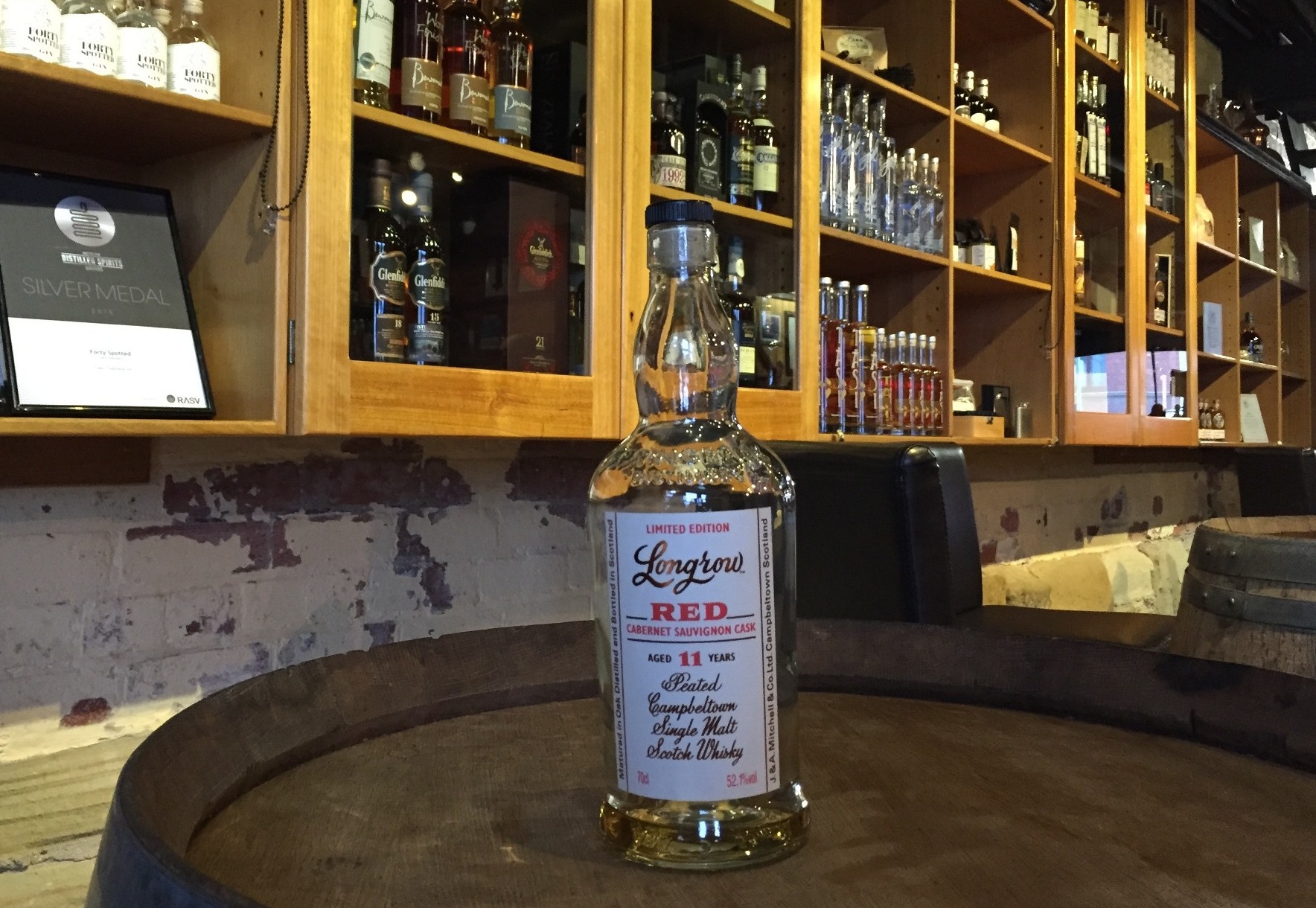
Longrow Cabernet Sauvignon Cask

Reviewed by: Nick

Longrow Cab Sav

As the abundance of sherry barrels diminishes, whisky makers are forced to look elsewhere for maturation options. The obvious solution, of course, is using the barrels of another grape flavoured product – no, not hubba bubba bubblegum – wine. Wine cask maturation is being used by distillers worldwide: some as a novelty but others as a serious addition to their main range.

The wonderful whisky makers of Longrow are no strangers to experimentation. One of their more intriguing bottles is the Cabernet Sauvignon Cask – aged for seven years in refill bourbon hogs heads and a further four years in Cab Sav barrels sourced from my very favourite wine region: South Australia’s McLaren Vale.

Warning: this is not a beginners whisky. Nor is it an easy drinking whisky. Nor, I believe, could I describe it as a ‘nice’ whisky. But it sure is a fascinating one. On the nose I detected, well, heaps. Initially a gentle smoke, reminding you that yes, Longrow do peat their barley. Once the smoke clears notes of grapes, banana and burnt orange rind flow through. Over all, it is complex and delicious.

The palate is a bit of a shock. Initially it is sweet with fizzy sherbet complimenting the peat. The red grapes make a return, along with other fruit such as melons and apricots. And then the spirit transforms. The finish is long, though not necessarily because of the slightly higher percentage of alcohol. It’s a little… soapy? This is a tasting note I (and seemingly I alone) seem to find in many wine-matured whiskies. There are other, nicer elements: smoked ham, salt, fish, bonfire ash, general seaside senses. This whisky is from Campbelltown, after all!

In no way do I regret buying this whisky. There’s a lot to like and a lot to discuss. But I didn’t love it. And that’s ok.

★★