Hobart

Caol Ila 12 Year Old

Reviewed by: Mooresy

Caol Ila

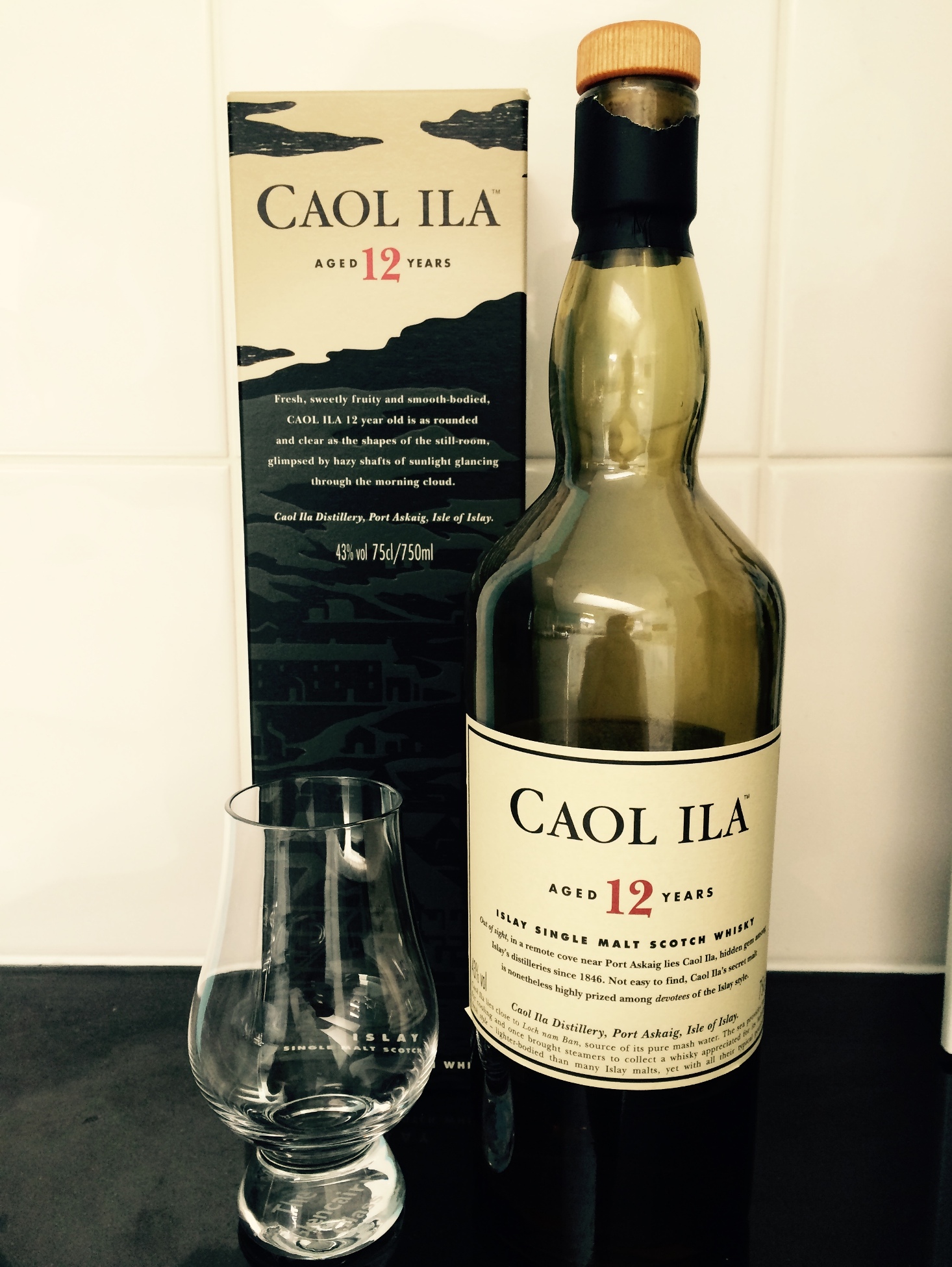
Caol Ila is a deceptive drop, both in pronunciation and in presentation. The Scots will tell you, aggressively, that there is one way to pronounce Caol Ila and that is “Cull Eel-a” blurred into one word. You’ll be lucky if spellcheck doesn’t turn it into Coal Ikea, but stay well away from that and do not be fooled by your non-Gaelic upbringing.

It is also deceptive on appearance. The box is black, but in particular the bottle is darkened grey glass, as if the Islay smoke itself was swirling inside staining the bottle like the wind lashes coastal cliffs. But once the dram is poured, the liquid is pale as if pulled straight from a virgin oak barrel.

Caol Ila means Sound of Islay but is not one of the best well known of the Islay malts and, despite being the largest Islay distillery, it is not in the Islay triumvirate. I am leaving Bowmore out of the triumvirate if anyone is struggling to narrow it down to the big three.

On the nose, there is the smoky peat smell that makes it quintessentially Islay. There are hints of peppermint and the fresh fruit leaf smell coming through but most surprising is how the brine – more subtle than many an island whisky – adds an intensity without being overpowering.

This translates onto the palate where, combined with a caramelised sugar sweetness, the peak hit comes back for a second round. Despite the colour and viscosity on appearance, Caol Ila is quite an oily whisky and arrives like a malt older than its twelve years but without the punch of those elders. It is disappointingly only bottled at 43%.

The finish is long and the oily quality stays in the mouth for round three of peat hit. But don’t get me wrong, this in not the kind of peat that will clear a room from smell alone. Unlike the infamous (and exceptional) Octomore, you don’t wake up the morning after trying to remember when you smoked a cigar the night before. But it has just enough to be an excellent easy-drinking Islay malt.

Perhaps the most endearing element of the Caol Ila 12 is what, I suspect, it contributed to the now deceased blended malt Johnnie Walker Green Label, but that is a story for a future musing.

★★★

Yamazaki Distillers Reserve

Reviewed by: Nick

Yamazaki Distillers Reserve whisky waffle

Even the most diehard Scotch whisky traditionalists can no longer argue that countries other than Scotland cannot produce top quality single malts. Japan has become one of the leaders in New-World whisky-making and recent awards, such as the number one spot in Jim Murray’s 2015 whisky bible, suggest that the status quo is changing – slightly – but noticeably.

The establishment responsible for the latest-greatest single malt is Yamazaki, Japan’s oldest distillery. Some of their products are undoubtedly spectacular and produce flavours that will stand out in any collection. Others, however, are more content to blend into the background.

The Yamazaki Distillers Reserve features younger spirits matured in ex-red wine casks married with older sherry and Japanese oak (mizunara) casks. The results are pleasant, although certainly not world-beating.

Dark fruits are immediately noticeable on the nose along with some sappier floral notes. There is also a slight dollop of vanilla with subtle hints of wood shavings. It is lively across the palate – spicy and challenging and certainly not smooth. Although far from sweet, it contains notes of stewed apricots and raspberry jam, but these compete for attention with oaky tannins and form an intriguing but overall unbalanced flavour. There is a bitterness to the finish which partially hides the more pleasant fruitier notes and the overall impression is one of ‘so close, but yet so far’.

The Yamazaki Distillers Reserve is far from a bad whisky. It is interesting, challenging and uniquely Japanese. It is, however, far from Yamazaki’s best drop and certainly lacks the balance of flavours found among the distillery’s more accomplished products.

★★

Inaugural Young Whisky Enthusiasts Event

Posted by: Mooresy

Throw away your soft-caps, pipes and tweed vests, it’s time to bring whisky out of the dusty gentlemen’s clubs and into the open where it belongs. Whisky is unique in that it’s both an ancient and emergent industry at the same time. Old recipes hold their timeless elegance and modern distillers are creating experimental creations: between them there is a flavour for everyone.

Increasingly more young people are keen to get into the whisky scene. They either know what they like and are excited to try more, or they are new to the drink and want some guidance. Either way, they often don’t want to attend tastings full of middle-aged people with years of knowledge, and they often don’t speak up when they think they have guessed a flavour or a smell.

This is a great loss, and I want to change that.

That is why I started the Young Whisky Enthusiasts, to encourage interested people to get more involved. The tastings have been small but due to the support they have received, we are moving venues and getting bigger. Through the generous in-kind support of the Lark Distillery, we are saying farewell to small tastings and welcoming bigger and better things.

Mooresy: "there is a lot of whisky in this photo"

Mooresy: “there is lots of whisky in this photo”

The first of our tastings at the new venue will be held at 7:30 PM on 5 November 2014 at the Lark Cellar Door in Hobart. There will be rare and expensive whiskies on the tasting table, so contact me (0417 382 542, alexandermoores@gmail.com, or on Facebook) to secure your ticket. Price is $30 and includes at least 5 special drams.

At this first distillery tasting we will do a world tour of whisky taking in many countries and flavours, as well as voting on the name of our group and doing a people’s choice award which will help shape the next tasting.

It’s your community too, so get involved and help us forge a future for young whisky enthusiasts.

Strathisla 12 Year Old

Reviewed by: Ted

Strathisla 12

Some people say that nothing that comes out of a medicine bottle ever tastes good. Well, I would argue that is not always the case, especially when the bottle contains Strathisla 12 Year Old.

Now, I’m not saying that whisky is medicinal (although my dad always had a glass if he felt a cold coming on), but the Strathisla 12 captures the look of a Victorian medicine bottle, with beautiful dark green glass, embossed lettering, several fonts, and a lovely etching of the distillery.

Strathisla is owned by Chivas Brothers, makers of the well known range of Chivas Regal blends. According to the box the distillery itself is ‘The oldest distillery in the Highlands’, although we would debate this fact slightly. Not the age mind, but the location, because when you look on a map you would be forgiven for thinking that Strathisla is smack bang in Speyside.

A sly Speyside imp certainly dances into the character of the Strathisla 12. The nose is light and sharp, with notes of hard fruit, grain, and crushed grass. The taste is crisp and green, with strong bitter herbal flavours that cut across the tongue, leaving a lasting dryness. There’s a raw, untamed edge to this Strathisla that suggests a younger whisky than its 12 years. Perhaps a few more years in the barrel would coax it into bloom.

If you are one of those people that are of the opinion ‘It’s herbal, so it must be good for you’, then you will probably find a better bet in the Strathisla 12 than downing some concoction of random weeds pulled from the garden. The bitterness will definitely be a turnoff for some people, but sometimes that’s just what you want. In fact, come to think of it, the herbal qualities may even make it an excellent component for a cocktail. Take a walk into the leafy green garden of Strathisla and see if it’s just the tonic you’re looking for.

★★

Amrut Fusion

Reviewed by: Mooresy

Amrut Fusion
Keen not to be left behind, India’s first single malt was launched in 2004 by Amrut Distilleries and has had a meteoric rise to success in the world market over the last decade. Not trying to imitate Scotch, Indian whisky brings its own special something to the field.

True to its name, this variant is a fusion between the traditional methods of the Scots and the experimental, unshackled approach of Indian distillers. Like a child who has moved out of home in defiance but is still keen to impress the parents, Amrut whiskies are a reminder to the world that independence can lead to innovation in a way only ex-colonial powers demonstrate.

For long-time drinkers of Scotch whisky who are yet to stray into the realm of Australian, Japanese or any other countries, Amrut Fusion will be a surprising drop. On the nose there are hints of spice and sweetness, pushing the mind to thoughts of chai and other familiar Indian flavours.

After a short while, the intensity fades and, I for one, was left with the clearest smell of warm cinnamon doughnuts. On a cold night sitting on a balcony somewhere looking over the ocean, one would feel they were right there at a carnival surrounded by cotton candy, caramel popcorn, and of course the doughnuts.

To taste it gets more traditional, the fruitcake and chocolaty flavours, with the vanilla notes almost inescapable in bourbon-matured drams. The Scottish barley has arguably its biggest influence on the palate through the peat it brings to Fusion, giving a nice smoky kickback to whisky’s origins. Nothing overpowering, just enough to affect the finish and push it out that little bit longer.

There’s a moderate finish, but it’s hard to identify the length because once finished there is a strong desire to just top up the glass a little more and keep the sensation alive. Imagine opening a box of 12 cinnamon doughnuts: you never eat just one.

In the same way that Suntory exhibits qualities archetypal to the qualities of the country in which it was made – precision, exactness, and patience – there is something of the same in Amrut. A busyness and complexity that may make it hard to pin down individual flavours at first but given time all come together and paint a picture everyone can enjoy. There are few whiskies where the phrase “the whole is greater than the sum of the parts” is so applicable.

Amrut has several variants including a peated and a cask strength version of their original single malt, but Fusion is delicious, readily available, affordable, and has a hedonic quality that so far differs from all other Indian whisky (not to mention Scotch whisky) in a charming and moreish way.

★★★

The Whisky Waffle community

Posted by: Nick

The more I discover about the Tasmanian whisky scene, the more I appreciate the close-knit little community that has developed. People are friendly, enthusiastic and willing to help out one another to ensure this thriving industry continues to boom. Our website is only a tiny part of the bigger picture but we would love to help foster this sense of community.

And on that note, we would like to announce the next writer upon Whisky Waffle: YOU! Well – it could be you! If anyone has a piece they are keen to share with the world, or a dram they are desperate to review, send us an email at whiskywaffle@gmail.com and let us know!

So with no further ado may I introduce our first guest contributor: Mr Alex ‘Mooresy’ Moores!

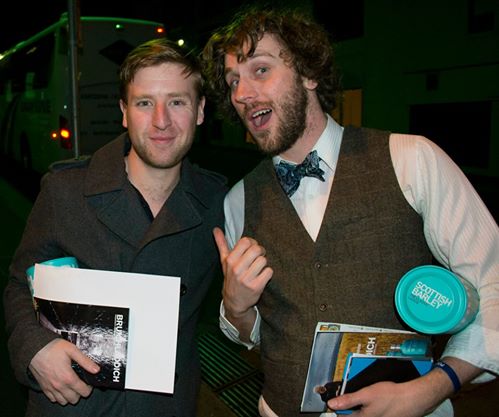
Mooresy and Nick are in 'good spirits' after meeting Jim McEwan. See what I did there?

Mooresy and Nick are in ‘good spirits’ after meeting Jim McEwan. See what I did there?

I met Mooresy while attending the Jim McEwan night last Thursday and was impressed by his enthusiasm and passion for the water of life. His first review will hit the site tomorrow and I assure you, it’s a cracker of a read. Make sure you stop by to check it out!

Until then, keep waffling!


Photo provided by the TWAS. Used with permission.

Jim McEwan: the Rock-Star of Whisky

They say you should never meet your heroes. But in the case of Jim McEwan, master distiller of Bruichladdich, they could not be more wrong.

On Thursday the 9th of October, in Howrah of all places, I had the great pleasure to meet an absolute legend of the whisky world. His introductory spiel described him as “a man you should move heaven and earth to see”. He himself informed us that after six drams I would be thinking of him as a rock star. That wasn’t true. In my eyes, he was a rock star before I had touched a single drop.

The only photo I managed to get taken before my camera's memory filled up. Typical.

The only photo I managed to get taken before my cameras memory filled up. Typical.

Upon walking into the venue I could have been forgiven for feeling out of place. I was possibly the first person to ever wear a bow tie into the Shoreline Hotel. But I quickly realised I was right where I intended to be after spotting a who’s who of Tasmanian whisky: Tim Duckett. Dean Jackson. Casey and Jane Overeem. Richard Stewart. And of course, Robbie from Lark.

The person we had come to see, however, was from slightly further afield and made his entrance in a style befitting of a master Scottish distiller. Clad in a black suit with Bruichladdich-Blue shirt and tie, he marched into the room to the sound of blaring bagpipes. And there he was, the self-proclaimed ‘cask whisperer’ himself (he confessed he enjoyed talking to his whisky barrels with phrases such as: “you are so beautiful”).

Once our applause had died down, he congratulated the piper, Heath, handing him a dram of Islay’s finest. Upon watching Heath sample the whisky, he commented: “Never have I seen a piper take sips!”

Heath was quick to reply: “I was expecting it to be good!”

Jim laughed and grabbed a bottle to refill the glass and did so – right to the top!

It was a night full of similar banter and hilarious anecdotes providing many laughs for all in attendance. Jim confessed that when he begins nights such as this he doesn’t know what he’s going to say, much like fellow Scotsman, Billy Connolly. Hence, many rambling tangents were followed – and some great stories developed from them.
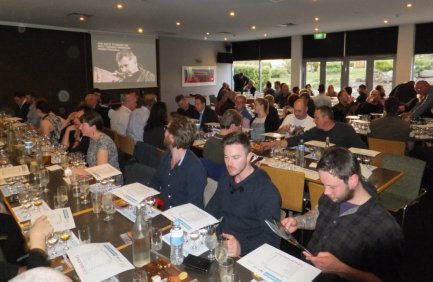
So many whisky fans in one room!

So many whisky fans in one room!

He began with praise for Tasmania, which filled my heart with pride. He had just attended what he described as his “twentieth tasting in two days” and was impressed with the Lark and Heartwood that he tried. Tasmania, he said, has many similarities with Scotland, and while at first this induced some home sickness, he confessed that after six drams of Lark whisky his pining was miraculously cured. His spiel concluded with the highest praise of all, confirming a belief many Tasmanians hold: “Tasmania is the new Islay”.

The tales continued throughout the night, and we heard the story of how Jim followed his heart to the closed and neglected Bruichladdich distillery and re-employed much of the same crew that used to work there: getting the band back together, Blues Brothers style.

He mentioned how the decision to make gin saved the distillery in financially troubled times, using the “traditional Scottish tactics of bribery and corruption” to convince a fellow gin maker from Birmingham to provide some know-how. ‘The Botanist’ is now a highly regarded product – even by me, the non-gin drinker!

Other stories were less relevant, but just as entertaining. For example the time in the 60s he met psychedelic rock star, Donovan.  Donovan had, remarkably, been sent to Islay to get ‘clean’; the result of which was many shouted drams for the locals, and Donovan leaving the island in an ambulance.

There were many, many more tall tales told as the whisky flowed: creative use of Heinz salad cream bottles – and Big Angus’ wellies, tasting notes for Japanese students that were lost in translation, advice for every male present to seek themselves a ‘man-cave’, and of course the knock on the door of Gunta (just after Scotland had defeated England 7-0 in the world cup final).

Perhaps the most poignant of all, however, was Jim’s belief in his community. Bruichladdich employs over 70 people on Islay. Many larger distilleries have no more than 6 staff members. It was that sense of the island coming together that instilled Jim with more pride than anything else he had achieved. I mentioned to him afterwards that of all the distilleries I had been to, Bruichladdich had the best people. “And isn’t that what counts?” he said, clearly chuffed.

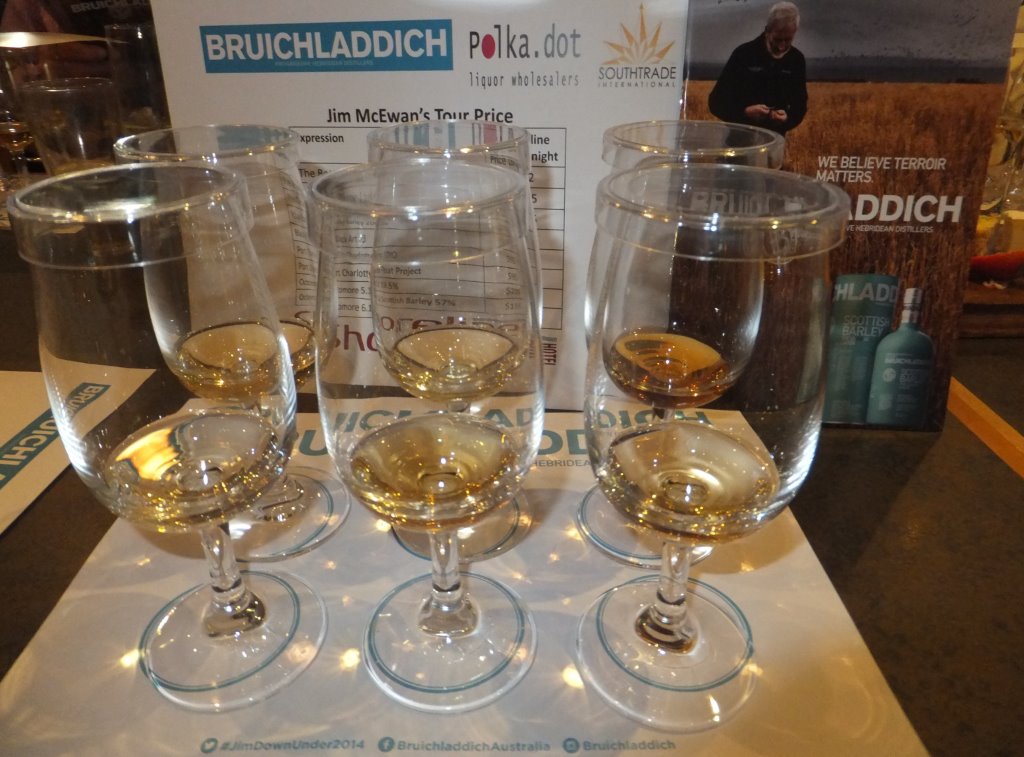
Half a dozen drams - a quiet night for Jim McEwan!

Half a dozen drams – a quiet night for Jim McEwan!

The whisky, while not the main attraction of the night, was exceptional. The Laddie Classic was lightly salty, reflecting the conditions in which it was matured, but it was also floral and fruity. The Islay Barley was next, maltier, stronger, and one of Jim’s proudest accomplishments, having been grown, distilled and bottled all on site. “How many distilleries in the world can lay claim to that?” he asked. Redlands’ Dean Jackson just sat quietly.

This was followed by the Black Arts 03.1 – a whisky described by Jim as a “protest whisky”. It was his raised middle finger to the marketing team, to whom he would not reveal its cask types. He challenged us to guess for ourselves. The popular answer was sherry, although he was quick to point out that this was not the sole ingredient. “How many people have actually bought a bottle of sherry in the last six months?” he asked. In the entire room only two people raised their hand. “Sherry is dead in the water. We need to look further”. There were certainly some wine notes in amongst this whisky – it reminded me strongly of the Dalmore Cigar Malt Reserve.

Curiously we then diverged from the tasting order. We moved straight to whisky number five, which was the Port Charlotte 10 Year Old. Named after a long since closed distillery, this whisky was coated in delicious swirling, but not overpowering, peat. There were apricots and other stone fruit flavours to be found and reminded me of Bruichladdich’s neighbour, Kilchoman. Jim told us he tracked down an aged old man who many years in the past had worked at the original Port Charlotte distillery. Upon being asked if he remembered the taste of the whisky, the response was: “Aye aye aye aye aye. Aye aye. Aye aye aye. Aye. It tasted good!”

Whisky number six was the famous Octomore 6.1, the most heavily peated whisky in the world. I must confess to having sampled this dram before and adoring it – although this experience was slightly different to the way I previously tried it. Jim encouraged us to take a generous glug, hold it in our mouths for 30 seconds before swallowing. He compared this sensation to Usain Bolt bursting from the blocks and after trying it, I could understand the analogy.

I must confess that I could not tell you much about whisky number four. At that point in the evening, Jim declared we were to do a highland toast. Left foot on a chair, right foot on the table we enthusiastically repeated many (mispronounced) Gaelic words, waving our glass about (trying not to spill any), before taking a generous swig. Amazingly, even after the quantity of whisky that had been consumed, no glasses (or bones) were broken, much to the relief of the nervous looking bar staff.

Allof us up on the table - and Jim was the most spritely!

Out of all of us, Jim was the most spritely!

The night concluded with a rendition of the Scottish national anthem – or so we thought until the Proclaimers ‘I would walk 500 miles’ blared through the speakers. Jim stood up the front and conducted our raucous chanting.

As the people filtered from the venue at the end of the night, I left enlightened, inspired and thoroughly entertained. Never had the community that accompanies whisky drinking been so apparent in Tasmania. We were united as one, all in awe of a man who we regarded as an idol: the master distiller. However at the same time upon meeting him and discovering how humble and down to earth he was, we were also able to describe him with the highest praise an Australian could give: Jim McEwan is a good bloke.
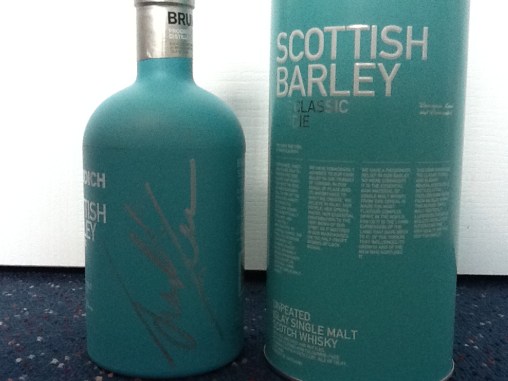
This bottle was coincidentally the same colour that Jim was wearing! And a bottle I will treasure forever.
This bottle was coincidentally the same colour that Jim was wearing! And a bottle I will treasure forever.

Jim McEwan comes to Tasmania

Jim pours generous nips

Jim pours generous nips

Posted by: Nick

Tasmania is certainly a rising star within the landscape of the whisky world. Evidence of this is the upcoming visit to Hobart by a man who can be aptly described as one of the world’s few ‘celebrity distillers’. This is none other than the incredible Jim McEwan, head distiller for the ground-breaking Bruichladdich Distillery.

Jim McEwan has been in charge of the spirit created at Bruichladdich since its reopening in 2001 and has been instrumental in acquiring the ‘progressive’ reputation of the distillery. Using different barrel types, aging processes and, occasionally, the most heavily peated malt the world has ever seen, he continually creates revolutionary whisky. Jim’s experimentation has not gone unrecognised; he is the only man to have been crowned ‘Whisky Distiller of the Year’ three times.

The event is to be on Thursday the 9th of October and is already sold out; this is to be expected from an event of this nature. But if you’re curious to find out what he has to say, fear not – as Whisky Waffle’s own Nick Turner will be there to learn from the master. Expect a blog post at the end of the week sharing some of the secrets and magic revealed by Jim on the night.

If you have any questions you would like Nick to ask Jim, write them in the comments and he will endeavour get you some answers!

Lark Port Wood Distillers Selection

Reviewed by Nick and Ted

Lark Distillers Selection

Tasmania has many different distilleries to choose from and whiskies to savour, but if you were to pick just one, this would have to be it. Lark distillery resurrected the fine art of small scale distilling in Australia, providing a foundation to the swiftly burgeoning scene that exists today.

The Distillers Selection does not provide an age statement, but as it is aged in ex port-wood quarter casks the maturation process is accelerated and the flavours speak for themselves.

Oranges. The true heart of the Lark flavour, a view endorsed by Bill Lark himself (we asked him in person). The nose provides a zesty citrus burst with smooth caramel undertones. This is a big whisky across the palate; full bodied and complex. The finish leaves a memorable taste of dark chocolate and orange rind, with a spicy zing from the 46% alcohol specific to this Lark release.

Across the range of Tasmanian whiskies you may find smoother, richer or more complex drams, but you would be hard pressed to find one that you could honestly describe as better. The Lark Distillers Selection speaks for Tasmania, and represents the start of a new chapter in the evolution of world whisky.

★★★★★