Islay

Johnnie Walker Black Label

Posted by: Nick

WW Black Label

Johnnie Walker got one thing right when creating their original premium bottling: the name. Black Label subtly suggests quality. Conclude any mundane product title with it and witness the elevation in esteem it receives. For example, Kellogg’s cornflakes: Black Label. Colgate toothpaste: Black Label. Toyota Corolla: Black Label. Chartered accountancy: Black Label.

The name alone should be enough to convince most discerning whisky drinkers that in comparison to the Red Label, this drop is a step up. And it is – but only slightly.

Black extra Nick Whisky Waffle

Johnnie Walker Black is blended from over 40 whiskies all of which are at least 12 years of age. There is a nice range of flavour in this dram, and the supposedly ‘trademark’ smoky character is even vaguely noticeable! The key to this whisky is balance: balance between enjoyable flavours and downright unpleasant ones.

This principle is demonstrated in the nose, which presents a battleground where pleasing chocolate-orange notes and nasty chemical aromas compete for supremacy. There is a lot to like here, although, conversely many elements I’m not at all keen on. The palate continues in a similar vein – the sickly sweetness from the Red Label makes a return but is partially disguised by more agreeable flavours such as oak, nutmeg, and in particular, peat-smoke. It’s the sort of smoke which is only really noticeable if you’ve just polished off a decidedly unpeated malt, but when discovered, it really gives this whisky a lift.

There is a degree of complexity on the finish that is not found in the Red Label. Despite only being bottled at 40% ABV, it features a small amount of lasting spiciness. Sadly the unpleasant sweetness also makes a return and rather spoils the party.

Johnnie Walker Black Label is a mixed bag of a whisky. For every interesting and enjoyable flavour, there is another objectionable one dragging it down. It seems destined to forever be a mixer for those who prefer a slightly classier Scotch and coke. It is premium only in name, sadly not in nature.

★★

#johnniewalkerweek

Find out about the rest of our multi-coloured adventures:

Johnnie Walker Red Label

Johnnie Walker Double Black

Johnnie Walker Gold Label Reserve

Johnnie Walker Platinum Label 18 Year Old

Johnnie Walker Blue Label

Johnnie Walker Green Label

Johnnie Walker: which is best?

Johnnie Walker Red Label

Reviewed by: Nick and Ted

WW Red Label 2

In theory, blended Scotch whisky should showcase the best elements of the Scottish regions: the mellow sweetness of Speyside, the full bodied character of the Highlands, sexy smoke from Islay and the Islands. Mmm, makes you drool doesn’t it?

Johnnie Walker Red Label manages to showcase none of the above. Instead it somehow picks the worst of these regions: sickly sweetness from the lolly shops of Speyside, industrial air pollution, not from Islay, but Kilmarnock, and what of the character from the Highlands? Well, the only part it manages to keep is the dreadful weather.

Red extra Nick and Ted Whisky Waffle

To look at the Johnnie Red you would not detect anything amiss, but as soon as you give it a nose the questionable quality rears its head. Cloying treacly notes overpower the faint hints of oak desperately trying to claw their way through. Subtlety is not on the agenda here.

The palate is pretty one-dimensional, dominated by a fairly inconsequential caramel that fails to deliver anything of interest. There is a faint hint of maltiness, like cream biscuits where someone has licked out the filling, although admittedly they’re not even the nice kind of biscuits. The finish is lasting in the same way that a glass of cordial lingers at the back of the throat when you haven’t watered it down enough. The burn is not so much from the alcohol but the unpleasant sweetness.

Around the world the Johnnie Walker Red Label is predominantly served as a mixer, and tasting it neat we can understand why. Having said that, millions of litres worth of the stuff is sold around the world every day. In fact it’s the highest selling Scotch whisky on the planet, so basically, what do we know?

#johnniewalkerweek

Find out about the rest of our multicoloured adventures:

Johnnie Walker Black Label

Johnnie Walker Double Black

Johnnie Walker Gold Label Reserve

Johnnie Walker Platinum Label 18 Year Old

Johnnie Walker Blue Label

Johnnie Walker Green Label

Johnnie Walker: which is best?

Whisky Waffle announce: Johnnie Walker Week

Posted by Nick and Ted

The Whisky Wafflers are chuffed to announce their first ever ‘event week’! Over the next seven days they will be sampling each of the main expressions of Scotland’s most famous and renowned blended whisky. I am of course referring to: Walkers Kilmarnock Whiskies!

What’s that? It’s not called that these days? Well what is it then? Oh. I see. I stand corrected.

I am of course referring to: Johnnie Walker!

Whisky Waffle considering Johnnie Walker

If you are a Scotch whisky drinker, it’s likely that at some stage in your life, you will have tried a Johnnie Walker product. If you are not a Scotch whisky drinker, it’s even more likely that at some stage in your life you will have tried a Johnnie Walker product – and it put you off.

Regardless, be sure to tune in over the next seven days for our light hearted and occasionally tongue in cheek opinions of all six main expressions, as well as the story of our darkest whisky drinking day.

With all that and more coming up, be sure to visit the page over the next week and find out exactly what we think of the best selling whisky in the world!

#johnniewalkerweek

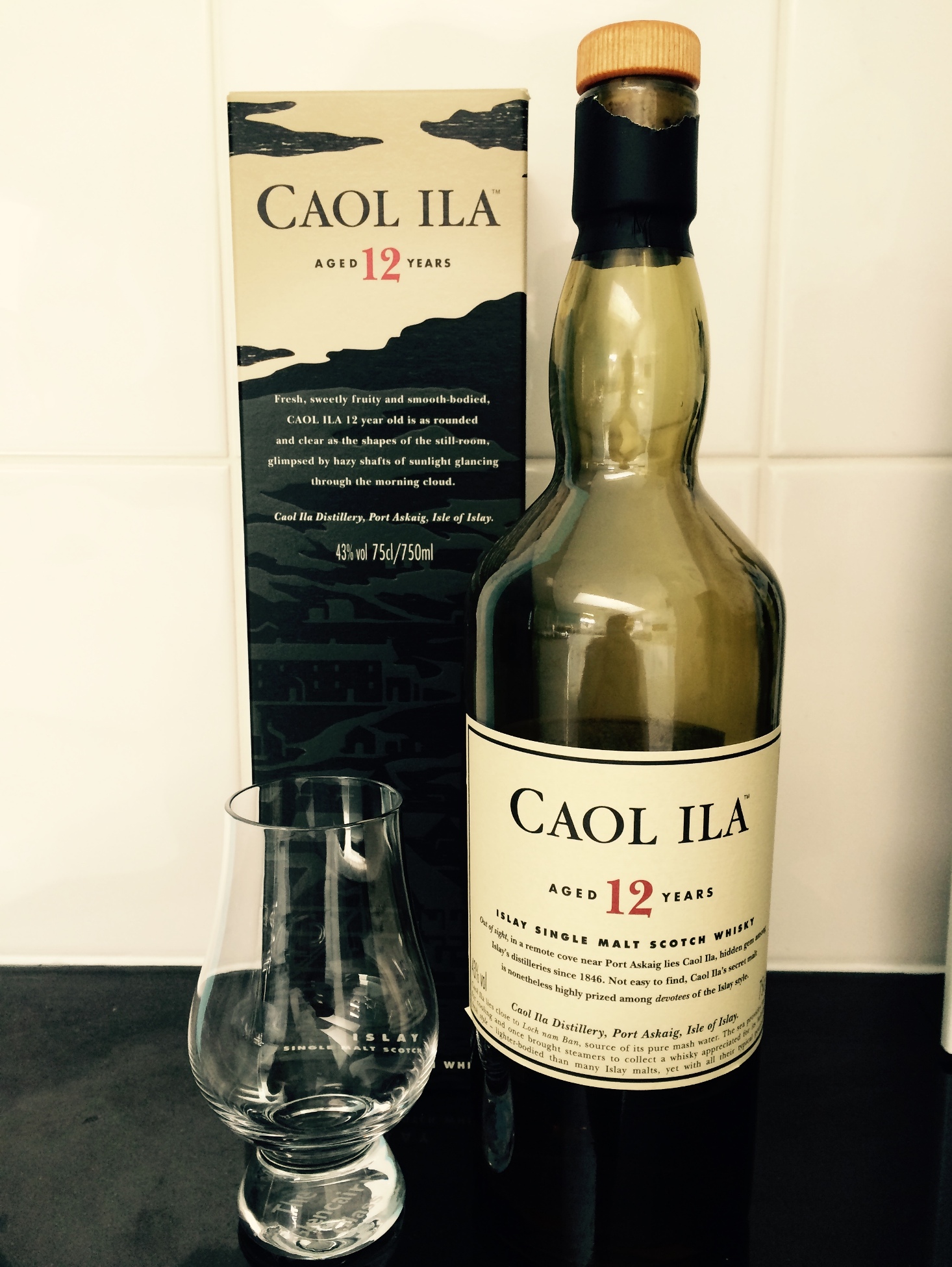
Caol Ila 12 Year Old

Reviewed by: Mooresy

Caol Ila

Caol Ila is a deceptive drop, both in pronunciation and in presentation. The Scots will tell you, aggressively, that there is one way to pronounce Caol Ila and that is “Cull Eel-a” blurred into one word. You’ll be lucky if spellcheck doesn’t turn it into Coal Ikea, but stay well away from that and do not be fooled by your non-Gaelic upbringing.

It is also deceptive on appearance. The box is black, but in particular the bottle is darkened grey glass, as if the Islay smoke itself was swirling inside staining the bottle like the wind lashes coastal cliffs. But once the dram is poured, the liquid is pale as if pulled straight from a virgin oak barrel.

Caol Ila means Sound of Islay but is not one of the best well known of the Islay malts and, despite being the largest Islay distillery, it is not in the Islay triumvirate. I am leaving Bowmore out of the triumvirate if anyone is struggling to narrow it down to the big three.

On the nose, there is the smoky peat smell that makes it quintessentially Islay. There are hints of peppermint and the fresh fruit leaf smell coming through but most surprising is how the brine – more subtle than many an island whisky – adds an intensity without being overpowering.

This translates onto the palate where, combined with a caramelised sugar sweetness, the peak hit comes back for a second round. Despite the colour and viscosity on appearance, Caol Ila is quite an oily whisky and arrives like a malt older than its twelve years but without the punch of those elders. It is disappointingly only bottled at 43%.

The finish is long and the oily quality stays in the mouth for round three of peat hit. But don’t get me wrong, this in not the kind of peat that will clear a room from smell alone. Unlike the infamous (and exceptional) Octomore, you don’t wake up the morning after trying to remember when you smoked a cigar the night before. But it has just enough to be an excellent easy-drinking Islay malt.

Perhaps the most endearing element of the Caol Ila 12 is what, I suspect, it contributed to the now deceased blended malt Johnnie Walker Green Label, but that is a story for a future musing.

★★★

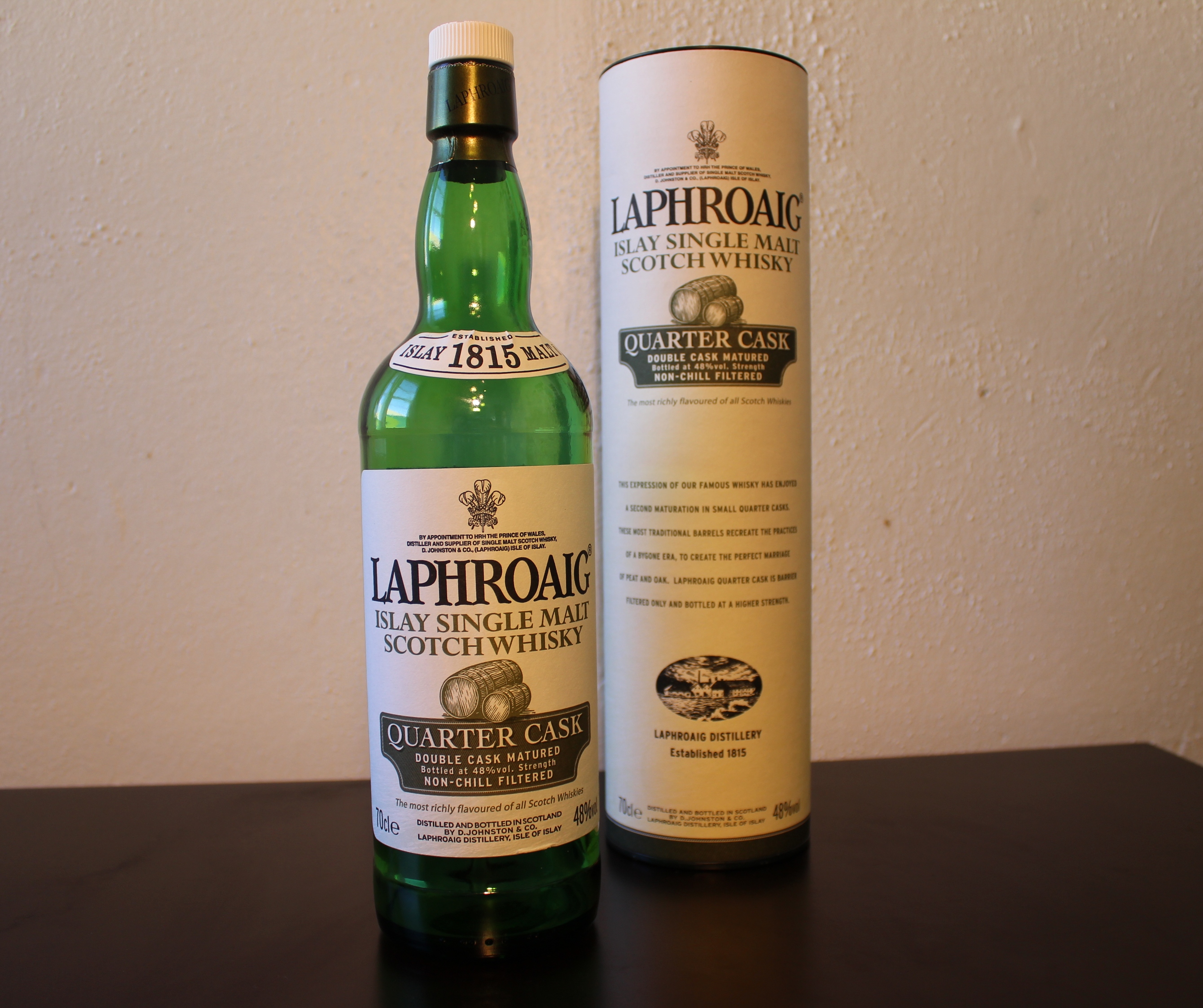
Laphroaig Quarter Cask

Reviewed by: Nick

Laphroaig Quarter Cask whisky waffle

At the time, this was the most expensive bottle of whisky I had ever bought. My best friend, co-writer and co-drinker Ted, had just bought a bottle of Lagavulin 16 and I convinced myself I needed to follow suit with something equally special. So I parted with more money than a uni student like me would normally spend in a month, and took the plunge into the world of Islay whiskies. I was not disappointed.

While this whisky may be younger than 10 years (no age statement is provided, so it’s hard to be sure) it has been matured in smaller ‘quarter’ casks, hence the name of the expression. The reduction in barrel size ensures the spirit has had more contact with the wood than it would usually be allowed (Laphroaig claim 30% more!) and suddenly a more complex, more dynamic whisky is born.

There is still plenty of peat on offer here. However, while the 10 Year Old is merely smouldering, the Quarter Cask is burning intensely: it is the whisky equivalent of a blazing bonfire.

Coastal elements are present on the nose; a sea breeze of salt, brine and seaweed. The fire transfers to the palate: the increased bottling level of 48% gives this whisky the kick and spice that the 10 Year Old lacks. Sweeter flavours come through: toffee, treacle, cocoa, even caramel. The finish is lengthy and memorable. Huge gusts of smoke roll across the palate, and linger for minutes afterwards.

Peated whisky is made by many distilleries. But rarely has one got it as right as this. There is without doubt still a sense of rawness about it. In no way can it be described as the smoothest, most elegant, or even the best whisky you will taste. But all these elements, remarkably, work in its favour. This is peated whisky. This is Islay.

★★★★

Jim McEwan: the Rock-Star of Whisky

They say you should never meet your heroes. But in the case of Jim McEwan, master distiller of Bruichladdich, they could not be more wrong.

On Thursday the 9th of October, in Howrah of all places, I had the great pleasure to meet an absolute legend of the whisky world. His introductory spiel described him as “a man you should move heaven and earth to see”. He himself informed us that after six drams I would be thinking of him as a rock star. That wasn’t true. In my eyes, he was a rock star before I had touched a single drop.

The only photo I managed to get taken before my camera's memory filled up. Typical.

The only photo I managed to get taken before my cameras memory filled up. Typical.

Upon walking into the venue I could have been forgiven for feeling out of place. I was possibly the first person to ever wear a bow tie into the Shoreline Hotel. But I quickly realised I was right where I intended to be after spotting a who’s who of Tasmanian whisky: Tim Duckett. Dean Jackson. Casey and Jane Overeem. Richard Stewart. And of course, Robbie from Lark.

The person we had come to see, however, was from slightly further afield and made his entrance in a style befitting of a master Scottish distiller. Clad in a black suit with Bruichladdich-Blue shirt and tie, he marched into the room to the sound of blaring bagpipes. And there he was, the self-proclaimed ‘cask whisperer’ himself (he confessed he enjoyed talking to his whisky barrels with phrases such as: “you are so beautiful”).

Once our applause had died down, he congratulated the piper, Heath, handing him a dram of Islay’s finest. Upon watching Heath sample the whisky, he commented: “Never have I seen a piper take sips!”

Heath was quick to reply: “I was expecting it to be good!”

Jim laughed and grabbed a bottle to refill the glass and did so – right to the top!

It was a night full of similar banter and hilarious anecdotes providing many laughs for all in attendance. Jim confessed that when he begins nights such as this he doesn’t know what he’s going to say, much like fellow Scotsman, Billy Connolly. Hence, many rambling tangents were followed – and some great stories developed from them.
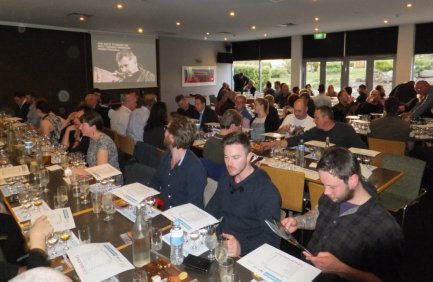
So many whisky fans in one room!

So many whisky fans in one room!

He began with praise for Tasmania, which filled my heart with pride. He had just attended what he described as his “twentieth tasting in two days” and was impressed with the Lark and Heartwood that he tried. Tasmania, he said, has many similarities with Scotland, and while at first this induced some home sickness, he confessed that after six drams of Lark whisky his pining was miraculously cured. His spiel concluded with the highest praise of all, confirming a belief many Tasmanians hold: “Tasmania is the new Islay”.

The tales continued throughout the night, and we heard the story of how Jim followed his heart to the closed and neglected Bruichladdich distillery and re-employed much of the same crew that used to work there: getting the band back together, Blues Brothers style.

He mentioned how the decision to make gin saved the distillery in financially troubled times, using the “traditional Scottish tactics of bribery and corruption” to convince a fellow gin maker from Birmingham to provide some know-how. ‘The Botanist’ is now a highly regarded product – even by me, the non-gin drinker!

Other stories were less relevant, but just as entertaining. For example the time in the 60s he met psychedelic rock star, Donovan.  Donovan had, remarkably, been sent to Islay to get ‘clean’; the result of which was many shouted drams for the locals, and Donovan leaving the island in an ambulance.

There were many, many more tall tales told as the whisky flowed: creative use of Heinz salad cream bottles – and Big Angus’ wellies, tasting notes for Japanese students that were lost in translation, advice for every male present to seek themselves a ‘man-cave’, and of course the knock on the door of Gunta (just after Scotland had defeated England 7-0 in the world cup final).

Perhaps the most poignant of all, however, was Jim’s belief in his community. Bruichladdich employs over 70 people on Islay. Many larger distilleries have no more than 6 staff members. It was that sense of the island coming together that instilled Jim with more pride than anything else he had achieved. I mentioned to him afterwards that of all the distilleries I had been to, Bruichladdich had the best people. “And isn’t that what counts?” he said, clearly chuffed.

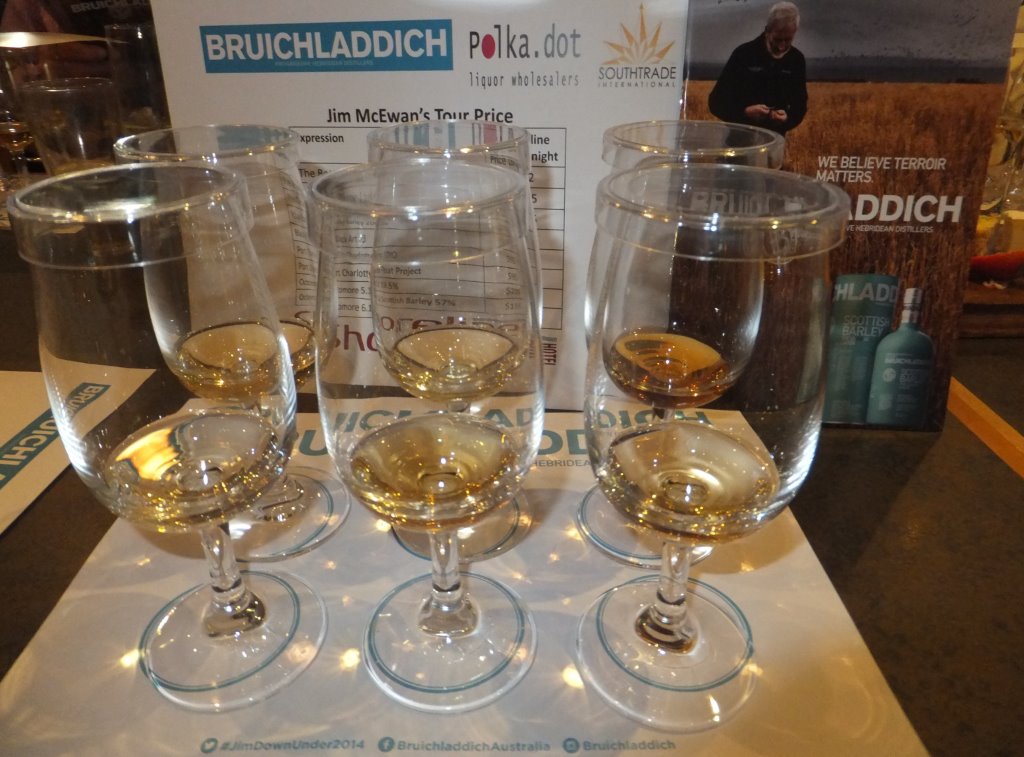
Half a dozen drams - a quiet night for Jim McEwan!

Half a dozen drams – a quiet night for Jim McEwan!

The whisky, while not the main attraction of the night, was exceptional. The Laddie Classic was lightly salty, reflecting the conditions in which it was matured, but it was also floral and fruity. The Islay Barley was next, maltier, stronger, and one of Jim’s proudest accomplishments, having been grown, distilled and bottled all on site. “How many distilleries in the world can lay claim to that?” he asked. Redlands’ Dean Jackson just sat quietly.

This was followed by the Black Arts 03.1 – a whisky described by Jim as a “protest whisky”. It was his raised middle finger to the marketing team, to whom he would not reveal its cask types. He challenged us to guess for ourselves. The popular answer was sherry, although he was quick to point out that this was not the sole ingredient. “How many people have actually bought a bottle of sherry in the last six months?” he asked. In the entire room only two people raised their hand. “Sherry is dead in the water. We need to look further”. There were certainly some wine notes in amongst this whisky – it reminded me strongly of the Dalmore Cigar Malt Reserve.

Curiously we then diverged from the tasting order. We moved straight to whisky number five, which was the Port Charlotte 10 Year Old. Named after a long since closed distillery, this whisky was coated in delicious swirling, but not overpowering, peat. There were apricots and other stone fruit flavours to be found and reminded me of Bruichladdich’s neighbour, Kilchoman. Jim told us he tracked down an aged old man who many years in the past had worked at the original Port Charlotte distillery. Upon being asked if he remembered the taste of the whisky, the response was: “Aye aye aye aye aye. Aye aye. Aye aye aye. Aye. It tasted good!”

Whisky number six was the famous Octomore 6.1, the most heavily peated whisky in the world. I must confess to having sampled this dram before and adoring it – although this experience was slightly different to the way I previously tried it. Jim encouraged us to take a generous glug, hold it in our mouths for 30 seconds before swallowing. He compared this sensation to Usain Bolt bursting from the blocks and after trying it, I could understand the analogy.

I must confess that I could not tell you much about whisky number four. At that point in the evening, Jim declared we were to do a highland toast. Left foot on a chair, right foot on the table we enthusiastically repeated many (mispronounced) Gaelic words, waving our glass about (trying not to spill any), before taking a generous swig. Amazingly, even after the quantity of whisky that had been consumed, no glasses (or bones) were broken, much to the relief of the nervous looking bar staff.
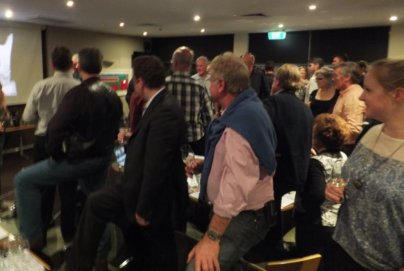
Allof us up on the table - and Jim was the most spritely!

Out of all of us, Jim was the most spritely!

The night concluded with a rendition of the Scottish national anthem – or so we thought until the Proclaimers ‘I would walk 500 miles’ blared through the speakers. Jim stood up the front and conducted our raucous chanting.

As the people filtered from the venue at the end of the night, I left enlightened, inspired and thoroughly entertained. Never had the community that accompanies whisky drinking been so apparent in Tasmania. We were united as one, all in awe of a man who we regarded as an idol: the master distiller. However at the same time upon meeting him and discovering how humble and down to earth he was, we were also able to describe him with the highest praise an Australian could give: Jim McEwan is a good bloke.
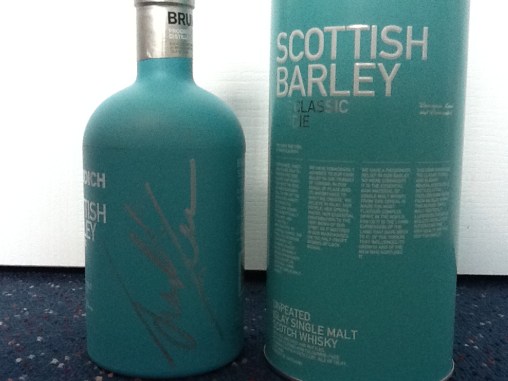
This bottle was coincidentally the same colour that Jim was wearing! And a bottle I will treasure forever.

This bottle was coincidentally the same colour that Jim was wearing! And a bottle I will treasure forever.

Laphroaig 10 Year Old

Reviewed by: Nick

Laphroaig 10 whisky waffle

Peat. One of the biggest, strongest and most divisive flavours found within a dram of whisky. The smoky, medicinal notes send some people running to the hills with just the merest of whiffs. But to others, there are no better flavours in the entire world of whisky. These flavours are most strongly associated with one place: Islay.

The early Ileach distillers did not set out with the intention of creating such iconically flavoured whisky. The use of peat to smoke the barley was born out of necessity rather than creativity. Islay is as remote as it is boggy, and getting coal to the island on a train was simply not an option. So the locals turned to a resource they had in abundance: peat. It kept them warm in their houses against the wild force of the Atlantic Ocean, so burning anything else in their kilns was never a consideration.

The most famous example of peated whisky is made by the Laphroaig Distillery. As far as standard releases go, nothing is on the same extreme level in terms of the peaty intensity of its flavour.

In their 10 Year Old expression it is immediately noticeable – before it has even come close to your nose. Smoke. Ash. Medicinal iodine notes, all there smouldering together. This is the scent of a bonfire at the beach.

The palate is legendarily akin to licking a burnt log. Maritime notes are present; briny, seaweed flavours ebbing through gently. Other, more obscure elements are there too, such as leather and sawdust. The bourbon cask imparts only small amounts of vanilla; and what comes through is particularly dry and slightly bitter.

The finish is disappointingly short and contains several soapy, chalky notes, before the smoke gently comes rolling back, leaving a warm, lingering ash-like flavour.

While it is not the best Islay, or even Laphroaig has to offer, there is no doubt this dram showcases some amazing peaty flavours. It is, however, something of a one card trick, let down by the flavours that accompany the smoke. This does not disappoint me too much. If this is merely the entry level, how good must their other expressions be?

★★★

Jim McEwan comes to Tasmania

Jim pours generous nips

Jim pours generous nips

Posted by: Nick

Tasmania is certainly a rising star within the landscape of the whisky world. Evidence of this is the upcoming visit to Hobart by a man who can be aptly described as one of the world’s few ‘celebrity distillers’. This is none other than the incredible Jim McEwan, head distiller for the ground-breaking Bruichladdich Distillery.

Jim McEwan has been in charge of the spirit created at Bruichladdich since its reopening in 2001 and has been instrumental in acquiring the ‘progressive’ reputation of the distillery. Using different barrel types, aging processes and, occasionally, the most heavily peated malt the world has ever seen, he continually creates revolutionary whisky. Jim’s experimentation has not gone unrecognised; he is the only man to have been crowned ‘Whisky Distiller of the Year’ three times.

The event is to be on Thursday the 9th of October and is already sold out; this is to be expected from an event of this nature. But if you’re curious to find out what he has to say, fear not – as Whisky Waffle’s own Nick Turner will be there to learn from the master. Expect a blog post at the end of the week sharing some of the secrets and magic revealed by Jim on the night.

If you have any questions you would like Nick to ask Jim, write them in the comments and he will endeavour get you some answers!

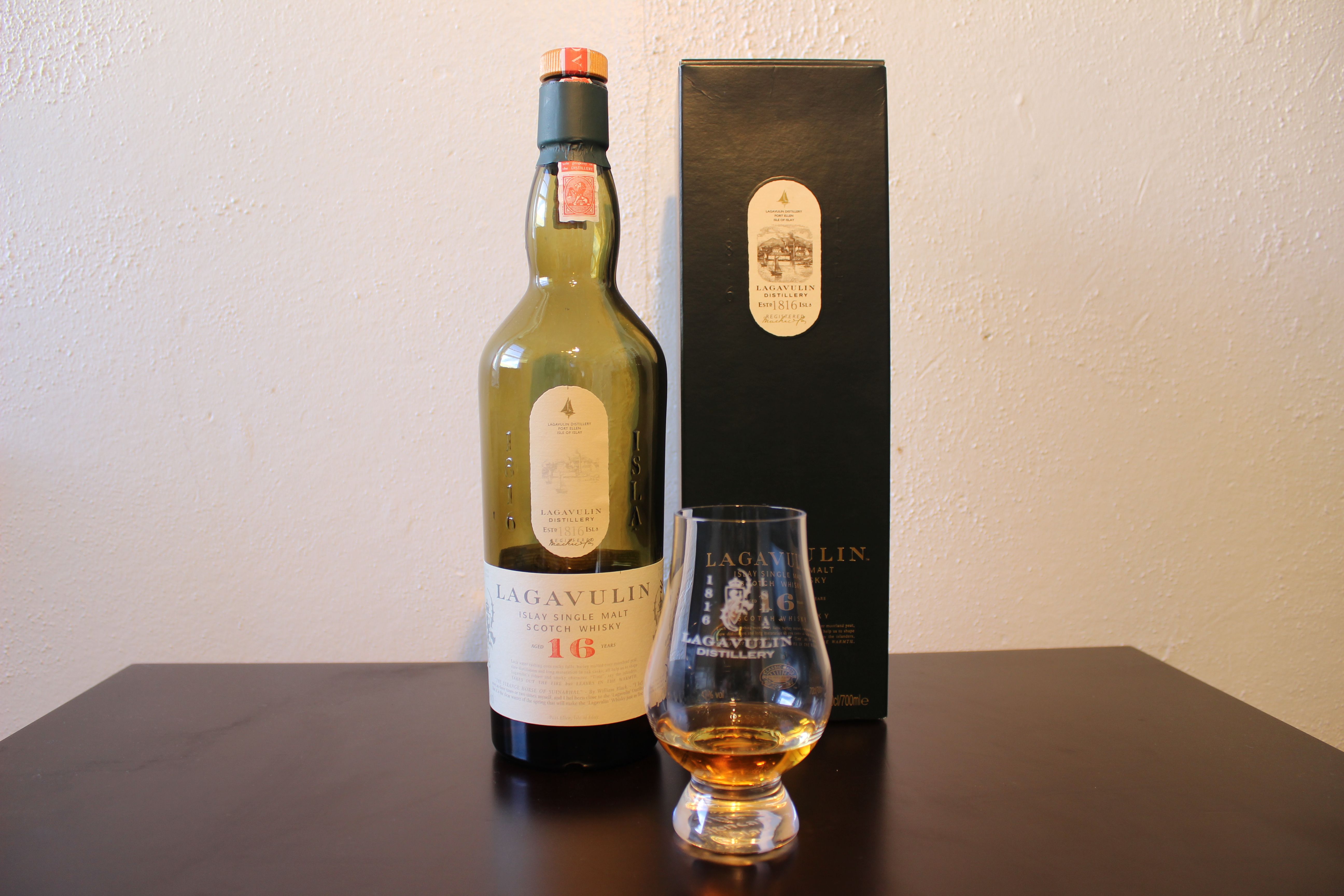
Lagavulin 16 Year Old

Reviewed by Ted

Lagavulin 16 whisky waffle

Balance. Subtlety. Lagavulin 16yr old. As George Takei would say: “Oh my…“.

Heralding from Islay, that near-mythical island of Scottish whisky making, the Lagavulin 16 is aged for most of its life in American oak bourbon casks, then finished in European sherry oak. The maturation sheds of Lagavulin distillery bear the full brunt of the winds and spray of the Atlantic Ocean, and these caress the barrels, imparting their spirit into the developing whisky.

The delicate nose of the Lagavulin 16 has wonderful hints of brine, sea air and mineral salts balanced against a warm brush of smoke and caramelised fruit. The colour is a very light amber, with almost a hint of green, like the first blush of patina on bronze.

After an initial warming hit of peat, the seaside elements make a return with engagingly salty, bitter, metallic notes tempered by nutty caramel and pear. Finally the lovely peat smoke glides across the back of the tongue and down the throat, leaving a peppery finish. This isn’t the usual hearty, roaring bonfire that so typifies many Islay whiskies, but rather the gentle, delicate smouldering of a seaside campfire in the soft golden light of a still dawn. A moment to reflect and savour.

If any of these flavours were too dominant, particularly those drawn from the ocean environment, then this expression of Islay would be diminished, perhaps even unpleasant. Yet in balancing all the parts so precisely against each other, and weaving them so subtly together, a magnificent tapestry is created. The skill of the Lagavulin distillers laid bare. This is a whisky for those quiet, contemplative moments in life, and a truly worthy addition to any collection.

★★★★★


Ardbeg returns from space!

Posted by: Nick

My good friend and drinking guru Scott once successfully fooled me into believing the bottle of Ardbeg Galileo he was pouring me a nip of had actually been into space. As in the very bottle he held in his hand. I was naturally overawed and sipped my drink reverently, commenting stupidly how the lack of atmosphere did not diminish it’s peaty flavours. He eventually came clean and confessed the reason that it’s peaty flavours were undiminished was because it had never actually left earth. It was created in honour of the Ardbeg space project, where a barrel had indeed been sent into space. I had just not been drinking it.

Fast forward to the present and the Ardbeg space program has now landed! Three years and 15 570 orbits later, a barrel of Ardbeg’s finest is currently being inspected by men in white coats, and of course, Ardbeg whisky creator, Dr Bill Lumsden, to find out about the effects of zero gravity on the maturation process. The question remains, however, what will these effects be? Will my learned whisky drinking friend Bonnie be correct in her assertion that the whisky would have spent three years in a ball in the centre of the barrel, not interacting with the wood at all? Or could this be the birth of a new super-whisky?

What is certain, however, is that Ardbeg are celebrating in the best way possible – by bringing out a new release of their famous (and currently out of stock) Supernova! Plus, you can play an Islay-themed version of space invaders, so it’s worth checking out the site simply for enjoyable procrastinatory reasons alone!

Space travel and Islay-whisky. Life surely does not get more exciting than this.

Ardbeg in space