review

Jim Beam Kentucky Straight Bourbon

Reviewed by: Nick and Ted

Jim Beam

When Jacob Beam first distilled some corn along the banks of Dicks River in Kentucky circa 1795, he probably cranked out some pretty rough and ready stuff. Well, it seems that over the years not much has changed. Jim Beam has its origins as a small family business plying their trade in the newly formed state of Kentucky, but since then the family has grown just a tad. In 2014 Jim Beam was involved in a shotgun wedding which resulted in it picking up the double-barrel name (geddit?) Beam-Suntory. And all this multi-national success only came at the low, low price of its soul. Well, it seemed like a good deal at the time.

Not that the brand was particularly struggling it must be said, as Jim Beam Kentucky Straight Bourbon is one of the most recognisable and consumed spirits on the face of the planet. Most often you can observe it in its natural environment being mixed with coke, or being shotted by teens trying to be tough (and then regretting it later).

The boys from Whisky Waffle are even tougher than that. They sipped it. Neat.

Ted and Beam

On the nose the Beam is surprisingly smooth. And sweet… you could be forgiven for the thinking that it’s a liqueur. Honey, pear and confectionery notes of red frog and fairy floss (“cotton candy” in Beam’s motherland) slide across the ol’ olfactory bulbs. Overall it’s not too bad actually.

But then like a Disneyland water-slide, things go down the tubes. On the palate the analogy is rather appropriate as the Beam is about as watery as the pool at the bottom of the aforementioned slide. It also tastes like quite a few people have been swimming in it before you. The quality is thin, with a hint of sour white grapes coated in a film of dish liquid. Once you’ve emerged from the murky waters, your mouth is left with the not altogether pleasant taste of ethanol, cheap Sav Blanc and tourists in Mickey Mouse swimmers.

In fact, drinking bog standard Beam is a lot like a trip to Disneyland in general. It’s exciting at the start, but at the end of the day you are left feeling hot, weary, annoyed, and like your personal space has been violated by hordes of Japanese tourists (Suntory joke). Jim Beam Kentucky Straight Bourbon is not a whiskey we would turn to regularly, but then again we’re not really doing it right. Coke anyone?

Jack Daniel’s Old No. 7 Tennessee Whiskey

Reviewed by: Nick and Ted

Jack Daniels Old no. 7

When you think of American whiskey, you probably think of Jack Daniels. That makes us a little sad. You’d be forgiven for such thinking of course, as it is the highest selling American whiskey in the world. This was not always the case.

Back in the mid 1800s a recently orphaned Jack Daniel found himself in need of a home. Fortunately he was taken in by a local lay-preacher who moonlighted as a moonshiner. Jack saw the light and so his path was set as a still man.

These days JD is famous for its blue-collar local hero vibe, placing itself as the everyman’s drink of choice. Unfortunately, while it may be heroic in terms of volumetric output and sales, there’s certainly nothing local about it any more.

While Jack Daniels is well within its rights to label itself as bourbon, it shuns this moniker, preferring to be known simply as Tennessee Whiskey. In reality, the name is really all that sets it apart: there’s certainly nothing special about the flavour, that’s for sure.

Nick and JD

Once you have steeled yourself enough to take a sip, you will be met with a concoction of molasses and cheap vanilla essence, as well as an undertone of raw spirits. It’s relatively broad and full-bodied, but with lots of harsh, jaggy edges.

After you have bravely taken a sip, you will find yourself amongst the vegetation. Unfortunately, rather than a meadow of flowers, it’s more like a pile of damp leaves blocking your gutters. It is pleasantly warm on your palate, although less so when you notice that someone has actually painted nail polish remover on your tongue. The finish is a combination of several elements that you don’t usually, or indeed ever, look for in a whiskey, including turps and blue heaven flavouring.

While there are many high alcohol percentage whiskies that give the illusion of being lower due to their smoothness, the JD deserves some credit for managing to achieve the opposite. While it’s only bottled at 40%, the rough and raw nature of this spirit gives it the impression of a distinctly unpleasant cask-strength.

While the stats may suggest that Jack Daniels is the most popular whiskey in America, the drink does not back it up. This is mass produced American whiskey at its best – or should that be worst?

Whisky Waffle Present: American Whiskey Week

Posted by Nick and Ted

Bourbon Week

Jim Beam: Hmm… Tastes like bourbon; Makers Mark: yup, that’s also bourbon; Woodfords Reserve: I’m detecting notes of… wait, what is that… bourbon?; Jack Daniels: technically they don’t even call it bourbon, but you know what, yeah it totally is.

In our admittedly (very) limited experience with the whiskies of the US, we both tend to agree that the overriding flavour is… well… bourbony. In Scotland a drive from one end of the town to the other can result in whiskies so different from each other that you would swear that they could not possibly be made with the same three ingredients. In contrast, across the 4500km from coast to coast in America, not much seems to change. Sure there are subtle nuances, but in the end it’s all just bourbon isn’t it?

Bourbon: The Facts You Probably Already Know But We’re Going To List Anyway: (Don’t Judge Us Ok?)

  1. Not all American whiskies are bourbon, but all bourbons are whiskies.
  2. Almost all bourbons are made in the state of Kentucky. Tennessee is too cool and narcissistic to use the term ‘bourbon’ and instead likes to go with the rather unoriginal ‘Tennessee Whiskey’.
  3. Bourbon is made using one of Nick’s favourite foods… Pizza!… no, wait, the other favourite… Corn! By law, bourbons must contain at least 51% corn, and no more than 80%. The remainder is usually made up of a mixture of rye, barley or wheat.
  4. By law, bourbon must be aged in brand new charred oak casks, thus keeping coopers in a job.
  5. They must all taste like bourbon.

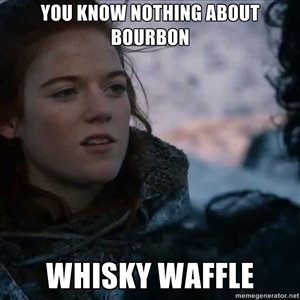
Meme Ygritte

Ok, before you all go on the warpath, we fully admit that we don’t really have a leg to stand our lofty opinions on. We have inadequate, shall we say, ‘practical knowledge’ on the subject. Therefore, we will be embarking on a week long quest to explore the amber offerings of the U.S. of A and educate ourselves about the subtleties of Scotch’s redneck American cousin. And who knows, we may even discover a flavour in there that’s not bourbon.

#AmericanWhiskeyWeek

Glendronach 12 Year Old

Reviewed by: Nick

Glendronach 12 Year Old

Now, be honest with me. Raise your right hand if you have bought, with your own money, in the last six months, a bottle of sherry? Anyone? I thought as much.

The once proud sherry industry is declining slowly, but surely. While on the surface this may not seem to really affect we drinkers of distilled barley, there is, in fact, much cause for concern. Because without sherry, specifically, without the barrels that once contained the stuff, many of the most wonderful whiskies in the world would not exist.

Case in point: the Glendronach 12 Year Old. And it is a great little drop. Vibrant, spicy, balanced and heavily sherried. The latter is not a subjective tasting note. The whisky does indeed possess a highly sherried character because it has been matured in a mixture of Pedro Ximinez and Oloroso sherry barrels.

The flavour this imparts is obvious on the nose in the form of sweet creamy raisin aromas. There is a golden syrup-like quality, too, alongside dried figs and orange peel.

On the palate the flavours are, surprisingly, not as sweet as the nose suggests. However it has a smooth mouth feel and the creaminess is still present. There is a nuttiness about it as well, and more dried fruit with perhaps a touch of glace cherries. Little wonder sherry-matured whiskies are regularly likened to fruitcake.

The finish is short, disappointingly, as up to this point I was immensely enjoying the ride. Wait – there it is, ever so subtly lingering at the back of the throat with the remnants of the grape flavours. I had to go searching for this one, but I found once discovered it glows faintly, like the last few embers of a campfire.

The sweetness of this whisky is nice, although it would probably discourage me from having too many drams of this in the one night. Instead, this is the perfect choice to directly follow a bourbon-aged malt at a tasting, to really show just how radically different sherry matured whisky is.

We may as well enjoy it for the time being. Because as time rolls on there will be fewer and fewer sherry barrels around to put whisky in.

★★★

William Grant & Sons come to Burnie

Posted by: Nick

William Grant & Sons logoI could be forgiven for thinking I’d come along to the ‘Burnie’s Best Beards’ convention, as upon arrival I was met with some of the most impressive facial hair this side of Ulverstone. This could only be a whisky tasting!

But it was no ordinary tasting. We were sampling drams created by the third largest producer of whisky in the world: William Grant & Sons; guided through the evening by Rich Blanchard whose job title literally was ‘Whisky Specialist’. Unfortunately this qualification does not teach him which way round the 1 and the 2 go on the tasting notes, and we discovered that we would be beginning with a 12 year old whisky, not a 21 year old!

Grants in Burnie editied whisky waffle

Rich: “And then you pour it down your throat. I told you this tasting business was easy!”

The tasting consisted of many drops I had sampled before, although never in quite so meticulous an order. Being a Grant’s night we began with the self-proclaimed saviour of single malts: the Glenfiddich. We tasted a range of ages: the famous 12 Year Old (where the pear cliché was immediately rolled out), the 14 Year Old Rich Oak (which, true to its name was distinctly oaky: akin to tasting old furniture), the 15 Year Old Solera Vat (still a favourite) and the 18 Year Old (undoubtedly the smoothest).

We then paused to refill our glasses, and Rich delivered his two minute spiel about how whisky is made – in five minutes. He also told us a little of the history of William Grant, detailing his purchase of stills from Cardhu for his own distillery, which was family built – literally. School holiday projects for the Grant family were a little more serious than building a cubby-house.

Rich then mentioned the mastery of recently retired Grant’s head distiller David Stewart, highly regarded still-man, double-maturation pioneer and generous whisky pourer. I made a metal note to try and meet this man one day.

This brought us nicely to Grant’s other crown jewel: The Balvenie. Again beginning with the 12 Year Old (not the 21) before moving onto the 14 Year Old Caribbean Cask (with no reveal as to the source of the barrels – though we ruled out Cuba!).

The final two drops were undoubtedly the highlights. The 17 Year Old DoubleWood I regard highly, so much so to award it the prestigious ‘Tartan Slipper’ in the 2014 Waffle Awards. Finally was the 15 Year Old Single Barrel: sherry cask. I’d had the bourbon equivalent of this drop before but it had not prepared me for what I found in this one. Could it be… peat?

Rich revealed that, yes, the Balvenie did peat their barley, albeit slightly. It was an intriguing drop and a perfect way to finish the night.

As I left to commence my walk up the hill (always easier after eight drams) I could not help but feel a little bit pleased. A proper whisky tasting in my little home town! A massive thanks must go out to Steve Kons for organising the night and to the people at William Grant & Sons for making the journey to the North West.

Springbank 10 Year Old

Reviewed by: Nick

Springbank 10 Year Old

Welcome to Campbeltown. I shall begin by clarifying to my fellow Tasmanians that I am referring to the town in Scotland, not the eternal toilet stop halfway between Hobart and Burnie.

Campbeltown is located at the tip of the suspiciously shaped Kintyre peninsula in the south of Scotland and was once known as the ‘whisky capital of the world’, being home to as many as twenty-eight distilleries. Sadly (at least for the sailors who make port there) this is comprehensively no longer the case. Several distilleries, however, are still going as strong as ever.

Springbank, Longrow and Hazelburn are all based in Campbeltown. In fact, they are all based at the same distillery. And despite being located at the same premises, all three make many varied and fascinating drams. Longrow whiskies are heavily peated, and often aged in unusual and quirky barrels. Hazelburn whiskies are triple distilled, and as smooth and creamy as their similarly produced Irish counterparts. Springbank, the biggest and most well known of the three, makes whisky with a maritime influence, harking back to drams made in the nineteenth century when the town was in its pomp.

Their entry level is the 10 Year Old and it is a perfect dram to demonstrate what they are about. The nose is oily and buttery with a sweet seaside edge. This is whisky doing salted caramel. There is also the faintest hint of smoke, of course nothing like the Islay peat monsters which linger only a small stretch of water away.

It is bottled at, in my opinion, the optimum level for whisky: 46%, and the slightly higher alcohol percentage gives this whisky a pleasantly light spice across the tongue. The flavour is slightly fishy, and I mean this literally, instead of labelling it ‘suspicious’ (although some people would take this claim to be very suspicious indeed).

The Springbank 10 Year Old has been matured in both ex-bourbon and sherry barrels, and the sherry in particular is notable on the finish where raspberry jam flavours mingle with the slightly smoky notes creating something memorable and completely unique to Campbelltown.

While the flavours in this dram are all fairly gentle and subtle they combine nicely to create a pleasant and easy drinking whisky. It therefore serves as a perfect introduction to the lost whisky region of Campbeltown and to the wonderful drops made there by Springbank and its two sister distilleries. Of course, if the 10 Year Old is a little light and inconsequential for your liking, you could always jump straight to the 15 Year Old – now there is a dram that means proper business…

★★★

Miyagikyo 12 Year Old

Posted by: Ted

Nikka Miyagikyo whisky waffle

More Japanese whisky? Bring it on! For your delectation (or mine rather, seeing as I’m the one drinking it. Go find your own) we have another drop from Nikka, one of the two big players in the Japanese whisky market.

Because Japan is a collection of islands, Nikka and its rival Suntory each own a bunch of distilleries scattered around the archipelago, with each providing its own special character and techniques.

Miyagikyo distillery is based in Sendai on Honshu, the largest of the islands. The distillery was founded by the legendary Japanese whisky maker Masataka Taketsuru. Quite unusually, Miyagikyo apparently makes both single malts and grain whiskies at their site.

The peculiarities don’t stop there. According to Nikka, Miyagikyo uses steam heat distillation to create their product, a process where steam is introduced into the distillation apparatus to carry the volatised compounds into the condensation flask. Whether this changes the flavour in any significant way I will leave up to you.

On the nose the Miyagikyo has that hot and sour Japanese vibe, like honey and lemon tea with a hint of ginger. As it first enters your mouth the spirit is silky smooth, quickly turning dry and dustily spicy. Pepper, caramel, metal, sour plum (which seems to be a common factor in Japanese drams) and lemon drops crawl fuzzily across the tongue. Tartness and sweetness make well balanced bed-fellows.

The Miyagikyo is a very laid back Japanese drop. Probably something best drunk while contemplating the universe in a garden of falling cherry blossom.

Rising Sun spirit/

Tranquil Miyagikyo flows/

The zen of amber/

★★★

The coming of age of a non-whisky drinker

Posted by: our newest guest reviewer Stretch

Stretch whisky waffle

Growing up watching spy movies and idolising heroes like James Bond, I have always thought there was something quintessentially cool about asking for something from the ‘top shelf’. Suavely asking the bartender for just that satisfied the wide-eyed nine year old in me, even if I didn’t know what I was talking about! Such is the reverence that whisky has earned ever since we managed to distil that liquid nectar, and with a little help from popular culture, propel it into the pure essence of class.

As a lesser mortal who does not drink whisky, I have never quite grasped how much was involved with drinking it. Having tried it on a number of occasions over the years, I can say that drinking whisky has never been the most pleasurable of experiences for me. Being first introduced to it as a young lad on a fishing trip with my father, he told me that this was what kept him warm at night. “It’s like a fire in your belly,” he would say, and standing next to him freezing my toes off, it sounded like a pretty good thing he had going on. After burning my throat and recovering from the subsequent coughing fit, I quickly determined that I did not like whisky and would stick to my hot chocolates for keeping warm.

Years later, and after numerous attempts to drink whisky, I still couldn’t acquire the taste. Maturing my taste buds to the refined flavours of (good) coffee, beer, wine and accompanying foods, I had come to appreciate the finer side of life and all it had to offer. Except for whisky. As with everyone, there will always be a flavour to your palate that you will not enjoy. However, as is the case with many things in life, you need to grow accustomed to them and this is how I approached whisky. If I could come to like wine and beer, drinks I detested in the past, then I could like whisky too. With a push from the Whisky Waffle boys, my plan slowly became a reality.

The first step was to work out where I had gone wrong in the past. Drinking cheap run-of-the-mill blends was a likely culprit. Johnny Walker Red, Ballantine’s so-called ‘Finest’ Scotch Whisky or Chivas Regal 12 Year Old didn’t necessarily provide the best starting point for my whisky tastes. Nick and Ted soon solved this. With the two boys being proud Tasmanians, and myself an interstate import, we started with the island’s up-and-coming industry. If you’re going to do something, do it properly and start with the good stuff, something which Lark, Nant and Sullivans Cove offer in droves. The Tasmanian distilleries provided me with a taste I had not experienced before. It still burnt my throat, but it also had a nice after-taste to it. Whisky, which had for so long been terrible, became a little less than terrible. And it was at this point that I decided I no longer hated whisky, I just did not appreciate it enough. With some help from my whisky friends, who knows, in time I too may begin to waffle.

Star rating for whisky in general (★★ 1/2 stars)

Stretch the model

Find out more about Stretch at his bio.

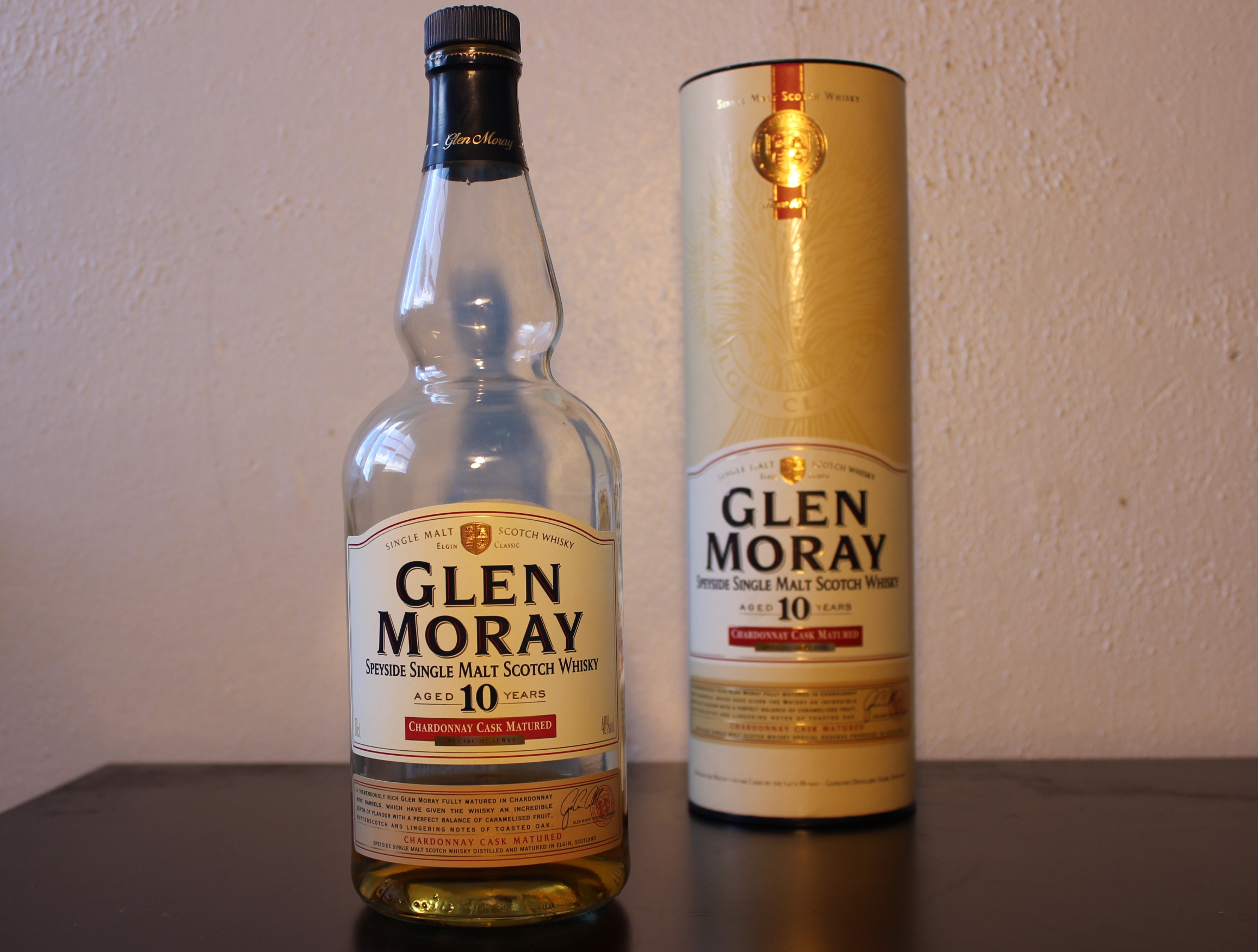
Glen Moray 10 Year Old Chardonnay Cask

Posted by: Nick

Glen Moray 10 Year Old Chardonnay Cask

Finished in ex-Château Rayas casks: sounds impressive. Six years in French Oak Bordeaux wine barrels: sounds fancy. Maturation spent in Margaret River Shiraz casks: ooh I’d like to try me some of that! Ten years in Chardonnay barrels: wow, that sounds… wait did he just say Chardonnay?

When you consider all the premium ex-wine casks left behind by wineries across the world, maturing whisky in humble Chardonnay barrels seems like an incongruous thought. But that’s exactly what Glen Moray have done, producing a dram with flavours which live up to the curious nature of its creation.

The Glen Moray 10 Year Old Chardonnay Cask (or as we Australians at Whisky Waffle chose to label it: ‘Cardy Cask’) spends its entire 10 years of maturation in white wine barrels. And the flavours imparted certainly sets it aside from other Glen Moray expressions.

The first and perhaps biggest clue is on the nose. It is creamy and sweet – more fudge than caramel – and contains a hint of vanilla, giving it the impression of creaming soda. There is also a strong hit of acidity, reminiscent of not so much pineapple, but pineapple cream desserts.

With many drams, it is easy to predict the whisky’s taste after smelling it, but this is not the case with the Chardonnay Cask. The palate is vastly different to the nose; it is darker, with nutty elements immediately present: hazelnuts, pecans, even marzipan. More can be detected when the spirit is swirled in the mouth including notes of honey and a certain degree of woodiness.

The finish packs a surprising punch: sour citrus notes linger well after the liquid is gone, leaving a tangy, spiciness to contemplate.

Glen Moray has long held a reputation for providing reasonable whisky at a more than reasonable price. The Chardonnay Cask is no exception, and while it is easy to drink, it comes with the added bonus of containing many intriguing flavours to muse over. And all of this from a humble ‘Cardy Cask’!

★★★

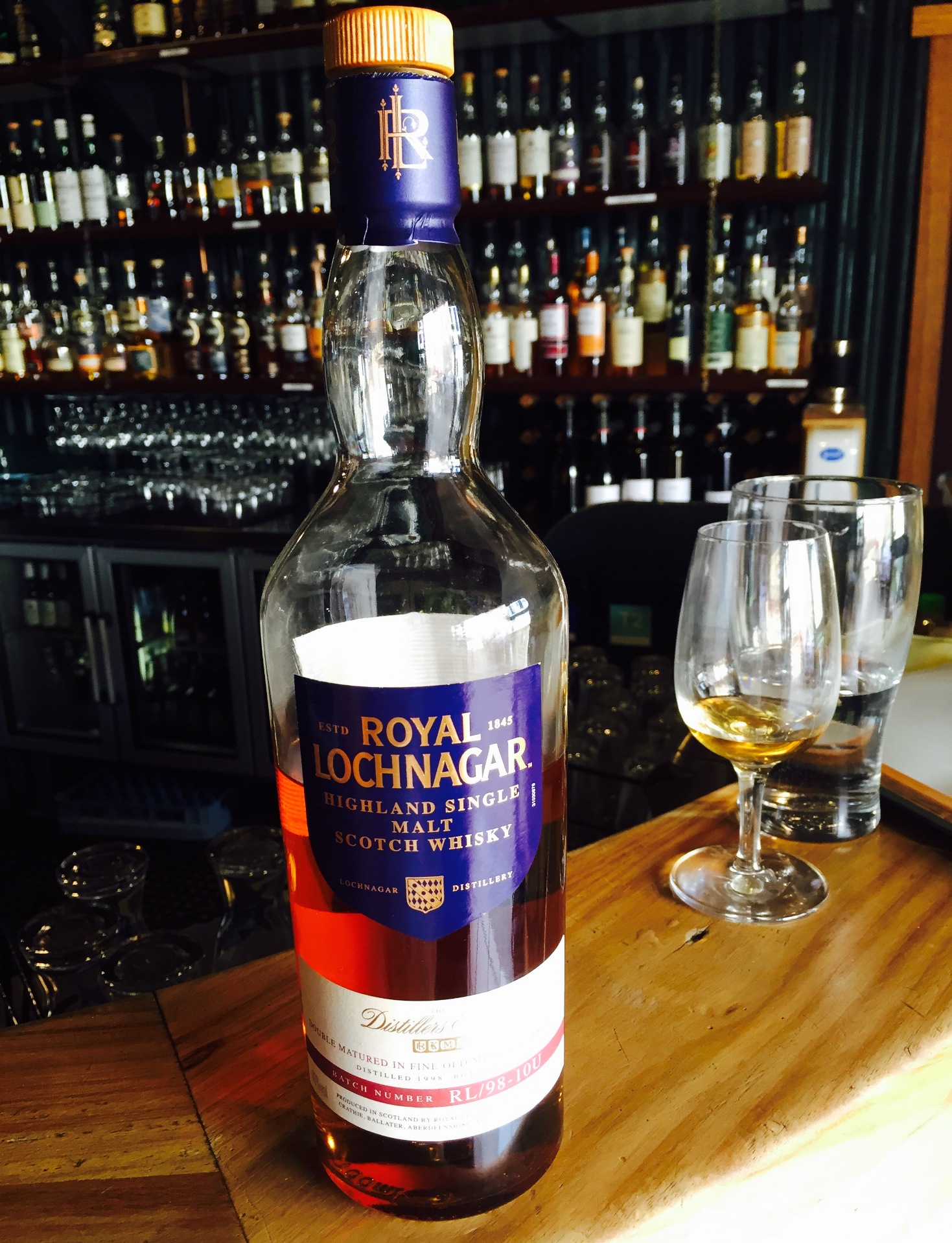
Royal Lochnagar Distillers Edition

Reviewed by: Nick

Royal Lochnagar Distillers Edition

Every now and then what you really look for in a whisky is one that you can drink. I realise that this may sound a ludicrous statement for something which is, undoubtedly, a liquid, but bear with me and I shall explain.

I’m always on the lookout for interesting and unusual new drops to challenge me and set me off waffling about the subtle complexities that can be discovered from dram to dram. However, if every dram I consumed affected me in such a way then, apart from having no friends, I would risk straying too far from the very essence of whisky; that is: it is made to be drunk (with the possible exception of the Macallan Cire Perdue).

With this in mind I believe there is no better candidate for the position of ‘drinkable whisky’ than the Royal Lochangar Distillers Edition. A rather underrated distillery, Lochnagar got it’s ‘Royal’ tag by impressing Queen Victoria on a visit, although the scale of this achievement is questionable as it was reportedly very easy to please Queen Victoria with whisky. Nevertheless the title stuck and it is now the smallest of Diageo’s 28 distilleries.

The Distillers Edition is aged for a period in ex-Muscat casks, adding a layer of silk and sweetness without making it overly-sugary or syrupy. The extra maturation seems to round off some of the sharper edges, making the whisky smoother and easier to drink, though this does not take away from the overall flavour; there are still many appealing elements to discover.

This is immediately apparent on the nose, which is heavy with alluring caramel. Citrus notes follow as well as a dash of rose essence. It has a smooth and creamy mouth feel, retaining the caramel elements and adding flavours of almonds coated in layers of honey and chocolate. There are also the faintest hints of berries to be discovered, lingering in the background. The finish is light and short but the butterscotch theme continues until the end. The overall effect is that of the sauce to sticky date pudding. And those who know me understand what a large compliment I am paying it.

The Royal Lochnagar Distillers Edition is certainly not the most complex or intriguing whisky going around. Nor is it in any way dull. It is a very easy drinking whisky, and this is in no way bad thing. In fact, I believe that it is this dram’s biggest strength.

★★★