Tasting notes

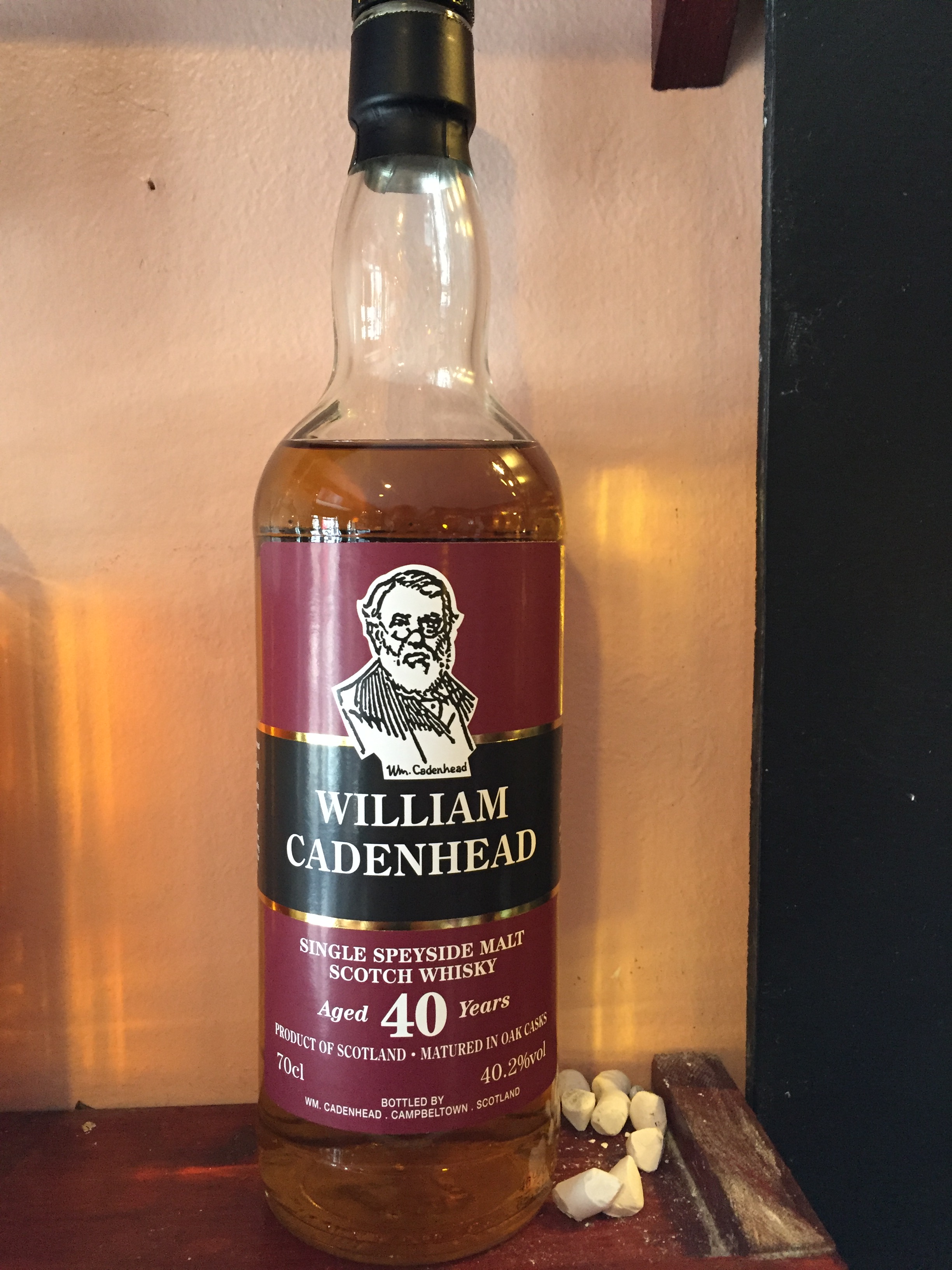
William Cadenhead Single Speyside Malt Scotch Whisky Aged 40 Years

Reviewed by: Ted

William Cadenheads 40 YO

The art of independent bottling is a fascinating one, taking the product of a distillery and aging it oneself in a new and interesting way. If performed successfully, the end product should hark back to it’s origins and yet metamorphose into something beguiling and delightful. A whisky butterfly if you will.

WM Cadenhead Ltd is Scotland’s oldest independent bottler, established in 1842. As such, they have had some time to perfect the art and their releases tend to command considerable respect.

The William Cadenhead Single Speyside Scotch Whisky that I was fortunate enough to try was a mere 40 years old! While the bottle did not reveal the origin of the spirit, I have been told that it allegedly contains spirit from Glenfarclas, a family-owned distillery steeped in tradition.

On the nose the William Cadenhead 40yo is like timber polished to the smoothness of glass using the finest vanilla and caramel scented beeswax.

In the mouth the spirit is what I imagine drinking satin would be like, rippling folds of cool smoothness sliding over the tongue and susurrating down the throat. The flavour is the lightest touch of honey, tree spices and dried fruits.

If you are ever fortunate enough to come across the William Cadenhead 40yo I would highly recommend taking the opportunity to try it. This is independent bottling at its most elegant.

★★★★★

Speyburn 10 Year Old

Reviewed by: Nick

Speyburn 10 year Old

It’s the very end of harvest season here in Tasmania. Fresh produce abounds, from potatoes to pears, onions to oranges, and asparagus to apples: our family-friend farmers’ pickings filling my kitchen with an alluring bouquet. The fresh fruit combines to remind me strongly of the scent of a dram I have recently acquired: the Speyburn 10 Year Old.

“Delicious” I hear you cry “a whisky with all amazing the flavours of harvest time! It must be good.” And it is. But it also isn’t. This is a whisky full of contradictions.

The contradictions start with the distillery itself. Translating literally as “River Spey”, Speyburn identifies as a highland whisky despite being found within a mile of such Speyside giants such as Glen Grant and The Glenrothes. It has received many modern awards, though it’s greatest accomplishment still seems to be being built in the year of Queen Victoria’s Diamond Jubilee. It also, commendably, bucks the NAS trend by releasing a 10 Year Old, a 25 Year Old… and nothing in between.

The harvest fruits are prevalent on the nose. Overripe red apples, peaches and lemons dominate proceedings in a way entirely unsubtle. It’s enjoyable but certainly citrus-heavy. The palate is sweet and malty, like children’s breakfast cereal. There is more lemon here, causing the whisky to veer dangerously towards dish-cleaner territory, though is stopped short by a bitter cooking apple note on the finish.

There are undeniably many enjoyable flavours in the Speyburn 10 Year Old. It’s well worth a try and certainly wonderful value – just don’t expect subtlety to be among its virtues. Rather than a sweet bite of an apple, it is more like the entire orchard has been emptied into your kitchen.

★★

The Bruny Island House of Whisky

Posted by: Nick

Nick and neck

Nick at the Neck: obligatory photo when on Bruny

My home state of Tasmania is rather famous for its natural beauty. From untouched beaches to spectacular mountains, there are some incredible sights to see. Tasmania is also rather famous for being small – however, small is a relative term. It takes the best part of a day to drive from one end of the state to the other and then all you’d see is the boring Midlands Highway (no offence Tunbridge, but you are unquestionably dull).

If you want to see Tasmania in microcosm, the place to do so is Bruny Island in the State’s south. Spanning only 50-odd km north to south, most of the island can be explored in a well-organised long weekend. On such a weekend you will be able to see all that Tasmania is famous for: picturesque coastline, unspoiled wilderness, classy wineries, boutique cheese factories and amazing seafood restaurants. Most importantly however, you will also find a stunning range of locally produced whisky.

Scenic lighthouse

Which Tasmanian whiskies do I refer to? Simple. All of them.

Whisky Waffle at the House of Whisky

If you ever find yourself anywhere near the vicinity, a trip to the Bruny Island House of Whisky is a must. The range of Tassie drams, from the everyday to the ‘impossible-to-find-anywhere-ever’ is astonishing. The knowledge and passion of owner Lee, his family, and his staff is spellbinding. And the choice of just four drams to include in your personal flight is almost too hard. But not so hard I didn’t manage it.

I began with a rare Lark Distillers Edition. For those who haven’t picked up on it, I am of the belief that there is possibly not a more perfect whisky in the world than a Lark Distillers. Although I have to say, the others did their best to challenge this theory. Next was a dram of the Mackey Single Malt, one of Tassie’s new kids on the block in terms of recent releases. Trying this got me well and truly excited to see what is in store for the future of the distillery. Perhaps Whisky Waffle will have to call in there soon.

My Flight

My flight, and Lee’s hair

Next I returned to Lark for a cask strength: this one aged in ex-bourbon barrels, a maturation process I hadn’t tried from Lark before, and it was everything I hoped it would be. Finally, I finished it off with another strong contender for best Tasmanian whisky – heck – best whisky full stop: the Overeem Port Cask cask strength. I rarely get a chance to try this one and loved every morsel in the glass.

To conclude my tasting Lee allowed me a discounted price to try the mysterious ‘Exile’: a cask strength dynamo with a past connected to both Lark and Sullivans Cove, but mostly shrouded in secrecy. It also blew me away – another strong contender for best of the day.

Whisky Wall

This is the smallest of multiple whisky walls…

I left the House of Whisky buzzing – partly because of all the cask strength I’d just knocked back, but mostly because of the warm, welcoming and friendly atmosphere and the enjoyable conversation I had found inside. I was also tempted to march straight back in and try all the wonderful drops I had missed off my flight, such as the powerful Heartwood and the fascinating Trappers Hut. Sadly I had a ferry to catch and needed to leave the tiny model of Tasmania and return to the full-scale version. I think that it’s safe to say that I’ll be back sooner rather than later and once more enjoy the charms (and drams) of island life.

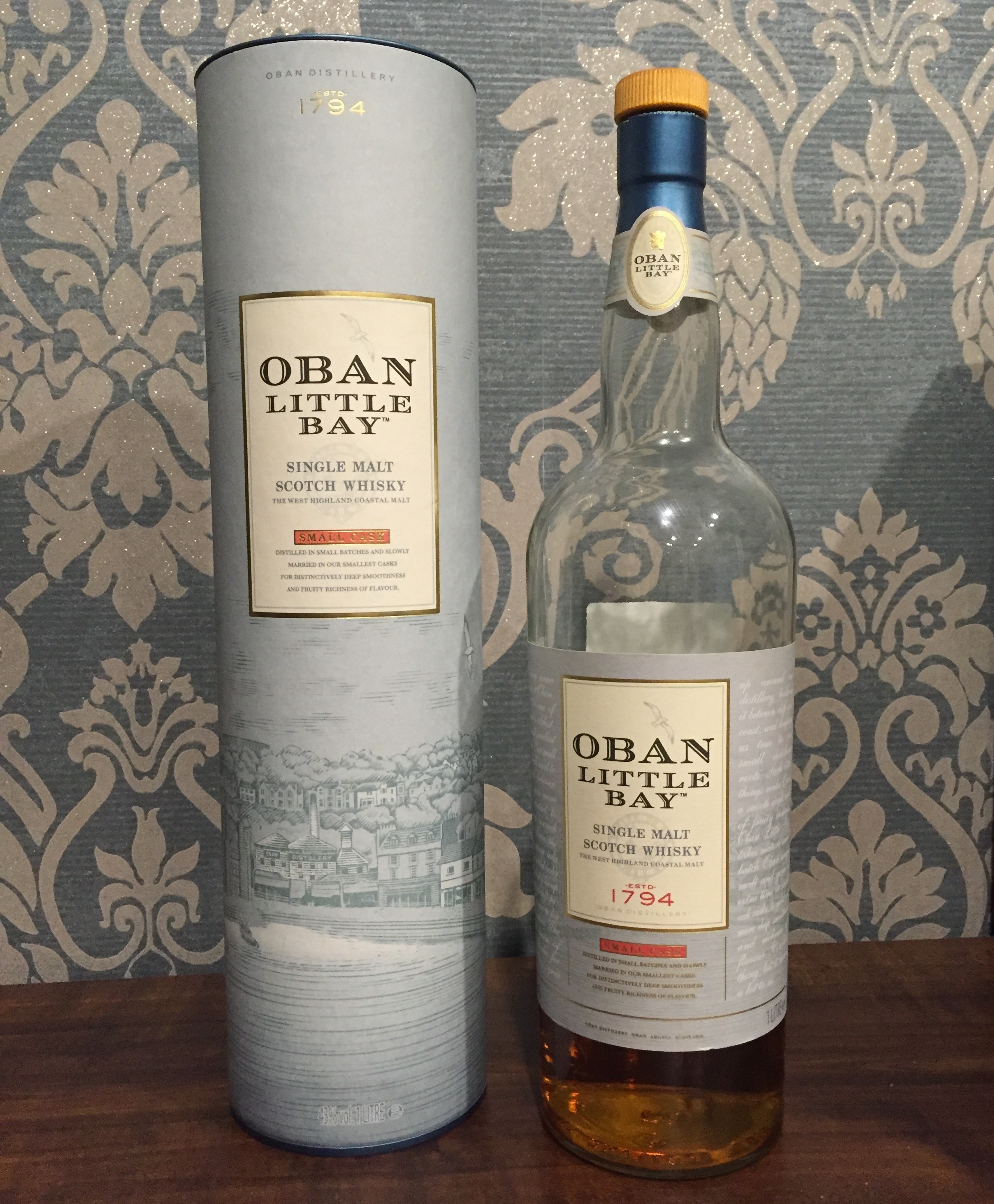
Oban Little Bay

Reviewed by: The Cynical Scot

Oban Little Bay WW

When you only have a little to say about a little dram, make sure the little says a lot. Oban Little Bay is a recent outpouring from a little town on the west coast of Scotland.

Oban claims its little spirit lives within the copper stills, where it rests between batches to help develop the experience. Little oak casks are the next little touch to smooth the draw and build the richness.

On the nose it spins and winks and jigs, while the taste is a warm clear heat; a dancing djinn on the warm moor. Though not smoky, it feels like fire.

This emissary from the little people doesn’t decide whether the spirit is of earth or fire or water, but being from Oban it dances between them all and lives in none. A real genie in a bottle.

★★★

How it compares:

The Little Bay has a youthful, flickery, salty warmth, whereas the 14yo is a sweeter, more complex and refined drop. Even though we would go for the 14yo, the Little Bay has its own magic touch.

Talisker Dark Storm

Reviewed by: Ted

Talisker Dark Storm

Thunder crashed and wind howled across Skye as the Taliskerians prepared to bottle their new whisky, a non-age statement barrelled in extra-heavily charred oak casks. Keith glanced at Nev and shouted over the noise “what do you reckon we should call this stuff?”

“Dunno… Sunny Skyes?”

“Nah, that’s the name of Mark Lochhead’s villa on Majorca. What do you reckon Taranis?”

Taranis, the Celtic god of thunder, had started working at the distillery after a bit of a slump in the smiting business and a failed attempt to break into Hollywood. After a moment’s pause, he reached into Nowhere and pulled out a bronze goblet covered in spoked wheel designs that made the world spin if looked at for too long.

Plunging the goblet into a barrel, he scooped up a god sized dram and breathed deeply of the captured spirit. Rich stewed fruits, heavy spices, grilling meats, chocolate, banana and curling sweet smoke rose up to meet him.

Planting his feet, Taranis took a mighty draw, amber liquid spilling down his braided moustaches. Sharp, crackling salt on burning driftwood burst across his tongue, followed by dark honey and cured meats. Over the top rolled curling smoke, like a forest fire seen on the horizon. The finish was bright, sharp and lingering, yet somehow contained it’s opposite, the void.

Keith and Nev looked at each other nervously. The brooding 8ft tall figure in its leathers and woad was a forbidding sight. Suddenly Taranis stirred, his eyes sparking with distant lightning, and spoke in a voice like far away thunder rolling across the hills:

“DARK STORM”

And so it was.

★★★

Dark Ted

How it compares

The Dark Storm is quite raw and robust compared to the 10yo, which is (slightly surprisingly) smoother and lighter. The Dark Storm makes big leaps and bounds over its other Talisker NAS stablemates, the Storm and the Skye. We’ve had the Storm and found it to be lacking in guts, a bit… bland, and from reports the Skye is even lighter. If you’re looking to try a NAS Talisker, the Dark Storm is definitely the way to go.

Auchentoshan Classic

Reviewed by: Nick

Auchentoshan Classic

If you’re fortunate enough to visit Glasgow (like me) and are somewhat interested in the odd dram (like me) then you simply must pay a visit to Auchentoshan Distillery (like me). The triple distilling Lowlands champions have been producing some lovely drops for a while now and a tour of the establishment that creates them is well worth it. The tour concludes, as all the best do, with a tasting – sampling Auchentoshan’s core range. The 12 Year Old is among those offered, as is the fantastic Three Wood. Up first, however, is the Auchentoshan Classic – a Non Age Statement whisky.

Upon my visit I got the impression that the staff were keen to skip past this one and get stuck into the 12 Year Old – as if they were saying, “but enough of this folly, time for some real whisky”. I mean, admittedly our trusty guide was right – the 12 blows the Classic out of the water. But there’s still something to say for the lowly old (young?) NAS bottle.

The Auchentoshan Classic is lighter in colour than other releases from the distillery and demonstrates very clearly its bourbon maturation. On the nose it is sweet, grassy and with a touch of honey. It is pleasant and summery. The palate is similarly sweet with notes of fruit-based confectionery. I also got the faintest hints of peanut butter, cloves and marmalade. The finish is short but strangely rather fitting for this gentle dram.

This is a feather-light whisky.  A Pinot Noir rather than a Shiraz. But every now and again, that’s alright. Especially if you’re on the distillery tour and the 12 Year Old is up next!

★★

Classic Nick

How it compares:

The 12 Year old is so much more vibrant than the Classic. They are both light and sweet, but the 12 Year old has depths to explore – whereas with the Classic what you see is what you get. The finish is similarly short with both drams – and while this is a disappointment in the 12, the abrupt finish seems to suit the Classic. Still, though, I think I’d rather have the Three Wood.

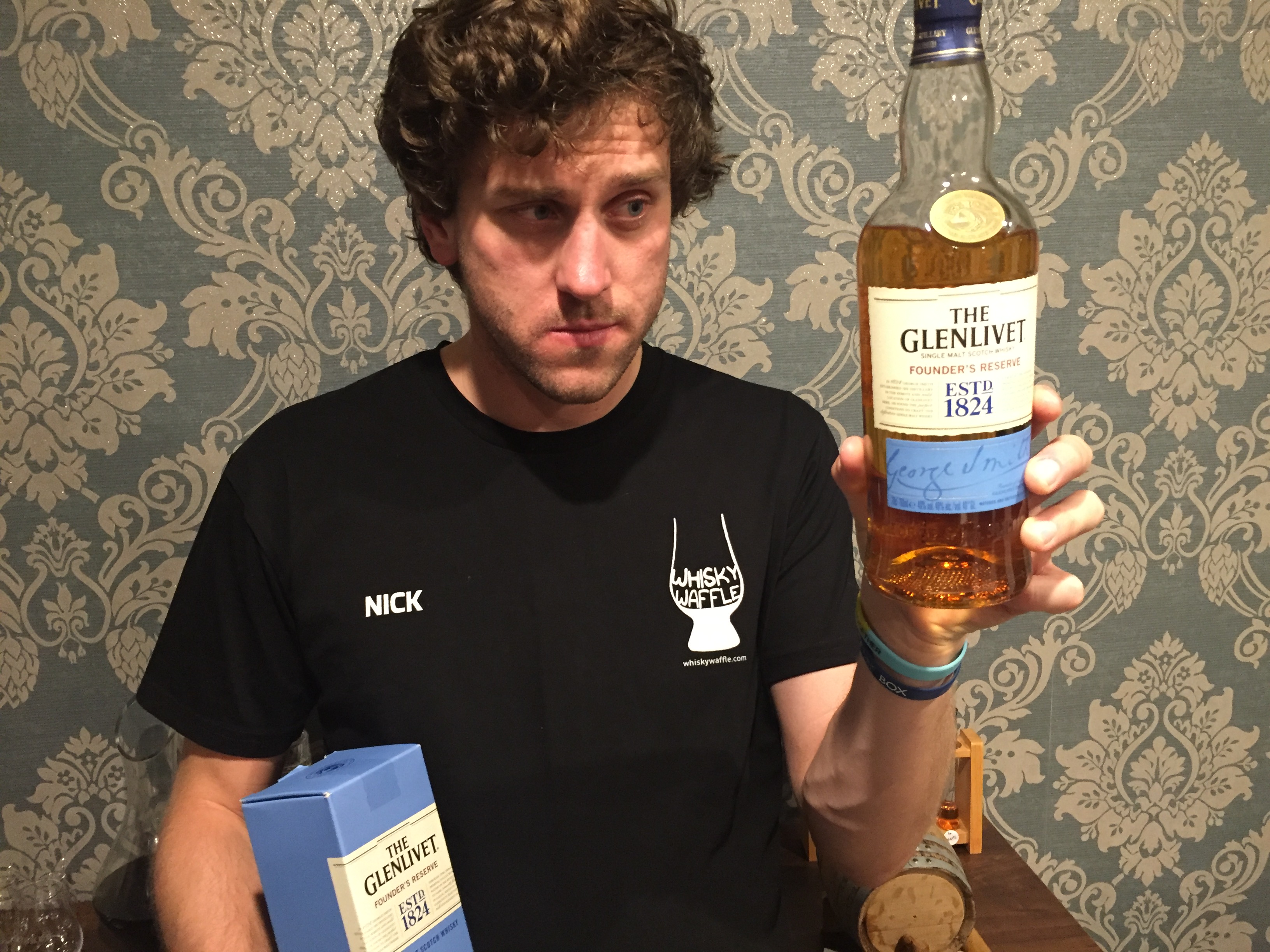
The Glenlivet Founders Reserve

Reviewed by: Nick

Founders Reserve n waffle

In 2015 we farewelled a Whisky Waffle favourite son, the Glenlivet 12. It was there to share the laughs when we held cards nights, to comfort us when we’d had a rough day at work and raised high when we rung in the New Year. Sadly Glenlivet, in their ultimate wisdom, have retired the 12 for the foreseeable future. But fear not – they have introduced a direct(ish) replacement! It comes in shiny blue packaging so it must be good, mustn’t it? Ladies and gentlemen, I present to you the Glenlivet Founders Reserve.

It would be so easy to do a straight comparison of the two whiskies, but I decided to sample the new kid on the block on its own to see how it stood up. It turns out ‘stood up’ was possibly the wrong analogy. Sat down maybe? Perhaps slouched…

On the nose, I found the Founders Reserve has plenty of caramel and some dry malty notes. An acceptable, if not auspicious start. So I took a sip. This turned out to be an error. There’s an unpleasant sweetness in there – a sugary, treacly flavour lacking in any complexity. It’s not bad per se, but there is a distinct manufactured, home-brand quality about it which is hard to enjoy. The finish is warm and spicy, almost tangy on the back of the tongue. Finally there is the merest hint of raisins, a cameo appearance that leaves you wishing there was more to be found.

I cannot say that the Founders Reserve is particularly offensive in its flavour. But I can (and do) claim that it is all a bit bland and inconsequential, bordering on boring, which disappoints me greatly. Glenlivet are truly great makers of Scottish whisky and it saddens me to think that a generation of whisky drinkers will discover the distillery via this disappointing bottle.

★★

Nick and the Glenlivet Founders Reserve

How it compares:

Without doubt there are similarities in flavour between the Founders Reserve and the 12 Year Old – they are both obvious Speysiders full of caramel and honey. But the 12 Year Old has so much more going on than the NAS bottle. There are subtle complexities to be found throughout the 12 which the Founders lacks. The Founders Reserve is the Coke Zero to the 12’s Coca-Cola.

No Age No Good? Whisky Waffle launch NAS Week

Posted by: Nick

Wafflers in smoking jackets

Some may argue that our attire is the greater controversy here…

A controversial topic? Surely we don’t do that here at Whisky Waffle! Well, just this once, we thought we’d take things seriously and leave our flippancy behind.

Sort of…

Today’s discussion is about non-age statement, or NAS, whisky. For non-whisky geeks, NAS whisky is a bottling that cannot be described as a 12 Year Old, or a 10 Year Old, or an anything-year old, because there is younger spirit mixed through like a very whisky-flavoured cocktail.

These NASes are borne out of necessity: since us Wafflers discovered the stuff, there just hasn’t been enough of it around! So rather than waiting the usual 12 years, distillers have been getting impatient and slapping 9 year old, 8 year old (3 year old?) spirit into the mix and coming up with impressive sounding Gaelic names to go on the label.

So how do we feel about this situation? Is the stuff as NASty as it sounds? Well, to be honest, I have no problem with the concept of NAS whisky. I mean, you just can’t deride the Talisker Storm as liquid Nickleback while simultaneously proclaiming the Ardbeg Uigeadail as the solution for world peace. So just like any supposedly ‘superior’ whisky with a number on the bottle, there are good ones and there are bad.

Founders Reserve n waffle

But seriously, the box IS rather pretty…

Which brings me neatly to Glenlivet – a prominent convert to the NAS fad. I wrote a glowing review about their ever-dependable 12 Year Old and described how its accessibility was its strength. That was, until it was no longer accessible. In its place, in a blue box (which is sadly not bigger on the inside) came the sophisticated-sounding ‘Founders Reserve’. I was slightly concerned – though this disquiet came from my affection towards the 12 rather than my automatic dismissal of anything ageless. I was perfectly fine so long as it tasted good. Which, I’ve recently discovered, it doesn’t.

It’s not that the dram is comparable to the toxic output of a nuclear reactor. It’s quite drinkable in a ‘at-least-it’s-not-red-label’ sorta way. But it doesn’t stand up to the depth and character of the previous entry-level incumbent. And this made me both sad and rush out to get a bottle of the 12 while I still could.

Non age statement whisky is not the scourge of the earth that many flat cap-wearing whisky reviewers may have you believe. There are some tasty drops out there that would please the most snobbiest of whisky snobs (if you told them it was an old bottle of Macallan). However, in the case of Glenlivet, where you can directly compare the old and the NASish new – it’s one nil to the age statements.

Of course, another way of looking at it is that after eight drams, it doesn’t really matter how long it’s been in a wooden barrel for…

The writing of this article prompted a lively debate among the Whisky Waffle boys – so much so, that they decided to spend a week looking at some prominent NAS releases to see if they are as derisory as their reputation suggests. So with great excitement – we present to you NAS-Week! Make sure you pay a few visits throughout the week and find out our thoughts – or post some juicy trolling comments! Tomorrow will kick off proceedings with a detailed review of this article’s nemesis: the Founders Reserve! But why start there? Leave us a comment telling us EXACTLY how you feel about non age statement whisky in the replies!

#NASweek
Oban 14 Year Old

Reviewed by: Ted

Oban 14

Rather like the wild haggis (Haggis scotticus), Oban distillery is a curious wee beastie. Located on the craggy west coast of Scotland in the town of the same name, Oban is one of the oldest distilleries in the country, founded in 1794 on the site of an old brewery by brothers John and Hugh Stevenson. Interestingly however, despite its lengthy existence it has remained one of the smallest distilleries around, with only two pot stills in residence to make the good stuff.

Understandably, the limited production capacity has focused the Oban distillers, choosing to craft a few expressions rather than the seemingly endless releases pedalled by larger producers. Luckily this means that the Obanites have had plenty of time to refine and tinker with their creations.

Oban’s flagship dram is one that should pique the curiosity of any whisky fiend looking for something a little different. Eschewing usual ageing lengths, the Oban 14yo, part of Diageo’s “Classic Malts Selection”, exploits an interesting niche between youth and maturity, and it must be noted, at a price on par (at least in Australia) with many 12yo whiskies.

The character of the 14yo walks a fine line, balanced as it is between the highlands to the east and the islands to the west. A careful nosing reveals a light, sweet, dusty spirit with suggestions of damsons and green apples, giving it a sense of kinship with other highland drops such as Dalwhinnie.

The taste on the other hand speaks of its seaside home, beginning with a bright, slightly salty burst on the front of the palate, lifted by the 43% strength, followed by a hint of seaweed and coastal air. The mid palate smooths out and becomes much more rounded, with dried fruits, zest, spices and perhaps just the lightest hint of smoke. The finish is clean and doesn’t linger for too long.

Once you’ve knocked back a few sips of the 14yo it’s worth holding the glass up to the light and contemplating the colour, which should be a dark amber. The reason I make mention of this is that the 14yo is not aged in the sherry casks that the colour suggests, but rather ex-bourbon hogsheads.

The answer to this conundrum will cause some to shrug their shoulders unconcernedly and others to foam at the mouth in righteous indignation: caramel e150a. Why Oban chooses to use artificial colouring, while other premium distilleries go to great pains to point out that they keep their own products au naturale, is a secret known only to the Obanites. Whether or not it’s presence affects the flavour of the 14yo I will leave up to your own distinguished palates, fellow wafflers.

The small size of Oban definitely works in its favour, allowing it time to lovingly craft a quirky and interesting product that does not hurt the wallet too much. The 14yo is certainly a delightful and evocative drop; and unlike the pesky wild haggis, is relatively easy to track down for those curious to discover the ‘west highland’ flavour.

★★★

Great Outback Rare Old Australian Single Malt

Reviewed by: Mooresy

Great Outback Rare Old

This is weird story worthy of a waffle. Australian whisky has a generally agreed history, the modern chapter of which begins in the 1980s with the Lark family overturning a century and a half of legislative prohibition on distilling in Tasmania. This led to a resurgence of distillers and, as a very appropriate homage to whisky’s very beginnings, some people who had no doubt been fooling around as bootleggers went legitimate. The Great Outback Rare Old Australian Single Malt – a mouthful of descriptors, almost as if someone took all the best buzzwords that make whisky seem exclusive and put them all into the name – is a mystery in that history.

From what I can gather from my Poirot-esque deductions is that it was distilled somewhere between 1960 and 1985, that it is either from a now forgotten Tasmanian still (the bottle indicates it was produced at the Tasman Distillery, which no-one can find) or a Western Australian still pretending to be Tasmanian, and that it is pretty rare. Some rumours include that it is the reject stock of the closed Corio Distillery or that it is not Australian and was just labelled that way to hide an origin that would have been less palatable. It is a confirmed fact, however, that this single malt has a blended variety that can still be found so maybe these rumours of reject stock and foreign distillation are accurate for the blended version.

Something that is more than rumour is that this whisky is actually very good. With a label that looks like a knock-off product sold by some people who’ve refilled an empty bottle with some water and caramel colour, it is about as far from that as you can imagine. The colour is a nice pale gold suggesting there is a straight bourbon cask maturation and on the nose I think that is correct but there is also a vivid complexity I was not expecting. It’s fresh and grassy, with a little toffee and vanilla, but also a lovely tropical fruit and pineapple citrus alongside an orange smell that is actually reminiscent of Lark. Not only that, but there are some interesting botanicals with fresh thyme and something peppery thrown into the mix.

The other brilliant thing about it, which transfers over to the palate, is it is devoid of the ethanol kick that can permeate and drown out the subtleties. The relatively low alcohol content helps this, but it is also just a very clean and crisp spirit. There is certainly some tropical fruit – brilliant passion fruit – and the malty vanilla really comes out to balance against the toasted oak flavours. It is unsurprising that it is not peated, as this was presumably created before peat bogs were officially uncovered in Tasmania or peated barley was imported. Or before peat even existed anywhere in the world, who knows.

This is not a whisky for people who are looking for a heavy hitter, a peaty belter, or an oak punch. It is certainly not for anyone who wants to be able to sit down with book and look up the dram as they drink it. This one for those who like a crisp and complex confectioner’s creation with a side of Conan-Doyle intrigue to keep them guessing.

If you are the distiller of this fine drop, get in touch. Partly because there are several questions I have for you, but mainly because I am hoping you still have a few bottles of the stuff kicking around the attic you might be willing to offload.

★★★★