Australia

Delving into Dark Valley: the launch of Tassie’s latest dram

Posted by: Nick

nick-and-dark-valley

Independent bottling in Tasmania is a relatively rare thing. Sure, there’s the mighty Heartwood leading the way and a few others coming on board, but by and large, it’s an unexplored market. One person who realised this a long time ago is whisky fanatic and Whisky Waffle guest contributor, Alex ‘Moorsey’ Moores. Despite maintaining a fledgling full-time career in law, he has achieved what most whisky lovers can only dream about – he has created his own whisky: Dark Valley.

mooresy-and-dark-valley

Dark Valley was named after the area of Hobart in which Alex grew up, Glen Dhu. While the temptation was there to name his drams simply ‘Glen Dhu’, being a qualified solicitor he was aware of the legal dangers of such a Scottish sounding name. He instead opted to translate the Gaelic into English and name his bottles ‘Dark Valley’, setting the tone for the gothic labels and imagination-stirring individual release titles such as ‘Raven’s Roost’ and ‘Hunter’s Keep’. Importantly for Alex, he did not wish to tinker in any way with the whisky – he wanted to showcase it in as close to its natural form as possible. This meant no diluting, no blending, no finishing and no filtering. His aim was to create a whisky that was the next best thing to getting it straight from a barrel.

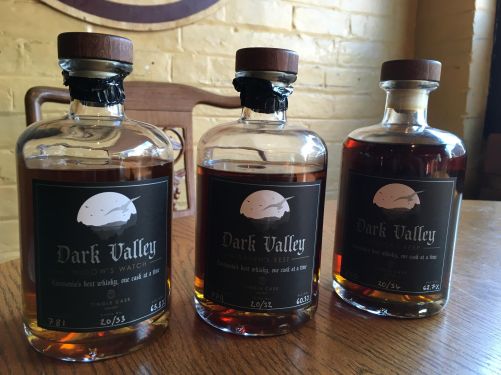
While the first releases from Dark Valley feature whisky distilled at Lark Distillery, it is Alex’s hope that one day all Tasmanian distilleries will contribute spirit for his range. He already has Redlands on board and northern-Tassie’s new boys Adams are next on the list. For now though, there are three different bottlings in existence, all of which I was lucky enough to try at Dark Valley’s Hobart launch.
dark-valley

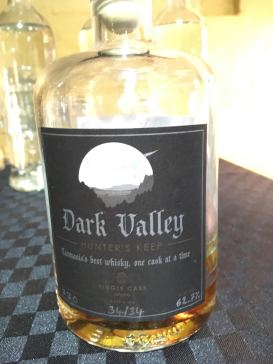
The first I tried was the 60.3% sherry matured ‘Raven’s Rest’. My initial reaction was “Yes. Yes yes yes. Yes. Yes.” It was like cooking raspberry jam – so warm and fruity. Next up was the ‘Widow’s Watch’ – bourbon matured and 65.8%, it was full of vanilla and baked goods. I decided on cupcakes, with orange icing and poppy seeds.  Finally was the port matured 62.7% ‘Hunter’s Keep’, and it was my favourite of the lot. It combined the flavours of the other two beautifully while adding hints of cinnamon and nutmeg, creating an effect I described as ‘mulled whisky’. It was superb.

The drawbacks of setting up a new whisky brand is, of course, the cost. Dark Valley will certainly not be going into mass-production any time soon. In fact, these releases came from tiny 20 litre casks, meaning just over 30 bottles of each were made. However, this doesn’t mean you’re unlikely ever to see sight nor sound or them. Alex’s very firm goal is to get Dark Valley into whisky bars – and not into the hands of collectors. He intends to get his product into various establishments in Melbourne and Tasmania, with a few in Hobart showing some interest after the successful launch. In the coming months, if you happen to be near a whisky bar in any of these locations, ask after Dark Valley, because once people discover how good it is it’s not going to last long.
dark-valley-bottle

Finally, on a more personal note, I’d just like to offer my sincerest congratulations to Alex for achieving the spectacular feat of getting his whisky to bottling stage. Moorsey is a genuinely top bloke and I know he’ll be another wonderful torchbearer for Tasmanian whisky.

Welcome to the Southern Wild

Posted by: Nick and Ted

1-southern-wild-whisky-waffle

Yes, Ted hit his thumb with a hammer

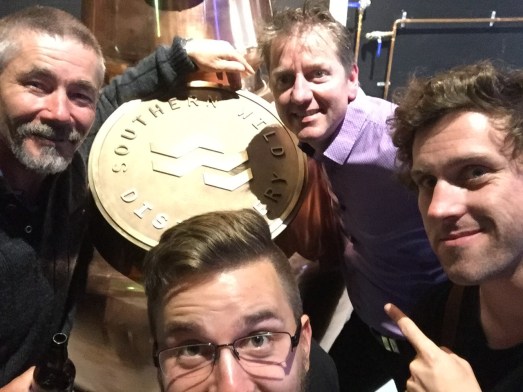
Compared to the glut of distilleries in the Southern region of Tasmania, the North West has been fairly light-on for dram making. To be accurate, hitherto there has actually been just the one producer (although they make up for that by being the largest in the Southern Hemisphere). Thankfully, that paucity is set to change with the opening of a new kid on the block – say hello to Southern Wild distillery.

Based in Devonport, Southern Wild is the brainchild and consuming passion of one George Burgess. We first met George at a dinner in 2014 where he confided to us his dream of establishing a distillery in his home town and “teaming up with other passionate specialist Tasmanian producers to create small batch varieties of unique hand-crafted and seasonal/rare finest quality distilled spirits and liqueurs”. Our response was ‘nice one, it’s good to have dreams’, but boy has he really followed through with that threat!

2-george-souther-wild-whisky-waffle

George: one day this will be whisky!

A food technician by trade, George has already spent years developing the skills and know-how that has allowed him to dive deep into the world of distilling. He loves discovering new ingredients for his gin-making and tinkering about with different flavours and scents. In fact, the name Southern Wild was inspired by the raw natural beauty of the places he finds some of his botanicals. “I’ll be going down some rough bush track, no phone signal and a nagging feeling of lurking cannibals. Suddenly the bush will clear and you’ll find yourself in this beautiful location encircled by nature and meet the most friendly, down-to-earth folk tending this amazing locally-grown produce.”

Formerly known as Devonport Distillery, Southern Wild has moved about a bit over the years – and its shiny new venue is not even its final location! Devonport has been going through a bit of an identity crisis of late which has led to the creation of what is known as the ‘Living City’ project. In a nutshell, this venture aims to knock down chunks of an inefficient and spread out CBD and rebuild them with a focus on fresh local produce, performing arts spaces and, eventually, a foreshore precinct. The former will be housed in a glamourous farmers market known as Providore Place, with small pods for local producers such as Southern Wild Distillery to sell their wares. A brand new building will be created for the distilling as the current home is a converted loading bay at the back of the council building – however we must admit, for a loading bay it scrubs up rather nicely.

4a-southern-wild-whisky-waffle

Stills and suspended plants make for the best distilleries

The room is dominated by the shiny new still, while a gleaming bar is a hive of activity with recently hired bar staff making fancy cocktails. Overlooking the entire room is a mezzanine with space for a band to play – a highlight for George when he first sighted it, telling us his response was “you had me at mezzanine”. Behind the music/hangout area is what looks like a mad scientist’s laboratory, but in reality is the space where George creates and tinkers with his product.

While there are currently a few barrels maturing several intriguing varieties of what will one day be called whisky, George unfortunately doesn’t have any ready yet. Instead he is focusing on what is truly his pet project: his gin. Ever since we’ve known him, George has been raving about his passion for gin and now he’s created not one, but three, each uniquely Tasmanian. Named ‘Dasher & Fisher’ after the two rivers which flow into Devonport’s own waterway, the Mersey, he has created ‘Mountain’ gin, richly flavoured by Tasmanian pepperberries, ‘Meadow’ gin, containing a strong hint of lavender and ‘Ocean’ gin, intriguingly salty with notes of wakame seaweed. While Ted loved the London dry style of the Mountain, Nick was more into the coastal aromas of the Ocean.

5-dasher-n-fisher-whisky-waffle

The Ocean gin, surrounded by its botanicals

While this is only the beginning for Southern Wild, it certainly has a bright future ahead of it. It will be fascinating to watch the evolution of the distillery as it transitions from its temporary residence to its permanent home and the inspiration that provides George in his creations. And of course, being Whisky Waffle, we are particularly looking forward to the moment when we can share a dram. From the sneak peak we’ve had though, we are confident that Southern Wild will be releasing whisky that truly speaks for the place it was made, just as its maker intended.

6a-southern-wild-stillmaker-whisky-waffle

The still-maker, the still-man, and two idiots who are still waffling

The Pot Still Exclusive Invergordon 26 Year Old Single Grain Whisky

Reviewed by: Ted

invergordon-26

It’s very rare that I come across a whisky distilled in the year of my birth; usually they seem to fall either side of it. While that’s probably just me not looking in the right places, it’s definitely rare that the dram in question is a single grain scotch whisky.

Lesson time: Single malt scotch whisky can be made using only malted barley, whereas grain whiskies (like it says on the tin) can be made using other grains, such as wheat, and can be malted or unmalted. You don’t generally tend to see single grain whiskies on their own in the wild because their normal purpose in life is to form the base of blended scotch whisky.

Alongside the prestigious single malt producers are a multitude of unsung distilleries pumping out grain whisky for use in your Johnnie Walkers and Dewars’ and the like. Case in point: Who’s heard of Invergordon? Nope, me neither, but turns out they’re a thing.

I actually came across this bottle while I was in an excellent Glaswegian bar called ‘The Pot Still’ (up the end of the mall if you want to find it). While chatting to the barman I challenged him to pour me something unusual, and so he did.

Produced at Invergordon as an exclusive bottling for the Pot Still (in celebration of something or other I think. I forget what) this particular bottle was distilled on the 3rd of March 1988 and aged for a rather astonishing 26 years in cask# 24975 (no idea what, but from the colour I’m guessing an ex-bourbon).

Bottled at a hearty 53.7%, the nose of the Invergordon is vibrant and zesty, zinging with lemon, pineapple, pine resin and wood polish. Underneath the initial sharpness sits a smoother, rounded layer of pear, plum, apricot, dates and nuttiness. Finally, gliding out underneath is a waft of vanilla.

The first mouthful hits hot and sharp, with more lemon and pineapple, and then slides down your throat with a burning coolness like you’ve just had a strong mint. A second attempt, giving more time to develop in the mouth, finds toffee, green wood and a bitter, grassy, herbal finish.

I am sorry (not sorry) to say that you are probably highly unlikely to find a bottle of this anywhere. I only happened to stumble across mine because I was in the right place at the right time and the barman still had a small stash behind the bar that he was willing to part with.

If you do have a bottle, or are in the Pot Still and they’ve got some left, well done you, you’re part of an exclusive club. As for the rest of you great and unwashed masses, I think that this serves as a reminder not to discount the humble grain whisky. While they don’t get the same love as their single malt cousins, with a bit of age they can hold their own any day.

★★★

Heartwood Convict Resurrection

Reviewed by: Nick

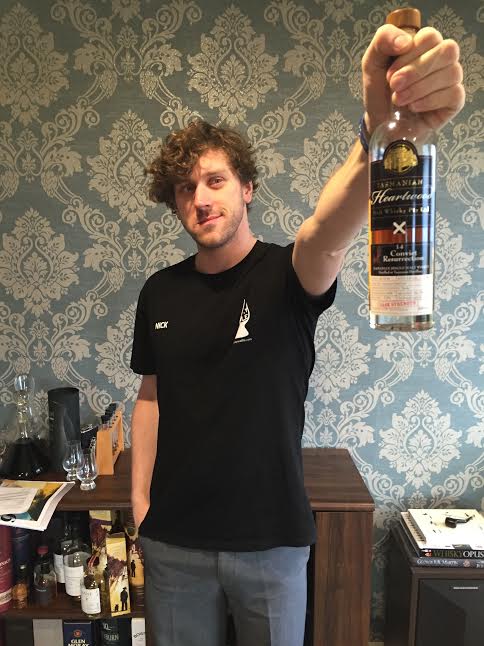
Heartwood Convict Resurrection

In Scotland, independent bottling of whisky is commonplace. Companies such as Gordon & MacPhail, Berry Brothers & Rudd, Flora & Fauna – basically anything with an ‘&’ in it – run successful businesses and produce some fine drams. In Tassie, well, it’s a little rarer. While Trappers Hut and Tasmanian Independent Bottlers are coming along nicely, there’s one name leading the way: Heartwood.

Heartwood was created by Tasmania’s own mad scientist of whisky, Tim Duckett, whom I imagine spends his days bent over a steaming cauldron of luminous Tasmanian whisky, stirring it with a wooden oar and chanting “double double toil and trouble”.

If you’ve ever come across a bottle of Heartwood, you’ll attest that it was unquestionably a memorable drop. There’s certainly a lot to remember, from the wonderful designs on the labels to the distinctive names: ‘Vat Out of Hell’, ‘Release the beast’ and ‘Any Port in a Storm’ to name a few. However, the most memorable aspect of any Heartwood bottling – by far – is the strength. The ABV of all releases ranges from percentages in the mid 60s to percentages in the mid 70s. That’s right – mid 70s!!!

The bottle I decided to purchase sits at an eye watering 72% and is called the ‘Convict Resurrection’, part of a series of convict-inspired bottlings referring to Tasmania’s original function as a penal colony. The whisky comes from Sullivans Cove barrel HH0239, which was an American oak ex-port cask. And boy, is it something.

Every aspect of this whisky is massive. The nose hits you like a boxing glove wielded by Sugar Ray Leonard, teeming with creamy fruit flavours like plum jam spread on rich brie. As is to be expected, the palate also packs a punch – taking a sip is like wrestling a crocodile – and yet there are so many flavours to be found: raisins, nutmeg, pinecones and blackberries – perhaps with the thorns still attached!

The finish is the most surprising element of the whole dram as it is incredibly smooth. It seems to evaporate at the back of your throat, leaving the most glorious lingering warmth with notes of jam and honey.

If you ever see a nip of Heartwood available anywhere – don’t think – just buy it. Sure, it’ll be pricey, but only 200 or so of each bottle is made and once they’re gone, they’re actually gone. Heartwood fans don’t buy the stuff to leave it sitting on a shelf.

Seriously, try it if you can. I promise it will be memorable – in the best possible way.

★★★★★

Heartwood n Nick

Tasmanian whisky: One state. Three ingredients. Unlimited flavour.

#TasWhiskyWeek

Belgrove Brown Rye

Reviewed by: Ted

Belgrove Brown RyeEverybody knows by now that Tasmania is a hub of whisky revolution. Ever since the resurrection of the industry in the 90’s, things have been taking off quicker than an alka-seltzer bottle rocket. So how do you innovate in a young industry that’s already innovating its socks off? Rye thought you’d never ask…

Founded by Peter Bignell, a man often described as a Da Vinci of distilling (well, he definitely is now), Belgrove Distillery is located just outside Kempton in the southern Midlands of Tasmania. DIY, organic and hand-made sums up Belgrove’s vibe, with Pete quite literally crafting everything from the ground up, including the stills, barrels, biodiesel (made from left-over chip oil from the local take-away and used to power the stills) and of course the grain used in the whisky itself.

The grain is where Belgrove really makes its point of difference from all the other Tasmanian distillers. Why use boring old barley when you can use rye instead, organically grown on-site? After growing a bumper crop of the stuff on the farm in 2008 (a favourite grain of the Canadian distillers but not used in Tassie), Pete was apparently inspired to turn it into whisky. Being a extraordinarily talented and driven individual, one thing led to another and here we are today.

Belgrove now produces a number of different 100% rye drops, including white rye, black rye, peated rye and of course, the subject of this review, the brown rye.

The nose of the brown rye is dark and fruity, full of ripe apple, plum and apricot. It rather reminds me of the scent of the bowl of home-made preserved stewed fruit my grandma always used to keep in her kitchen cupboard, a very fond memory. Alongside the fruit is rose petals, custard and an undertone of dull metal, like drinking from a rough copper mug.

The taste is quite different to the flavour complex produced by the nose. Although its body initially starts off fruity, it immediately transmogrifies into deep earthy, ashy flavours, like smouldering rye stubble in a paddock or curling incense smoke in a gypsy tent. The finish is slightly bitter and astringent but very satisfying, like having a cup of black tea after a sweet dessert.

Everything you thought you knew about Tasmanian whisky goes out the window when you try the Belgrove brown rye. It’s like learning to drink whisky all over again, an exciting time full of power and emotion. It is a spirit that resonates powerfully with the creative, hands-on ethos of its maker. If you want to try something different, yet still uniquely Tasmanian, then the rye of Belgrove awaits you.

★★★

Belgrove Brown Rye

Tasmanian whisky: One state. Three ingredients. Unlimited flavour.

#TasWhiskyWeek

Nant Sherry Wood 43%

Reviewed by: Nick

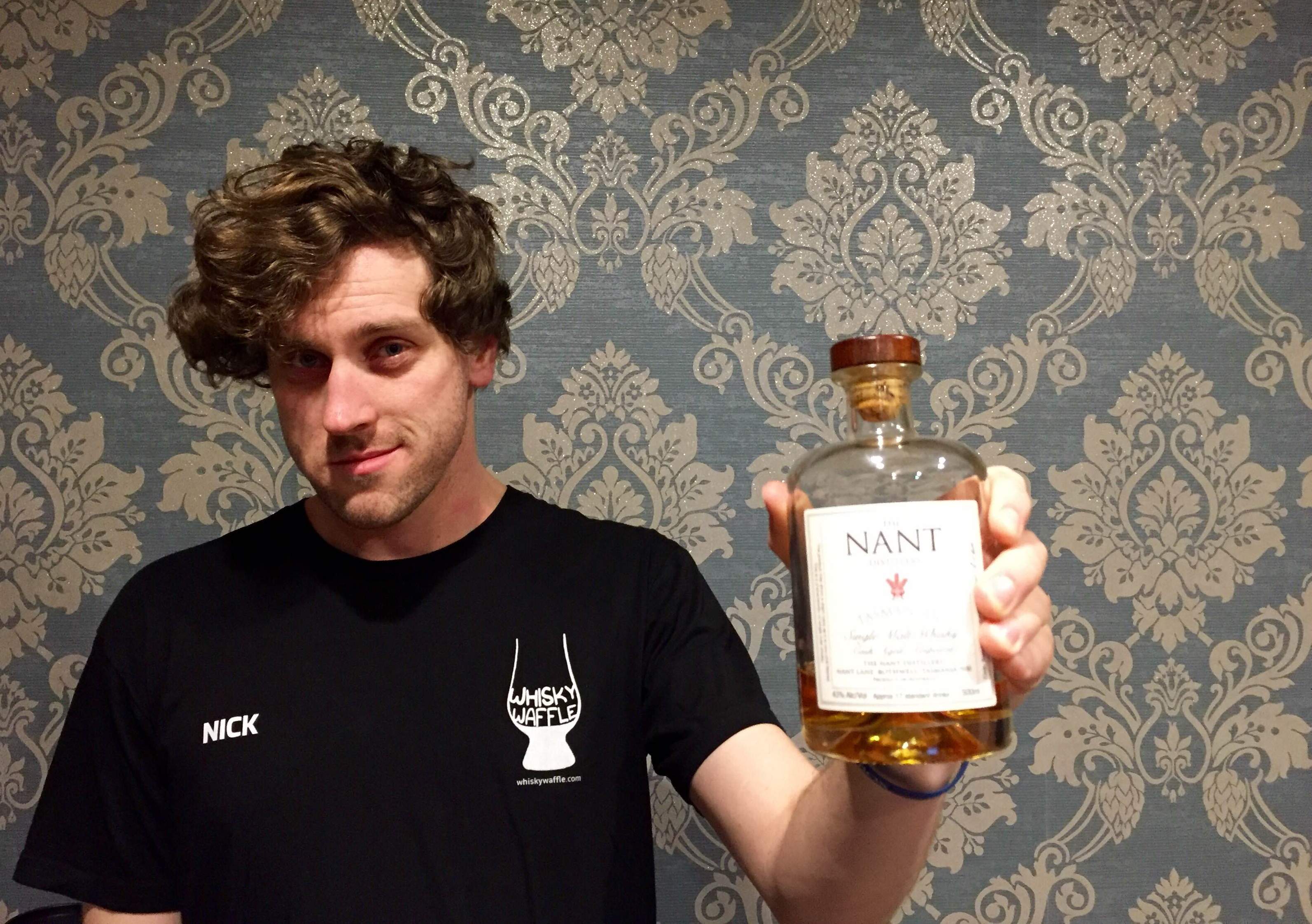
Nant Sherry Wood 43%

I imagine the founding of Nant distillery by Brisbane businessman Keith Batt, went something like this:


“What do you want for your birthday this year, honey?” asked Mrs Keith. Keith thought for a moment.

“I’m torn between a Caribbean island, a bar-franchise and a horse,” he replied, not a drop of irony on his face.

“A horse?” replied Mrs Keith, “where on earth would you put one of those?”

“Well obviously I’ll need to invest in some property to store it in – preferably somewhere exotic and remote.”

“How about Peru? Then I can get a Llama!”

“Yeah, I’m not so keen on the ponchos or  folk music. Tell you what, how about we stick the horse in some old paddock in Tasmania and I’ll also get the bar-franchise?”

“Alright, fine. But you may need to think of something to do with the property down in Tassie.”

“Oh, don’t worry about that. I’ll just stick in a whisky distillery and sit around fixing an old water mill until Jim Murray arrives.”


Of course I unquestionably make light of the momentous decision to build Nant Distillery up in the highlands of Tasmania – an establishment which I can confidently state is the most scenic of all Tasmanian distilleries. And as much as I can mock Nant’s business-like set up, I cannot downplay the excellence of its whiskies.

One of my favourite Tassie drops is the Nant Port Wood, a fantastic representation of the Tasmanian flavour, and the cask strength version of the Bourbon Wood is one of Tasmania’s finest whisky accomplishments. They also release a Sherry Wood and it is this expression I review today.

The nose is drier and earthier than any other Nant release. There are elements of vanilla, figs and golden syrup, but this is matched by moss and spicy oak. The palate is equally contrasting with notes of toffee, raspberry jam and plenty more oak, while mingling in the medium long finish are herbs and you guess it: oak, It all combines to form an intriguing and challenging Tasmanian whisky.
While I couldn’t claim this to be my favourite Nant expression, it’s certainly an interesting drop and one that I would never describe as boring. It forms an integral part of an increasingly impressive Nant back-catalogue. I guess then, it was well worth Keith Batt getting that horse!

★★★

Nant n Nick

Tasmanian whisky: One state. Three ingredients. Unlimited flavour.

#TasWhiskyWeek

Hellyers Road Peated

Reviewed by: Ted

Hellyers Road Peated

So, you’re a big fan of peated Scottish single malts, but in order to save the world from certain destruction (just go with it, ok?) you have to buy a Tasmanian whisky. What are you going to do? Never fear, Hellyers Road has your peat needs covered with their appropriately named Peated expression

When it comes to peated whisky in Tasmania, the situation is a little more complex than first meets the eye. Tasmania actually has its own peat bogs, however the smoke is quite different to the Scottish stuff, being softer, gentler and more rounded. It is also restricted to a few distilleries that own leases to the bogs (the rest is locked up in national parks and the like).

In Hellyers Road’s case they don’t have access to a native bog, so instead they import peated barley all the way from maltings in Inverness, Scotland. The side-effect of this is that Hellyers Road Peated is much more closely aligned to Scottish drams than other Tasmanian malts (side note: Hellyers Road use local grown barley for their non-peated expressions).

Nosing the Peated expression is like standing in a grain storehouse, grabbing a big handful of peat-smoked barley and taking a deep sniff. Underneath the big, fat, bold, smoky cereal flavours can be found cocoa, black currants, pencil shavings and smouldering leaves.

The first layer of taste is what you would probably expect from a heavily peated whisky – strong, thick smoke that billows around the mouth, a bit like standing on the wrong side of the campfire. When you clear away the smoke however, you are left with a light, smooth and slightly sweet dram, without too much else going on. The finish is long and smoky, but gentle. In fact, the smoke probably rounds out the feel of the dram as a whole, smoothing out some of the harsher edges that can be found in a younger whisky such as this.

When compared to a traditional Islay single malt like Laphroaig or Ardbeg, the Hellyers Road Peated perhaps misses some of the strong coastal flavours that punch through from underneath, but makes it up in other areas. A light whisky, heavily peated, this Hellyers Road expression delivers a different experience to anything else available from Tasmania.

★★★

HR n Ted

Tasmanian whisky: One state. Three ingredients. Unlimited flavour.

#TasWhiskyWeek

Lark Classic Cask

Reviewed by: Nick and Ted

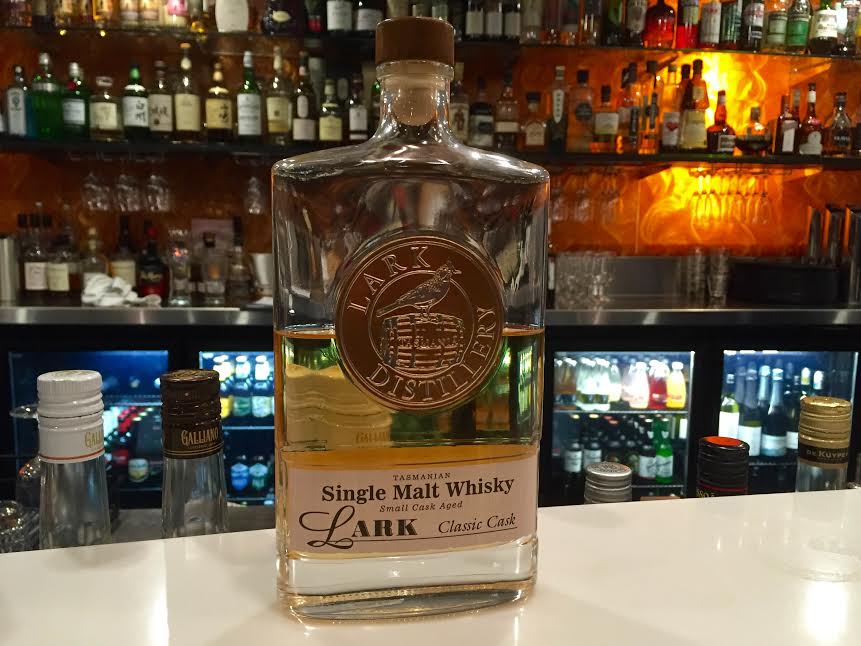
Lark Classic Cask

It all started, as the best stories do, with a fishing trip. While waiting for some prime trout to bite in the Tasmanian Highlands, a man had an epiphany that would change the course of history.

The man reasoned that Tasmania has pure water, excellent barley and native peat bogs, so why then was no one making world class whisky there? That man’s name was Bill Lark and today he is revered as the godfather of Tasmanian whisky.

While Tasmania is now world famous for its whisky, the road was not an easy one. A ban on small-scale distilling had been in place for over 150 years, but that didn’t stop Bill from convincing politicians to overturn the law (presumably over a dram or two). Once the path was clear, Bill’s wife Lyn bought an antique 4 litre copper pot still and together they founded Australia’s first modern whisky distillery, the eponymous Lark.

While Bill has taken a step back from distilling duties, he remains to this day a champion of Tasmanian whisky. In 2015 he was justly recognised for his efforts by being inducted into the prestigious Whisky Magazine Hall of Fame, the first Australian distiller to achieve the honour.

Lark Distillery releases a range of products, including an excellent cask strength, a phenomenal distiller’s selection, epic special editions and of course, not forgetting their standard release, the Classic Cask.

If you know anything about Lark, you know that oranges is what it is all about and this becomes apparent as soon as you take a nose of the Classic Cask. The sweet citrus flavour blends with rich dark chocolate and vanilla, like a gourmet dessert in a glass. The chocolate comes to the fore on the palate, a mixture of milk and dark, followed by delicate oak, pepper and almond praline. The finish is medium length and slightly nutty.

Tasmania has waited a very long time to be able to drink this whisky. We will be forever grateful to Bill Lark for having the foresight and courage to take a step into the unknown and found a movement that is now respected and celebrated world wide.

Cheers Bill!

★★★

Lark n Ted

One state. Three ingredients. Unlimited flavour.

#TasWhiskyWeek

Tasmania and Whisky Waffle launch Tasmanian Whisky Week

Posted by: Nick

It seems we Wafflers are not the only ones who love Tasmanian Whisky! We reported recently that Whisky Live is coming to Tasmania for the first time. But, why stop there? The Tasmanian whisky community has decided to crash the party and create the inaugural Tasmanian Whisky Week.

TWW Logo

While we say ‘week’, it will in fact last for nine days between Friday July 22 and Sunday July 31 and will feature a number of industry events at Tasmanian distilleries, bars, restaurants – even barns! Throughout the week a number of distilleries will open their doors to host tours, rare whisky tastings, gourmet meals and more. You’d better hurry, though – tickets are selling fast!

Of course, Whisky Waffle will also be taking part in this week of festivities. Throughout the seven days leading up to Whisky Live we will be releasing a series of articles and reviews celebrating some of our favourite Tassie drops. Even if you are from another part of the world, log on to Whisky Waffle throughout the week to celebrate along with us.

Hellyers Road Whisky Waffle

Two Hellyers Road Whisky Walks for the price of one!

Among the many events taking place are exclusive tours of Lark, Overeem, Sullivans Cove and Hellyers Road, or a combination of the above, with Drink Tasmania.

For something more extravagant why not check out the whisky and cheese afternoon at Redlands, a whisky and food matching masterclass at Launceston Distillery, or the Shene Estate after dark tour.

Mackey Shene photo Paul County

Mackey AND Shene Estate! Wait… they’re the same thing? Picture courtesy of Paul County Photography

Perhaps you’re after something a little stronger, such as trying a range of amazing Heartwood products – or maybe you’d like to try some boilermakers with Belgrove’s Pete Bignell and his son, brewer Tom Bignell. Nant are not missing out either, hosting a meet-the-distiller two course lunch.

For those looking for something even more special, there is the Founders Dinner, a three course meal complete with rare Tasmanian whiskies and four of the most important men in the business: Bill Lark, Casey Overeem, Patrick Maguire (Sullivans Cove) and Mark Littler (Hellyers Road). If you have a little more time and money, there is the option of a two day jaunt around the Tasmanian highlands, visiting multiple distilleries and the very location of Bill Lark’s epiphany.

Drink Tas tour

Brett Steel, Pete Bignell and some happy whisky drinkers on a Drinks Tas tour

Finally, there is Whisky Live, the catalyst of the week and a compulsory visit for fans of Tasmanian and Scottish whisky alike.

It’s going to be a huge week. Our only regret is not being able to attend each and every event. One thing is for sure however – when it comes to Tasmanian whisky, there is a lot worth celebrating!

Wafflers and Brett

Cheers Brett! Tas Whisky Week. Let’s do this!

Timboon Single Malt Whisky

Reviewed by: Nick and Ted

Timboon port front

Back in the early 1800’s Scottish whisky was forced, kicking and screaming, to go straight. Distillers were required to become legal or shut down, formally founding many of the grand old distilleries we see today. In comparison, Australia had to wait another 150 years for legalisation to occur, resulting in many heroic folkloric moonshiners keeping local spirits up.

One such rapscallion was Tom Delaney, a notorious bootleg distiller of the Timboon region of Victoria, who made a dram locally known as ‘Mountain Dew’. Fast forward 100 years and small scale distilling in Australia is now legal, and Tom’s legend has not been forgotten.

Based in an old railway shed, Timboon Distillery draws inspiration from the whisky making heritage of the region, creating a range of distilled products, chief amongst them being their Single Malt Whisky. Matured in small ex-port barrels, this young whisky is a distinctive Aussie drop.

On the nose the Single Malt has notes of vanilla and caramel, mixed with the more unusual flavours of blue heaven and mint-chocolate. Perhaps this is not so surprising, seeing as Timboon was founded by the owners of an ice cream company.

The minty flavour continues on the palate, along with polished timber, red currant and spiced plums. The mid-palate is smooth and then suddenly goes missing for a moment, before revealing a spicy, slightly metallic finish.

While this may not the most balanced whisky Australia has to offer, there are definitely some intriguing flavours to be found. We are sure that Tom would be proud to know that his distilling legacy lives on and look forward to future releases from Timboon Distillery.

★★