bourbon

The 25 days of Aussie whisky – Day 7: Bladnoch 10yo 46.7%

Posted by: Ted

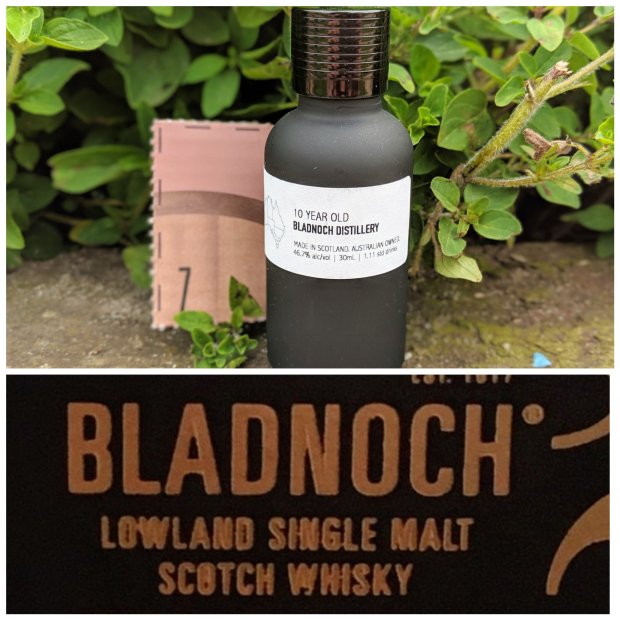
On the seventh day of Christmas my true love gave to me… a glass of Bladnoch 10yo Scotch whisky. Wait a minute, Scotch? Huh? Ok, so this one fudges the brief a bit, but it works if you squint your eyes. Founded back in 1847, Bladnoch is the southernmost Scottish distillery (not quite as far as Australia though) and one of only six remaining in the Scottish lowlands. After going into liquidation in 2014, it was purchased the following year by Australian businessman David Prior, who renewed and expanded the brand.

The 10yo is a release of older, pre-takeover stock aged exclusively in ex-bourbon casks. The nose has a distinct note of canteloupe and boiled caramel sweets, while the mouth is light and sharply sweet with a finish of spice, wood and grain. Technically, I suppose you could call the Bladnoch the only true ‘Australian made’ Scotch whisky. Worth a try if you like your drams sweet and light.

#whitepossumspirits

The 25 days of Aussie whisky – day 5: Limeburners Port Cask 43%

Posted by: Ted

On the fifth day of Christmas my true love gave to me… a glass of Limeburners Port Cask whisky. Crafted by Great Southern Distilling Co. at their Albany distillery in Western Australia (they also have a site in Porongurup that makes Tiger Snake Sour Mash Whiskey), the Limeburners takes its name from the nearby convict-built kilns that provided building lime during colonial times.

This particular Limeburners edition starts off life in ex-bourbon American oak barrels before being transferred to Australian port casks for finishing. The nose has a funky ripe banana in caramel sauce vibe going on, while the mouth feel is dry and hot, with an alcholic spiced plum finish. The Port Cask would make a great accompaniment to a platter of fine local produce while camping on the beautiful southern coast of WA.

#whitepossumspirits

The 25 days of Aussie Whisky – Day 4: 23rd Street Distillery Hybrid Whisk(e)y 42.3%

Posted by: Ted

On the fourth day of Christmas my true love gave to me… a glass of 23rd Street Distillery Hybrid Whisk(e)y. Australians love the whole fusion cuisine thing and this old world-meets-new world-meets-even newer world blend is no exception. The mad tinkerers at 23rd Street take 5yo-ish Scotch whisky from Scotland and splice it together with 2yo-ish bourbon whiskey from America (hence ‘whisk(e)y’) and then finish it off in ex-bourbon casks at their digs in South Australia.

The Hybrid lives up to the whole Jekyll and Hyde vibe, with the Scotch and bourbon both playing off each other. The nose is light and sharp, with competing woody, floral and fruity notes, while the palate starts off smooth and honeyed before developing into a hot, sweet, bright and lingering finish. The Hybrid is proof that the antipodes are still the real wild west (south?) of whisky and (nearly) anything goes.


#whitepossumspirits

The 25 days of Aussie whisky – Day 1: Upshot Whiskey 43%

Posted by: Ted

On the first day of Christmas my true love gave to me… a glass of Upshot Whiskey. Made practically on the other side of the world in Western Australia by the funky folks at Whipper Snapper Distillery (they once created a quinoa whiskey just for fun), the Upshot Whiskey gets that extra ‘e’ because it’s essentially Aussie ‘Bourbon’.

Scratch out the corresponding section in the booklet to reveal some fun facts about each dram.

Using a mash bill of WA-grown corn, wheat and malted barley and aged for at least two years in heavily charred American oak, the Upshot cranks up the vanilla and caramel on the nose, while the palate sports tannins, cereal and hot steel. Park a deckchair on Cottesloe Beach on a scorching WA summer’s day and wriggle your toes in the sand while you relax with a dram of Upshot.

#whitepossumspirits

Launceston Distillery Land Their First Release

Posted by: Ted

LaunnieLogo

The old Ansett Hangar 17 at Launceston airport looked almost exactly the same as it had the last time I had visited a couple of years ago. The only real sign of time progressing was a new opaque glass and aluminium door grafted into the old corrugated iron wall, bearing the crest of Launceston Distillery, and a sandwich board in front of it declaring the place to be ‘open’.

Hangar17

Hangar 17, the home of Launceston Distillery

After crossing the threshold I was warmly greeted by distillery Director Chris Byrne, who commented “hopefully my sign holds up against the wind, I’ve given it a bit of angle, but we’ll see.” (It had disappeared by the time I left). Nestled in the foyer were a couple of old airline seats. I asked if they were Ansett, but Chris shook his head and replied “We had an old bloke drop in and say the pattern was 1960’s Qantas. It’s definitely from back then anyway, just look at the ashtrays.” [Correction: the guy who sold the seats to the distillery has been in touch and they are definitely Ansett. He said he will be having stern words with Chris about listening to old blokes who walk in off the street]. We grabbed a cup of tea to ward against the cold, pausing a moment to admire the whiteboard still bearing operational notes left after Ansett collapsed in 2001, and then wandered out for a look at the distillery.

QantasChairs

Sorry Ansett diehards, these are just scummy old 60’s Qantas seats… Plot twist! Turns out they are actually Ansett and the old bloke didn’t know what he was talking about!

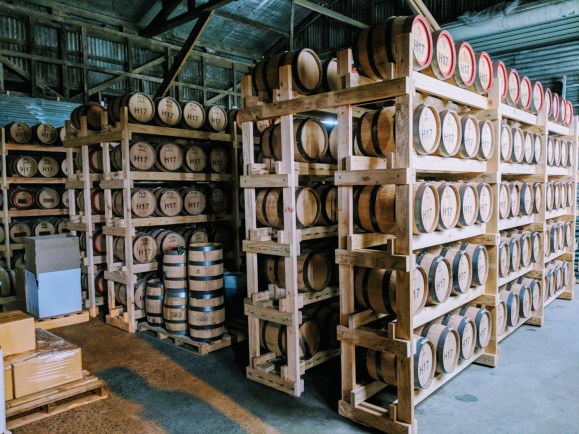
The main hangar, once used to house aircraft, was as large as ever, but the floor space had diminished significantly since last time thanks to the appearance of several rows of 100L casks. Chris grinned at the sight and commented that “the original bond store off the side is full of 20L casks now, so we had to expand out here. We’re hoping that we have enough 20L casks stored now to get us through to when we start releasing our 100L’s in a few years time.”

LaunnieHistory

The history of Hangar 17 on display

Sitting next to the stacks was a board covered in posters documenting the history of the site, which Chris was more than happy to explain. During the lesson he pointed at the numbers and lines on the floor: “See those there? That’s where they used to line up the luggage crates. Apparently one was pushed into the wall by accident, but because they hadn’t secured it down when they extended the shed, the whole bottom of the wall got pushed out. We had to pull it back in with a ute when we were doing the place up.”
Hanagar 17 3

Phwoar, check out the insulation on those

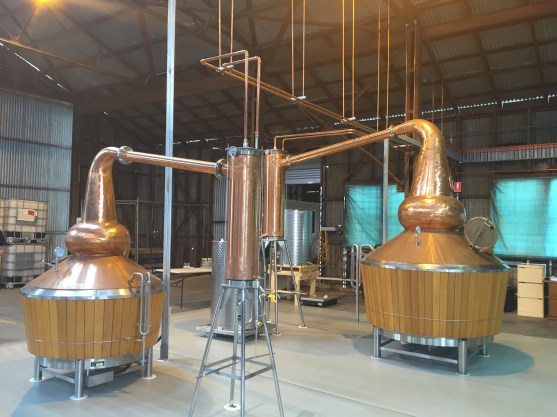
Eventually we wandered over for a look at the bond store, passing by the two Knapp-Lewer stills with their beautiful timber insulation. Last time I had seen the bond store there had only been a solitary row of casks huddled forlornly against the wall, but now the room was full to the brim of neatly racked 20L casks. While we were admiring the view, head distiller Chris Condon and Angus the distillery dog returned from the airport terminal, where they had just delivered the first order of whisky to the airport shop. “They’ve got some good advertising up, so hopefully people stop and pick up a bottle.”

AngusAnsett

Angus the distillery dog travels in style

Chris B handed me over to Chris C and we made a beeline for the tasting bar, built from an old Ansett check-in desk and an in-flight drinks trolley, for a chat and some cheeky bevvies. The most notable feature of the bar was the row of bottles perched on top, thanks to Launceston Distillery releasing their first whisky just last month, a milestone that was very pleasing to Chris: “One of the problems with distilling is that because it takes so long to get to that first release, it can sometimes feel like you’re not making any progress, so it’s great to finally have something to show for all our hard work!”
LaunnieBond

20L nirvana

The bottles on offer covered the first four batches laid down by the distillery, with each batch released as a marriage of 20L casks bottled at a standard 46% abv. Batch 1, the first edition, was an ex-Apera (the Australian version of sherry) casking, Batch 2 was an ex-tawny (Australian port) casking, Batch 3 was another Apera, although apparently with a different character to Batch 1 as the casks had been sourced from SA Cooperage rather than the Tas Cask Co, and finally Batch 4 was an ex-bourbon casking.

LaunnieBatches

L-R: Batch 1 (ex-Apera), Batch 2 (ex-Tawny), Batch 3 (ex-Apera), Batch 4 (ex-Bourbon)

On the nose Batch 4 was light, crisp and grainy, with notes of fresh apples and green grapes. In contrast, Batch 1 was sweet, sticky and rich, with dried fruits, orange syrup, red jubes and undertones of malt, wood shavings and bacon. Batch 2 was dark, with red berries, leather, wax, timber and a clean oiliness.

On tasting, Batch 4 was sharp and bright on the mouth, with acidic herbal notes and a clean finish. In complete contrast, Batch 1 was like an explosion from the aromatic end of the spice rack, with strong flavours of aniseed, cinnamon, cloves and star anise, as well as almonds, milk chocolate, mandarins and a tanninic finish. Finally, Batch 2 was dark, rich and sweet, with notes of dark chocolate and black cherries and a smooth, oaky finish.

Chris revealed that each batch was just over two years old and I asked whether he had toyed with the idea of leaving them longer under oak: “We didn’t just dump them out arbitrarily at two years obviously, it’s more considered that, but you start getting to a point where you have to ask yourself, ‘Am I doing more harm than good for the sake of a few months?’. That’s the tricky thing about 20L casks, there’s a real risk of over-oaking.”

LaunnieTasting

Head Distiller Chris Condon rocks the Ansett memorabilia

Chris was also keen to show me the boxes that had been designed for the bottles and explained the relevance of each design element: “The colour is actually the Ansett blue, while the clouds are from a photo taken of the sky above the airport. If you look closely, you can also see lines running across the box which are actually from an 1830 map of the region. All the surrounding towns and landmarks are there, which really grounds it in this place.”

AngusAuthor

The author and Angus relax before the flight

After the tasting, I had a quick relax on some genuine Ansett airline seats with Angus the distillery dog (“Judging by the condition, we don’t think they were ever installed in a plane,” commented Chris), said a quick farewell to Chris B who was finishing labeling the last of the personalised pre-order bottles that had been offered as part of the 1st release and collected my own bottle of Batch 1 from Chris C.

LaunnieLabels

Chris Byrne, hand-labelling master

Before I left, I had one last question on my mind. Last time Whisky Waffle visited, the distillery team had been tossing up names for the whisky. At that time ‘Hangar 17’ had been a strong contender in tribute to the building that housed their distillery, so I asked Chris what had changed: “We ending up going that way in part because there was a legal issue with Hangar 1 in San Francisco, who are vodka makers and objected to us using the name. I’m actually really pleased that we went with Launceston Distillery though, because that’s who and what we are. It’s a really strong geographic name that people can connect with.”

He paused a moment then laughed and quipped “At the end of the day, Hangar 17 is still our physical address, so they can’t take that away from us. We’ll see how we go.” Well readers, if the quality of the whisky is anything to go by, then it’s no hard stretch to say that Launceston Distillery will go far.

Head over to the Launceston Distillery website to purchase a bottle or organise a tour: https://www.launcestondistillery.com.au/
The Devil Went Down to Moonah: Devil’s Distillery Releases Hobart Whisky

Posted by: Ted

Strolling past the shabby brick warehouse on the outskirts of central Hobart, glancing briefly at the fading letters on the wall declaring ‘Tasmanian Egg Farms’, you would be forgiven for thinking that it was just another derelict industrial site. However, the warm scent of malt drifting out of the rear loading dock and along the street suggests all may not be as it seems. Spirits lurk inside… Devilry is afoot in Moonah.

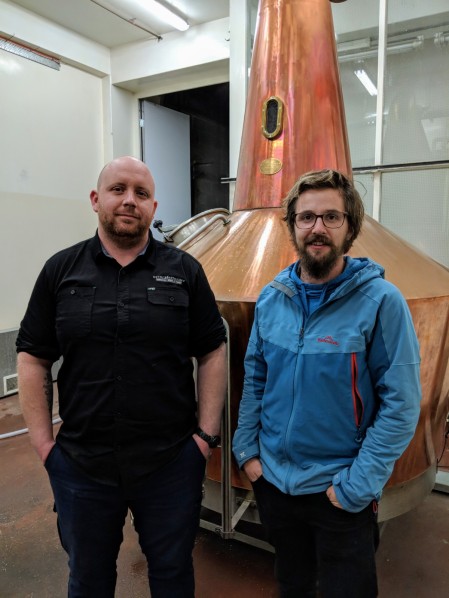
I recently had the opportunity to drop by Devil’s Distillery and catch up with manager John Jarvis. We had last met in my home stomping ground of Burnie at an event showcasing their Tasmanian Moonshine Company brand. Mutterings of nearly mature whisky had reached my ears and piqued my curiosity. Now, like a member of Mystery, Inc., I had the chance to enter the Devil’s lair and unmask the truth.

Devil bond

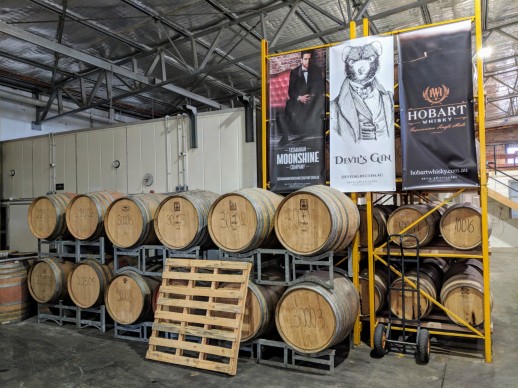
Hungarian origin barrels resting in the Devil’s Distillery bond store

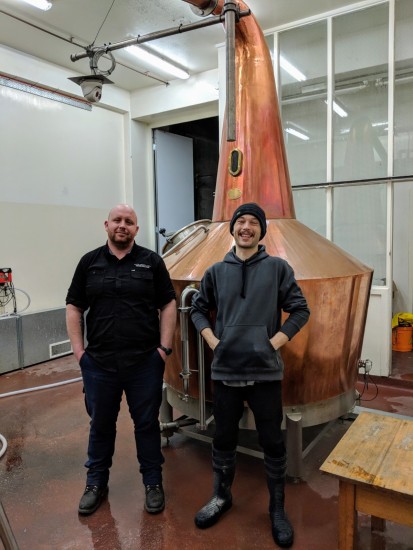
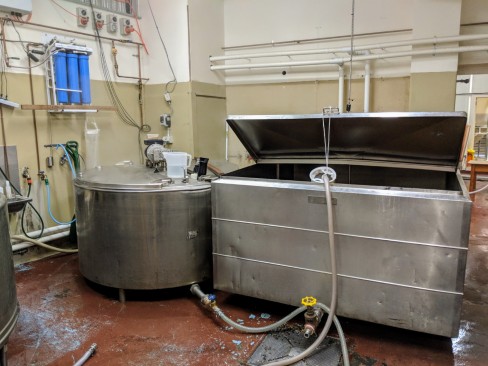
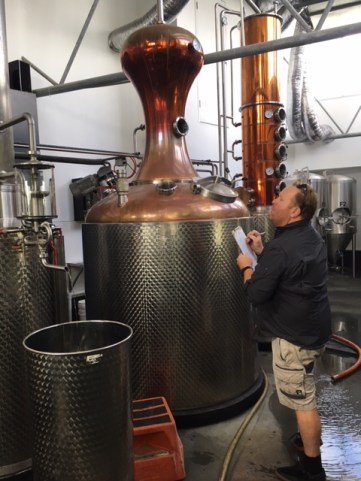
Hidden inside the old warehouse is a burnished copper Knapp-Lewer pot still, a squat stainless Coffey still, some wash tuns made out of re-purposed milk vats and a small trove of casks nestled on brand new yellow pallet racking. Tending to the equipment are minions Ben and Gus. “Sorry about the chaos,” comments John “We’ve been sorting things out and doing some renovation.”
“It was worse when we didn’t have the racking,” chips in Gus “there were pallets of barrels stacked randomly all over the place.”

Devil distillers

John and Gus 

The barrels in question are a combination of 20L, 40L, 100L and 300L casks. Some are sourced from Australia, others interestingly hail from Hungary, but all will be left to rest until the contents have transmuted into whisky. John enjoys experimenting with the different cask types they have amassed, including port, sherry, bourbon, tokay and pinot. “Every release will be different. I’m still learning, but that’s all part of the challenge and it’s good fun being able to sit down and figure out what works best for a particular release.”

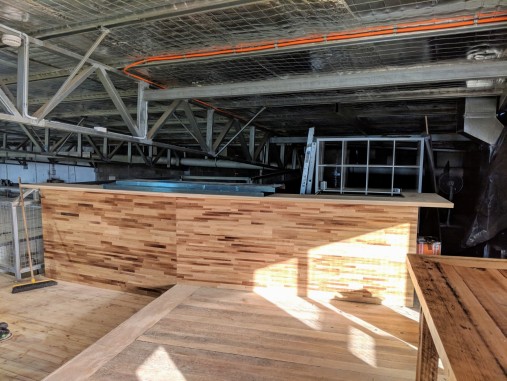
Down the far end of the building are some offices with a mezzanine space above. Ascending the stairs we find an angular wooden bar, a long wooden tasting table and handyman hard at work sanding the reclaimed timber floors. Once finished, the mezzanine area will form a private tasting bar for the distillery where guests can come by appointment, relax and try the products on offer. I notice that one patch of the cinder block wall looks different to elsewhere. “Rocky (Caccavo), the owner, decided that he was going to polish the blockwork, so he grabbed a grinder and started going at it,” laughs John “the dust was horrendous though, so I think we might just render it now.”

Devil bar

The new bar on the mezzanine

Looking out over the space, I can see that it is rapidly filling up with barrels and other paraphernalia. “We don’t have any immediate plans for expansion.” Explains John “We’ll need to get some off site bond space obviously, but at the end of the day we’re a small-scale craft distillery. Quality over quantity. It’s a great location though, just a stone’s throw from the city in one direction, and a stone’s throw from MONA in the other.”

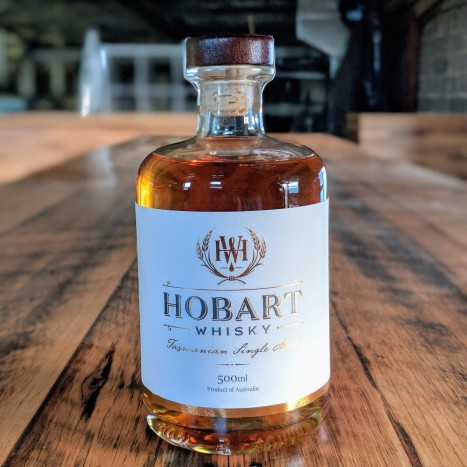
We head downstairs to John’s office, where a shiny new bottle of whisky is waiting patiently for our attention on the desk. Devil’s Distillery is releasing its single malt under the label of ‘Hobart Whisky’, which is quite amazing for a relatively new distillery in the now well established Tassie scene. “When we were deciding on names, we were shocked to find that Hobart Whisky was still available for use. We’re really stoked to have it.”

Devil vat

Converted milk vats for the win

The first release is a marriage of five 40l ex-Hill Rock Distillery bourbon casks aged for two years and seven months and bottled at 48.8%abv. The wash used in the release was sourced from local brewery Moo Brew, however future releases will contain wash made in-house at the distillery. When sourcing the casks, the cooper recommended that the staves be left intact without shaving or re-charring, allowing the new-make to fully interact with the original Hill Rock character.

Devil whisky

Hobart Whisky first release

This is evident in the whisky, with the spirit showing a much redder hue than you would necessarily associate with ex-bourbon casking, the white Hobart Whisky label contrasting nicely. On the nose the first release is sweet and creamy, with a bourbon-driven body of vanilla, butterscotch and light, dusty oak, as well as notes of maple, peach and lavender. The mouth is light, beginning with wood shavings, then transitioning to citrus, straw and the acidity of young stone fruit, before finishing with a delicate lingering sweetness.

Excitingly, the first release will make it’s debut during Tasmanian Whisky Week 2018, with the first public bottles available for purchase for $195. Most of the 430 bottle run will go directly to bars, so whisky fiends keen on securing one are advised to get in quick. As we wander out, John is excited for the future and how people will react to the whisky. “Everyone who has tried it has been really positive so far; the feedback has been encouraging.”

Devil blogger

The author meeting the Devil’s own Distiller

I came away feeling satisfied that I had unmasked the Moonah Devil as a young whisky of high quality and a promising future. Hopefully over time Hobart Whisky will grow into its name and become a flagship for the southern capital of whisky. John’s parting comment was encouraging in that respect: “At the end of the day I just want to be able to focus my attention on the whisky and make sure that everything we make is top notch.”

As they say, the devil is in the detail.

Limited bottles will be available for purchase during Tasmanian Whisky Week (13-19th August) at the Liquid Gold event on Thursday evening, Saturday afternoon at the Spirit Showcase and Sunday morning at the Farmgate Market.

Hobart Whisky 1st Release 48.8%:

***

Investigating Iron House Distillery

Posted by: Nick

1

Michael Briggs, head distiller of Iron House Distillery is the most relaxed empire builder you are ever likely to meet. This is because he’s not an empire builder. He’s a bloke – who has just happened to build an empire.

Iron House is more than a whisky distillery. It is also a brewery and a vineyard, while the still is also used to create various styles of gin, vodka and brandy. With all these products on the go you’d be forgiven for thinking Iron House was an overly complicated business. Michael (or ‘Briggsy’ as he’s known to one and all) avoids this by sticking to one overarching philosophy: KISS. Keep It Simple, Stupid.

2

Iron House is located at the majestic White Sands Resort on the East Coast of Tasmania. The resort was purchased by Briggsy’s father-in-law some 15 years ago. The place was slightly run down and frayed at the edges but fell into hands willing to turn it into something special (although it is said by some that it may have been bought just to get access to the boat ramp!). Once the premise was secured the next phase in the plan was to create something to sell on the taps – which is where Briggsy stepped in, forming Iron House Brewery.

The name was derived from the location – the area was once a 19th century camp ground for those travelling from the south and allegedly became home to the first tin-roofed building on the east coast, or as the locals referred to it: the Iron House.

3

Once the brewery was up and running the next logical step was (of course) to make whisky. While this was always part of Briggsy’s plans, the creation of the distillery was borne out of necessity. The amount of beer production per year was exceeding their current market – and rather than expanding to the mainland or overseas, Briggsy decided the left over wash could be put to better use.

A still was duly purchased – from Germany via the USA – and it arrived in pieces with absolutely no instructions. Like a complicated box of LEGOTM, Iron House’s mechanical engineer Michael Aulich assembled it, guided by pictures he found online, and eventually Iron House became the proud owners of a copper column still and an oddly shaped pot still.

6

While Iron House has yet to release its first whisky, I was able to try some new make spirit (or, to quote Briggsy: “white dog”) fresh from the still. On the nose it packed that fruity high-alcohol punch, though on the palate it was grainy and cerealy (Weet-bixy, for my fellow Australians). It was full of character and intrigued me as to what it would become.

I got a small preview of this downstairs in the bond store. There are multiple barrels within that have been filled for more than 2 years, the minimum age for a whisky. However Briggsy labelled them “legally ready, but not Iron House ready”. His plan is to blend multiple barrels in a Solera system to create a consistent, accessible product. He is a big believer that Tasmanian whisky should not be out of the reach of regular people – from the perspective of both flavour and price. Thus we can expect to have to wait until mid 2019 at the earliest to see an Iron House single malt release (however to tie you over there is some delicious virgin-oak-matured brandy which is nearly ready!).

4

Briggsy admitted the biggest strength of Iron House is also its biggest weakness. White Sands Resort is found at the most spectacular coastal site and yet this location is over two hours drive from either of the state’s biggest cities: Hobart and Launceston. However, if you find yourself cruising Tasmania’s beautiful East Coast then a stop into White Sands and the Brewhaus Cafe & Bar is a must. The distillery and brewery are separated from the cafe by many large glass walls, through which you can witness the entire whisky making process. It is a truly memorable and worthy addition to the Tasmanian distilling community – and well worth a visit.

8

Kings County Bourbon 43%

Reviewed by: Ted

Kings County Bourbon 43

This is about as hipster as I get. Leaning up against a rough-sawn wooden bar in a small craft beer joint in Kyoto and sipping some NYC bourbon poured from a 375ml bottle with a label that looks type-written. In fact, as I type these words, a number of Japanese gents wearing round steel-rimmed glasses and with beanies perched on their heads have just walked in. I am probably not cool enough for this place.

The bar is called Bungalow; the fact that it is separated from the busy street outside by only a clear plastic screen somehow makes it seem even more edgy. The vibe inside is very chill though, with friendly bar staff, a selection of Japanese craft beers and luscious funk tunes oozing from the speakers.

It also has precisely one whiskey, the Kings County Bourbon Whiskey. Apparently the owner is friends with the importer of the Kings County and is a fan, hence its presence as the only whiskey in a craft beer bar.

Kings County is apparently the oldest operating whiskey distillery in New York City… Est. 2010. It’s youth is due to the fact that it is the first whiskey maker in the Big Apple since prohibition ended. Based in the old Brooklyn Navy Yards, they craft spirit in their Scottish-made still using corn and barley grown on-site. It’s very much part of the dynamic and sustainable ethos that exists in Brooklyn today.

kings-county-bourbon.jpg

All the details…

The spirit itself is a very dark copper colour and is bottled at a pleasing 45%. Being a bourbon it has that heavy, corn-driven punch, but in this case it’s pleasantly not overpowering. There’s a sweet, savoury sharpness that evokes some of the flavours that I have come across in Japan. Soy sauce, mirin, that sticky stuff I had on that grilled meat in that yakitori joint, a hint of salt and tuna sashimi. Of course, these flavours are super-subjective seeing as this is a through-and-through American spirit. I’ve just been exposed to a lot of eastern flavours this past week.

The mouth-feel is solid. The usual big, sweet corn flavours are there, but they are well controlled and even-tempered. It has a crispness and acidity that evokes a glass of Sav Blanc or Pinot Grigio, leaving a nice juicyness to linger on the palate. There’s a buttery, saltiness too, like that scallop I had in Kuramon Ichiba Market that was grilled over coals in its own shell.

The Kings County is a damn fine whiskey, perhaps made even better by dint of my current geographical location. Kyoto is a beautiful city, Bungalow is just my kind of bar and the Kings County is an excellent finish to the day. If you’re going to drink a whiskey you’ve never heard of in a bar in Japan that you stumbled across by chance, consider making it a Kings County.

★★★★

Kings County Ted

Auchentoshan Heartwood

Reviewed by: Ted

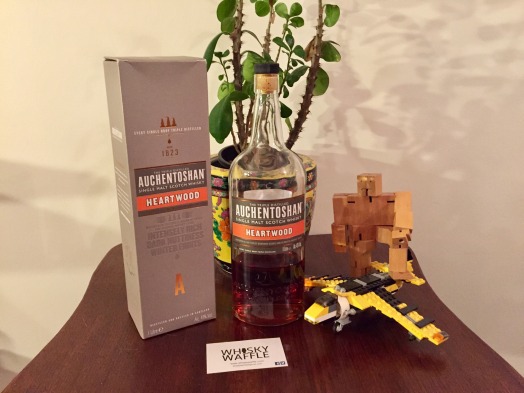
Auchentoshan Heartwood

If you’ve ever flown overseas, then chances are you will have wandered through the duty free section and marvelled at the huge selection of booze available. For some reason the brand marketers have decided that what the Jetset crowd really crave are exclusive releases that are not worthy of the wingless plebs on the street. Indeed, a whisky fan can spend hours gazing at all the fancy labels, musing about the unusual caskings and trying to decide whether to get that 1L bottle of NAS Scotch, or lash out and buy that rare Japanese number in the gorgeous bottle.

The thing is, are these exclusive bottlings actually any good compared to their standard counterparts?

Let’s take the Auchentoshan Heartwood as an example (not to be confused with the Tasmanian Heartwood brand). Hailing from the Lowlands of Scotland, the Non Age Statement Heartwood edition is produced ‘exclusively for the global traveller’ (that’s you). Auchentoshan itself is notable for being one of the only distilleries in Scotland to triple distil its whisky.

The packaging for the Heartwood is pretty much the same as the standard range, just bigger thanks to the 1L bottle size (aww yeah!). ‘Heartwood’ refers to the dense wood at the centre of a tree, which Auchentoshan rather tenuously links to bourbon and sherry casking being at the heart of their whisky (yeah, they had to torture that one a bit).

Marketing guff it may be, but the bit about using bourbon and Oloroso casks is true. The colour certainly suggests that sherry barrels have been in the vicinity; Auchentoshan claims that the particular hue of the spirit is ‘dark honeycomb’. I on the other hand think that it looks, well, orange, rather like that other most Scottish of drinks: Irn-Bru. A tad heavy on the E150 perhaps? (I’ve since found this great article by LittleTipple noting that the colour of Auchentoshan looks rather similar to bodybuilders who have got a bit excited with the fake tan. Good times).

The nose is dull and heavy, oozing over the rim of the glass like an exhausted slug. After a while the dark brew starts to present toffee and almonds (praline perhaps?) and Terry’s chocolate orange.

The mouth is thick and sweet, with a dense oakiness that lives up to its namesake. The finish offers a lingering hit of burnt orange that is oddly unsatisfying.

In conclusion, buyer beware. The exotic looking jewels of the duty free section may appear tempting, but on closer examination you might just discover that all you really have is a poor imitation of the original. Still, you can’t deny they’re fun to look at. Happy flying, and good luck!

★★

King in the north: Fannys Bay Distillery launches its whisky

Posted by: Ted

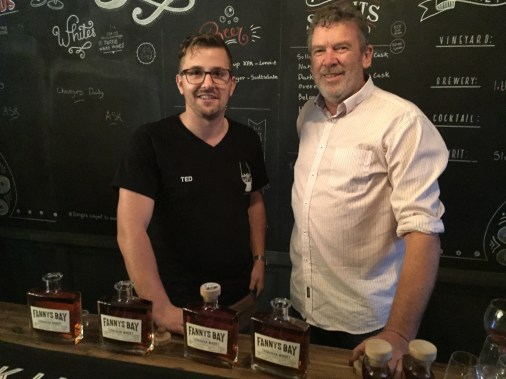
Ted n Mat Whisky Waffle

Compared to the established distilleries of the south, the north of Tasmania has been something of a permafrost-covered wasteland, devoid of all but the hardiest specimens. Scratch the surface however and you will find new life growing vigorously, with a multitude of start-ups building stills and laying down spirit.

Now the first of this new cohort has come to fruition, with Fannys Bay Distillery officially launching its range. Owned and run by the lovely Mathew and Julie Cooper, Fannys Bay is based on the far north coast in the rather appropriately named hamlet of Tam O’Shanter.

Small scale, hand crafted and innovative could be the bywords of Fannys Bay. The small still that resides in the Cooper’s garage was hand built by Mathew and each 20L barrel that is filled is mothered like a flock of chickens until maturity.

The launch was held at the recently opened Kingsway Whisky Bar in Launceston. The venue turned out to be rather easy to find thanks to the live quartet of bagpipers stationed outside the doorway, deafening guests as they entered the bar.

Bagpipes whisky waffle

The long, narrow space was quickly filled with friends and fans of Fannys Bay, including luminaries of the Tassie whisky scene such as Casey and Jane Overeem, Craig Johnstone, Damien Mackey, Rex Burdon, George Burgess and Troy Trewin. Mathew and Julie were gracious hosts, warmly welcoming their well wishers and even finding time to carry around some of the excellent cheese platters that had been provided.

Troy, Jane, George, Ted

Troy, Jane, George and some hipster

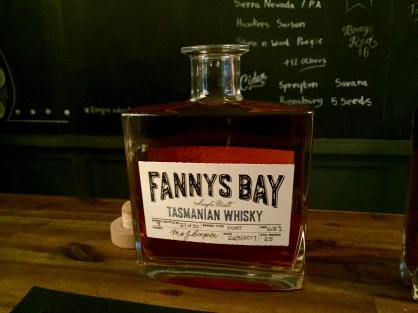
While the brie may have been rather fine, the real stars of the show were the three expressions of Fannys Bay being generously poured by Mathew. On offer were a pinot cask 43%, a port cask 62% and a sherry cask 63.4%. The pinot was light and smooth with notes of grapes and green apples. In comparison the sherry was robust and full of stewed fruits and spice, while the port was dark and rich, oozing raisins, sticky prunes and burnt toffee. Everybody who tried a dram came away with a satisfied look on their face and there was quite a long line to buy the flat, rectangular bottles with their vaguely Victorian inspired lettering and painted reverse.

Fannys Bay Bottle whisky waffle

The official part of the evening was conducted by Rex, Jane and Casey, who all spoke passionately about the warm, friendly and hospitable nature of the Coopers and their willingness to share their knowledge and experience with others. Jane noted that it was ‘exciting to see people who have such passion jumping into an industry with such a huge amount of opportunity’. After rather sheepishly admitting that he had been to see the distillery for the first time only a few hours before, Craig got up recited a poem to a rather amused crowd:

May you have shortbread when you’re hungry,

Whisky when you’re dry,

Pennies when you’re poor,

And heaven when you die.

Speeches whisky waffle

After the speeches were concluded, several bottles of the first barrel laid down by Mathew were put up for auction. Barrel #1 (Bourbon) Bottle #1 was claimed by Traralgon based whisky collector Shane Barbour, who remained calm under fire from competing bids to claim his prize (he mentioned that he also has a #1 bottle of Oveerem, lucky sod). Talking afterwards, Shane reflected that one of the reasons he keeps coming down is that everyone in the Tassie scene is so friendly and welcoming (plus the chance to collect unique whiskies).

The evening concluded in a relaxed fashion, with guests chatting away amicably in small groups and nibbling pieces of Fannys Bay pinot cask chocolate brownie. Mathew and Julie glowed with pride as they reflected on the success of the evening. When pressed, Mat said that he was “very, very pleased to be able to show that we have such a great Tasmanian product,” with Julie adding that “It’s been such a great journey.”

Mat n Julie Whisky Waffle

The last word comes from Troy (which I think would rather please him), who quite succinctly summed the evening up thus: “Tonight was a candlelight held up in the Tasmanian craft distilling scene, industry coming together to celebrate this nascent venture, a leader of the northern new wave. Patience has been worth it.”

Look out Southerners, the North is alive!

b n w Ted whisky waffle