review

Dalmore 12 Year Old

Reviewed by: Nick

Dalmore 12

In the United Kingdom, something that is passionately loved by half the population while fervently hated by the other is known as being rather ‘Marmite’. In Australia nothing sits more squarely in the love/hate status than Collingwood Football Club. In the movie world, the title goes to Napoleon Dynamite. And in the whisky world, the ultimate love-it-or-hate-it drop could be none other than Dalmore.

For every whisky drinker shouting Dalmore’s merits from the rooftops, I have met another who just cannot fathom the appeal. Even the usually serene waters of Whisky Waffle are rocked by this divide. While we normally agree on most matters whisky related, I am partial to a drop of the stag-bedecked highland malt while m’colleague Ted couldn’t care less that their founder saved King Alexander III from a deer once upon a time (actually, scrap that, he loves the story, just doesn’t want to drink the 12 Year Old)

I rather like the 12 – although I wouldn’t regard it as an everyday whisky. To me, it calls to mind a reasonable cognac (on the rare occasion that I’ve had the chance to try that stuff). I find it distinctly grapey and full of tannins – which I like. However, I get the impression that these same characteristics are what turn Ted – and many others – off the stuff. So my theory is thus: Dalmore is a red wine drinkers whisky. While the Speysides exhibit typical Sauvignon Blanc or Pinot Grigio lightness and crispness – this dram is heavy, complex and extremely dry.

On the nose I get equal measures of ham and raspberry jam – surely a combination that could only be found by a whisky drinker. The palate is slightly yeasty with red grapes and ashy notes. The finish is medium in length and warmth, leaving you with flavours of oak and pastry.

While I could happily sip on this particular drop for an entire evening, I can utterly understand where the Dalmore sceptics are coming from. This is not a whisky for everyone. You’ll either love it or hate it. However, for all those haters out there, can I recommend trying the Cigar Malt Reserve before writing off Dalmore forever – now that is a proper whisky.

And even if you still don’t like it – you’ve got to admit – Dalmore bottles are beautiful.

Nick’s rating: ★★★

Ted’s rating: ★★

Sullivans Cove French Oak Cask

Reviewed by: Nick and Ted

IMG_5551-2

This is it ladies and gentlemen, the moment you’ve all been waiting for: Whisky Waffle review the greatest whisky in the world.

But wait. Hold your horses there, Whisky Waffle. Due to the unique nature of single barrel releases, the French Oak bottle we tasted was not drawn from barrel HH525, the release that won 2014 World’s Best Single Malt at the World Whiskies Awards. Our bottle came from barrel HH595 (noted in case it wins next year!).

So then, the whisky we are drinking is not the best in the world. But it’s pretty damn close.

Sullivans Cove is the creation of Tasmanian Whisky pioneer Tasmania Distillery. Among their releases is a bourbon-matured American Oak expression and a blended Double Cask, but it is this one, matured in ex-European oak port casks, which is the most revered.

The nose is intriguing, with elements of caramel, cinnamon, overripe apples and the salt spray you may receive when standing on the stretch of coastline which bears this bottle’s name. The palate is light, but complex, with burnt toffee and leatherwood honey delicately balanced against earthy terracotta outdoorsy notes. The finish evaporates off the back of the palate and yet leaves a gentle caramelised linger.

Despite not being the exact bottle which received a plethora of honours all over the world, in tasting this edition it is easy to see where the judges were coming from. This is a superbly balanced drop and showcases all that is great about Tasmanian whisky.

★★★★

IMG_5556

Tasmanian whisky: One state. Three ingredients. Unlimited flavour.

#TasWhiskyWeek

Belgrove Brown Rye

Reviewed by: Ted

Belgrove Brown RyeEverybody knows by now that Tasmania is a hub of whisky revolution. Ever since the resurrection of the industry in the 90’s, things have been taking off quicker than an alka-seltzer bottle rocket. So how do you innovate in a young industry that’s already innovating its socks off? Rye thought you’d never ask…

Founded by Peter Bignell, a man often described as a Da Vinci of distilling (well, he definitely is now), Belgrove Distillery is located just outside Kempton in the southern Midlands of Tasmania. DIY, organic and hand-made sums up Belgrove’s vibe, with Pete quite literally crafting everything from the ground up, including the stills, barrels, biodiesel (made from left-over chip oil from the local take-away and used to power the stills) and of course the grain used in the whisky itself.

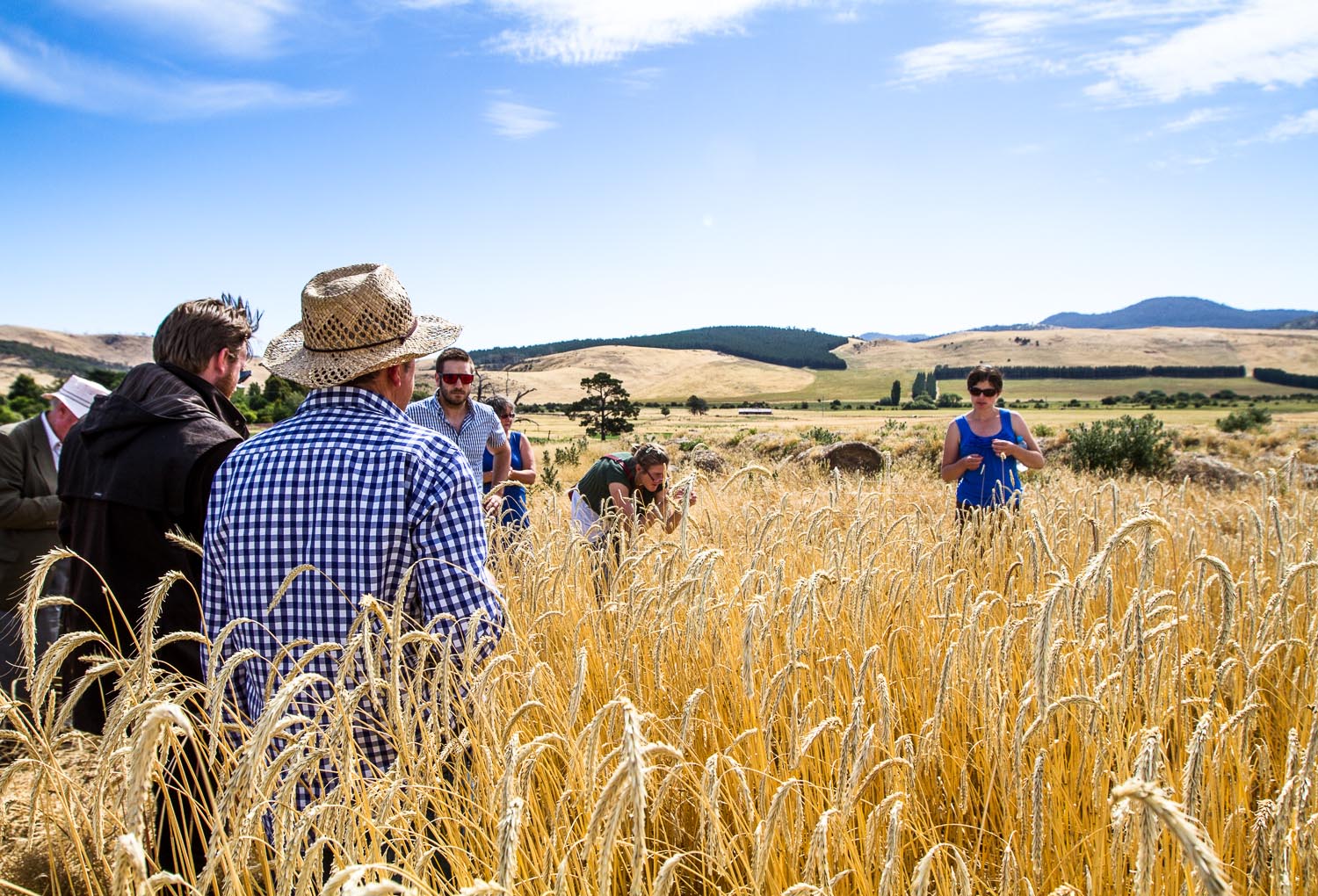
The grain is where Belgrove really makes its point of difference from all the other Tasmanian distillers. Why use boring old barley when you can use rye instead, organically grown on-site? After growing a bumper crop of the stuff on the farm in 2008 (a favourite grain of the Canadian distillers but not used in Tassie), Pete was apparently inspired to turn it into whisky. Being a extraordinarily talented and driven individual, one thing led to another and here we are today.

Belgrove now produces a number of different 100% rye drops, including white rye, black rye, peated rye and of course, the subject of this review, the brown rye.

The nose of the brown rye is dark and fruity, full of ripe apple, plum and apricot. It rather reminds me of the scent of the bowl of home-made preserved stewed fruit my grandma always used to keep in her kitchen cupboard, a very fond memory. Alongside the fruit is rose petals, custard and an undertone of dull metal, like drinking from a rough copper mug.

The taste is quite different to the flavour complex produced by the nose. Although its body initially starts off fruity, it immediately transmogrifies into deep earthy, ashy flavours, like smouldering rye stubble in a paddock or curling incense smoke in a gypsy tent. The finish is slightly bitter and astringent but very satisfying, like having a cup of black tea after a sweet dessert.

Everything you thought you knew about Tasmanian whisky goes out the window when you try the Belgrove brown rye. It’s like learning to drink whisky all over again, an exciting time full of power and emotion. It is a spirit that resonates powerfully with the creative, hands-on ethos of its maker. If you want to try something different, yet still uniquely Tasmanian, then the rye of Belgrove awaits you.

★★★

Belgrove Brown Rye

Tasmanian whisky: One state. Three ingredients. Unlimited flavour.

#TasWhiskyWeek

Nant Sherry Wood 43%

Reviewed by: Nick

Nant Sherry Wood 43%

I imagine the founding of Nant distillery by Brisbane businessman Keith Batt, went something like this:


“What do you want for your birthday this year, honey?” asked Mrs Keith. Keith thought for a moment.

“I’m torn between a Caribbean island, a bar-franchise and a horse,” he replied, not a drop of irony on his face.

“A horse?” replied Mrs Keith, “where on earth would you put one of those?”

“Well obviously I’ll need to invest in some property to store it in – preferably somewhere exotic and remote.”

“How about Peru? Then I can get a Llama!”

“Yeah, I’m not so keen on the ponchos or  folk music. Tell you what, how about we stick the horse in some old paddock in Tasmania and I’ll also get the bar-franchise?”

“Alright, fine. But you may need to think of something to do with the property down in Tassie.”

“Oh, don’t worry about that. I’ll just stick in a whisky distillery and sit around fixing an old water mill until Jim Murray arrives.”


Of course I unquestionably make light of the momentous decision to build Nant Distillery up in the highlands of Tasmania – an establishment which I can confidently state is the most scenic of all Tasmanian distilleries. And as much as I can mock Nant’s business-like set up, I cannot downplay the excellence of its whiskies.

One of my favourite Tassie drops is the Nant Port Wood, a fantastic representation of the Tasmanian flavour, and the cask strength version of the Bourbon Wood is one of Tasmania’s finest whisky accomplishments. They also release a Sherry Wood and it is this expression I review today.

The nose is drier and earthier than any other Nant release. There are elements of vanilla, figs and golden syrup, but this is matched by moss and spicy oak. The palate is equally contrasting with notes of toffee, raspberry jam and plenty more oak, while mingling in the medium long finish are herbs and you guess it: oak, It all combines to form an intriguing and challenging Tasmanian whisky.

While I couldn’t claim this to be my favourite Nant expression, it’s certainly an interesting drop and one that I would never describe as boring. It forms an integral part of an increasingly impressive Nant back-catalogue. I guess then, it was well worth Keith Batt getting that horse!

★★★

Nant n Nick

Tasmanian whisky: One state. Three ingredients. Unlimited flavour.

#TasWhiskyWeek

Hellyers Road Peated

Reviewed by: Ted

Hellyers Road Peated

So, you’re a big fan of peated Scottish single malts, but in order to save the world from certain destruction (just go with it, ok?) you have to buy a Tasmanian whisky. What are you going to do? Never fear, Hellyers Road has your peat needs covered with their appropriately named Peated expression

When it comes to peated whisky in Tasmania, the situation is a little more complex than first meets the eye. Tasmania actually has its own peat bogs, however the smoke is quite different to the Scottish stuff, being softer, gentler and more rounded. It is also restricted to a few distilleries that own leases to the bogs (the rest is locked up in national parks and the like).

In Hellyers Road’s case they don’t have access to a native bog, so instead they import peated barley all the way from maltings in Inverness, Scotland. The side-effect of this is that Hellyers Road Peated is much more closely aligned to Scottish drams than other Tasmanian malts (side note: Hellyers Road use local grown barley for their non-peated expressions).

Nosing the Peated expression is like standing in a grain storehouse, grabbing a big handful of peat-smoked barley and taking a deep sniff. Underneath the big, fat, bold, smoky cereal flavours can be found cocoa, black currants, pencil shavings and smouldering leaves.

The first layer of taste is what you would probably expect from a heavily peated whisky – strong, thick smoke that billows around the mouth, a bit like standing on the wrong side of the campfire. When you clear away the smoke however, you are left with a light, smooth and slightly sweet dram, without too much else going on. The finish is long and smoky, but gentle. In fact, the smoke probably rounds out the feel of the dram as a whole, smoothing out some of the harsher edges that can be found in a younger whisky such as this.

When compared to a traditional Islay single malt like Laphroaig or Ardbeg, the Hellyers Road Peated perhaps misses some of the strong coastal flavours that punch through from underneath, but makes it up in other areas. A light whisky, heavily peated, this Hellyers Road expression delivers a different experience to anything else available from Tasmania.

★★★

HR n Ted

Tasmanian whisky: One state. Three ingredients. Unlimited flavour.

#TasWhiskyWeek

Booker Noe’s Special Barrel Bourbon

Reviewed by: Ted

Booker Noe's

Ok people, tread carefully, we’re hunting a pretty dangerous lil’ beastie today and I wouldn’t like to see anyone lose a leg. It’s got a strong nose, a powerful kick and a bite worse than the biggest, meanest black bear you ever did see. What am I talking about? Why, Booker Noe’s Special Barrel Bourbon of course…. Look out! *crunch*

This big hitting bourbon takes it’s name from one of Kentucky’s most beloved sons, Booker Noe, grandson of the great Jim Beam himself. As master distiller at Jim Beam for many years, and a child of one of America’s greatest whiskey dynasties, Booker had an innate knowledge of the spirit he crafted. As a testament to his skill he selected barrels of special character to create an expression bearing his name and personal taste.

According to Booker’s note on the bottle label, his grandfather preferred his whiskey to be aged between 6-8yrs. My bottle, containing batch C04-A-28, hits that mark perfectly, being aged for 7yrs and 4months precisely. What really gives the Booker Noe its teeth is that fact that it’s bottled straight from the barrel. Therefore the bottle of dark, uncut Kentucky spirit sitting before me is a hefty 64.55% abv, or 129.1 proof in the American money.

I make no joke about the potency of this stuff, as it’s responsible for some of the few alcohol induced blank spots in my memory. Just to hammer the point home, our women folk are generally pretty indulgent and tolerant of our whisk(e)y drinking proclivities. Yet when the Booker comes out, or even if there’s vague hints of it, stern looks and muttering along the lines of ‘Oh God, you’re not drinking that stuff again are you? Remember what happened last time?’ occurs. Suffice to say, m’colleague and I have not been found in the best shape afterwards.

Yet, even after all that, there is something about the Booker Noe that keeps drawing us back. It’s the bold, gutsy, manly nature of it I think. Bourbon in the raw. The nose is solid, a big slab of dusty corn sweetness that drops down on you like a sack of, well, corn. Of course, because of the strength there’s an undertone of nail polish remover, but it blends well with the sweetness, only frying the occasional unsuspecting nose hair.

The taste is bold, taking a big, sharp, sweet, fruity swipe at your palate. The spirit fills the mouth, making your cheeks tingle and the blood rise. The finish is oaky and sour, and keeps you pinned down until it finishes punching you in the face.

Booker Noe’s Special Barrel bourbon is the American spirit at its brawniest. It’s creator was a larger-than-life figure and his bourbon certainly lives up to that legacy. Hunt the wild Kentucky beast if you dare, but be careful it doesn’t bite you too hard. But maybe it’s just like the note I stuck on the box says: “Because I like to live… dangerously.”

★★★

Tasmania and Whisky Waffle launch Tasmanian Whisky Week

Posted by: Nick

It seems we Wafflers are not the only ones who love Tasmanian Whisky! We reported recently that Whisky Live is coming to Tasmania for the first time. But, why stop there? The Tasmanian whisky community has decided to crash the party and create the inaugural Tasmanian Whisky Week.

TWW Logo

While we say ‘week’, it will in fact last for nine days between Friday July 22 and Sunday July 31 and will feature a number of industry events at Tasmanian distilleries, bars, restaurants – even barns! Throughout the week a number of distilleries will open their doors to host tours, rare whisky tastings, gourmet meals and more. You’d better hurry, though – tickets are selling fast!

Of course, Whisky Waffle will also be taking part in this week of festivities. Throughout the seven days leading up to Whisky Live we will be releasing a series of articles and reviews celebrating some of our favourite Tassie drops. Even if you are from another part of the world, log on to Whisky Waffle throughout the week to celebrate along with us.

Hellyers Road Whisky Waffle

Two Hellyers Road Whisky Walks for the price of one!

Among the many events taking place are exclusive tours of Lark, Overeem, Sullivans Cove and Hellyers Road, or a combination of the above, with Drink Tasmania.

For something more extravagant why not check out the whisky and cheese afternoon at Redlands, a whisky and food matching masterclass at Launceston Distillery, or the Shene Estate after dark tour.

Mackey Shene photo Paul County

Mackey AND Shene Estate! Wait… they’re the same thing? Picture courtesy of Paul County Photography

Perhaps you’re after something a little stronger, such as trying a range of amazing Heartwood products – or maybe you’d like to try some boilermakers with Belgrove’s Pete Bignell and his son, brewer Tom Bignell. Nant are not missing out either, hosting a meet-the-distiller two course lunch.

For those looking for something even more special, there is the Founders Dinner, a three course meal complete with rare Tasmanian whiskies and four of the most important men in the business: Bill Lark, Casey Overeem, Patrick Maguire (Sullivans Cove) and Mark Littler (Hellyers Road). If you have a little more time and money, there is the option of a two day jaunt around the Tasmanian highlands, visiting multiple distilleries and the very location of Bill Lark’s epiphany.

Drink Tas tour

Brett Steel, Pete Bignell and some happy whisky drinkers on a Drinks Tas tour

Finally, there is Whisky Live, the catalyst of the week and a compulsory visit for fans of Tasmanian and Scottish whisky alike.

It’s going to be a huge week. Our only regret is not being able to attend each and every event. One thing is for sure however – when it comes to Tasmanian whisky, there is a lot worth celebrating!

Wafflers and Brett

Cheers Brett! Tas Whisky Week. Let’s do this!

Glen Moray Port Cask Finish

Reviewed by: Nick

Glen Moray Port Cask

As an out and proud fan of Glen Moray distillery and a waffler known to be partial to a little port matured whisky, the Glen Moray Port Cask Finish sounded like the perfect dram for me. Combining the sweet elegant Speyside flavour with a rich wine-infused layer – what could possibly go wrong? As it turns out: quite a lot.

Upon its arrival at my door, I eagerly whipped the bottle out of its box and was greeted with the most peculiarly coloured whisky I had ever seen. I’ve observed variations of the (hilariously unintentionally poetic) “burnt crimson” theme before, but this whisky was – and there’s no more accurate description – orange. It was the kind of radioactive-peach hue normally reserved for fake tan. Alarm bells were ringing – but I didn’t want to fall into the trap of judging a book by its colour. There was only one thing to it – I had to try some.

After the first sniff it was clear that I was not trying a regular Speysider here. There was a lot of fruit – by which I mean a veritable orchard’s worth – and it was overripe, perhaps on the turn and ready for the compost heap. There were some bitter dark chocolate notes as well as equally bitter notes of wet grass. All in all, it was… shall we say memorable.

Surely the palate would be an improvement. And it was, albeit slightly. It was sweet and sticky with strong winey notes combining to form something reminiscent of strawberry jam. Don’t get me wrong, I love me some strawberry jam. Just this particular fruit spread was more Woolworths brand rather than homemade by my Grandma. The sweetness was more of a sugar syrup than a caramel and the vanilla more essence than extract. The finish started strongly with some nice blackberry flavours but descended into a rough spicy alcohol burn, surely a product of its youthful non-age statement nature.

Wow.

I did not love this whisky nearly as much as I expected. All things considered it was more than a little, well, rubbish. However, I can’t say I’m unhappy that I bought it. Scotland is hugely diverse in its drams and this is as far removed from an elegant Speyside drop as an Islay peat monster. Unfortunately in this case – the differences are not for the better.

Limeburners Infinity Solera Cask

Reviewed by: Nick

Limeburners Infinity Solera

The thing about the Australian Whisky scene is that we are unquestionably small-fry. It is a quantifiable fact that we produce less whisky per annum than Glenfiddich sloshes from its barrels. Size, or rather lack thereof, is the overriding factor in most Aussie distilleries’ tendencies to release single barrel expressions – they simply don’t produce enough product to have an alternative. This is great if you happened to own an unopened bottle of HH525 Sullivans Cove in 2014. If you did, I hope your new private yacht is treating you well.

Single barrels are not as good however, when the aim of your whisky game is consistency of flavour. You know, that old chestnut of getting one bottle of your standard release to mildly resemble the taste of another one. The best way to achieve this is to blend (or more romantically, ‘marry’) a range of casks together – thus ironing out any ‘bumps’ in flavour. Even better still, is if you can use a Solera vat, which are only ever half empty (or full. Not sure which is the most optimistic phrasing in this case.)

With this groundbreaking new technology (invented c.1790), distilleries are suddenly able to better define their flavour and ensure that a bottle you buy this year is (pretty much) the same as the one you purchase at a later date.

One of the first distilleries in Australia to adopt the Solera technique is the wonderfully-named Great Southern Distilling Company based in Albany, Western Australia. They market their wares under the label ‘Limeburners’ and in their short history, have released some stellar drams.

While director/distiller Cameron Syme is a huge fan of the variety found in single barrel releases, he acknowledges the need for a consistent product and an entry level into the Limeburners range, resulting in the creation of the Limeburners Infinity. Cameron says that his distillery’s key commitment is “to make Australian whisky which can compete and hold its own at the highest international levels. Infinity is certainly capable of that.”

This particular release contains 8 year old whisky matured in several 500L South Australian port puncheons. The infinity name is appropriate, as the Solera system will always leave at least a teeny tiny fraction of these original whiskies in the mix.

Eager to support the distillery, I stumbled upon this bottle’s first release on Dan Murphys and promptly blew my savings for the week. So what exactly is the Infinity Solera Reserve like?

On the nose there are immediate traces of the port influence – ripe oranges dominate alongside zesty citrus and vanilla, bringing to mind cupcakes with lemon icing. The palate is complex – certainly not smooth, but well balanced with flavours of strawberry jam, honey and malt biscuits. In the finish I spotted hints of the bitter soapiness I sometimes detect in wine-matured whisky (yes, I know, this is port matured and therefore I sound crazy). However, this vague disagreeable note dissipates quickly and is replaced by an intriguing dryness which contrasts pleasantly with the initial flavours.

Usually I find it pretty counterintuitive adding water to my whisky, but in the case of this one, it takes on a whole new character with a splash of H20. Suddenly, large dollops of gooey caramel dominate the palate and the flavours morph from undeniably Australian to slightly Speysidey.

This whisky is a significant step for Australian whisky. Lack of consistency is one argument the Cynical Scot has always held over me in our heated whisky-fuelled debates about the validity of non-Scottish drams. It seems that, at least in Limeburners’ case, I will be able to return to the bottle shop in a year, in two years, or even in ten and get this same drop. Or alternatively, I could save my pennies and buy one of their delicious cask strengths…

★★★

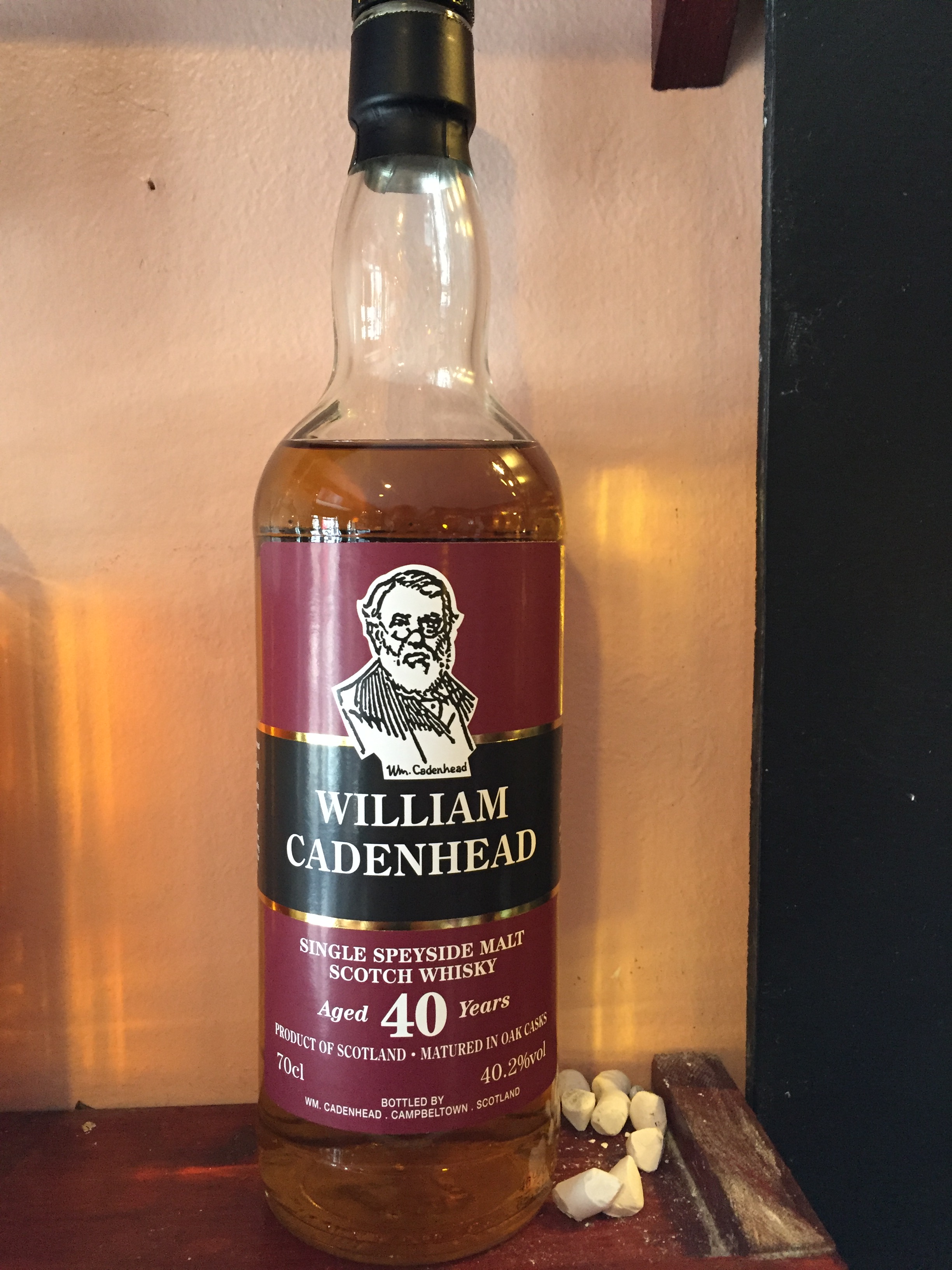
William Cadenhead Single Speyside Malt Scotch Whisky Aged 40 Years

Reviewed by: Ted

William Cadenheads 40 YO

The art of independent bottling is a fascinating one, taking the product of a distillery and aging it oneself in a new and interesting way. If performed successfully, the end product should hark back to it’s origins and yet metamorphose into something beguiling and delightful. A whisky butterfly if you will.

WM Cadenhead Ltd is Scotland’s oldest independent bottler, established in 1842. As such, they have had some time to perfect the art and their releases tend to command considerable respect.

The William Cadenhead Single Speyside Scotch Whisky that I was fortunate enough to try was a mere 40 years old! While the bottle did not reveal the origin of the spirit, I have been told that it allegedly contains spirit from Glenfarclas, a family-owned distillery steeped in tradition.

On the nose the William Cadenhead 40yo is like timber polished to the smoothness of glass using the finest vanilla and caramel scented beeswax.

In the mouth the spirit is what I imagine drinking satin would be like, rippling folds of cool smoothness sliding over the tongue and susurrating down the throat. The flavour is the lightest touch of honey, tree spices and dried fruits.

If you are ever fortunate enough to come across the William Cadenhead 40yo I would highly recommend taking the opportunity to try it. This is independent bottling at its most elegant.

★★★★★