Scottish Whisky

Glenlivet Nàdurra 16 Year Old

Reviewed by: Ted

Glenlivet Nadurra 2

We are quite fond of The Glenlivet. The 12yo is a dependable drop that hits straight down the middle, perfect for when you just want to sit back and have a dram (although the introduction of the Founders Reserve may change all that). So what happens if you knock things up a notch?

If you think that your glass of Glenlivet needs a bit more punch, then look no further than the Nàdurra. Gaelic for ‘natural’, the Nàdurra is a cask strength release from the Speyside distiller. Glenlivet claims that it is a traditional 19th century style dram, evoking the character of the whiskies originally created by founder George Smith.

Using first-fill American oak casks, the Nàdurra is aged for 16 years and then bottled between 54-55%. My particular example stands at 54.7% and was bottled 06/13 from batch 0613X. As you would expect from a bourbon-aged whisky, the colour is fairly light, although the strength keeps it at a weak amber rather than straw-like.

The nose is fat and rounded, with melted brown sugar, vanilla, cinnamon, cloves, cocoa, peach, malt biscuits and apricot jam. It’s fairly direct on the nostrils too thanks to the strength, but the sweet, gooey nature means that it oozes seductively, like the smell of pudding wafting from the kitchen on a cold night.

On the mouth the Nàdurra is hot and slightly dry, with a nice spiciness. When you take a sip it zooms straight to the roof of the mouth before plonking down onto the back of the tongue. A bitter caramel finish lingers around the mouth, although I suspect it would be rather shorter at a lower strength.

The Glenlivet Nàdurra is no everyday dram to knock back after work. Instead it’s perfect for snuggling down on the couch at the end of the evening, or, and I speak from personal experience, keeping warm while gazing up at the stars on a perfectly clear night. If you’re looking for a friendly companion cask-strength dram, then the Nàdurra is a natural choice.

★★★

Glen Moray 12 Year Old

Reviewed by: Nick

Glen Moray 12 Year Old

It is quite often the case in the whisky world that what you pay for is what you get. It is usually a safe assumption that a $40 bottle will be inferior to one costing three figures. However, there are so many exceptions to this rule that I begin to wonder why us whisky fanatics spend the money we do.

Case in point is the Glen Moray 12 Year Old, a bottle that first caught my eye when I was a uni student and therefore always on the lookout for an alcoholic bargain. The Glen Moray was, quite simply, the cheapest single malt I could find in Australian bottle shops. However I was quick to discover it held a certain charm that saw it rise above many of the blends I could also afford.

There is no denying that it is a simple dram, bearing all the hallmarks of Speyside. On the nose there are notes of sweet biscuits and honey. Predictably from a whisky matured entirely in bourbon casks, there are also elements of vanilla. The palate is sweet, almost syrupy, with toffee, banana and heathery floral notes. The finish contains more vanilla, spice and Werthers-esque caramel.

The Glen Moray 12 Year Old is never likely to rack up a high score at any whisky awards shows. But in my opinion there’s absolutely nothing wrong with that. It is simply a straightforward and inoffensive whisky that punches above its weight against the larger players.

★★

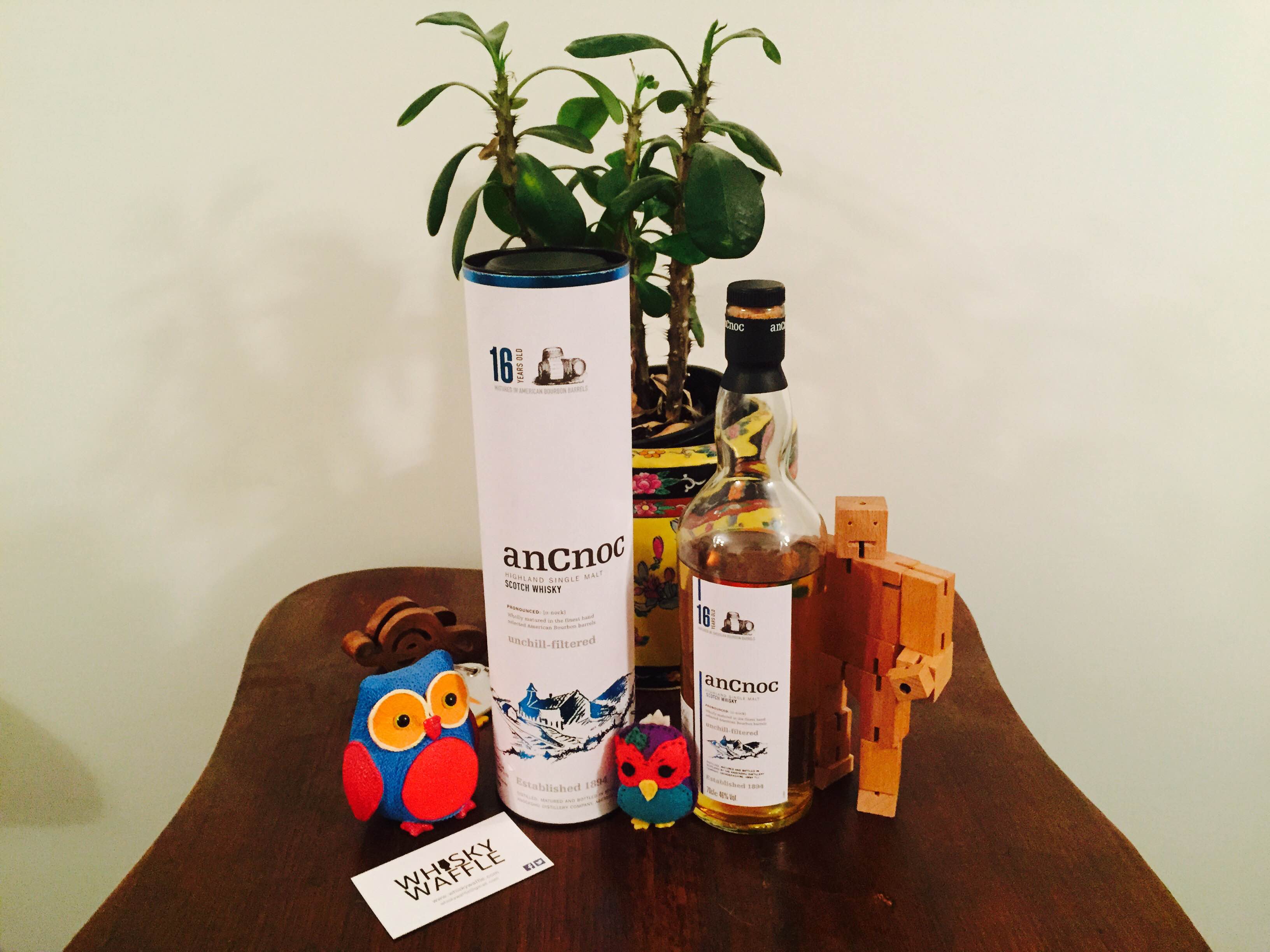
anCnoc 16 Year Old

Reviewed by: Ted

anCnoc 16

One of the fun things about whisky is that it can reveal to you a time and place as part of its character. If the anCnoc 12 Year Old is a summers day, then surely its older sibling, the 16 Year Old, is the evening.

Produced by Knockdhu Distillery, founded in 1894 and one of the smaller operating distilleries in the Scottish Highlands, the AnCnoc 16yo is a burnished gold in colour, darker than the straw-like 12yo.

On the nose the 16yo is smooth and sweet, with no hint at all of the occasional raw alcoholic jaggies lurking in the 12yo. Herbs, particularly mint, garnish a bowl of caramelised pears in syrup dolloped on Weetbix. The taste is sharp and bright, striking the upper palate. The finish is hot and bittersweet, drying the mouth and lingering for some time afterwards.

The AnCnoc 16yo is much better rounded than its younger kinsman, with maturity found through age. While the 12yo has the heat, dustiness and brashness of the day, the 16yo is the relaxing warmth of the evening. A perfect companion to watch the light fade on a clear summer night.

★★★

Highland Park 12 Year Old

Reviewed by: NickHighland Park 12

Single malts. They’re a varied lot. Some people like peat monsters. Some like sherry bombs. Others enjoy their whisky light and floral. Others still prefer their drams sweet with hints of vanilla. Pleasing everyone with one drop, however, is a much harder task. Unless, of course, you happen to have a bottle of the Highland Park 12 Year Old on your shelf. This bottle truly is the great all rounder of Scottish whisky.

Highland Park also has the distinction of being Scotland’s northernmost distillery, located on the largest of the Orkney Islands, pipping its neighbour Scapa by under a mile. As the island group was settled long ago by Vikings, it should come as no surprise that the flavours on offer are a veritable smorgasbord.

Up first comes a nose with many varied elements: a whiff of grapes and malty biscuits. There is chocolate, so dark it is mostly cocoa, mingling with notes of pear and bubblegum. Finally is the smoke: far subtler than anything from Islay. It brings to mind smouldering vegetation, an attempt to create a fire from damp leaves on a drizzly day.

The palate is equally varied. It initially suggests a roast meal: beef, parsnips, even gravy, before giving way to mandarin, brown sugar and chocolate milk. The smoke lingers gently, now mostly burnt out and close to charcoal. Finally this all gives way to a long spicy finish with salt, tobacco and mint combining with flashes of caramel.

The Highland Park 12 Year Old is unlikely to be anyone’s number one whisky. It is not weighted in a particular direction to please one group of whisky fans over another. Instead, it sits squarely in the middle, a dram to be enjoyed by everyone no matter their preferences. This is a whisky that brings people together, and if that is not a glowing endorsement, I don’t know what is!

★★★

Bunnahabhain 12 Year Old

Reviewed by: Ted

Bunna 12

The world of whisky is a lexicological minefield, populated by distilleries and bottlings with all manner of weird and wonderful names. The birthplace of whisky in particular likes to play mind games with the innocent, wide-eyed bystander, the Scottish tongue bending words in ways you just wouldn’t expect.

A true prince of the pack is a distillery from Islay with a name that causes the unprepared mind to melt at the sight of it. Gather your wits dear reader and say hello to Bunnahabhain (phew!). Right, so just to be clear, that’s BOO-na-HAVen (but to really get it, here’s a helping hand from Brian Cox).

The Bunna, as it is more colloquially known, is one of the oldest distilleries on Islay, producing drams since 1881 in the village of the same name. Naturally, being from Islay means that Bunna drams are peated. Unlike other distilleries on the island, however, they aim for a far more subtle maritime nature, with the Bunna motto being ‘the gentle taste of Islay’.

Encased within a heavy black glass bottle emblazoned with the sailor logo and the Roman numerals XII (a numbering system used for their aged releases), the Bunnahabhain 12yo is the core release of the distillery. Made with water from the Margadale spring and bottled at that sweet spot of 46.3%, the 12yo brings forth a rich golden hue.

On the nose the 12yo is light, smooth, sweet and fruity, with ripe autumn apples, dates, plum jam, red grapes and raisins from the ex-sherry casking. Mixed in with the fruits are chestnuts, cashews, pistachios, dark chocolate, brine and rich oak. A veritable cornucopia indeed.

On the palate the liquid hits sharp, salty and dry, like taking a mouthful of seawater on a summertime dip. Underneath sits salted caramel, ginger, mixed peel, seaweed and a faint hint of driftwood smoke. The finish is again salty, and lingers on the tongue like the end of a day at the seaside, a mixture of brine, sweat and sunscreen.

Bunnahabhain is certainly not one of the Ileach peat monsters, choosing to keep that beast well chained in its cave. Instead it manages to sing an incredible song of its maritime environment, perfectly capturing the salt laden winds that blow in from the stormy Scottish coastal waters. The Bunnahabhain is indeed a whisky that is as complex in its nature as it is in its name.

★★★

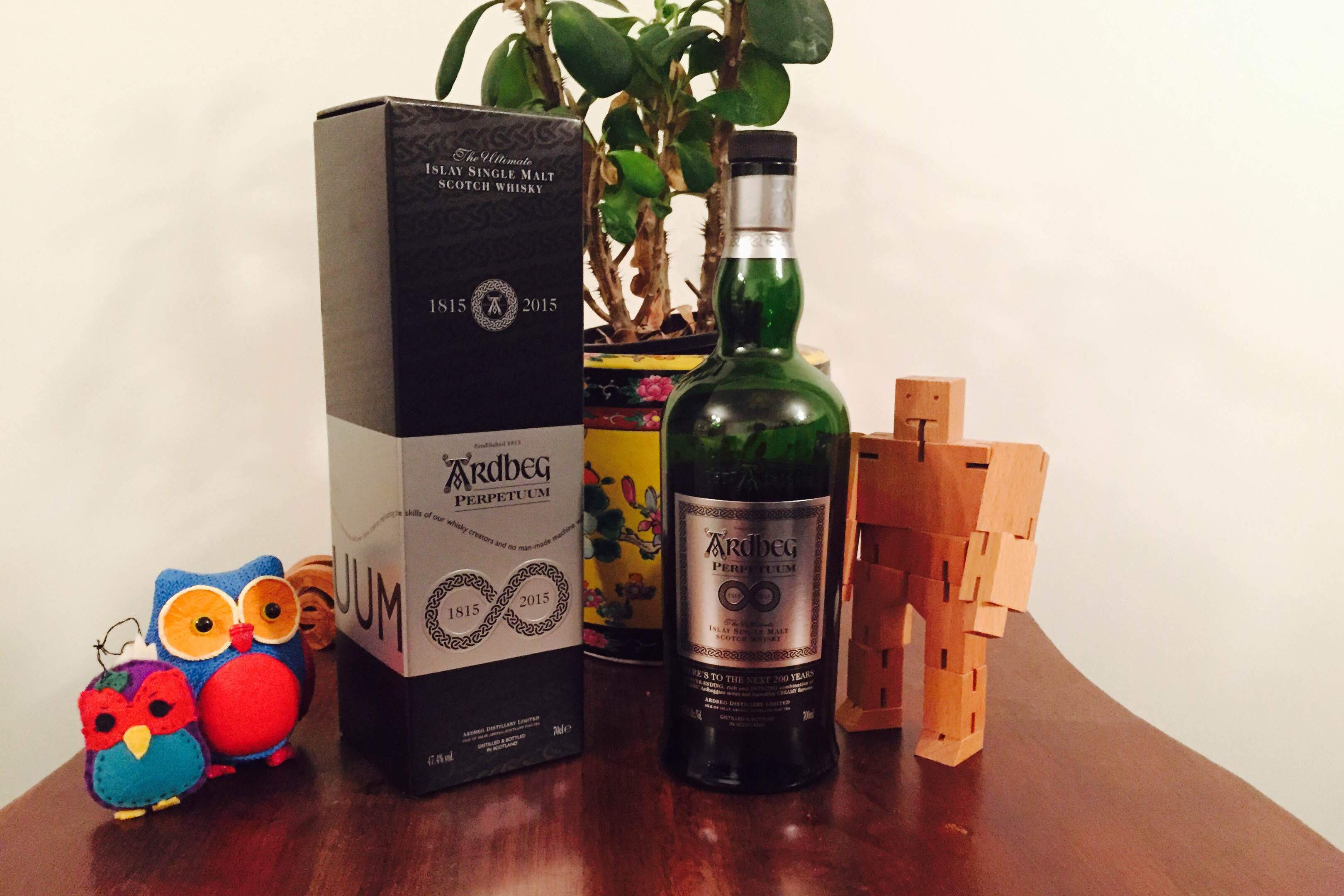
Ardbeg Perpetuum

Reviewed by: Ted

Ardbeg Perpetuum

200 years might not be infinity, but it’s certainly a long time to be producing whisky. Ardbeg distillery, nestled on the coast of Islay, is to be heartily congratulated for reaching such a momentous milestone.

The distillers at Ardbeg love a good special edition release, and in celebration of their big birthday they have brought forth the Perpetuum. The whisky celebrates the love, dedication and skill of its creators, acknowledging that while times and technology change, no machine will ever be able to recreate the spark of the human touch.

It’s certainly a beautiful object to gaze upon, with shiny silver labels, a Celtic braid infinity symbol and PERPETUUM surrounding the box in monolithic black letters. Oh my goodness the 47.4% spirit inside is a worthy representative of Ardbeg’s art. Just to look at it’s a gorgeous pale, silky gold with a subtle peach tinge.

The nose is delicate and creamy, and has delicious buttery shortbread infused with a hint of sea salt. Twining through is a touch of fine smoked meats, smouldering driftwood and hot malt. The first sip delivers rich, woody smoke to float over the tongue. Underneath sits a pool of salty mineral-rich water with the occasional mandarine bobbing around in it, counterpointed by a sharp bittersweet herbal finish that lingers on. As the bottle says, it almost seems to be never ending.

The Perpetuum is a snapshot of the last 200 years of whisky making at Ardbeg, and hints at the way forward into the next 200 years. Like the infinity symbol the represents it, hopefully we will be coming back to the Perpetuum, and indeed all Ardbegs, again and again for many years to come.

★★★

‘Big Peat’ or ‘The Perks of Random Conversation at the Bar’

Reviewed by: Ted

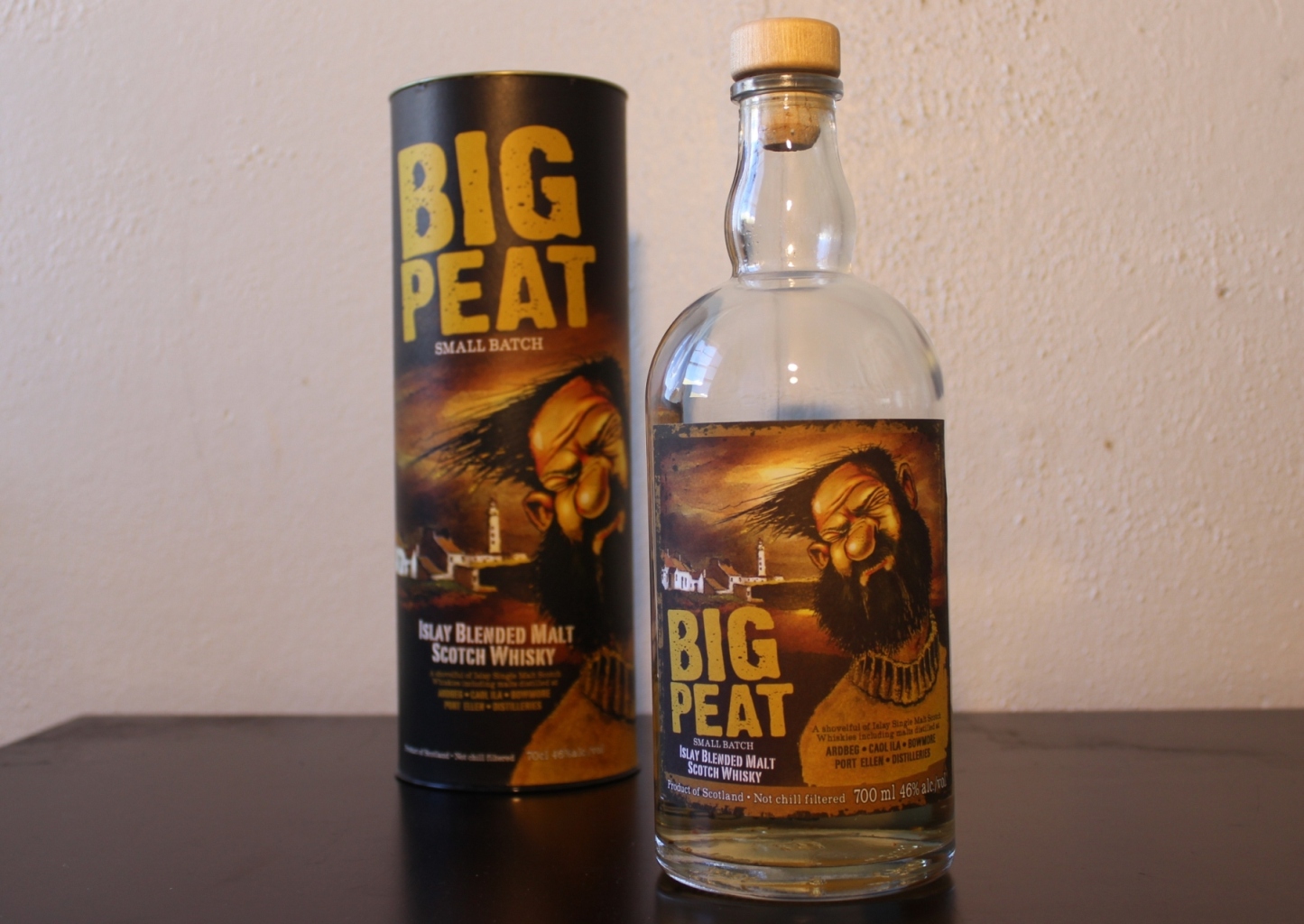
Big Peat

This story begins, as so many great stories do: m’colleague and I were at the bar. Admittedly not an unusual state of affairs. On this particular night we were chatting to our barman mate, and a friend of his that he’d just introduced us to. For the purposes of this story, let’s call him Doug. Doug was feeling in a rather celebratory mood as he’d just scored himself a job working as a pharmacist in sunny (and I mean that in the most ball-of-thermonuclear-fire sense of the word) Alice Springs, which is pretty much smack bang in the centre of Australia. Quite a change from little old Burnie on the NW Coast of Tasmania, which can occasionally be sunny if it really makes the effort.

After the usual necessary social preamble was out of the way, the conversation happily turned to that most mysterious, complicated and variable of subjects… women! No, wait, I meant whisky! Doug, as it turned out, was quite the connoisseur (and not just of whisky. On a side note he very charitably bought us a glass of Cognac from the highest extremity of the top shelf, an interesting experience to say the least). We all shared a common passion for peated whiskies, particularly those from what is arguably the spiritual home of the smoky dram: Islay.

These days people mostly talk about Islay in terms of its single malts, but historically the island’s distilleries injected popular blends with some much needed character (and they still do!). However, there is a theory that history works in cycles, and what was once old becomes new again (which probably explains the questionable return of scrunchies and chokers). Interestingly enough, what was getting Doug excited that evening wasn’t the single malts from one of the hallowed Islay distilleries, but a blend. An all-Islay blend. “It’s fantastic! You should track it down”. Fateful words readers, because a few cheeky drams relaxing the mind and the heady world of internet shopping instantly at ones fingertips is a dangerous combination. Let’s just say that I didn’t take much convincing, and moments later I was the proud owner of a bottle of this curious beastie.

Cut to a few weeks later and m’colleague and I were staring with anticipation at a large post box that we had dubbed ‘The Bunker’. With no little ceremony (mostly involving the humming of the tune from the start of ‘2001: A Space Odyssey’) we cracked open the box, and were greeted by one of the coolest bits of tube artwork this side of Eilean Mhic Coinnich. Meet the Big Peat, an all-Islay blend purporting to contain ‘a shovelful’ of single malts from the distilleries of Ardbeg, Caol Ila, Bowmore, and Port Ellen. The aforementioned artwork is a brilliant graphic-style picture of a hirsute gentleman standing in front of what I can only assume is the Rhinns of Islay lighthouse on a beautiful island day (which is to say that the sky is the colour of tea, and our man has his face squinched up against the wind, which is trying its best to blow his hair away).

Chuckling with glee we popped the top and unsheathed our prize from its scabbard. Gasps of surprise met the sight before us (don’t worry, we hadn’t been ripped off and sent a bottle of JW Red instead). You see, normally we would picture the drams of Islay as being dark and brooding in hue, but the Big Peat was filled with bright spirit the colour of pale golden straw. Some people just like to mess with your mind. Of course, there was only one sensible recourse to meet the conundrum before us, and it wasn’t hiding under the table. Bust out the glasses and crack that sucker open good sir!

A generous splash of whisky later and we were ready to begin uncovering the secrets of the Big Peat. There was no denying that it lived up to its name. The smoke was there as soon as we poured it into the glasses, infused with plenty of dark chocolate, malt, rich earth and those medicinal notes that Ileach whisky is famous for. We were in no doubt about the heritage of the spirit sitting before us, whatever the colour. A closer snort revealed thick sweet notes and perhaps a bit of overripe fruit, like a squashy banana. We eyed each other off; curious, but not too bad a start.

Slurp! Hot, woody, ashy smoke poured into our mouths and then… not much else. Sure, there was a light, sweet after-taste, but it was gone in a flash, and all that was left was spicy, medicinal smoke coiling around the tongue. It was like being on the edge of a bush fire; plenty of smoke getting all up in your face, but no blazing heat to go with it. Hmmm…

We could see what Douglas Laing & Co, the makers, were trying to get at; surely crafting a vatted blend out of the great single malts of Islay should be as awesome a combo as haggis with tatties and neeps! Yet somehow they’d got a wee bit over excited with the whole BIG PEAT malarkey and forgotten that it isn’t just the smoke that makes an Islay dram exceptional, it’s the bricks and mortar and the shape of the fireplace too. The way that sweetness melts into savoury, medicinal tang challenges the tastebuds, dark flavours are shot through with light, seaside elements help wash everything across the palate, and then finally the smoke that sits over them all. It’s a complex ecosystem that requires careful balance to work well.

Sitting back we mused upon the Big Peat. By no means did we think that it was a bad dram, far from it, just that somehow it deserved to be better. Perhaps the mix wasn’t quite right, maybe a dash of Bruichladdich or Bunnahabhain could have rounded out the flavours working underneath the smoke. Who knows? What we did know though, was that the Big Peat had challenged us, and that a random discussion in a bar can lead to interesting and unexpected places. So go on, strike up that conversation, you might just find something new.

★★★


The Glenrothes 1995, 1998 and Select Reserve Box Set

Reviewed by: Ted

Glenrothes trio

Vintage. It’s not really a word that you associate with whisky. For the overwhelming majority of drams the process is to lay down some spirit in a barrel, let it age for a pre-determined number of years and then bottle it as, say, a 12yo or an 18yo. The whole concept of releasing the product of one particular year, a vintage, is smack bang within the realms of the wine makers, hence generally seeing wines labelled with the year they were made.

However, there is one whisky maker that has very firmly gripped the concept of vintaging by the proverbial horns and run like mad with it. The Glenrothes distillery, founded in 1878 and located in the Speyside whisky region (and not in the Scottish Lowlands town of the same name), has carved out a niche for itself by taking this unusual approach to aging whisky. Perhaps we should not be too surprised by this as The Glenrothes is owned by Berry Bros. & Rudd, one of the oldest and most respected wine merchants in London.

While only around 2% of its stock actually goes towards the making of vintages, with the majority of production helping to create blends such as Cutty Sark and Famous Grouse, The Glenrothes distillers make no bones about the fact that the single malt range represents the apex of their art. One of the inherent problems with releasing product from a single year is that it can lead to inconsistency, as one release in all likelihood will taste different to the next. Not necessarily a negative, just that it’s not like purchasing a 12yo and then buying another later on and knowing that what you get will be exactly the same regardless of the year of production.

The Glenrothes counters this idea by claiming that whisky is in reality just like wine and should be allowed to mature at its own rate, with bottling only occurring when the spirit has reached, in The Glenrothes own words, its ‘peak of perfection’ rather than at a pre-selected age. As you might imagine, The Glenrothes crew take a very active approach to checking their casks, determining the readiness of a vintage by looking for a unified ‘personality’ across a range of casks from that year.

Speaking of casks, The Glenrothes has a very strong wood policy and the deepest of respect for their barrels. They say that the effect of the wood on their spirit is far more important that the length of time it spends aging, and that the careful selection of cask sizes and timber types is vital for achieving perfection. The Glenrothes use a mixture of first and second fill bourbon and sherry woods, and carefully marry them together to create the unique flavour profile for a vintage.

For this review we will be sampling not just one, but three releases from The Glenrothes! Their marketing team has very helpfully created a box set containing 100ml bottles of three of their more accessible drams: the 1995 and 1998 vintages, and their Select Reserve, a vatting of casks from different years created to be the holotype of The Glenrothes flavour profile. But wait, there’s more! The box set also contains three mini Glencairns monogrammed with The Glenrothes logo, a handy set of info booklets and cards describing the range, and of course the box itself, elegantly crafted from sturdy buff and copper coloured cardboard.

Glenrothes SR

All three expressions are quite light and spicy on the nose, which is probably in part thanks to the very tall stills and long distillation times used by The Glenrothes. The Select Reserve is quite broad and fat, with notes of fudge, old leather (from a classic car say), orange and almonds. In comparison the 1998 (bot. 2014) has caramelised pear, boiled caramel sweets and, rather oddly, perhaps a touch of engine grease (that’s not a bad thing. It’s a nostalgic smell that reminds you of your father working on a car when you were young). Finally, the 1995 (bot. 2013) is filled with hot, spicy and slightly sour grain mash, clover honey and curiously, a bit of melon.

Glenrothes 95

The very first touch of the Select Reserve on the lips is creamy, and then it bursts in a big ball of heat and spice inside the mouth, probably helped by the 43% used for all three of the drams. There is a hit of marzipan on the follow-through, while the finish is tangy and lingers gently on the tongue. In contrast the 1998 is smooth and creamy, and slides evenly across the tongue. The finish is fairly short and has a slight floral air to it. Again, the 1995 is sour and fruity, with green apples, pears and plums, finishing up with a nice fresh herbal zing at the end.

Glenrothes 98

The ‘ready when it’s done’ approach works out well for The Glenrothes. Each of its vintages is skilfully crafted and captures some special quirk that entered the distillation for that year. The clever and considered use of barrelling no doubt also helps to imbue each expression with its own character. Drinking a dram of The Glenrothes is a bitter-sweet thing; a happy encounter, but all the time you know that one day the vintage will run out, and never again will you meet that particular personality. So go, find that experience and capture it in your memory before it is too late.

1995 ★★★

1998 ★★★

Select Reserve ★★★

Talisker 57˚ North

Reviewed by: Nick

Talisker 57 degrees north whisky waffle

Whenever I pour one of my non-whisky drinking friends a wee dram (watching in amusement as they splutter noticeably and their face flushes a conspicuous shade of red) I tell them to picture themselves in a small rugged hut on the west coast of Scotland as a fierce Atlantic storm batters the walls and ceiling. That, I proclaim, is the ideal location to enjoy whisky. While a fireplace may sufficiently heat your extremities, a dram of whisky will warm you from the inside out. And if I were huddled in this rugged hut on such a night, the drop I would turn to first is the Talisker 57˚ North.

This whisky, made on the Isle of Skye’s sole distillery, is named for two reasons: firstly (and I may be biased, but I would claim foremostly) because the spirit is bottled at a practical 57%. Secondly (and perhaps more poetically) because the town of Carbost, home to Talisker, is found at 57˚ North of the equator. In this part of the world, your insides are quite often in dire need of warming.

To put it into perspective, Canada’s 2010 Olympic Winter Games host, Vancouver, is situated at a mere 47˚North while my often freezing home state of Tasmania is at just 42˚South. Talisker Distillery is only two degrees further south than notoriously icy Scandinavian capitals Stockholm and Oslo. So it stands to reason that a warming dram or two is created there.

On the nose, there’s no doubting this is an Island whisky. Smoke wafts liberally out of the glass, although possibly more subtly than some Talisker expressions. Other elements are noticeable too: pepper, chorizo, and cured meats. It is like inhaling deeply at a gourmet barbecue.

There is certainly a woodiness about this whisky on the palate – although not reminiscent of your standard oak notes. Instead the flavours are dustier, earthier, more akin to a tree’s bark than the wood underneath. Elements of honey and marmalade hint at typical Talisker sweetness, though it is more toned down than the 10 Year Old. Instead, wonderful new flavours are present such as bacon and buttery toast, as well as some less pleasant bitter sappy elements which give the impression of burning wood that is slightly too green.

The good news is, this whisky leaves the best until last: the finish is undoubtedly the highlight of the dram. It is long – so very long – and hot and lively. After the spiciness fades, the smoke returns gently, bringing your tasting full circle.

Drinking this whisky, I find that I take my own advice. I close my eyes and picture the howling gale, the bucketing rain and the crashing thunder. Scotland is no stranger to wild weather. And in the eye of the storm, the Talisker 57˚ North is the dram you need.

★★★★

Glendronach 12 Year Old

Reviewed by: Nick

Glendronach 12 Year Old

Now, be honest with me. Raise your right hand if you have bought, with your own money, in the last six months, a bottle of sherry? Anyone? I thought as much.

The once proud sherry industry is declining slowly, but surely. While on the surface this may not seem to really affect we drinkers of distilled barley, there is, in fact, much cause for concern. Because without sherry, specifically, without the barrels that once contained the stuff, many of the most wonderful whiskies in the world would not exist.

Case in point: the Glendronach 12 Year Old. And it is a great little drop. Vibrant, spicy, balanced and heavily sherried. The latter is not a subjective tasting note. The whisky does indeed possess a highly sherried character because it has been matured in a mixture of Pedro Ximinez and Oloroso sherry barrels.

The flavour this imparts is obvious on the nose in the form of sweet creamy raisin aromas. There is a golden syrup-like quality, too, alongside dried figs and orange peel.

On the palate the flavours are, surprisingly, not as sweet as the nose suggests. However it has a smooth mouth feel and the creaminess is still present. There is a nuttiness about it as well, and more dried fruit with perhaps a touch of glace cherries. Little wonder sherry-matured whiskies are regularly likened to fruitcake.

The finish is short, disappointingly, as up to this point I was immensely enjoying the ride. Wait – there it is, ever so subtly lingering at the back of the throat with the remnants of the grape flavours. I had to go searching for this one, but I found once discovered it glows faintly, like the last few embers of a campfire.

The sweetness of this whisky is nice, although it would probably discourage me from having too many drams of this in the one night. Instead, this is the perfect choice to directly follow a bourbon-aged malt at a tasting, to really show just how radically different sherry matured whisky is.

We may as well enjoy it for the time being. Because as time rolls on there will be fewer and fewer sherry barrels around to put whisky in.

★★★