distillery

Distilled Not Diluted: a rebuttal from a cynical Scotsman

This article is a response to our article: A Brave New World

Posted by: The Cynical Scot
Cynical Scotsman

So Ted. The big boys are coming to town are they? The fathers of Scotch are looking at the colonials and are coming over to gobble us up?

Come off it!  ‘Big Industry’, ‘sharks circling’, ‘crusty entrenched old world?’ Diageo buying into Starward? A chance to get some big bucks into the Australian whisky industry? You do know that Diageo owns far more distilleries than they care to slap a name on the front of. They have done a very clever job of maintaining the branding and character of individual distilleries as the industry recovered in the ’80s and ’90s. They have reopened distilleries that had been moth-balled after not having a legitimate business case.

Saying Scotch is ‘weighed down by centuries of tradition’ misses not only the importance of the tradition, but also the dynamic changes that have taken the industry to what it is today. This has also created quality recognisable products (have a look in every duty free in every international airport in the world). Whisky is something that if you put a cheap and an expensive dram into plain bottles and labelled them both ‘whisky’ it would be difficult for the layman to differentiate between them. Selling of whisky involves more than just touting a nice tasting beverage. It is the selling of an image, a lifestyle, a legend and sometimes a dream. I don’t buy Diageo whisky, I buy Talisker, Caol Ila, Lagavulin and when I have to, Johnnie Walker.  http://www.diageo.com/en-row/ourbrands/categories/spirits/Pages/Whiskey.aspx

So it seems Australia is selling out. Diageo have bought in, and as a minority shareholder in a single distillery at that. So what?….  What’s in it for them and what’s in it for Starward?

Well, for Diageo they can dip their foot in the water and get a first hand look at the Australian business environment. They can get a taste for a new market and they have a fresh brand to expand and work with.

For the distiller they have the knowhow of a company that has many very successful whisky brands under its belt and certainly knows how to flog the stuff. Having a big producer on board will probably make it easier for them to weather ups and downs in demand. Not only that, an individual distiller with higher production could also better standardize their product. Don’t get me started on ‘vintaged’ releases.

It’s one distillery. It’s a minority share. I don’t think Diageo is going to weaken the idea of Australian whisky, but they may change it in time. They may produce an affordable Australian brand. No more expensive bottles you may ask? Not at all. You’ll still see 500ml bottles priced at over $150. What you will have is diversification into the wider market. Imagine being able to taste something from Bothwell in Tasmania and say ‘Yup, that’s definitely Nant. That’s how it tastes’, and it only costs $85 (or whatever). Well, then you could buy a bottle for a friend. Two years after you tasted the stuff you’d still know what they were getting!

This would be a move in the opposite direction from the Scottish market, which traditionally seems to have existed in the mass-produced signature single malt or blend. More recently there has been a trend for creating a broader high-end range and raiding the history books for thought provoking names (I’m thinking of Highland Park in particular here: http://highlandpark.co.uk/taste/). But that’s how whisky works isn’t it? A single recognisable product becomes the poster boy for the new entrant and the budget conscious enthusiast. Then you have a few fancy, expensive types that allow the distiller to show off the finer points of their art and the consumer to have something extravagant to crack open when Grandpa has his 80th. No bad thing.

But where do you want the growth within the sector to come from? Do you want the Australian industry to grow from the inside as demand rises and production increases to meet it? Or do you want a big boy from out of town to buy it all up and franchise the lot? I would say that one aspect that sets Australian whisky apart is the fact it is a small craft industry. You sell out from that you’re like an IT Startup selling out to Google. Sure you’ve made your money, but did you really care about your product or was it just a means to an end?

So many questions. Fortunately, the Australian distilleries I know of don’t seem to be like this. They’ve been founded by distillers who have often made their money elsewhere and are using that to fund a business in something that matters to them – whisky. And good whisky at that.

So hello Diageo. Welcome to Australia, there’s work to be done but let Australian whisky speak for itself and find its own formula. It already has its own character. I’d hate to think that Australian whisky just became another branch of the Scotch map – Speyside, Lowlands, Highlands, Islay and Australia. If it ever gets to that I’ll find an island somewhere that Diageo hasn’t heard of and start growing some barley. Maybe Bill Lark will already be there.

A Very Waffly Christmas

A very waffly Christmas

And so we reach the end of another year. There have been many drams downed, drunken selfies taken, and outrageous tasting notes invented. But stick around, there is so much more in store for Whisky Waffle! Soon we’ll be revealing the winners of the coveted Waffle Awards for 2015. We are debuting a new guest reviewer: the Cynical Scotsman himself! And we have a new ‘event week’ lined up for 2016. Until then, have a merry as well as a “merry” Christmas. Stay safe and keep on waffling.

Nick and Ted

A Brave New World: Diageo invest in Australian distillery

Posted by: Ted

The whisky scene in Australia, by its very nature as a young and emerging industry, has hitherto always been gloriously independent. Brave and adventurous souls carving out their own mark in this new frontier of whisky making, men and women free to pursue their own ideologies and dreams. Very different to the crusty, entrenched old world, where the multitudes of distilleries are weighed down by centuries of tradition and the idea of a truly independent producer is hard to come by in the face of hungry multinationals.

Diageo

It was always going to happen you know. Never a doubt. You can bet your bottom dollar that ever since Bill Lark emerged from the Tasmanian Highlands as an enlightened being, the big boys have been keeping a very close eye on developments in the antipodes. If the Australian whisky scene succeeded in its ambitions, and my word it most certainly has, the sharks were always going to be circling ready. There have been a few nibbles here and there over the years, but finally someone has taken a proper bite.

Diageo, global spirits bigwig and owner of globally renown brands such as Johnnie Walker, Smirnoff and Baileys, has decided to take a chance navigating by the southern constellations and bought a minority share in Victoria’s New World Whisky Distillery, makers of Starward whisky. Starward, with excellent releases such as the Apera cask single malt or the quirky ginger beer cask, has been making waves both at home and increasingly overseas, so it is no wonder that Diageo has considered it to be a worthy venture to invest in.

How this moment changes the landscape in Australia is yet to be seen. It is only logical that as the industry increases, the big boys will continue to invest in distilleries they consider to be appropriate extensions of their brand. To be honest this is actually a really good thing for Australia, as it will allow for much greater growth within the sector, solidify the local market, give better extension into new overseas markets and help whisky in this country mature and gain further acceptance as an world class product.

New World visit 5

But… at the same time we have to hope that this evolution doesn’t come at the cost of the attitude and culture that makes Australian whisky unique. It would be sad if that spark was lost through homogenisation and the finance-driven whims of corporate overlords. The whisky produced by Australian distillers is exceptional, a sentiment backed up by a slew of prestigious awards; if the quality of the spirit was diminished through bottom-dollar bean-counting it would be a slap in the face to the ideals of the men and women who have worked hard to bring this industry to life. Then again, even the hardest-boiled rager-against-the-machine has to admit somewhere along the line that these guys seem to have some vague idea about what they’re doing, so hopefully good stewardship and passion for the product will win the day.

Actually, come to think of it, something quite extraordinary may emerge out of all this. As we all know, Diageo’s flagship whisky is the Johnnie Walker, the highest profile blended whisky in the world. If Diageo keep adding Australian cup winners to its stable, who knows, maybe we’ll see the release of a true-blue Aussie blend! Strewth, prepare ya cakehole for the dinky-di Jonno Walkabout “MAAAAATE” travel-exclusive series, featuring the likes of the ‘Bronze Surfie’, the ‘Flamin’ Pink Galah’ and of course, the ‘Blue Bogan’.

The future is here and it’s a Brave New World. Watch this space.

The Glenlivet 18 Year Old

Reviewed by: Nick

Glenlivet 18

The banks of the river Spey in Scotland’s north east are fertile ground indeed. Nearly half of the country’s distilleries are located in this region which has come to be known, rather appropriately, as ‘Speyside’. Upon my criminally short drive through the area my head continuously moved side to side reading road signs pointing towards yet another famous distillery. It must have looked like I was watching a grand-slam final between Nadal and Djokovic! This abundance of whisky excellence could be found nowhere else on earth.

Speyside whiskies are known for being the smoothest, the richest, and the most elegant drams that Scotland has to offer, a reputation well deserved. Perhaps the best example of a Speyside malt is the Glenlivet 18 Year Old. It is one of the classiest single malts going around – and at a price that practically every other 18 year old whisky cannot come close to.

The whisky’s colour alone is enticing: a golden amber which glints in the sunlight. The nose is better: full of caramel, vanilla and orchard fruits. It is a pleasantly balanced aroma, not favouring one flavour over another. The palate is rich – full of flavour without being heavy. There is honey, oranges and malty biscuits, along with the faintest hint of sherry. The finish is light and not as sweet as the initial flavours suggest, with plenty of oak imparted from its 18 years in barrels.

There are literally thousands of whiskies made within a few miles of the river Spey. But if you were only able to try just one – then you could make a pretty strong case for this one.

★★★★


Iwai

Reviewed by: Ted

Iwai

Japanese culture is intriguingly dichotomous in nature. On one hand you have a proud culture with ancient, beautiful and highly ritualised traditions such as the tea ceremony. On the other hand, as anyone who has had the confusing pleasure of watching a Japanese gameshow can attest, there is a definite kooky streak to the inhabitants of the Land of the Rising Sun.

This duality of nature can also extend to the whisky that the Japanese produce. Shinshu Mars Distillery, located in Nagano Prefecture, was built by the Hombo family in 1985 but was closed in 1992 due to a decline in the local whisky market. It reopened in 2011 and is apparently considered to be well respected in the Japanese market. So far so traditional; it’s the whisky that they produce that’s a bit weird.

Iwai, named after Kiichiro Iwai who designed the stills, is one of the base releases for Shinshu Mars. According to one of the few bits of information written in English on the packaging it is aged in small bourbon casks, which rather confused me when I first opened the box. Instead of the normal pale straw colour that you would expect from a bourbon barrel aged whisky, the Iwai is instead the deep, rich amber colour of a whisky aged in port or sherry casks… Or one that’s had E150 caramel colouring added to spruce it up a bit, which was a thought that crossed my mind until I stumbled across a rather curious nugget of information.

Turns out that mash bill for the Iwai is mostly corn, with malted barley making up the remainder. So for all intents and purposes, the Iwai is essentially a Japanese bourbon! How mad is that!? No wonder the colour is so dark. The flavours also make much more sense when considered in the context of an American whisky rather than the Scottish style that is predominantly produced in Japan.

The nose of the Iwai is dominated by sweet, buttery caramel which hangs fat and low. Underneath sits hints of rose petals, vanilla and almonds, with a touch of salt thrown in at the end. You occasionally hit a bit of a rough edge, but it doesn’t throw things out too much. On the palate the Iwai is thick and oily, with a dull spiciness that crawls over the front of the tongue. Sticky dried fruits, aromatic spices and a grating of fresh ginger stroll casually through the middle, while the finish is gentle and tingly, with a slight apple sign-off.

While the Iwai isn’t the best Japanese whisky you will ever taste, it’s certainly one of the most interesting. There definitely isn’t anything else like it kicking about in Japan (at least that I’ve encountered). To be honest, it’s probably better than quite a few cheap real Bourbons. But then, the Japanese have always been good at taking the ideas of the west, tinkering about with them a bit, and then adding their own quirky spin to make something that is all their own.

★★

New World Projects Ginger Beer Cask

Reviewed by: Mooresy

New World Projects Ginger Beer Cask

There are some interesting experimental drams in the market, often tucked behind the more famous and mainstream variant at a bar, or in old dusty collections held by people who bought a one off bottling at a garage sale. New World Distillery on the other hand is not tucking their experiments behind anything, and the operation is far from dusty being more akin to a well-resourced military installation. Housed in a disused aeroplane hangar is the cross between Willy Wonka’s factory and Area 51, although the focus is on whisky and not chocolate or alien secrets.

Being founded on the principle of showing the world what whisky can be, with a “sky’s the limit” attitude, it is no surprise that the team that brought us Starward would release something that stretches the concept of whisky to new heights.

On the nose, you’d be hard pressed to pick it as a whisky. But the same can be said for other expressions from many different distilleries that have played with different casks. It you’ve only ever drunk a bourbon cask Highland whisky, then putting the nose into a PX finished Islay might create the same level of confrontation and confusion when told that not only is it whisky but it is as single malt as the next dram. The information that can be beaten out of the loyal distillery workers reveals that it is a virgin cask that has been stained with fermented ginger beer that has its own secret recipe. Starward whisky is then aged for three months on top of its normal maturation to soak up the gingery goodness.

Ginger is really the buzz word here. So much ginger. It smells like ginger and when you stare at in your half empty glass it even starts to look like ginger. That might be the half empty element assisting with that. The classic tropical fruit that is a signature of the Starward is still present, however. Nice aromas of pineapple, banana and mango. A good amount of citrus that mixes will with the ginger smell to give it a spicy aroma. It also smells like ginger.

Once tasted it will continue to confuse and delight. The mouthfeel is particularly good and I’m sure the 47.7% alcohol by volume was very carefully chosen with the texture in mind. On the palate, you guessed it: cloves. Also ginger. There is a good combination of spice and fruit to create the feel of a cocktail and it may yet be a mixologist’s inspiration. It is naturally sweet with some light vanilla and the prickle from the spiciness brings that out even more, in the way that sweet and sour emphasise both rather than diminish either. The finish is nice and long, due to the intensity of a dominant flavour and also the not-insubstantial alcohol content.

It is probably plagiarism to sum up this whisky as weird and wonderful, as I am sure that many reviews would use the same phrase. It is something that I would look out for tucked away at a bar or nestled in among the fur stoles and incomplete jigsaws at a markets, but given that this modern and funky take on whisky is in such high demand – evidenced by the fact that this is the second batch – it is probably unlikely to be there. Better to head out to New World Distillery, bonk a cooper on the bonce, and run off with your own bottle.

P.S. Neither Mooresy nor the Whisky Waffle boys advocate violence towards people in the whisky industry. We love those guys. For obvious reasons.

★★★★

Linkwood 20 Year Old Côte-Rôtie Finish

Reviewed by: Mooresy

Linkwood Cote Rotie

There are a lot of distilleries out there many people have never tried because all their wonderful product is being snapped up by the blenders. This is a remnant of a bygone era where single malt – especially single cask – was rough and dirty. Blenders swooped in to save the day by watering down the volatiles and mixing young and mature scotches together to smooth it all out. However single malt and single cask only taste bad if the distiller doesn’t know or care about what is going into the bottles at the end of the process. If it’s all about getting drunk, why would anyone go the extra distance for a fine product.

Fortunately, people are changing and the market is changing. Single malt is here to stay, and single cask releases are the bastion of exclusivity and discernibility. This has allowed some of the bigger whisky families to experiment every now and again with small amounts of their product and sometimes that creates a pretty special drop. The Linkwood Côte-Rôtie fits this bill for two reasons. First, it is a distillery owned by the global secret council of big whisky owners and is predominantly used in blends, including as a nice addition to Johnnie Walker’s vatted malt, which means there are specific flavours that are not usually separated and given their own podium. Second, it has been bottled independently by Gordon & MacPhail, so the final product has been selected by people whose primary expertise with whisky is casks and maturation. There is going to be something unique coming from that combination.

This one has also been finished in a very specific type of red wine cask giving it a rich and fruity smell with something very special coming from the grape influence. There are caramels and sugary honey but dominated by the smell of wine and vine mixed in with the actual wood itself, which I assume is European Oak unless the spice of the fruit is engaged in deception and subterfuge.

On drinking this whisky for the first time I thought this will be the one I tell everyone to try. And while I still will tell everyone to try it, on reflection I’m sure it’s not for everyone. Which brings me nicely to the point regarding the cask. The more whisky someone drinks, one of two things happens; either the person will get closer and closer to deciding the one whisky they want to drink at the expense of all the others – what I like to call “the wrong thing” – or they get more and more adventurous and inquisitive about different types and flavours. A batch of a well-known favourite finished in an unusual cask is a great way to see how important aging really is.

This one has spent two and a half years in its finishing cask, which is quite a long time in absolute terms. It is also well matured in general and you would expect a higher level of wood as a result. On the palate, the Côte-Rôtie has a lot of wood. I think that’s a good thing and that it really works for this particular drop. Those who like the simpler and sweeter whiskies will probably think this one has too much tannin, which is often the result of red wine finishes and long oak maturations. Surprisingly though it has not lost some of that underlying sweet complexity. The honey and caramel transfers through with some tart apple and cinnamon/nutmeg in the background.

A vino bomb is not for the immovable whisky drinker who has found the one flavour they want and doesn’t like anything else but, for the intrepid explorer who wants to backpack through the Rhone Valley and pop the bung on a nice red every couple of hours, sit back and quaff with a woody wonder.

★★★★

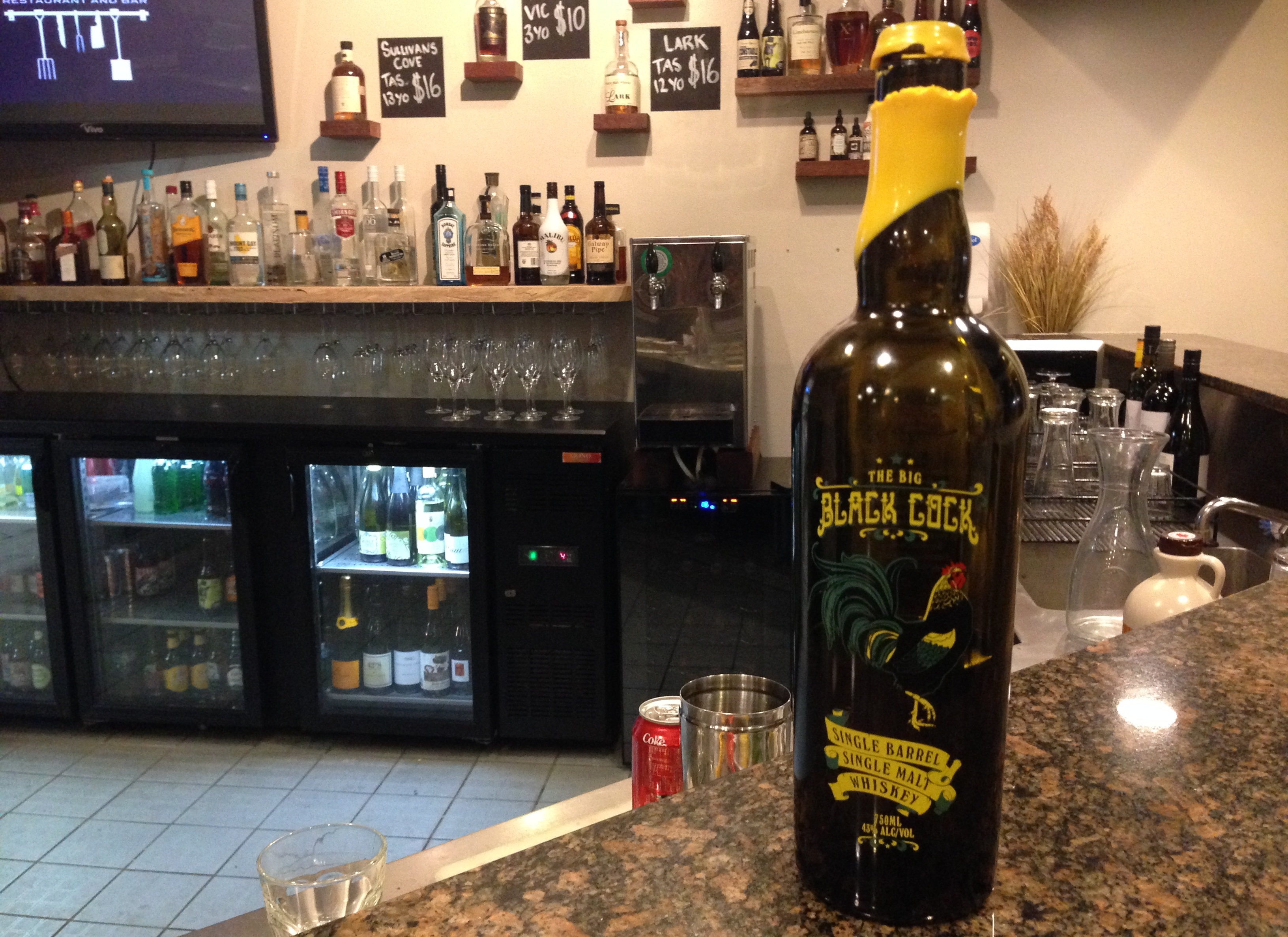
The Big Black Cock Single Malt

Reviewed by: Nick

BBC

Crikey! Now I know whisky is made in some pretty far out places but leaning towards the more radical end of the scale would have to be Mt Uncle Distillery in North Queensland. Despite the immense heat and being located on the outskirts of woop-woop, they have managed to produce a grouse little drop.

The 5 Year Old single malt has one of the more dinky-di whisky names going around. The drinks menu I had a gander at when first sampling it read BBC. However, the large rooster on the front of the bottle makes it clear: this whisky is called the Big Black Cock. It is fair dinkum outback whisky. And strewth: it tastes the part.

On the nose there are faint hints of malty Arnotts biscuits – quickly drowned by whiffs of recently slashed sugar cane and double coat tim tams. On the palate there is vanilla – perhaps a little too much – accompanied by Anzac biscuits and cherry ripe. There are also some bitter fruit elements – possibly created by the ex-red wine barrels they were matured in: American oak staves with French oak lids. The finish is warm and a little rough with spicy meaty notes, like snags on a barbie.

If you ever come across the BBC in a whisky bar down under it is certainly worth ordering – if only to be forced to say the name out loud – but also because of the beaut, uniquely Australian flavours to be found. This is true blue outback whisky. It’s unrefined. But a ripper.

★★★

Moseying on over to Mt Uncle: a visit to North Queensland’s only distillery

Posted by: Nick, photos by Paul Moran

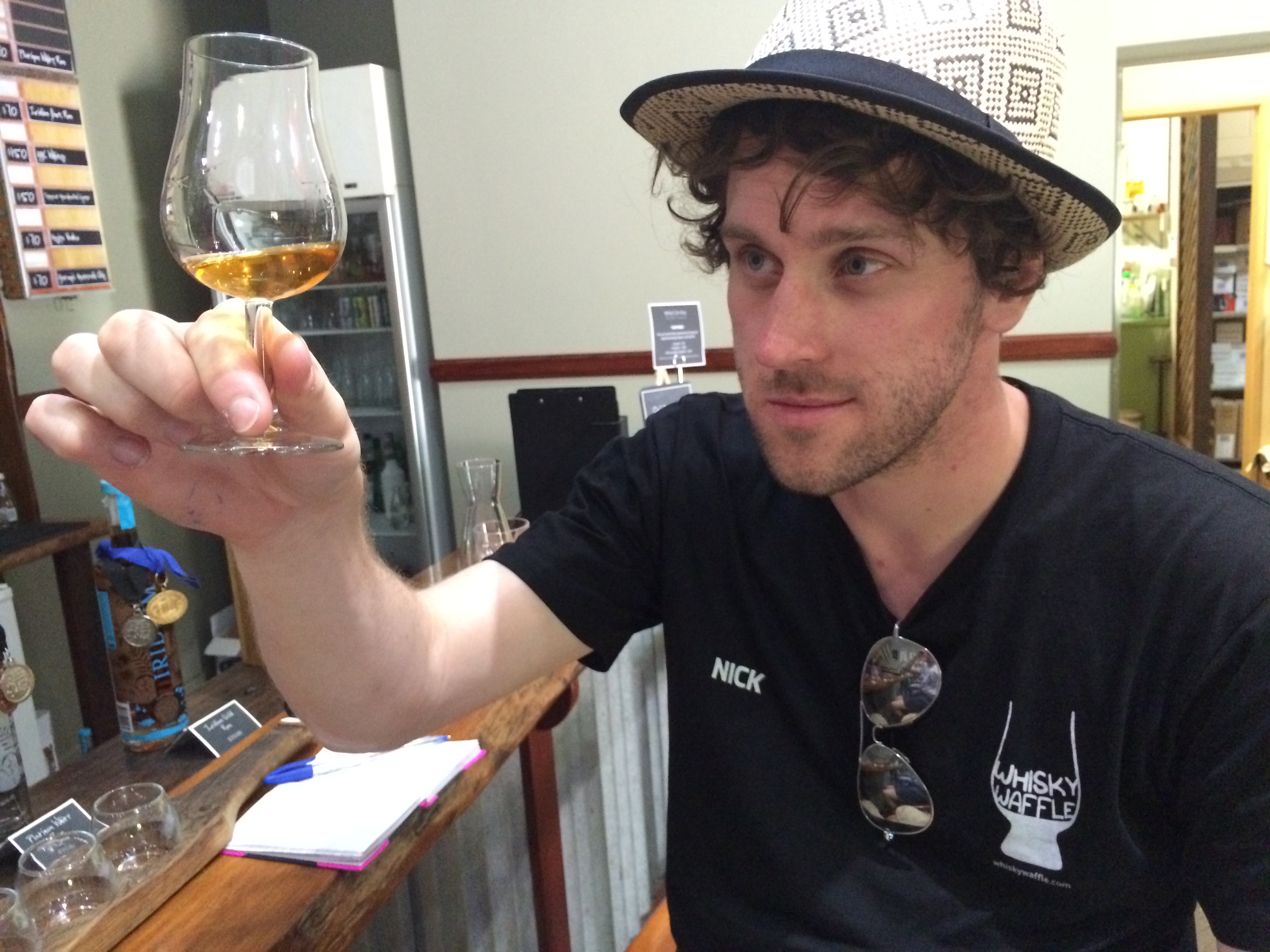
1 Nick at Mt uncle

Any excuse to wear the shirt.

I’m not sure what I expected from an outback distillery. Certainly not a wood and stone hut surrounded by a banana plantation with native animals roaming freely over the site. But it turns out that the outback distillery Mt Uncle is exactly that: a distillery in Australia’s outback.

Mt Uncle can be found half an hour from Cairns and is North Queensland’s only distillery. This means that it is the only whisky producer for a nearly 2000 kilometre radius – but I wasn’t going to let a small detail like that deter me!

2 BBC

I am prepared to travel for my whisky

The business was founded fifteen years ago by farmer Mark Watkins, and originally produced banana liqueur – a more conventional business in this part of the world. But in 2006, he bravely made the switch to distilling barley and is now reaping the rewards. Mark, however, is not big on tradition, preferring to do things his own way. This is in evidence with the name of his yellow-wax-dipped five year old single malt: The Big Black Cock. The large dark-feathered rooster on the front of the bottle clarifies the source of the controversial name.

3 BBC

Three big black cocks

And it’s a proper outback whisky. Buttery vanilla on the nose with dashes of various native vegetation. The palate is fruity and bitter, perhaps due to the ex-wine barrels it was matured in: American oak with French oak tops. The finish is long, and a little rough. Overall, an intriguing mix.

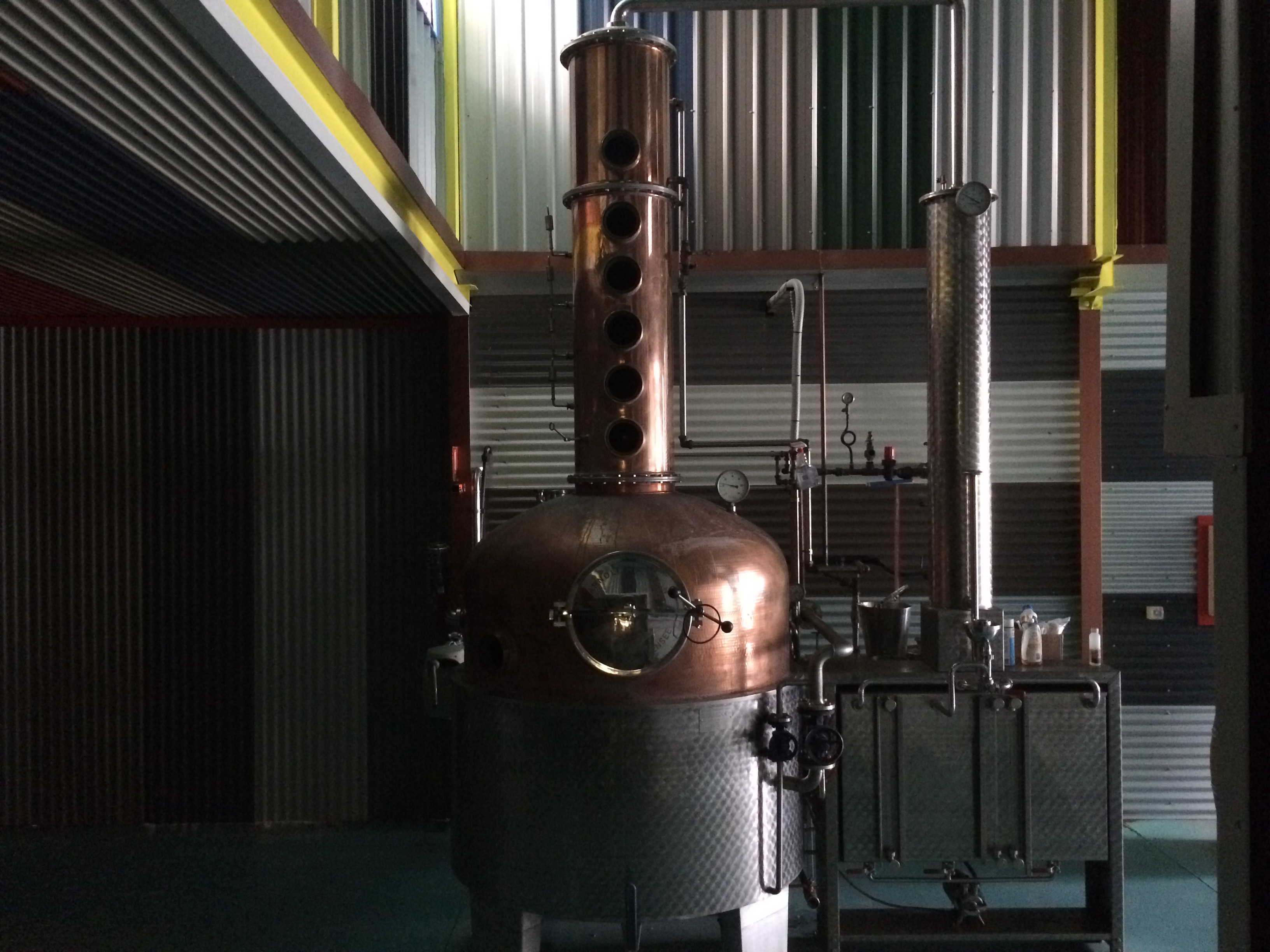
5 Still

Pot still, or column still? Or both?

The whisky was not the only product made at the distillery – Mt Uncle also produces a vast range of other spirits. This included an interesting vodka made from honey, and a light and a dark rum, both easy to drink. There was also a proper bush gin, made with botanicals such as wattle seed, peppermint gum, lemon myrtle and Lilly Pilly. Finally, a bright pink concoction claiming to be marshmallow liqueur, provocatively titled SexyCat. And it was delicious. Dangerously so. Perhaps also embarrassingly so. But certainly a memorable addition to the Mount Uncle range.

6 Sexy Cat trier

Perfectly acceptable for male drinkers everywhere… I’m telling myself…

Myself and my drinking-buddy-of-the-day Paul had a great time sampling the products, chatting with staff and wandering around the grounds. We kept remarking how nice the place was, though we had to keep reminding ourselves that it was a distillery. It was certainly not what we expected. But we were in tropical North Queensland surround by banana palms. How could we expect anything else?

4 the range

The range: and yes, the SexyCat is sitting in a high heel shoe!

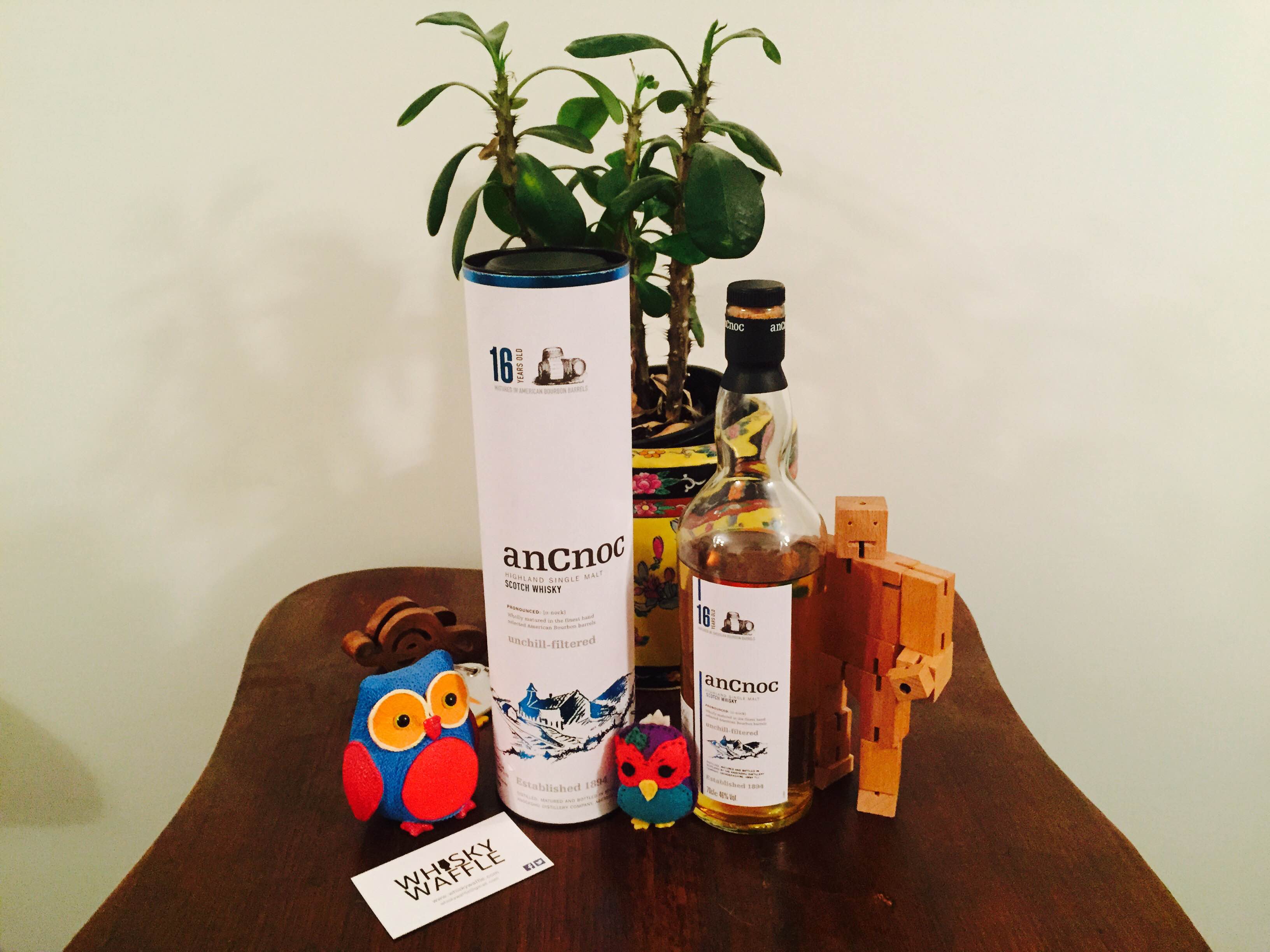
anCnoc 16 Year Old

Reviewed by: Ted

anCnoc 16

One of the fun things about whisky is that it can reveal to you a time and place as part of its character. If the anCnoc 12 Year Old is a summers day, then surely its older sibling, the 16 Year Old, is the evening.

Produced by Knockdhu Distillery, founded in 1894 and one of the smaller operating distilleries in the Scottish Highlands, the AnCnoc 16yo is a burnished gold in colour, darker than the straw-like 12yo.

On the nose the 16yo is smooth and sweet, with no hint at all of the occasional raw alcoholic jaggies lurking in the 12yo. Herbs, particularly mint, garnish a bowl of caramelised pears in syrup dolloped on Weetbix. The taste is sharp and bright, striking the upper palate. The finish is hot and bittersweet, drying the mouth and lingering for some time afterwards.

The AnCnoc 16yo is much better rounded than its younger kinsman, with maturity found through age. While the 12yo has the heat, dustiness and brashness of the day, the 16yo is the relaxing warmth of the evening. A perfect companion to watch the light fade on a clear summer night.

★★★