Whiskey Waffle

Whisky Waffle Episode 6

Posted by: Nick

The Whisky Waffle Podcast is back! With an additional exciting new feature: episode titles! Episode 6 is titled: Five regions… and Campbeltown.

This episode contains:

– The Waffle, where we introduce Scotland’s five whisky regions… and Campbeltown

– The Whisky, where we taste two highland whiskies from very near Speyside, the AnCnoc 16 Year Old and the Glendronach 12 Year Old

– Whisky Would You Rather, where Ted makes Nick choose between his eyes and his stomach; and

– From the Spirit Sack, where we are asked a geographical question about whisky

Whisky Waffle Logo 1

Kings County Bourbon 43%

Reviewed by: Ted

Kings County Bourbon 43

This is about as hipster as I get. Leaning up against a rough-sawn wooden bar in a small craft beer joint in Kyoto and sipping some NYC bourbon poured from a 375ml bottle with a label that looks type-written. In fact, as I type these words, a number of Japanese gents wearing round steel-rimmed glasses and with beanies perched on their heads have just walked in. I am probably not cool enough for this place.

The bar is called Bungalow; the fact that it is separated from the busy street outside by only a clear plastic screen somehow makes it seem even more edgy. The vibe inside is very chill though, with friendly bar staff, a selection of Japanese craft beers and luscious funk tunes oozing from the speakers.

It also has precisely one whiskey, the Kings County Bourbon Whiskey. Apparently the owner is friends with the importer of the Kings County and is a fan, hence its presence as the only whiskey in a craft beer bar.

Kings County is apparently the oldest operating whiskey distillery in New York City… Est. 2010. It’s youth is due to the fact that it is the first whiskey maker in the Big Apple since prohibition ended. Based in the old Brooklyn Navy Yards, they craft spirit in their Scottish-made still using corn and barley grown on-site. It’s very much part of the dynamic and sustainable ethos that exists in Brooklyn today.

kings-county-bourbon.jpg

All the details…

The spirit itself is a very dark copper colour and is bottled at a pleasing 45%. Being a bourbon it has that heavy, corn-driven punch, but in this case it’s pleasantly not overpowering. There’s a sweet, savoury sharpness that evokes some of the flavours that I have come across in Japan. Soy sauce, mirin, that sticky stuff I had on that grilled meat in that yakitori joint, a hint of salt and tuna sashimi. Of course, these flavours are super-subjective seeing as this is a through-and-through American spirit. I’ve just been exposed to a lot of eastern flavours this past week.

The mouth-feel is solid. The usual big, sweet corn flavours are there, but they are well controlled and even-tempered. It has a crispness and acidity that evokes a glass of Sav Blanc or Pinot Grigio, leaving a nice juicyness to linger on the palate. There’s a buttery, saltiness too, like that scallop I had in Kuramon Ichiba Market that was grilled over coals in its own shell.

The Kings County is a damn fine whiskey, perhaps made even better by dint of my current geographical location. Kyoto is a beautiful city, Bungalow is just my kind of bar and the Kings County is an excellent finish to the day. If you’re going to drink a whiskey you’ve never heard of in a bar in Japan that you stumbled across by chance, consider making it a Kings County.

★★★★

Kings County Ted

Thus Spake Jim Murray – 2018: A Whisky Bible

Posted by: Ted

Zarathustra2

Daaah…. daaah…. daaah………. DA DAAAAAAHHHHH!!!!!!!!!!! bom bom bom bom bom bom…

Sunlight oozed slowly across the darkling plain and up the face of the towering monolith. Its surface was like the purest of amber and there was a strange feeling of energy surrounding it. A group of primitive whisky writers, bloggers and critics lounged and tousled nearby, random, semi-intelligible cries like ‘bold coastal flavours’, ‘herbal undertones’ and ‘it has notes of sour plums’ punctuating the air.

One of the bloggers suddenly whipped his head up and stared intently at the monolith, before hesitantly creeping towards it. His companions quietened, the fibres of their tweed vests glinting in the sunlight as they watched their brother’s progress. The blogger halted nervously at the base of the monolith and carefully stretched up his hand toward the surface.

As soon as the blogger’s fingers brushed the unnaturally smooth amber surface, images poured into his mind, burning like distilled fire. Strange bulbous glassware… odd metal cylinders plunging into barrels to feed off their liquid hearts… infinitely high stacks of experimental casks with cryptic names like ‘gaja barolo’, ‘tokay’ and ‘sauternes’… fractal distillers endlessly chanting ‘Phenol quercus lacotone alba aldehyde robur’… towering columns of smoke that reeked of the sea… a tumultuous barrage other images too hard to describe, let alone understand.

Finally the terrible visage of a golden-eyed god appeared, his corona of white hair crowned by a panama hat. The god spoke, terrible, thunderous tones lancing into the mind of the blogger:

“Behold, these three releases shall be the best whiskies on earth in 2018:

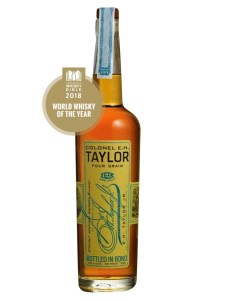
1.Colonel E.H. Taylor Four Grain Bourbon

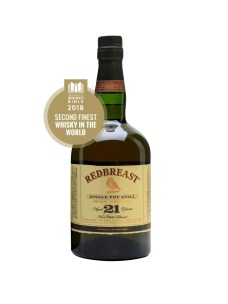
Winner2. Redbreast 21 Year Old

Second winner3. Glen Grant 18 Year Old

Third winner

This is the decree of Jim Murray, heed it and remember.”

Suddenly the raging tempest of images assaulting the blogger stopped, like the fabric of the universe had been sundered by a knife. As he withdrew his hand he felt a sudden feeling of purpose, a clarity of mind that pierced to the very centre of his spirit. He swung around and stalked with intent towards the biggest critic in the group, who was pontificating forcefully that ‘while other styles have certain merits, it is the sheer complexity derived from its long and rich history that elevates Scotch above all other forms.’

Daaah…. daaah…. daaahhh…. Ba BAAAAAAHHHH!!!!!! bom bom bom bom bom bom…

With a wild cry of ‘Bourbon is the new king!’, the blogger struck the critic a terrible blow and smote him to the ground, while the other wordsmiths hammered on their keyboards, hooting and gibbering in excitement. The blogger stood panting for a moment, then turned and strode away from the great amber monolith, his companions trailing behind their new leader, a sudden sweet, rich, punchy sensation pervading their minds.

Finally, the only thing left in the dying light was the monolith, the mysterious energy surrounding it holding a sensation of waiting, of expectation and anticipation, like somehow it knew that one day this would all happen again…

Fin

(To find out Jim Murray’s other decrees for his 2018 Whisky Bible, head over to The Whisky Exchange blog)

Spending Time at Sullivans Cove

Posted by: Nick

Sullivans Cove Whisky Waffle 1

If you’ve only heard of one Tasmanian distillery, chances are that distillery is Sullivans Cove. Based in Hobart and formerly known as Tasmania Distillery, this founding father of Tassie whisky has a chequered and yet ultimately inspiring past and, as we Waffle boys discovered when we visited their site recently, an extremely promising future.

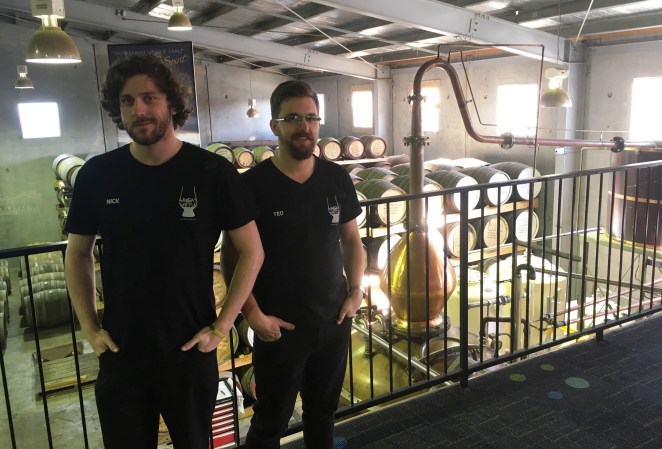
Sullivans Cove is one of Tasmania’s most visitor-friendly distilleries. The viewing platform looking out across the bond store is a proper money-shot (see above!) and in keeping with the establishment’s status as Tassie’s poster-child distillery. This honour was thrust upon Sullivans Cove in 2014 when a bottle of their French Oak Cask won the prestigious World’s Best Single Malt at the World Whiskies Awards and changed the face of Tasmanian whisky forever. But as our generous host, Strategy Manager Fred Siggins, was keen to point out, there is so much more to Sullivans Cove than barrel HH525.

Sullivans Cove Whisky Waffle 6

Consistency in flavour is a difficult task for the fledgling Australian whisky scene. Due to the size of the industry (or rather the lack thereof) most releases are the product of one barrel and therefore the flavours vary from bottle to bottle. While some distilleries choose to conveniently sweep this issue under the carpet, Sullivans Cove embrace it, hand labelling each bottle with a sticker informing the purchaser exactly which cask or casks are contained within. The result is that a dram of one French or American Oak bottling will be unlikely to taste identical to a previous one.

While this approach ensures Fred is continually explaining to customers why their new bottle tastes slightly different to their old one, it also forms one of the most exciting aspects of the distillery. During our visit we were lucky enough to sample not one, but two of the French and American Oak expressions. Had they not featured the distinctive blue and black labels we may not have picked them as the same bottling.

Sullivans Cove Whisky Waffle 7

In each case one dram was smooth and easy drinking and the other vibrant, fresh and zingy. Excitingly, we could not work out which of each we considered to be the better drop – instead deciding that we would prefer one over the other depending on the mood we were in. Fred agreed and recommended that Sullivans Cove customers leave a small amount in one bottle before opening the next, to really appreciate the difference.

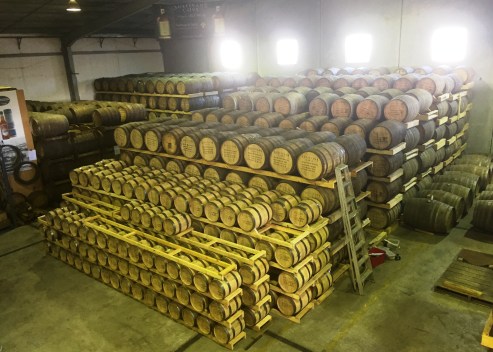
The other exciting aspect of the distillery is the age of the whisky in the bond store – and in their bottles. Sullivans Cove head distiller Patrick Maguire has been creating whisky since taking over the company in 1999 and giving it a much-needed new lease on life in the process. This means that some of the barrels are now pushing 18 years old, an incredible age for an Australian spirit.

Sullivans Cove Whisky Waffle 5

Both the French and American Oak releases are usually aged for anywhere between 10 and 17 years while the entry level Double Cask release, a marriage of 2 to 4 American Oak barrels and one French Oak barrel, contains a cross section of particularly mature whisky, unheard of in any other Tasmanian release.

The only drawback of this premium method of whisky creation is the premium price. Sullivans Cove make no bones though about the fact that they make a premium product and are not looking to change that any time soon. Fred did point out, however, that there is a lot of new Australian whisky coming into the market currently demanding a similar (or greater) price to the Sullivans Cove Double Cask. While this new stock is exciting, the whisky is likely to only be 2 to 3 years old. When compared with the potentially 17 year old whisky found in the Double Cask, it really paints the Sullivans Cove price point in a positive light.

Sullivans Cove Whisky Waffle 4

Sullivans Cove is now one of the most recognisable brands in the New World spirits scene, an achievement which is a true testament to the work put in by Patrick Maguire all those years ago. For a very long time, his whisky creation was a labour of love, an unprofitable venture fuelled by passion rather than profit. The rules have now changed, however, and currently there are over twenty distilleries in operation in Tasmania – with more on the way. It is certainly no overstatement to say that this reality may not have come to be if not for Sullivans Cove Distillery.

Sullivans Cove will be open for tours seven days a week, starting in September! Tours depart hourly and can be booked at the Sullivans Cove site.

Sullivans Cove Whisky Waffle 3

Hakushu Distillers Reserve

Reviewed by: Ted

Hakushu Distillers Edition

It can be a tricky and expensive task getting hold of age-statement Japanese whisky these days. If you’ve been paying attention to global whisky trends over the last five years-or-so, then you’ll know that Japanese whisky has been bang on-point and very much in demand by the smart set. The boom in sales, both locally and overseas, and a slight lack of foresight around barrel management has seen distillery stocks dwindle, so much so that that the two major players, Suntory and Nikka, have had to temporarily discontinue certain aged releases from their distilleries.

Naturally, the shortage in stocks has caused prices to skyrocket. I mean, just the other week I had the opportunity to buy a Yamazaki 50yo 3rd Edition 2011 Release for the low, low price of $157,763.99USD (I lashed out and got three)! Now, admittedly that is a bit of an outlier on the super-premium end of the scale, but even 12yo releases (if you can find them) are generally no less than $150AUD and more often than not well over $200.

So what does a common-or-garden whisky drinker do if you want to own a Japanese whisky without having to count your kidneys? Well, as it happens, there is an answer. These days most Japanese distilleries offer a Non Age Statement release of their product. While superficially a marketing device, the NAS releases are actually crucial for the ongoing survival of the distilleries, allowing continued market access by marrying dwindling older barrels with younger stock coming online.

An example of this is the Hakushu Distiller’s Reserve. While you can still find the 12yo for around $180, the distillers edition is available for a far more wallet pleasing $110. Located NW of Tokyo near Hokuto, an unusual feature of the Suntory owned Hakushu is that it boasts a bird sanctuary within its leafy grounds at the base of Mt Kaikomagatake in the Southern Japanese Alps.

Apparently the Hakushu Distiller’s Reserve marries younger lightly peated malt and heavily peated malt around the 8yo mark with American oak-aged spirit of around 18yo. Or so the internet, repository of all things, tells me; you certainly wouldn’t pick it as being peated if you tried it blind.

On the nose the Distiller’s Reserve is bright, fresh and zingy, delivering a satisfying bouquet of crunchy green apples, sour plum, lemon grass, mint and citrus (Yuzu if you want to get technical according to Hakushu). The scent is clean and light, like a crisply pressed kimono, although after a bit of breathing time it develops a softer, creamy edge.

On the palate the spirit is sharp, clean and metallic, like a samurai sword across the tongue, and delivers a hit of hard, sour stone fruits and a twist of lemon rind. The finish is lingering and herbal, with perhaps a touch of green tea. Couldn’t find that smoke though I’m afraid, although to be honest, with the flavour profile presented by the Distiller’s Reserve I didn’t miss it either.

People quite often get a bit salty about the concept of NAS releases, considering them to be inferior to age statement releases (often without real justification… although sometimes merited for sure, but we won’t go into that particular Reserve here). I am pleased to say however, that in this case the NAS epithet is not a negative one.

But that’s what the Japanese do isn’t it? They take a thing, study it with care and then make not just a copy, but something that is even better than the original. Which is lucky really seeing as the Distiller’s Reserve will be about all we can reasonably get our hands on from Hakushu for the foreseeable future. In conclusion, if you want to see a NAS done right, then look no further than the Hakushu Distiller’s Reserve.

★★★
Mendis Old Arrack

Reviewed by: Mum’s the Word

Mendis Old Arrack

Foreword by Ted:

Long-time readers of Whisky Waffle will know that I occasionally mention my mother on the blog, usually after she’s sourced something for me while travelling. Behind the scenes I usually run articles by her just to make sure the grammar is correct and there are no spelling mistakes.

Well, in a surprise move, Catherine has jumped down the rabbit hole and submitted a review all of her own after a visit to Sri Lanka. Arrack (not to be confused with Arak) is a South-East Asian spirit distilled from fermented coconut flower sap, although the precise methods and ingredients vary from place to place. The Sri Lankan version reviewed here is actually made rather like whisky, with the sap fermented in wooden washbacks before being twice distilled and finally aged in halmilla-wood vats for up to 15 years.

Now, Whisky Waffle purists will note that Arrack doesn’t contain a grain as its base and therefore is outside the usual remit of our blog. I on the other hand suspect it is rather poor form to turn your mother down when she has gone to the effort of writing you an article, so we’re more than happy to make the exception. And Arrack is sometimes known as Sri Lankan whisky, so there! So, sit back and enjoy this fresh article by Mum’s the Word:

Sri Lanka

When I have occasionally had a sniff of whisky, and a bit of a taste, my sinuses are generally cleared instantly and my taste buds and palate set on fire.

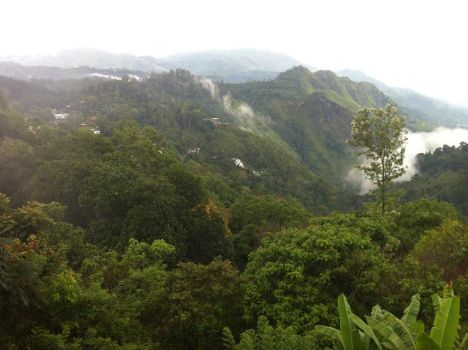
Not so on this occasion. In the spectacular setting of Ella in Sri Lanka I tasted Arrack – a Sri Lankan spirit made from the fermented juice of coconut flowers. The particular version I tried was the Mendis Old Arrack 100% Pure Coconut Arrack, naturally aged in halmilla (wood from the Tricomalee tree) vats.

The nose was mild (did not offend the sinuses) and faintly perfumed – coconut flowers? The first sip was sweetish with subtle flavours of … coconut? [Ed. Are you surprised?] The general flavours were reminiscent of Mum’s rice pudding or a delicate crème caramel (the WW boys would find many more descriptive words, but they have the ‘experience’ AKA the gift of the gab!) but there certainly was an alcoholic kick – especially after the third slug.

I think the subtle flavours would have been lost if diluted with ice/coke/soda as some of the group had, but served neat for me was delicious. It paired very well with a home-cooked Sri Lankan curry meal, the flavour being savoury, mildly spicy and certainly not sweet.

A certain Whisky Waffler son admitted a sneaking suspicion that he had tried Arrack before … “I say sneaking because I’m pretty sure I was kinda wasted at the time,” so anything he may be able to contribute on the subject may not count [Ed. Oh, and may I enquire just how much you had to drink, eh?]. I was planning to buy some Arrack in Sri Lanka duty free for further tasting with the expert advice of said son, but they didn’t have any!! Weird and disappointing.

Arrack would be a great start for the novice whisky/spirit drinker who did not want to be knocked off their seats.

★★★★  (but who am I to say?).

Larking about at Lark

Posted by: Nick and Ted

1a

Fact: the modern Tasmanian distilling scene was founded by Bill Lark.

Fact: the foundations for Whisky Waffle were laid down at the Lark bar.

Fact: it is rather shameful that we have never found the time to visit the Lark distillery

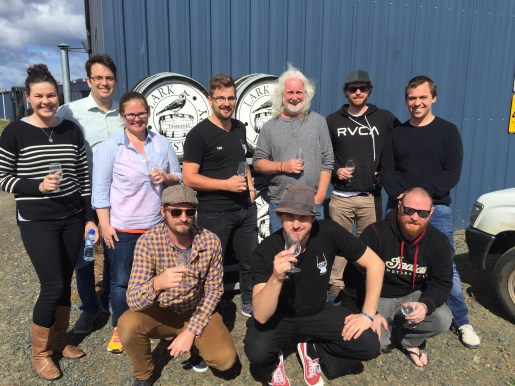
Recently the Whisky Waffle boys were down in Hobart with a rare free day to spend on whisky business, so we decided to take the opportunity to rectify an embarrassing gap in our Tasmanian distillery bucket list and tag along on an official Lark distillery tour.

1

We were about to run away with the barrels when we discovered they were empty.

Lark offers a two-hour daily guided tour of their distillery facility out at Cambridge, 15min east of Hobart. Our tour started at the Lark bar in Hobart where we met Guy, our guide, and the rest of the group. To work out in what order to hand out the complimentary Lark tasting glasses, Guy started off by asking how close everyone lived to the distillery. Surprisingly it turned out that we North West coasters were the only true locals, with the other guests ranging from Melbourne and Sydney to Alabama.

After introductions we all piled into the tour van, affectionately known as the ‘Drambulance’. On the way out to Cambridge Guy regaled us with tales of the history of the Australian whisky scene and the part Bill Lark played in its resurrection. The road into the distillery passes through the grounds of Frogmore Creek winery, the vines providing wild yeast that is encouraged into the Lark fermentation vats to help create the unique Lark flavour.

The distillery itself, in true Australian fashion, is in a large tin shed that overlooks the Coal River Valley. Upon arrival we donned fluoro vests and met Chris Thomson, the self-proclaimed ‘most experienced distiller in Australia’ (and who are we to argue with him).

3

Chris Thomson was also thrilled to meet the two most experienced Tasmanian whisky bloggers in Australia! (again self-proclaimed)

To lubricate our minds before starting the tour we were provided with a dram of the Lark Classic Cask, a perfect breakfast whisky (or at any other time of the day for that matter). Guy and Chris took us through the distilling process at Lark, from the Bill Lark-designed peat smoker, to the fermentation and the distillation.

Along the way the way we were able to try wort (aka sweet barley juice), wash (aka unhopped beer) and new-make spirit, which was fruity and soft. Chris gave us some handy nuggets of distilling advice such as “when going from the fores to the heart we smell and smell and smell and smell and smell and smell” and “using our amazing distillers skills we make the first cut,” *moves hose casually from one vat to another* “Very technical”.

7

Those are some niiiiice sparge arms!

The final part of the tour was spent in the bond store (also a large tin shed) where Guy told us about barrel making and aging. We were also able to try some Lark straight from the barrel, which Guy fished out with a spirit thief, as well as some whisky from sister-distillery Overeem. Also on offer were Lark’s whisky liqueur, Sláinte, and several variants of their Forty Spotted gin.

6

Every Lark tour is a barrel of laughs.

At the end of the sampling session our merry band of tourers re-embarked the Drambulance and headed back to the Lark bar. The tour had been a pleasant and informative mix of whisky stories, hands-on experience, technical information and waffling. Most importantly, we Waffle boys were finally able to show our faces in public again and proudly say that we had been to the distillery that started it all.

2

The best thing about whisky tour groups is that you all end up best mates at the end!

Inver House Green Plaid

Reviewed by: Ted

Inver House Green Plaid

Earlier this year I found myself hunting around for a passable quaffing Scotch to take away on our annual summer pilgrimage to Coles Bay (for those who are not familiar, Coles Bay, on the east coast of Tassie, is the town that sits on the edge of Freycinet National Park, home to the world famous Wineglass Bay. Check it out!).

M’colleague and I would define a quaffing Scotch as a whisky at the lower end of the price scale that manages not to taste like paint strippers and that you are more than happy splash around while in company. Like on a camping trip, for example.

After a bit of poking around I came across the Inver House Green Plaid Scotch whisky. On the face of it, the Inver House certainly looks like it fits into the sub-$40 (AUD) category (I think mine was about $35). Take four parts green tartan, add a crest, a couple of sprigs of Scotch thistle and a blurb about how Clan Donald is totally the bestiest evaaaa!!!, and there you have it.

But dig a little deeper and suddenly the Inver House starts to look a bit more interesting under the hood (apologies to my mother for this turn of phrase, but ‘under the bonnet’ just doesn’t seem to work as well somehow). Turns out Inver House Distillers Pty Ltd have quite a choice little stable of distilleries in their portfolio, namely – Pulteney, Balblair, Knockdhu, Speyburn and Balmenach.

Discovering that little nugget of information begs one the question: could this el-cheapo blend actually be a nugget of shining liquid gold??? Well… no. But it’s not too bad either.

As one might expect based on its (potential) components, the Inver House is fresh and bright, with a lick of grain, pear, apricot, grass and hazelnuts. Could that be a faint whiff of coastal air from Pulteney I detect… or just the result of my fervid imagination? It’s a tad rough, yeah, but not disastrously so.

The mouth is bright and pithy, with a generous hit of Lisbon lemons, butterscotch and wood polish. The finish makes your mouth pucker a bit like you’ve just taken a bite out of the aforementioned citrus fruits and then licked a metal spoon.

Look, the Inver House isn’t going to win any awards, regardless of its theoretical hidden pedigree. It’s kind of like when someone claims to be an Nth degree relation to the royal family. Cool, but there’s a lot of stronger contenders to get through before they get anywhere near the throne.

But for what it is, the Inver House is actually pretty good. You can happily drink it straight if that’s your groove, or if your mates want to mix it with coke then you’re not going to have to get your disapproving whisky-wanker face on. If you want a budget dram that you can share liberally with friends and have a good night of it, the Inver House has you covered.

★★

Buffalo Trace Kentucky Straight Bourbon

Reviewed by: Nick

buffalo-trace

Tastes like bourbon.

Ok, I freely admit, that statement alone does not do this dram justice. After all, this is whisky made at one of the oldest distilleries in the world! And yes, I do include Scotland in this claim.

Buffalo trace was founded in 1787 at a small settlement called Lee’s Town, a town presumably established by someone called Lee. The title ‘Buffalo Trace’ was given to it much later, but refers to the 18th century name for the distillery’s location: a trail forged by American bison as they crossed the Kentucky River. Buffalo Trace continued sending whiskey up the river across the ensuing centuries – even during prohibition when it was given a permit to produce medicinal whiskey. Unsurprisingly it was a very popular remedy.

But how does it taste?

Like bourbon.

No!

Well, yes.

But it’s good bourbon!

On the nose is, as you’d expect, sweet corn and vanilla, but also present are subtle notes of cinnamon and brown sugar. The palate is lightly spicy with grassy oak notes. The finish is medium in length with flavours of toffee and honey.

All in all, Buffalo Trace is a great example of a bourbon. It’s accessible and, all things considered, pretty darn smooth. Best of all, it’s a bourbon with a story. It allows you to cast your mind back to the late 1700s when settlers battled to survive – and make whiskey on the side!

And it tastes like bourbon.

★★★

Big Score for Ardnahoe: Jim McEwan joins the team

Posted by: Ted

ardnahoe-distillery

With an area of only 620km2 (ok, 619.6km2 if you want to be precise) Islay isn’t exactly a huge place. But what it lacks for in size, it certainly makes up for in the number of distilleries it has nestled on its shores, boasting a total of eight whisky makers. Excitingly though, in 2018 things are set to get even more squishy with the completion of a brand new distillery.

Taking the name Ardnahoe from the nearby loch from which it will draw its water, the new distillery will be built to the north of Port Askaig, nestling in between venerable stalwarts Caol Ila and Bunnahabhain, and will boast magnificent views across the Sound of Islay to neighboring Jura. The venture represents the first new distillery to be built on Islay since the opening of Kilchoman in 2005.

Ardnahoe is owned by the Glasgow based Hunter Laing & Co, an independent bottler and blender established in 2013. Run by Stewart Laing and sons Andrew and Scott, the company owns brands such as Old & Rare, Old Malt Cask and The Sovereign.

Ardnahoe will be the first distillery owned by the company and will not only allow them to directly tap into the global demand for Islay whisky, but also to have complete control over the whole spirit-making process. While announcing the project greenlight last year, Andrew Laing noted that: ‘Since starting our company we’ve seen a huge demand for Islay whisky around the world, and now is the perfect time to make the progression from blenders and bottlers to distillers, and secure our own supply of Islay single malt.’

To help with that transition, Hunter Laing & Co has managed to lure a local legend and bona fide rockstar of the Scottish distilling scene out of retirement to act as their Production Manager. Jim McEwan, until recently Master Distiller for Islay mavericks Bruichladdich, will play a pivotal role at the distillery, supervising everything from production processes to cask selection and even design of the equipment.

jim-mcewan-n-co

Jim McEwan (second left) with the Ardnahoe team

Reflecting on his choice to come out of retirement to work at Ardnahoe distillery, McEwan said: “I had intended to ride off into the sunset, but I’ve known Stewart for many years and have always been impressed with Hunter Laing whisky. When the call came in, it really excited me…

“It felt as though the stars were aligning; the amazing location, my history with Islay, my relationship with the Laing family, their passion for the project, the calibre of architect Iain Hepburn, plus my chance to get involved with the design of the distillery for the first time in my career, all made it feel like it was ‘meant to happen’.”

The Laing family are certainly excited about their choice of appointment too, with Andrew Laing proudly stating: “It’s hard to think of anyone better qualified than Jim McEwan to develop the character of the newest Islay malt whisky. Jim has lived and breathed Islay whisky his whole life and is bringing all of his passion and knowledge to Ardnahoe Distillery. The three of us are hugely impressed with the whiskies he’s produced in the past and can sleep easy knowing that he is in ultimate charge of whisky-making at Ardnahoe”

All that remains to do now is wait for the distillery to bear fruit. While that day is still many seasons away, you can guarantee that with Jim McEwan at the helm and Hunter Laing & Co’s passion for quality, the drams plucked from the tree of Ardnahoe will be very tasty indeed.