Scotland

Navigating to the New World Distillery: meet the purveyors of Starward

Posted by: Nick

New World visit 1

Behold, the New World of whisky!

The New World Distillery is a whisky-making establishment like no other. Equal parts industrial warehouse, hipster bar and mad scientist’s laboratory, stepping through the door I felt like I had slipped down my very own rabbit hole into whisky-wonderland.

Located in Melbourne’s north, the distillery is just a stone’s throw away from the bustling international airport. This is appropriate as the building is a vast refurbished aircraft hangar. The huge room is separated into partitions by rows of whisky barrels – a particularly novel bond store! In one corner of the room is a classy-looking bar with shelves bearing a massive range of the whiskies made on site – each with a premise more curious than the last. It was clearly going to be a good evening.

New World visit 6

Is that a pumpkin spiced gin amongst that lot?

Before settling in at the bar for an extended tasting session, there was the small matter of the tour. My guide on this adventure around the immense room was Paul, a man who I discovered was no stranger to a bit of whisky waffling. While the whisky production at his distillery was covered in detail, we also got sidetracked with conversations about peat, barley farming, excise tax and wood-smoked barley.

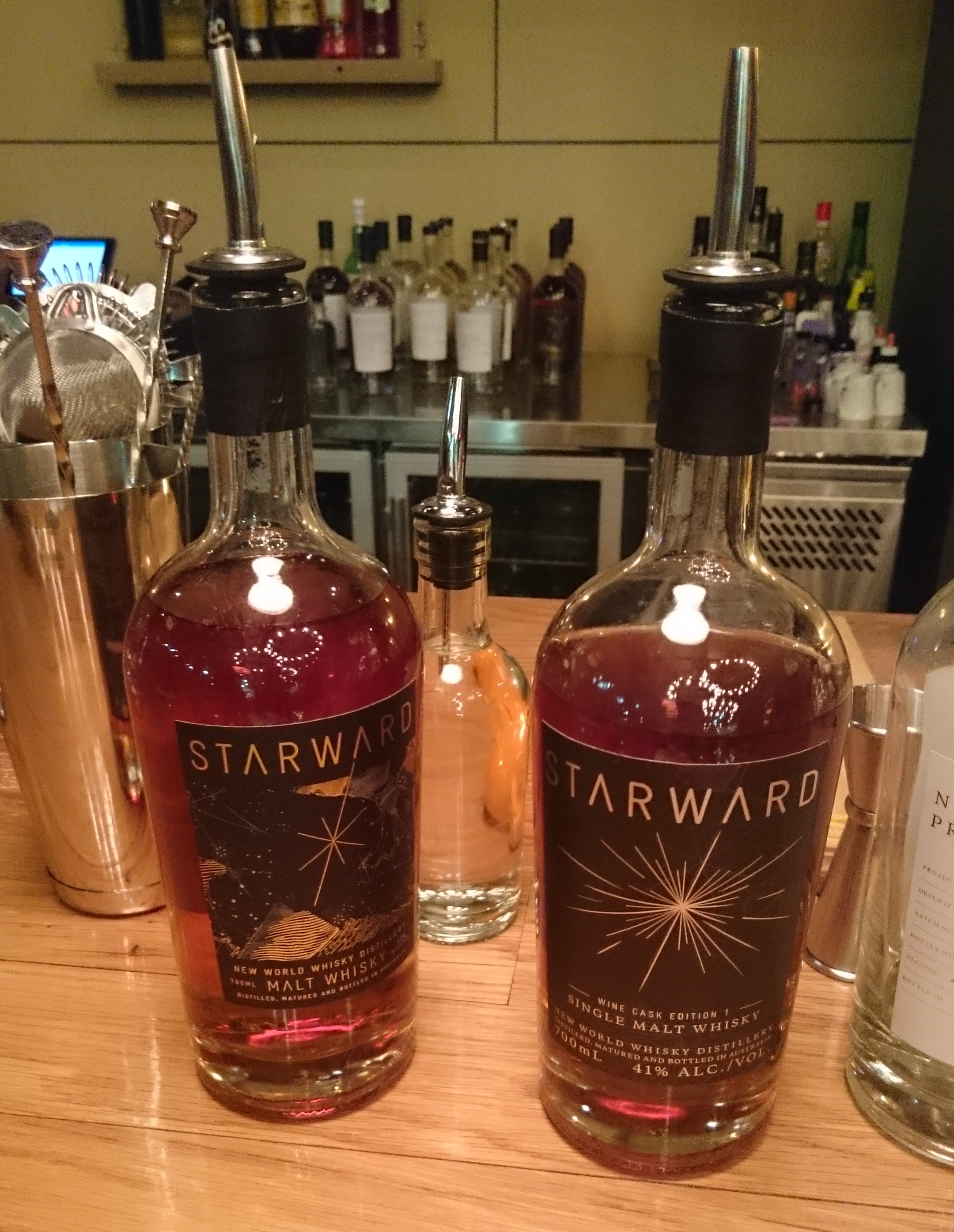
New World Distillery has been operating since 2010, releasing their main product under the label Starward. While Starward was originally exclusively Apera matured spirit, they have recently released a second variety aged in ex-Barossa Valley Shiraz casks. These aren’t the only bottles being created here however. The people at New World enjoy pushing boundaries; if not breaking the rules, certainly bending them a little. The most successful of these are released as a special range known as ‘New World Projects’ and well worth checking out.

The tour is engaging and informative: in particular Paul’s analogies likening making wort to brewing a cup of tea and charring barrels to burning sugar, explaining these obscure concepts effectively. I also got a generous swig of the new make spirit which I found light and fruity without losing its typical high-alcohol warmth. All in all it was one of the more (dangerously) easy-drinking new makes I’ve tried.
New World visit 3

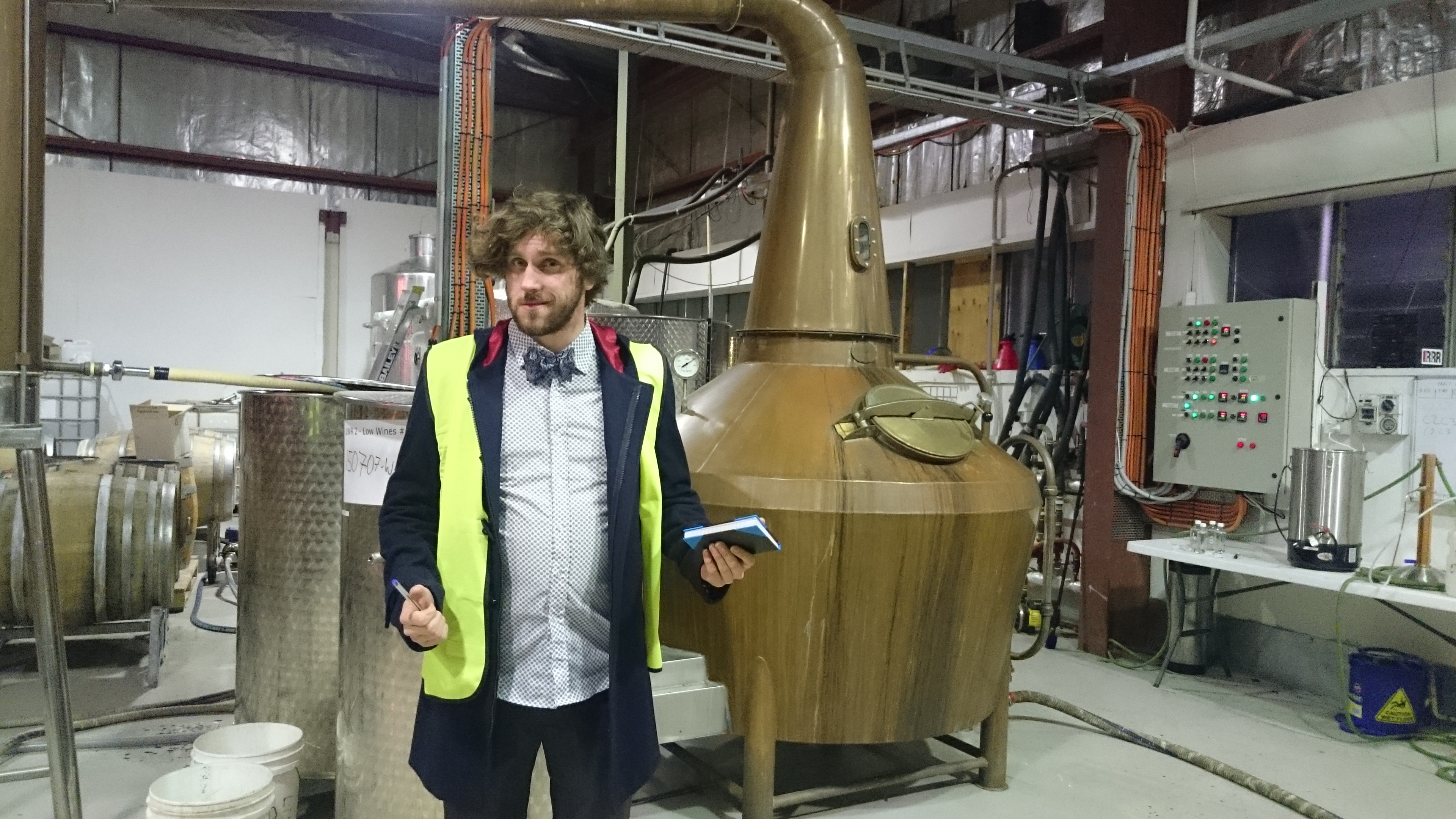
Whisky always tastes better when wearing a high-vis vest

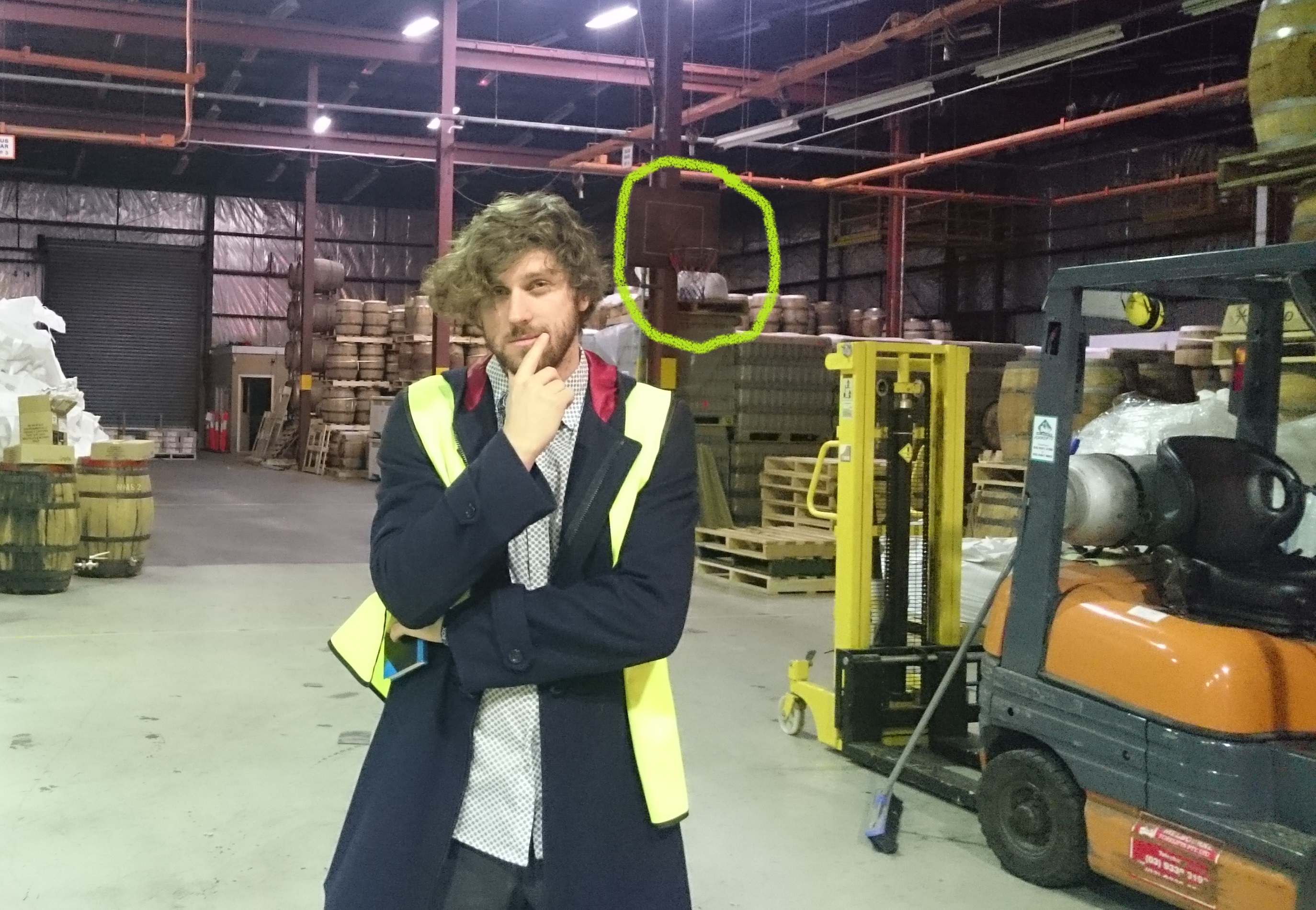
New World also came across as one of the hardest working distilleries going around. With a staff of only five on the floor and three behind the scenes (and Dan), they still manage to conduct three distillations a day. This is achieved by long shifts, late finishes and shared responsibilities, as well as a basketball hoop to keep the staff sane. This hard working approach is one of the biggest factors in ensuring their product is one of the most affordable Australian whiskies going around.
New World visit 4 - Copy

Starward score a three pointer!

After the tour I took a seat at the bar near a toasty gas heater and sampled the products I had just learned about. First was a comparison between the two Starward bottlings: the Apera cask and the wine cask varieties. While the Apera matured whisky was syrupy and raisiny, the Shiraz aged drop was more savoury with oaky tannins. I still confess to preferring the original Starward release, but my friends who accompanied me on my visit unanimously favoured the wine cask.
New World visit 5

Different constellations for different casks

From here I moved onto the bar’s extensive range of New World Projects bottles. These ranged from the sublime – two magnificent port matured whiskies – to the ridiculous – a perfectly clear three year old whisky with all the coloured components of the drop removed. There was also a wonderful 56.3% ‘doublewood’ bottle which had been matured in both the wine and Apera barrels, and a Heartwood-esque whisky with an alcohol percentage in the sixties known as the ‘Smoke and Mirrors’.

New World visit

One day all this will be mine… if I save up enough money to buy every barrel.

I left the giant hangar at the end of the night inspired by the products made in my home country. I was once again amazed by the vast contrast in flavours that can be created within a drink which only contains three ingredients. There are some great things happening in the Australian whisky industry and the guys at New World Distillery are right at the forefront.

The New World Distillery is open for tastings and tours at their site at Essendon Fields on Fridays from 6pm and on Saturdays between 2pm and 6pm.

The Glenrothes 1995, 1998 and Select Reserve Box Set

Reviewed by: Ted

Glenrothes trio

Vintage. It’s not really a word that you associate with whisky. For the overwhelming majority of drams the process is to lay down some spirit in a barrel, let it age for a pre-determined number of years and then bottle it as, say, a 12yo or an 18yo. The whole concept of releasing the product of one particular year, a vintage, is smack bang within the realms of the wine makers, hence generally seeing wines labelled with the year they were made.

However, there is one whisky maker that has very firmly gripped the concept of vintaging by the proverbial horns and run like mad with it. The Glenrothes distillery, founded in 1878 and located in the Speyside whisky region (and not in the Scottish Lowlands town of the same name), has carved out a niche for itself by taking this unusual approach to aging whisky. Perhaps we should not be too surprised by this as The Glenrothes is owned by Berry Bros. & Rudd, one of the oldest and most respected wine merchants in London.

While only around 2% of its stock actually goes towards the making of vintages, with the majority of production helping to create blends such as Cutty Sark and Famous Grouse, The Glenrothes distillers make no bones about the fact that the single malt range represents the apex of their art. One of the inherent problems with releasing product from a single year is that it can lead to inconsistency, as one release in all likelihood will taste different to the next. Not necessarily a negative, just that it’s not like purchasing a 12yo and then buying another later on and knowing that what you get will be exactly the same regardless of the year of production.

The Glenrothes counters this idea by claiming that whisky is in reality just like wine and should be allowed to mature at its own rate, with bottling only occurring when the spirit has reached, in The Glenrothes own words, its ‘peak of perfection’ rather than at a pre-selected age. As you might imagine, The Glenrothes crew take a very active approach to checking their casks, determining the readiness of a vintage by looking for a unified ‘personality’ across a range of casks from that year.

Speaking of casks, The Glenrothes has a very strong wood policy and the deepest of respect for their barrels. They say that the effect of the wood on their spirit is far more important that the length of time it spends aging, and that the careful selection of cask sizes and timber types is vital for achieving perfection. The Glenrothes use a mixture of first and second fill bourbon and sherry woods, and carefully marry them together to create the unique flavour profile for a vintage.

For this review we will be sampling not just one, but three releases from The Glenrothes! Their marketing team has very helpfully created a box set containing 100ml bottles of three of their more accessible drams: the 1995 and 1998 vintages, and their Select Reserve, a vatting of casks from different years created to be the holotype of The Glenrothes flavour profile. But wait, there’s more! The box set also contains three mini Glencairns monogrammed with The Glenrothes logo, a handy set of info booklets and cards describing the range, and of course the box itself, elegantly crafted from sturdy buff and copper coloured cardboard.

Glenrothes SR

All three expressions are quite light and spicy on the nose, which is probably in part thanks to the very tall stills and long distillation times used by The Glenrothes. The Select Reserve is quite broad and fat, with notes of fudge, old leather (from a classic car say), orange and almonds. In comparison the 1998 (bot. 2014) has caramelised pear, boiled caramel sweets and, rather oddly, perhaps a touch of engine grease (that’s not a bad thing. It’s a nostalgic smell that reminds you of your father working on a car when you were young). Finally, the 1995 (bot. 2013) is filled with hot, spicy and slightly sour grain mash, clover honey and curiously, a bit of melon.

Glenrothes 95

The very first touch of the Select Reserve on the lips is creamy, and then it bursts in a big ball of heat and spice inside the mouth, probably helped by the 43% used for all three of the drams. There is a hit of marzipan on the follow-through, while the finish is tangy and lingers gently on the tongue. In contrast the 1998 is smooth and creamy, and slides evenly across the tongue. The finish is fairly short and has a slight floral air to it. Again, the 1995 is sour and fruity, with green apples, pears and plums, finishing up with a nice fresh herbal zing at the end.

Glenrothes 98

The ‘ready when it’s done’ approach works out well for The Glenrothes. Each of its vintages is skilfully crafted and captures some special quirk that entered the distillation for that year. The clever and considered use of barrelling no doubt also helps to imbue each expression with its own character. Drinking a dram of The Glenrothes is a bitter-sweet thing; a happy encounter, but all the time you know that one day the vintage will run out, and never again will you meet that particular personality. So go, find that experience and capture it in your memory before it is too late.

1995 ★★★

1998 ★★★

Select Reserve ★★★

Talisker 57˚ North

Reviewed by: Nick

Talisker 57 degrees north whisky waffle

Whenever I pour one of my non-whisky drinking friends a wee dram (watching in amusement as they splutter noticeably and their face flushes a conspicuous shade of red) I tell them to picture themselves in a small rugged hut on the west coast of Scotland as a fierce Atlantic storm batters the walls and ceiling. That, I proclaim, is the ideal location to enjoy whisky. While a fireplace may sufficiently heat your extremities, a dram of whisky will warm you from the inside out. And if I were huddled in this rugged hut on such a night, the drop I would turn to first is the Talisker 57˚ North.

This whisky, made on the Isle of Skye’s sole distillery, is named for two reasons: firstly (and I may be biased, but I would claim foremostly) because the spirit is bottled at a practical 57%. Secondly (and perhaps more poetically) because the town of Carbost, home to Talisker, is found at 57˚ North of the equator. In this part of the world, your insides are quite often in dire need of warming.

To put it into perspective, Canada’s 2010 Olympic Winter Games host, Vancouver, is situated at a mere 47˚North while my often freezing home state of Tasmania is at just 42˚South. Talisker Distillery is only two degrees further south than notoriously icy Scandinavian capitals Stockholm and Oslo. So it stands to reason that a warming dram or two is created there.

On the nose, there’s no doubting this is an Island whisky. Smoke wafts liberally out of the glass, although possibly more subtly than some Talisker expressions. Other elements are noticeable too: pepper, chorizo, and cured meats. It is like inhaling deeply at a gourmet barbecue.

There is certainly a woodiness about this whisky on the palate – although not reminiscent of your standard oak notes. Instead the flavours are dustier, earthier, more akin to a tree’s bark than the wood underneath. Elements of honey and marmalade hint at typical Talisker sweetness, though it is more toned down than the 10 Year Old. Instead, wonderful new flavours are present such as bacon and buttery toast, as well as some less pleasant bitter sappy elements which give the impression of burning wood that is slightly too green.

The good news is, this whisky leaves the best until last: the finish is undoubtedly the highlight of the dram. It is long – so very long – and hot and lively. After the spiciness fades, the smoke returns gently, bringing your tasting full circle.

Drinking this whisky, I find that I take my own advice. I close my eyes and picture the howling gale, the bucketing rain and the crashing thunder. Scotland is no stranger to wild weather. And in the eye of the storm, the Talisker 57˚ North is the dram you need.

★★★★

5 Whisky Waffle Winter Warmers

Posted by: Ted

I said, brr, its cold in here, there must be some… low pressure systems, high precipitation rates and perhaps even the formation of snow caused by the seasonal polar tilt of the earth away from the sun, creating wintertime meteorological phenomena in the atmosphere. What, you weren’t expecting ‘Bring It On’ were you?

Yes folks, it’s winter in the Southern Hemisphere, and while for the most part that may not entail quite the same level of bone aching crazy cold that our Northern kin have to endure, it’s still enough to send us shivering. Well, what better way to beat the winter chills than a nice warming dram of whisky? And there’s one class of the amber stuff that does it better than any other: cask strength. So without any further ado, here are five cask strength whiskies that will help spread a warm glow inside your belly this winter:


5. Glenfarclas 105

glenfarclas-logo

If you need to get warm in a hurry, then why not have a giant gorilla sit on you? Well, not really, but that’s what the experience of drinking a drop of the Glenfarclas 105 is like. Bottled at 60%, this family-owned drop from Speyside is big, bold and will cause you to beat your chest like a silverback as its powerful sherry-driven flavours rampage through your veins. Drink while entertaining thoughts of scaling tall buildings.

4. Glenlivet Nàdurra

Glenlivet-Logo

Meaning ‘Natural’ in Gaelic, this 16yo dram from Glenlivet is the logical solution for warming up on a frosty night. Indeed, I can vouch for its efficacy, as I sipped a dram of it while watching a meteor shower on a cold, clear night (the shower was a bit of a damp squib, but the whisky was certainly good). The Nàdurra is taken from the barrel at a 54-55% strength guaranteed to put a rosy glow in the cheeks. Drink while pondering the natural order of the cosmos.

3. Nikka from the Barrel

Nikka logo

Japan certainly sees its share of cold weather, but not to worry, the gods saw fit to create a dragon spirit to fight the frost. It may come in a small package, but the Nikka from the Barrel packs a big dragony punch. Bottled at 51.4%, this fiery little blend is packed with hefty dollops of sweetness and spice backed up with a wicked sherry kick. Drink while watching ninjas fight in a snowy forest (well, at least it will keep you occupied as you fail to spot any of the combatants).

2. Talisker 57° North

Talisker logoWant hot coals to smoulder and smoke away inside you? Then what you need is some peated whisky, and what could be better than a ‘special strength’ release out of the wind-and-rain lashed Isle of Skye? As its name hints, the Talisker 57° North is bottled at… well… 57% and is full of Talisker’s trademark mixture of sweet and maritime flavours. Drink while wearing a blue knitted fisherman’s turtleneck in front of an open log fire.

1. Lark Port Wood Cask Strength

Lark logo

Need to feel your toes again on a chilly Tasmanian night (which to be honest, can happen in high summer. Thanks maritime climate!)? Well, how does drinking hot, spiced orange sound? That’s certainly what it feels like sipping some of Lark’s 58% Port Wood release. If Lark can revive the Tasmanian distillery industry, then it certainly shouldn’t have any trouble getting you back on your feet. Drink while huddled in a wooden hut in the Tasmanian highlands.

Slàinte mhath!

Ardbeg: a journey through time – the coming of age

Welcome back fellow Wafflers to the odyssey that is Ardbeg through the ages. We left our tale at a perilous standpoint, with our hero of a distillery surely doomed to closure and eternal obscurity. We resume the story in 1986 and Ardbeg has been shut for five long years. But the whisky community did not forget…

Ardbeg Day 2

Ardbeg: A journey through time – the coming of age…

Posted by: Nick

1987

Some hope emerges for our protagonist in the form of new owners, Allied Lyons. Could this be the salvation for the distillery and the wider community? Sadly, no. It is a false dawn, and Ardbeg is run merely to become one hundredth of a bottle in AL’s blends. No one has the foresight to recognise this was 99 parts too few…

1996

The distillery is neglected and once again it is unjustly left to dwindle to nothing. Surely this time, it really is the end for our hero.

1997

Finally, just when all seemed lost, someone sees the light! The folks at Glenmorangie realise that one day this quaint little establishment in Port Ellen could actually become one of the greatest distilleries in the world. It could even have a go at producing one of these new-fangled single malts! Or at least this is what Glenmorangie’s Dr Bill Lumsden, head of distilling and whisky creation believes. And when you have a title as impressive sounding as his, anything is possible.

The new owners open the creaky doors to the old bond store to reveal… barrels – housed there since the 1970s! We can only imagine the size of the grins on faces that day. This vintage product marks the beginning of many special one-off releases.

1998

The new owners begin work as if they want to make up for lost time. Progress is made remarkably quickly. Renovations to the visitor centre are duly carried out and the now famous Old Kiln Café is installed. More 1970s bottlings are released. And our hero is starting to get noticed. It doesn’t take long before there is a shiny award on the wall of the renewed visitor centre with the words ‘Distillery of the Year’ emblazoned on the plaque.

2000

One-off releases are doing their job. But what Ardbeg really needs was an identity; a main character. This arrives in the form of the 10 Year Old, young and fiery, peaty and heavy, and yet balancing seaside elements with oak and vanilla. It is quite unlike anything else on the market. And the world approves.

2001

With its standard bearer firmly realised in the form of the 10 Year Old, Ardbeg decides to push the boundaries further. The one-off bottlings have been very successful, so why not release one every year? This trend begins in 2001 and continues to this very day. First is the Lord of the Isles, followed by bottles such as the Airigh Nam Beist, Serendipity, Rollercoaster, Gallileo, and the much sought after (at least by us Wafflers) the Alligator.

2003

Another regular release joins the Ardbeg stable, this time an even more fascinating drop, the cask-strength Uigeadail (or Oogie as we Wafflers affectionately call it). Spending part of its maturation in sherry barrels adds another layer of complexity to this already multifaceted drop.

2007

The baton changes hands once again. From Duncan McDougall via fifteen others, Michael (Mickey) Heads becomes the latest distillery manager for Ardbeg.

2008

Worldwide recognition is only a matter of time for our hero. The famous Ardbeg 10 year old wins Jim Murray’s world whisky of the year award, and brings greater renown to the growing brand.

2009

Ardbeg makes it back-to-back when the Uigeadail follows in the footsteps of the 10 Year Old and reclaims the world whisky of the year award for the distillery!

Buoyed by this success, Ardbeg expand on their main range with the heavy and blazing Corryvreckan and the light and restrained Blasda.

The 2009 special release, even by Ardbeg standards, packs a peaty punch. It is appropriately titled the ‘Supernova’, and it goes on develop cult status among the ever-expanding legion of Ardbeg fans.

2014

Finally after years of yearning, this particular Waffler’s dreams come true, and Nick stumbles into Port Ellen, first stop: Ardbeg Distillery. He has a magnificent time, checking out the stills and the bond store before settling down in a comfortable chair to sample the wares and chat about the history of the great distillery. He could not be more pleased for the establishment that they near their 200th year as distillery and continue to make one remarkable drop after the other. He decides that Ardbeg truly is a hero and vows to one day chronicle the saga of its tumultuous, but ultimately highly successful life.

0182

2015

Ardbeg officially turns 200. The party begins.

Sláinte!

Click for part one

Ardbeg day 1

Ardbeg: a journey through time – the beginning

Ardbeg distillery, one of the true greats of Scottish whisky, is turning 200 – and may we add looking mighty good for its age! Whisky Waffle take this moment to celebrate by looking back at the history of this wonderful distillery in a new two-part adventure…

Ardbeg Day 2

Ardbeg: A journey through time – the beginning…

Posted by: Ted

1798
Fàilte traveller. You have been summoned here to witness the birth of a distillery, one that will become powerful and then dwindle to smoking peat embers, only to be stoked once again by the howling Ileach winds and rise even stronger than before. Look ye now to the peat bogs, for cometh the man, but perhaps not yet the moment. Duncan McDougall is his name, and he travels to rent the farmlands on the South East coast of Islay known as Ardbeg, Airigh nam Beist and Ardenistiel. Come; let us step forward in time to see what will be. I am sure one such as you knows the way of it.

1815

Now friend, the true moment. Here is Duncan, and with him his son John, and grandson Alexander. They have fashioned themselves as McDougall & Co. and raised a distillery on the land known as Ardbeg. Watch closely, ye silent observer, as they flicker across the years, crafting a dram with a heart of smoke.

1835

The fire that was Duncan burns no more, and John works the land in his place, while Alexander is tasked with tending the waters of life. Woe to the makers, insolvency falls, and Ardbeg changes hands. Let your gaze pierce across the sea to Glasgow, where the coffers of Thomas Buchanan Jr. now stoke the Ardbeg fires. But the McDougalls work on, leasing their creation from the new masters and tending to their amber child.

1853

Alexander is lost to time and the Ileach wind. Turn your gaze watcher, for new players walk the stage. Here is Flora and Margaret McDougall, sisters to the old wolf and distillers in their own right; Colin Hay, proprietor newly made; his son Collin Elliot Hay, distiller at the helm; and John Ramsay, great owner of not only Ardbeg, but Laphroaig, Lagavulin and Ardenistiel too. This small god of the Ileach tends his emerging villages and their vaunted distilleries well, ensuring that their leases endure long and the water flows unimpeded.

1887

Can ye feel the power in the air? The reek of the mash and the thrum of the industrious as they transform barley, water and yeast into more than a million litres of smokey whisky. These craftsmen are the kings of the island and their work a champion of the blend, although the true believers know to take strength from the untransmuted Ardbeg spirit. I see you watching me traveller, and seeking the nature of the fall. Step once again and we shall see.

1944

War. The venerable whisky makers of Scotland weep golden tears as their industry bleeds. On Islay, the once mighty Ardbeg is now only a shadow of itself. The distilling bans of this terrible world struggle are just another blow after the horrors of the Great War, and the harsh realities of economic depression. The old guard are no more, and a pall drifts from men who know how to be bankrupt or creative with bookkeeping.

1981
Here is the true nadir my friend. Ardbeg is closed and all but a few chosen gone. The village mournfully quiet and the air wrong, missing the tang of fermenting barley. The future uncertain. After the war life returned, but never recovered. The McDougalls passed their torch to the Ardbeg Distillery Ltd, and the distillery became a bauble for giants, a speck of smoked quartz tumbling in their collections. Your eyes betray you wanderer. What room is there in this bleak world for the distilleries of Islay they ask? Listen to the capricious Ileach wind my friend, for it blows from the east and whispers a name, Glenmorangie. I told you at the start of our journey that Ardbeg would rise once again, and here is its saviour. An amber crusader by the name of Bill Lumdsen will take Ardbeg and reforge it in smoke and fire into a legendary single malt famed across the world and even to the stars themselves.

But the how and why of that great transformation you must discover for yourself. Here our paths split and I must walk another road. I bid you farewell my friend, fellow watcher of the ages.

Sláinte

Click for part two

Ardbeg day 1

Overeem Port Cask Matured

Barrel Number: OHD-067

Reviewed by: Nick

Overeem Port Cask

Whiskies so often seem to reflect their creator. Bruichladdich whiskies display the passion and local ethos displayed by Jim McEwan. Variously finished Glenmorangie drams showcase that experimentation possessed by scientist Dr Bill Lumsden. Whiskies made at the Old Hobart Distillery, much like their creator, Casey Overeem, have true character. And much like Casey, this character is very likeable.

Old Hobart Distillery releases their whisky under the label ‘Overeem’ and is part of a growing collective of whisky makers from southern Tasmania consistently churning out a high standard of products. Overeem, like Lark and Sullivan’s Cove, use French Oak ex-port barrels cut down to 100 litres to mature a percentage of their whisky. The flavours created by this process, similarly to its contemporaries, are equally extraordinary. But there’s something a little extra special about the Overeem. It has an element of ‘handmade’ about it, something that suggests this whisky is crafted instead of distilled.

The nose is light but enticing. There are notes of berries and stewed apricots alongside faint traces of ginger and fennel. There are also some gloriously Tasmanian woody notes which call to mind a home-workshop stocked with Huon Pine.

The palate is richly flavoursome and offers many layers to discover. It is initially sweet and spicy, offering fizzy orange sherbet notes with a dash of pepper preventing it from becoming too sweet. There is also a degree of citrus and maltiness, combining to give the impression of a freshly baked sponge cake with lemon curd. The finish is lengthy and contains faint raisiny and caramel notes: finally, the much-vaunted fruitcake has made a subtle appearance!

This is a fantastic example of a Tasmanian Whisky in more ways than just flavour. It is the perfect illustration of a micro-distillery whose focus is on creating a well-crafted product. This is not done simply as a business venture, but instead as a way for one man to create the spirit that he loves. And Casey Overeem’s intent is certainly apparent when drinking the whisky which bears his name.

★★★★

Whisky Waffle Present: Whisky World!

Posted by: Ted

WWWWD edit

American Whiskey Week draws to a close: what we’ve learned

Posted by: Nick and Ted

And so after seven days, the Whisky Waffle boys finally stumbled out of the endless Kentucky cornfields. Many interesting facts had gone in one ear and out the other (must have been something to do with the corn), and much sippin’ of spirits had been accomplished.

We scaled the (Brokeback) Mountain of American whiskies, and came out safely on the other side. So what did we learn?

Bourbon-Back Mountain Whisky Waffle

The story of forbidden love between two men… and bourbon.

  1. Not all cowboys drink bourbon. We met one in a bar the other night (right in the middle of bourbon week of all times. You couldn’t make this stuff up), and he preferred the moon to be shining hard on his liquor;
  2. We won’t be tracking down the Jack Daniels or the Jim Beam again any time soon. As with most things, you get what you pay for;
  3. We prefer a bit of character over easy drinking in our corn juice;
  4. It is possible for a bourbon to take a subtle approach;
  5. Sometimes it is ‘really hard’ not to create innuendo;
  6. You can take American whiskey out of Kentucky, but you can’t take Kentucky out of American whiskey; and finally:
  7. When it comes down to it, bourbon still tastes a lot like bourbon.

Hudson Single Malt

Reviewed by: Nick and Ted

Hudson Single Malt

Start spreading the news, old New York is back doing whiskey business baby! But wait, the Hudson ain’t even bourbon! What we have here is a genuine single malt whiskey, the first non-bootlegged whiskey to be distilled in New York State since the end of prohibition.

The love child of Ralph Erenzo and Brian Lee, the duo made a brand new start of it in 2003, founding Tuthilltown Spirits on the site of the old Tuthilltown grist mill, about 100km north of the city that never sleeps. Business was slow to start after the company’s inception, but now they are the king of the hill of East Coast craft distillers.

Being 100% malted barley, you would expect the Hudson to be distinctly different in flavour to its fellow Americans. And yet, somehow right through the very heart of it there is still a bourbon streak. On the nose the Hudson Single Malt is lightly sweet, with notes of vanilla, oak, dried apricot and a flavour of grape that is more likely to be found in confectionery than growing on a vine.

On mouth the feel is dusty, akin to taking a book down off the shelf in an old library. The grapes make a return, this time in the form of a sweet Riesling. The palate is intriguing rather than smooth, with notes of bourbon competing with dried floral components. This little town dram melts rapidly away, leaving a hint of orange peel.

Nick Ted and Hudson

Corn or no corn, there is no doubting that this is American whiskey. There is more to this than your average bourbon, and it makes an admirable attempt to bridge the gap between America and Scotland. It also put the State of New York back on the whiskey map. After all, if it can make it there, it can make it anywhere.

★★★