Sherry

Bunnahabhain 12 Year Old

Reviewed by: Ted

Bunna 12

The world of whisky is a lexicological minefield, populated by distilleries and bottlings with all manner of weird and wonderful names. The birthplace of whisky in particular likes to play mind games with the innocent, wide-eyed bystander, the Scottish tongue bending words in ways you just wouldn’t expect.

A true prince of the pack is a distillery from Islay with a name that causes the unprepared mind to melt at the sight of it. Gather your wits dear reader and say hello to Bunnahabhain (phew!). Right, so just to be clear, that’s BOO-na-HAVen (but to really get it, here’s a helping hand from Brian Cox).

The Bunna, as it is more colloquially known, is one of the oldest distilleries on Islay, producing drams since 1881 in the village of the same name. Naturally, being from Islay means that Bunna drams are peated. Unlike other distilleries on the island, however, they aim for a far more subtle maritime nature, with the Bunna motto being ‘the gentle taste of Islay’.

Encased within a heavy black glass bottle emblazoned with the sailor logo and the Roman numerals XII (a numbering system used for their aged releases), the Bunnahabhain 12yo is the core release of the distillery. Made with water from the Margadale spring and bottled at that sweet spot of 46.3%, the 12yo brings forth a rich golden hue.

On the nose the 12yo is light, smooth, sweet and fruity, with ripe autumn apples, dates, plum jam, red grapes and raisins from the ex-sherry casking. Mixed in with the fruits are chestnuts, cashews, pistachios, dark chocolate, brine and rich oak. A veritable cornucopia indeed.

On the palate the liquid hits sharp, salty and dry, like taking a mouthful of seawater on a summertime dip. Underneath sits salted caramel, ginger, mixed peel, seaweed and a faint hint of driftwood smoke. The finish is again salty, and lingers on the tongue like the end of a day at the seaside, a mixture of brine, sweat and sunscreen.

Bunnahabhain is certainly not one of the Ileach peat monsters, choosing to keep that beast well chained in its cave. Instead it manages to sing an incredible song of its maritime environment, perfectly capturing the salt laden winds that blow in from the stormy Scottish coastal waters. The Bunnahabhain is indeed a whisky that is as complex in its nature as it is in its name.

★★★

Navigating to the New World Distillery: meet the purveyors of Starward

Posted by: Nick

New World visit 1

Behold, the New World of whisky!

The New World Distillery is a whisky-making establishment like no other. Equal parts industrial warehouse, hipster bar and mad scientist’s laboratory, stepping through the door I felt like I had slipped down my very own rabbit hole into whisky-wonderland.

Located in Melbourne’s north, the distillery is just a stone’s throw away from the bustling international airport. This is appropriate as the building is a vast refurbished aircraft hangar. The huge room is separated into partitions by rows of whisky barrels – a particularly novel bond store! In one corner of the room is a classy-looking bar with shelves bearing a massive range of the whiskies made on site – each with a premise more curious than the last. It was clearly going to be a good evening.

New World visit 6

Is that a pumpkin spiced gin amongst that lot?

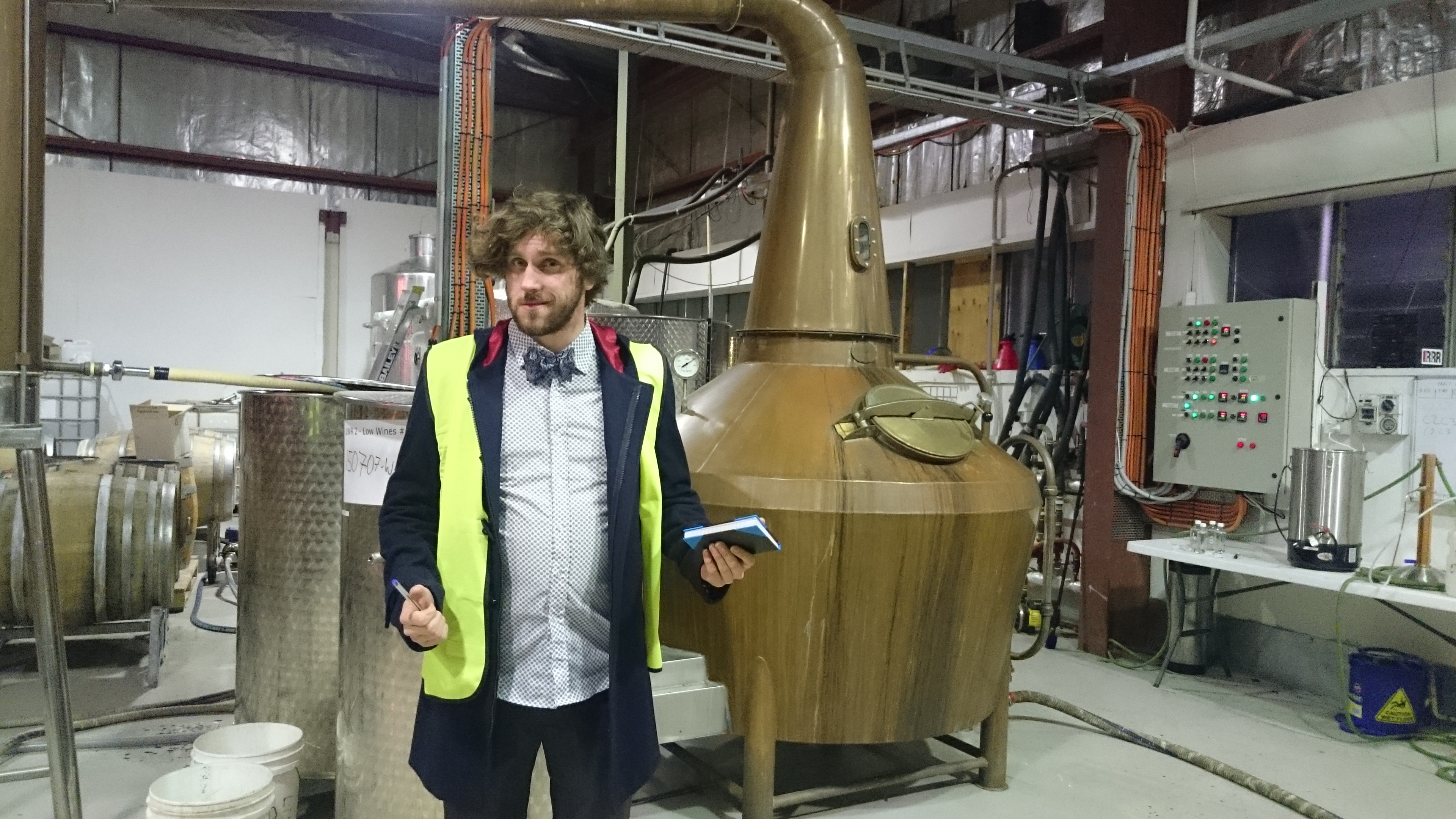
Before settling in at the bar for an extended tasting session, there was the small matter of the tour. My guide on this adventure around the immense room was Paul, a man who I discovered was no stranger to a bit of whisky waffling. While the whisky production at his distillery was covered in detail, we also got sidetracked with conversations about peat, barley farming, excise tax and wood-smoked barley.

New World Distillery has been operating since 2010, releasing their main product under the label Starward. While Starward was originally exclusively Apera matured spirit, they have recently released a second variety aged in ex-Barossa Valley Shiraz casks. These aren’t the only bottles being created here however. The people at New World enjoy pushing boundaries; if not breaking the rules, certainly bending them a little. The most successful of these are released as a special range known as ‘New World Projects’ and well worth checking out.

The tour is engaging and informative: in particular Paul’s analogies likening making wort to brewing a cup of tea and charring barrels to burning sugar, explaining these obscure concepts effectively. I also got a generous swig of the new make spirit which I found light and fruity without losing its typical high-alcohol warmth. All in all it was one of the more (dangerously) easy-drinking new makes I’ve tried.

New World visit 3

Whisky always tastes better when wearing a high-vis vest

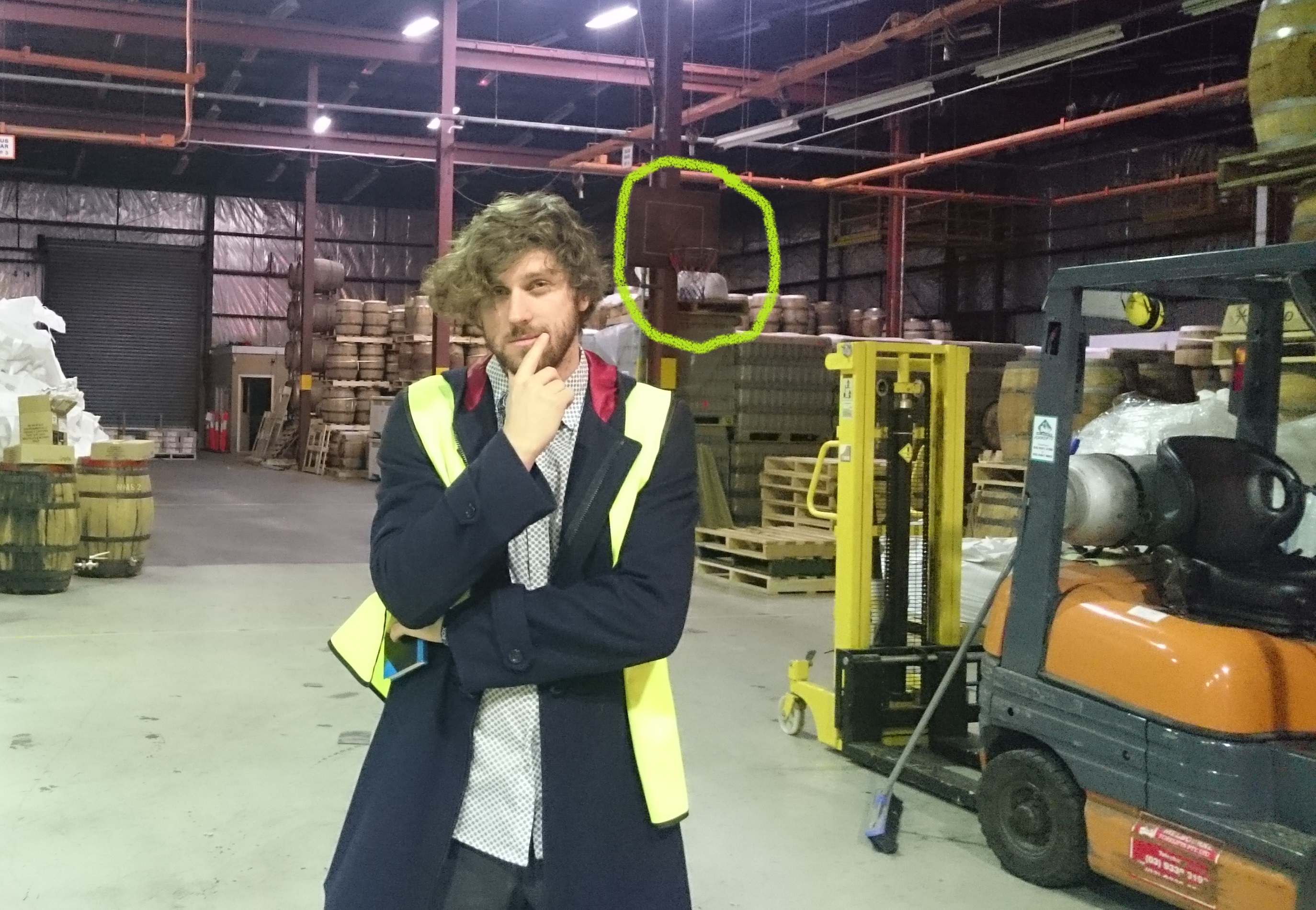
New World also came across as one of the hardest working distilleries going around. With a staff of only five on the floor and three behind the scenes (and Dan), they still manage to conduct three distillations a day. This is achieved by long shifts, late finishes and shared responsibilities, as well as a basketball hoop to keep the staff sane. This hard working approach is one of the biggest factors in ensuring their product is one of the most affordable Australian whiskies going around.

New World visit 4 - Copy

Starward score a three pointer!

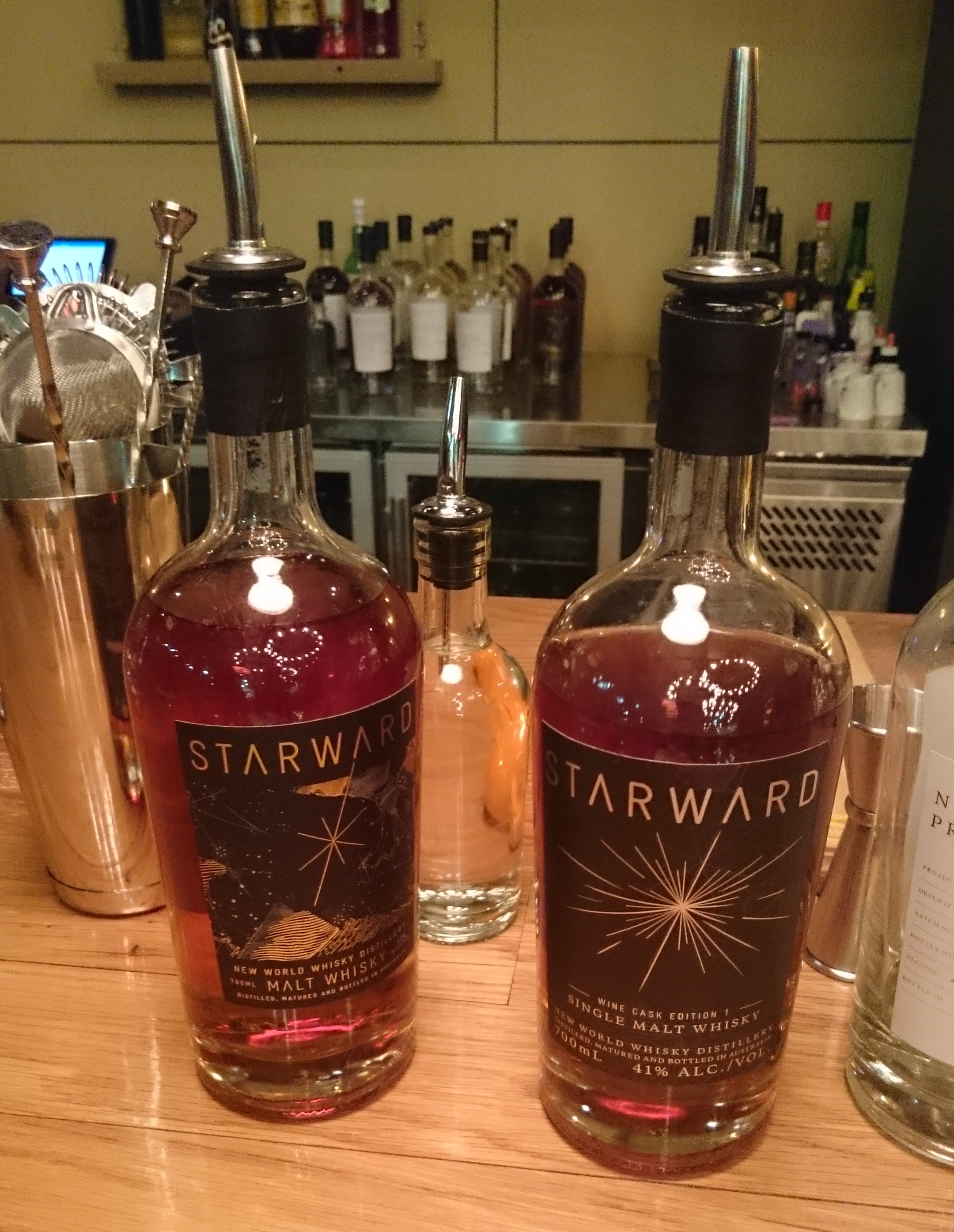
After the tour I took a seat at the bar near a toasty gas heater and sampled the products I had just learned about. First was a comparison between the two Starward bottlings: the Apera cask and the wine cask varieties. While the Apera matured whisky was syrupy and raisiny, the Shiraz aged drop was more savoury with oaky tannins. I still confess to preferring the original Starward release, but my friends who accompanied me on my visit unanimously favoured the wine cask.

New World visit 5

Different constellations for different casks

From here I moved onto the bar’s extensive range of New World Projects bottles. These ranged from the sublime – two magnificent port matured whiskies – to the ridiculous – a perfectly clear three year old whisky with all the coloured components of the drop removed. There was also a wonderful 56.3% ‘doublewood’ bottle which had been matured in both the wine and Apera barrels, and a Heartwood-esque whisky with an alcohol percentage in the sixties known as the ‘Smoke and Mirrors’.

New World visit

One day all this will be mine… if I save up enough money to buy every barrel.

I left the giant hangar at the end of the night inspired by the products made in my home country. I was once again amazed by the vast contrast in flavours that can be created within a drink which only contains three ingredients. There are some great things happening in the Australian whisky industry and the guys at New World Distillery are right at the forefront.

The New World Distillery is open for tastings and tours at their site at Essendon Fields on Fridays from 6pm and on Saturdays between 2pm and 6pm.

Starward Single Malt

Reviewed by: Nick

Starward

Regular readers of this blog would be forgiven for thinking that all of Australia’s world class whisky is produced in my home state of Tasmania. While I’ll still claim that most of it is, I will readily admit that some stellar drams are being produced on that tiny island up north, which some refer to as the Australian mainland.

One of the most exciting up-and-coming distilleries in the New World of whisky making is the appropriately named ‘New World Whisky Distillery’, which has been releasing whisky since 2013 under the name Starward. And there is a lot to like about it.

For a start, there’s the location. New World is based in Melbourne, the cultural hub of the country (sorry Sydney), and with a bar onsite at the distillery the city has gained a wonderful venue to sample spirits straight from the metaphorical horse’s mouth.

Secondly, there is the label. Starward is an alluring name for a whisky and the gold constellations streaking across a black background capture this image perfectly.

Thirdly there is the price. Australian whisky has the reputation for a remarkably full-bodied flavour, although at an equally remarkable full-bodied price. Starward bucks this trend, providing a local drop that will not break the bank (although perhaps dent the wallet a bit).

Finally, and unquestionably most importantly, there is the flavour. On the nose it is lively: this is a young whisky, but it is far from immature. There are notes of oranges, chardonnay and toffee. No doubting the country of this whisky’s origin.

On the palate there are certainly notes of the raisiny flavours emparted by sherry barrel maturation, although technically speaking, the barrels contained Apera: sherry made in Australia not Spain. Sweetness spreads across the tongue and the orange returns, this time with chocolate, giving a jaffa-like taste. I also picked up elements of glacé cherries and raspberry shortcake. As you do.

The finish is short, but not disappointingly so. There are hints of oak to be found as well as spicy, peppery elements. It is certainly pleasing enough to encourage a second sip!

While the Starward is not the most subtle or nuanced whisky you are ever likely to come across, it is undoubtedly really pleasant to drink. The distillery itself sums it up best with its claim: “Just like the country in which it is made, Starward is youthful, rich and bright”.

It is also just across the water. Whisky Waffle may have to pay it a visit sometime…

★★★

Glendronach 12 Year Old

Reviewed by: Nick

Glendronach 12 Year Old

Now, be honest with me. Raise your right hand if you have bought, with your own money, in the last six months, a bottle of sherry? Anyone? I thought as much.

The once proud sherry industry is declining slowly, but surely. While on the surface this may not seem to really affect we drinkers of distilled barley, there is, in fact, much cause for concern. Because without sherry, specifically, without the barrels that once contained the stuff, many of the most wonderful whiskies in the world would not exist.

Case in point: the Glendronach 12 Year Old. And it is a great little drop. Vibrant, spicy, balanced and heavily sherried. The latter is not a subjective tasting note. The whisky does indeed possess a highly sherried character because it has been matured in a mixture of Pedro Ximinez and Oloroso sherry barrels.

The flavour this imparts is obvious on the nose in the form of sweet creamy raisin aromas. There is a golden syrup-like quality, too, alongside dried figs and orange peel.

On the palate the flavours are, surprisingly, not as sweet as the nose suggests. However it has a smooth mouth feel and the creaminess is still present. There is a nuttiness about it as well, and more dried fruit with perhaps a touch of glace cherries. Little wonder sherry-matured whiskies are regularly likened to fruitcake.

The finish is short, disappointingly, as up to this point I was immensely enjoying the ride. Wait – there it is, ever so subtly lingering at the back of the throat with the remnants of the grape flavours. I had to go searching for this one, but I found once discovered it glows faintly, like the last few embers of a campfire.

The sweetness of this whisky is nice, although it would probably discourage me from having too many drams of this in the one night. Instead, this is the perfect choice to directly follow a bourbon-aged malt at a tasting, to really show just how radically different sherry matured whisky is.

We may as well enjoy it for the time being. Because as time rolls on there will be fewer and fewer sherry barrels around to put whisky in.

★★★

William Grant & Sons come to Burnie

Posted by: Nick

William Grant & Sons logoI could be forgiven for thinking I’d come along to the ‘Burnie’s Best Beards’ convention, as upon arrival I was met with some of the most impressive facial hair this side of Ulverstone. This could only be a whisky tasting!

But it was no ordinary tasting. We were sampling drams created by the third largest producer of whisky in the world: William Grant & Sons; guided through the evening by Rich Blanchard whose job title literally was ‘Whisky Specialist’. Unfortunately this qualification does not teach him which way round the 1 and the 2 go on the tasting notes, and we discovered that we would be beginning with a 12 year old whisky, not a 21 year old!

Grants in Burnie editied whisky waffle

Rich: “And then you pour it down your throat. I told you this tasting business was easy!”

The tasting consisted of many drops I had sampled before, although never in quite so meticulous an order. Being a Grant’s night we began with the self-proclaimed saviour of single malts: the Glenfiddich. We tasted a range of ages: the famous 12 Year Old (where the pear cliché was immediately rolled out), the 14 Year Old Rich Oak (which, true to its name was distinctly oaky: akin to tasting old furniture), the 15 Year Old Solera Vat (still a favourite) and the 18 Year Old (undoubtedly the smoothest).

We then paused to refill our glasses, and Rich delivered his two minute spiel about how whisky is made – in five minutes. He also told us a little of the history of William Grant, detailing his purchase of stills from Cardhu for his own distillery, which was family built – literally. School holiday projects for the Grant family were a little more serious than building a cubby-house.

Rich then mentioned the mastery of recently retired Grant’s head distiller David Stewart, highly regarded still-man, double-maturation pioneer and generous whisky pourer. I made a metal note to try and meet this man one day.

This brought us nicely to Grant’s other crown jewel: The Balvenie. Again beginning with the 12 Year Old (not the 21) before moving onto the 14 Year Old Caribbean Cask (with no reveal as to the source of the barrels – though we ruled out Cuba!).

The final two drops were undoubtedly the highlights. The 17 Year Old DoubleWood I regard highly, so much so to award it the prestigious ‘Tartan Slipper’ in the 2014 Waffle Awards. Finally was the 15 Year Old Single Barrel: sherry cask. I’d had the bourbon equivalent of this drop before but it had not prepared me for what I found in this one. Could it be… peat?

Rich revealed that, yes, the Balvenie did peat their barley, albeit slightly. It was an intriguing drop and a perfect way to finish the night.

As I left to commence my walk up the hill (always easier after eight drams) I could not help but feel a little bit pleased. A proper whisky tasting in my little home town! A massive thanks must go out to Steve Kons for organising the night and to the people at William Grant & Sons for making the journey to the North West.

Lark Double Sherry Cask Limited Release

Reviewed by: Nick and Ted

Lark Double Sherry Cask Limited release

We make no bones about the fact that we are ardent lovers of Lark. We will go to our graves swearing blind that our superlative wafflings are not just a bunch of old guff (in fact, many top whisky critics agree with our views). For those willing to make the journey, proof of Lark’s greatness can be found at their cellar door.

If you are one of the lucky acolytes to enter Larks lair, you will be met with a sherry monster of epic proportions. The Lark Sherry Double Cask Limited Release is matured for most of its life in a first-fill barrel, and then transferred for the last six months into another first-fill barrel. Apparently the transfer process causes high amounts of evaporation, helping to intensify the flavours.

Our first impressions of this whisky were huge. This is, without a doubt, one of the biggest, boldest noses we have ever come across; something that makes the entire cast of Asterix look like Tintin. This is Pinocchio if he embarked on a career as a lawyer. As soon as the glass enters the vicinity of your nostrils you are enveloped by a huge, warm blanket woven from raisins, figs, chocolate, golden syrup, honey and oak.

The first sip instantly hits you with a warm lively glow. Thanks to the 59.2% alcohol the mouth rapidly dries, leaving a satisfying bitterness across the back of the palate. This is a complex and challenging dram to be sure. Each sip reveals more layers of flavours, both subtle and bold.

Sadly for those with no immediate plans or means to travel to Tasmania, the Sherry Double Cask Limited Relase is only available at the Lark cellar door. For those who are within reach (hooray!), make sure you have a taste before the very finite number of bottles evaporate like the angels share (or before the Whisky Waffle boys drink it all!) Sitting at Lark’s bar, sipping double sherry matured whisky can only be described as pure ‘Larksherry’!

(Cheers to Dave at Lark for coining that one after mishearing a comment)

★★★★

Glenfarclas 105

Reviewed by: Nick

Glenfarclas 105

You never forget your first time. The insecurity as you take the plunge, the fire in your belly, the lasting satisfaction afterwards. I am of course referring to the first time you tried cask strength whisky.

Most whiskies sold commercially have been diluted down to an ABV deemed acceptable to public consumers of alcohol, usually 40-43%. This is undoubtedly a good thing, or us whisky drinkers would be permanently sloshed and unable to string multiple sentences together, let along write eloquently worded whisky blogs. However, there’s just something a bit special about trying a whisky as it can be found in the barrel.

These whiskies are called ‘cask strength’ and usually sit somewhere in the mid to high 50s percentage alcohol wise, although can rise as high as the low 70s. Trust me, when you are drinking one of these, you know about it.

Glenfarclas are a wonderful family-owned Speyside distillery who use mainly Sherry barrels to mature their spirit in. They release a range of (impressively affordable) age statements as well as the 105, their cask strength, which is bottled at a nice round 60%. And it’s an absolute monster. Although a monster in the vein of King Kong, in that it can be brought under control (at least temporarily, before storming off to climb the Empire State Building).

On the nose the sherry influence is prominent, notes of grapes, raisins and other dried fruits coming through along with several sweeter aromas of treacle and iced tea. It’s pleasant, although if your nose ventures too far into your Glencairn, you will receive an eye-watering whiff of the alcohol to come.

The palate is where you first notice the power of the whisky. Hot, spicy, tangy and sharp, it’s far from the smoothest drop you are likely to try. But once past the shock there are plenty of pleasing flavours to be found, such as oak, marmalade and stewed fruits, such as apricots and quinces. The finish of a cask strength whisky is often the highlight and the 105 is no exception. It is dry, long lasting and ever so warming. Not just in your mouth, but after you have swallowed it, within your entire chest. This whisky is a viable alternative to paying heating bills.

Many advocate the need to add water to cask strength whiskies. In a lot of ways they are right. With only a few drops of water, the Glenfarclas 105 becomes immediately smoother and presents new floral aromas and flavours of honey and cloves. But it also loses the fire contained within its 60% self. That wonderful warming sensation is gone, along with some of the magic of the drop.

The Glenfarclas 105 is a fantastic dram, and a great example of a cask strength whisky. It is certainly not for the faint hearted, but is well worth it if you can make it back for a second sip.

★★★★

Young Enthusiasts Meet Over Peat

Posted by: Mooresy

The first young whisky enthusiasts’ event held at the Lark Cellar Door was a huge success. The sell-out tasting session featured a whirlwind tour of some very special drops, as well as the bar staff choosing some extra whisky for people based on what they liked, and what they didn’t like.

Some people liked it so much, they bought a whole bottle of their favourite.

Whisky Business 1 whisky waffle

Whisky: the ultimate conversation starter. Especially after five drams…

In a blind tasting, attendees first had to guess the Cragganmore Double Matured Distillers Edition, with most people agreeing it was a definite step up from the entry level 12 Year Old. Second was a Jefferson’s 100% Rye Whisky which threw a few people. The spicy rye flavour was new to a lot of people, and a lot came back for seconds to help us finish off the bottle.

Back to malt whisky but not in a rush to return to Scotland, the group moved to the Yamazaki 12 Year Old (previously reviewed by Ted) which went down a treat. The night was full of gossip about Yamazaki because we had just heard about Jim Murray heaping praise on their Sherry Cask variant and that moved the conversations to sherry. This was a cunning hint by the guides because the next taste was a true sherry bomb. The group were blessed with an as yet unreleased double sherry wood from Lark, and it exploded sherry goodness all over the room.

Finally, the finisher. A Distillers Edition Lagavulin finished in Pedro Ximenez casks and probably the people’s choice for the night. The marriage of sherry and peat was a treat to witness with one member saying “it’s like you took all the things I like most about whisky and chose one based exactly on my personal taste”.

That’s the point of it all, right there.

Following the success of the event, the group – now called Whisky Business – will be having another tasting event at 7:30PM on Wed 17 December at the Lark Cellar Door in Hobart. If you are a novice and keen to come along, learn more and pick up some tips and tricks, please contact Alex Moores on 0417 382 542 or at alexandermoores@gmail.com.

Balvenie 12 Year Old DoubleWood

Reviewed by: Nick and Ted

Balvenie Doublewood 12 Year Old Whisky Waffle

Double the wood, double the fun! Just getting into whisky? Think you might like to give one of those new-fangled single malts a try? Can’t afford the Glenfiddich 50yo? Roll up and try the multi-barrelled, malty-talented whisky wizard, the one, the only: the Balvenie 12 Year Old DoubleWood! It’ll cure all your woes*!

* Side effects may include becoming compulsive about seeking out single malts, and mild discomfort in the presence of blends.

Balvenie is a member of the the William Grant & Sons stable, and is the less famous sister to Glenfiddich. Balvenie prides itself on continuing to use traditional hand malting methods, and is well respected for its high quality range of whiskies. Chief amongst these is the 12yo DoubleWood, a dram that has converted many a whisky novice.

There is a good reason for the DoubleWood moniker: while it spends the majority of its life in American oak, for the last few months of maturation the spirit is transferred to sherry butts. This technique imparts the range of flavour that makes this whisky special and means that there is something in it for everyone.

This variety of flavour is immediately evident on the nose with sweeter notes of caramel, fruit leather and vanilla pairing with a citrusy tang reminiscent of lemon drops, and aromatic spices such as nutmeg and cinnamon.

The flavour is very broad and rounded across the palate. There is an initial hit of oranges, followed by spicy ginger and buttery shortbread. The sherry influence is definitely present in the finish. Dried fruits such as figs, prunes and dates can be found, and a tasty flourish of old English toffee is left on the tongue at the end.

The Balvenie 12 Year Old DoubleWood is exceptionally smooth for its age, and is also excellent value for this level of quality. For experienced whisky drinkers there is so much to like here and it warrants repeated tastings (for research purposes, naturally). For those just beginning their journey, the DoubleWood provides an ideal gateway to the broader whisky world. So line up ladies and gents, there’s enough for everybody. You won’t be disappointed!

★★★★

Glenfiddich 15 Year Old

Reviewed by: Nick

Glenfiddich 15 whisky waffle

This is more like it Glenfiddich! In my review of the Glenfiddich 12 Year Old, I described it as pleasant but unremarkable. The 15 Year Old release goes some way to rectifying this. If Glenfiddich were a wine, the 12 year Old would be a white, whereas the 15 Year Old would clearly be a red.

This whisky is created using a Solera vatting technique, where various 15 year old expressions are married together in a large ex-wash back. The vat is never more than half emptied meaning a percentage of the remaining whisky that makes up each bottle is very old indeed.

This is immediately a more enjoyable whisky than the 12 year old. Darker in colour and more complex on the nose, various aspects of its mixed-maturation can be found within. There is vanilla from the bourbon casks and green sappy flavours from the new oak. The biggest contributor, however, is the sherry casks. The spirit matured in these barrels imparts dried fruits, toffee, even cola upon the palate and leaves a long, dry and memorable finish.

While the 12 Year Old is the most popular, and the 18 Year Old the smoothest, when taking into account the balance between flavour and value for money, I believe it is almost impossible to go past the 15 Year Old. It is the most complex and interesting by far and crucially, it gives you the most to talk about.

★★★★