opinions

Eriskay

Reviewed by: Ted

Eriskay

Charles Edward Louis John Casimir Sylvester Severino Maria Stuart. While you may think that I am just reeling off random names in some whisky fuelled musing, they in fact all belong to one particular person. A rather famous one in Scottish history at that. Loyalists to the throne scathingly called him the ‘Young Pretender’, but his followers, and indeed most people today, knew him thus: Bonnie Prince Charlie.

Although born in Italy, 1720, Charlie was actually descended from British royalty, grandson of the deposed Stuart King James II and VII. From a young age Charlie knew it was his mission and divine right to reclaim the throne. In 1745 he made his move, sailing from France and landing with his companions, known as the ‘Seven Men of Moidart’, on the small Outer Hebridean island of Eriskay to begin the ‘Jacobite Uprising’ and sweep through his ancestral home of Scotland to raise support.

‘What has this got to do with anything?’ you may be wondering. Well, it just so happens that the subject of this review takes its name from the island where Charlie and his men landed: Eriskay. Eriskay, or ‘Eric’s Isle’ in old Norse, is a blended Scotch whisky made from ‘quality Highland and Lowland Whiskies’. While the whisky is certainly Scottish, a closer inspection reveals that it is in fact bottled in Australia for the Ron Rico Distilling Company for sale on the local market.

Some cheap blends make no bones about the fact, often sporting rather woeful labelling. The Eriskay is indeed a cheap blend, purchased in this case for only AUD$37, however it’s certainly a cut above its companions in its dress sense. Superficially it looks rather like the label of the Talisker, with serifed lettering and a rather nice map in the background. However, bonnie looks alone do not make the man, there must be substance also.

History records that the Jacobite rebellion was doomed to failure, lost through poor battle strategy and politics. Unfortunately the Eriskay is rather similar in this regard. The nose is light and flat, consisting of mostly shortbread, malt and a bit of caramel slice, sweet but fairly unfulfilling.

Surprisingly, on the mouth there is an instant hit of smokiness, but it crawls low like the fug after a battle. Unfortunately this is followed up by the dull tang of metal, filling the back of the mouth like a round of musket shot. The finish is sharp, bitter and lingering, much like the remainder of Charlie’s life after his cause was crushed.

The Eriskay is definitely a whisky that sits squarely within its price range. While it may attract you with the promise of its Bonnie face, it seems that the Loyalists were right, and the Eriskay is indeed a ‘Young Pretender’.

★★
The Big Black Cock Single Malt

Reviewed by: Nick

BBC

Crikey! Now I know whisky is made in some pretty far out places but leaning towards the more radical end of the scale would have to be Mt Uncle Distillery in North Queensland. Despite the immense heat and being located on the outskirts of woop-woop, they have managed to produce a grouse little drop.

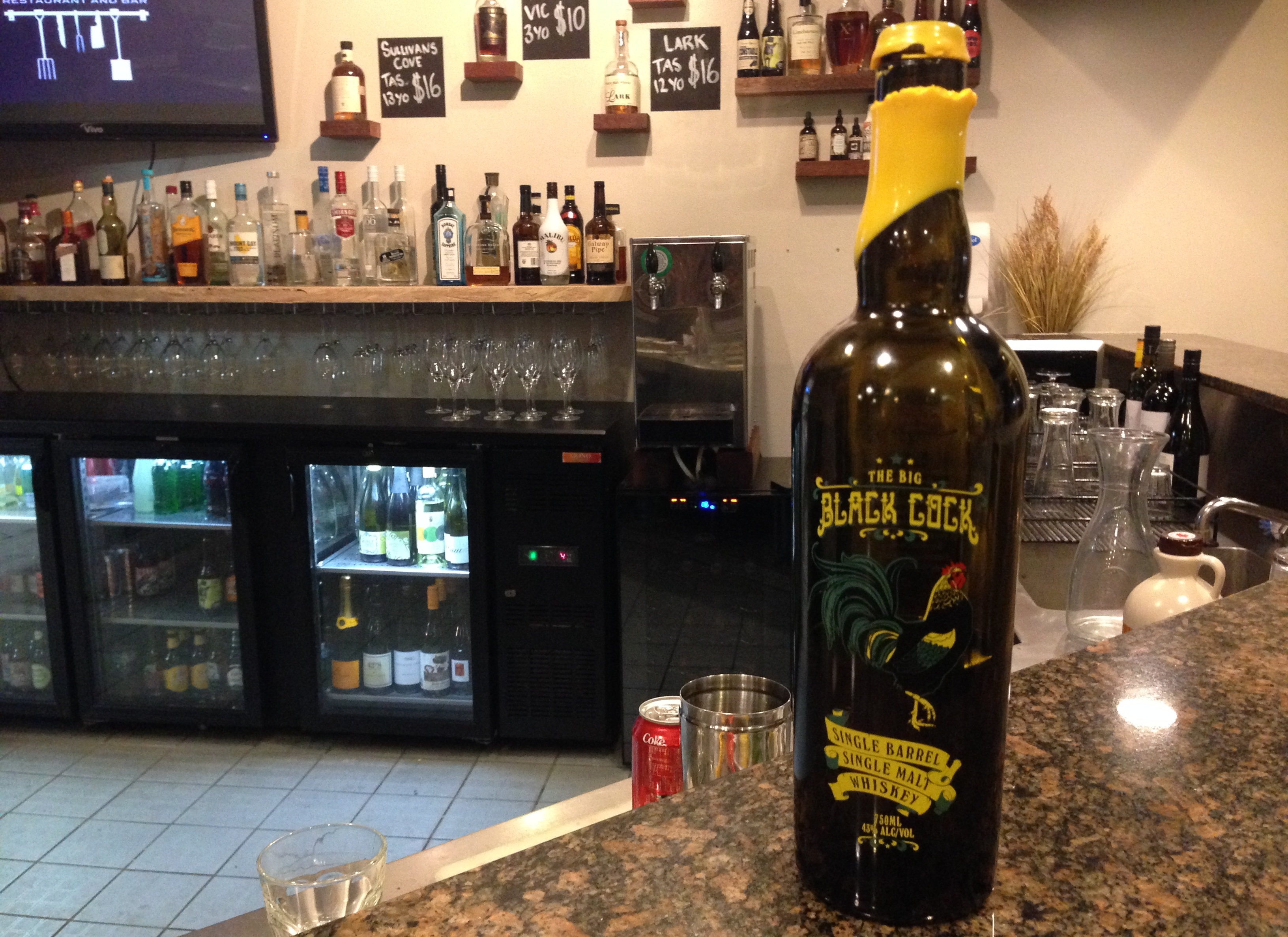
The 5 Year Old single malt has one of the more dinky-di whisky names going around. The drinks menu I had a gander at when first sampling it read BBC. However, the large rooster on the front of the bottle makes it clear: this whisky is called the Big Black Cock. It is fair dinkum outback whisky. And strewth: it tastes the part.

On the nose there are faint hints of malty Arnotts biscuits – quickly drowned by whiffs of recently slashed sugar cane and double coat tim tams. On the palate there is vanilla – perhaps a little too much – accompanied by Anzac biscuits and cherry ripe. There are also some bitter fruit elements – possibly created by the ex-red wine barrels they were matured in: American oak staves with French oak lids. The finish is warm and a little rough with spicy meaty notes, like snags on a barbie.

If you ever come across the BBC in a whisky bar down under it is certainly worth ordering – if only to be forced to say the name out loud – but also because of the beaut, uniquely Australian flavours to be found. This is true blue outback whisky. It’s unrefined. But a ripper.

★★★

Nant Homestead Reserve

Reviewed by: Nick

Nant Homestead Reserve

It’s no secret that Jim Murray, whisky writing’s answer to Simon Cowell, is a fan of Tasmania’s Nant Distillery. And that’s fine, he’s allowed to have favourite distilleries. Although, rarely does he offer to fly to the home country of said distillery to create an all-new product for them. But in the case of the Nant Homestead Reserve, a marriage of Nant’s bourbon, sherry and port matured whisky, that’s exactly what he has done.

Nant are makers of some fantastic drams, and Jim has praised their power, their full-bodied flavour and their uniquely memorable Tasmanian nature. But for some reason when offered the chance to create his own, he has failed to include any of the above characteristics. Instead he has created a whisky that proves it is possible to be too smooth.

The nose is familiar if you have ever had a Nant whisky before. It is fruity and candied with touches of vanilla. But it is understated and almost feels like it is missing an element. The palate displays subtle notes of orange, toffee and leafy vegetation. The finish dies away rapidly as if instead of drinking whisky you were simply sipping a glass of water. All together the final impression is that of dissatisfaction.

Of course, this is only one whisky drinker’s opinion. This may be an elegant easy drinking whisky to some. It may also be a viable starting point for non-whisky drinkers. Though for me it lacks the magic of some of Nant’s other releases such as the port, sherry and bourbon matured bottlings. They are all, without a doubt, more complex, interesting and flavoursome than the Homestead Reserve. This whisky is a case where the sum of the parts is greater than the whole.

★★

Glen Moray 12 Year Old

Reviewed by: Nick

Glen Moray 12 Year Old

It is quite often the case in the whisky world that what you pay for is what you get. It is usually a safe assumption that a $40 bottle will be inferior to one costing three figures. However, there are so many exceptions to this rule that I begin to wonder why us whisky fanatics spend the money we do.

Case in point is the Glen Moray 12 Year Old, a bottle that first caught my eye when I was a uni student and therefore always on the lookout for an alcoholic bargain. The Glen Moray was, quite simply, the cheapest single malt I could find in Australian bottle shops. However I was quick to discover it held a certain charm that saw it rise above many of the blends I could also afford.

There is no denying that it is a simple dram, bearing all the hallmarks of Speyside. On the nose there are notes of sweet biscuits and honey. Predictably from a whisky matured entirely in bourbon casks, there are also elements of vanilla. The palate is sweet, almost syrupy, with toffee, banana and heathery floral notes. The finish contains more vanilla, spice and Werthers-esque caramel.

The Glen Moray 12 Year Old is never likely to rack up a high score at any whisky awards shows. But in my opinion there’s absolutely nothing wrong with that. It is simply a straightforward and inoffensive whisky that punches above its weight against the larger players.

★★

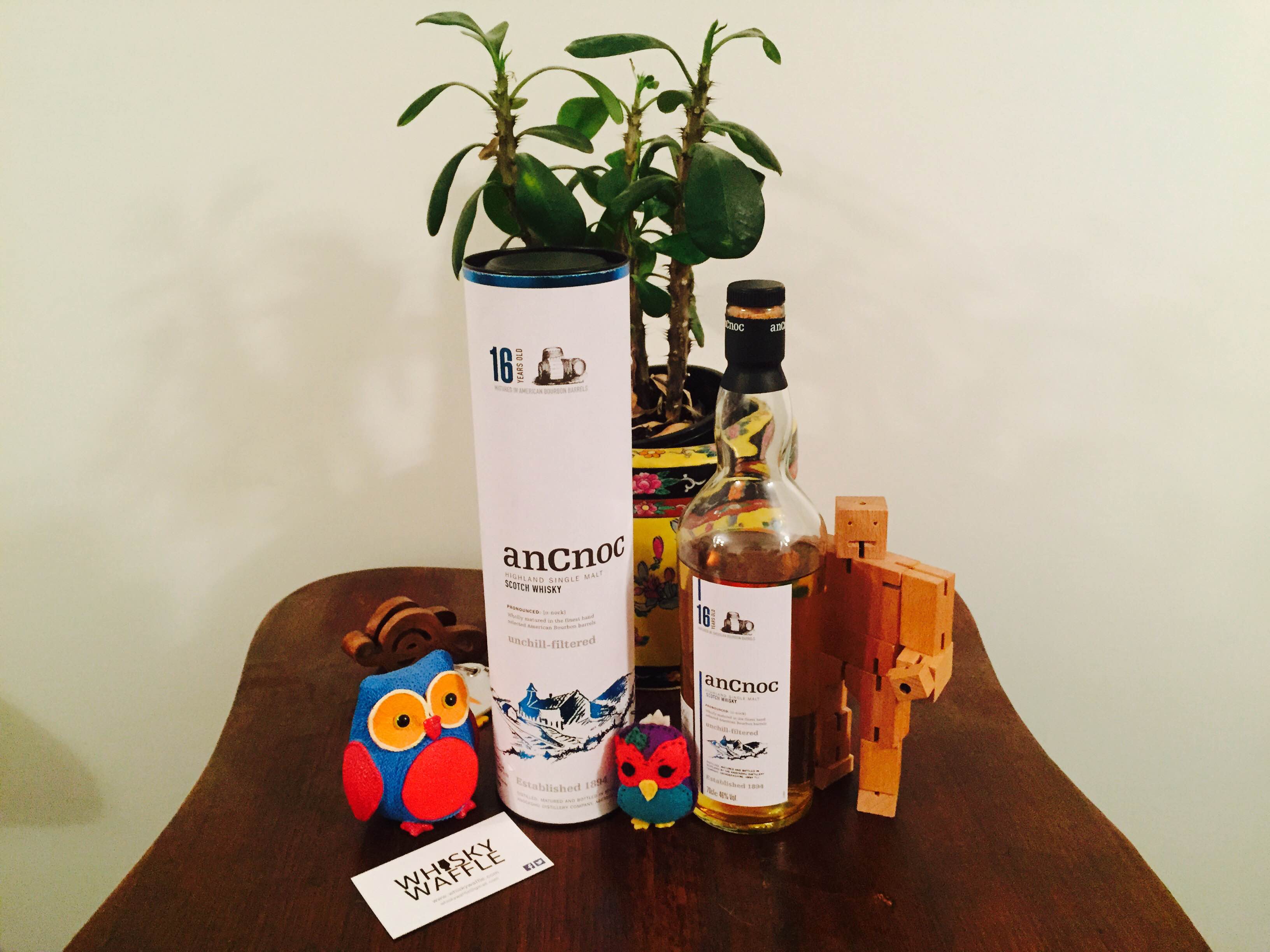
anCnoc 16 Year Old

Reviewed by: Ted

anCnoc 16

One of the fun things about whisky is that it can reveal to you a time and place as part of its character. If the anCnoc 12 Year Old is a summers day, then surely its older sibling, the 16 Year Old, is the evening.

Produced by Knockdhu Distillery, founded in 1894 and one of the smaller operating distilleries in the Scottish Highlands, the AnCnoc 16yo is a burnished gold in colour, darker than the straw-like 12yo.

On the nose the 16yo is smooth and sweet, with no hint at all of the occasional raw alcoholic jaggies lurking in the 12yo. Herbs, particularly mint, garnish a bowl of caramelised pears in syrup dolloped on Weetbix. The taste is sharp and bright, striking the upper palate. The finish is hot and bittersweet, drying the mouth and lingering for some time afterwards.

The AnCnoc 16yo is much better rounded than its younger kinsman, with maturity found through age. While the 12yo has the heat, dustiness and brashness of the day, the 16yo is the relaxing warmth of the evening. A perfect companion to watch the light fade on a clear summer night.

★★★

Bakery Hill: the final frontier

Posted by: Nick

Bakery Hill Tasting 5

Many bakers. Many hills.

Lark? Check.

Nant? Yep.

Limeburners? Sure have!

Hellyers Road? Of course.

Starward? Been there, done that.

Bakery Hill? Ah.

There it was: the one black mark on my record of Australian whisky tasting. I had never tried anything from Victoria’s acclaimed Bakery Hill Distillery. This had to be rectified. But how?

I decided to employ the tactic used by whisky drinkers throughout the ages: I would go to a bar.

The bar in question was the Woodlands Hotel in Coburg. And despite not being near any trees, let alone woods, it was an excellent establishment. As well as providing me with multiple pints of locally produced cider and one of the best burgers I’ve had in my life, they also stocked not one, not two, not even three, but four (I know, FOUR!) different bottles of Bakery Hill.

I glanced across the table at my friend and drinking-buddy-of-the-moment Viv, and nodded. Either by telepathy or the fact that we had previously discussed doing a tasting, we both knew: tonight was the night.

Bakery Hill Tasting 2

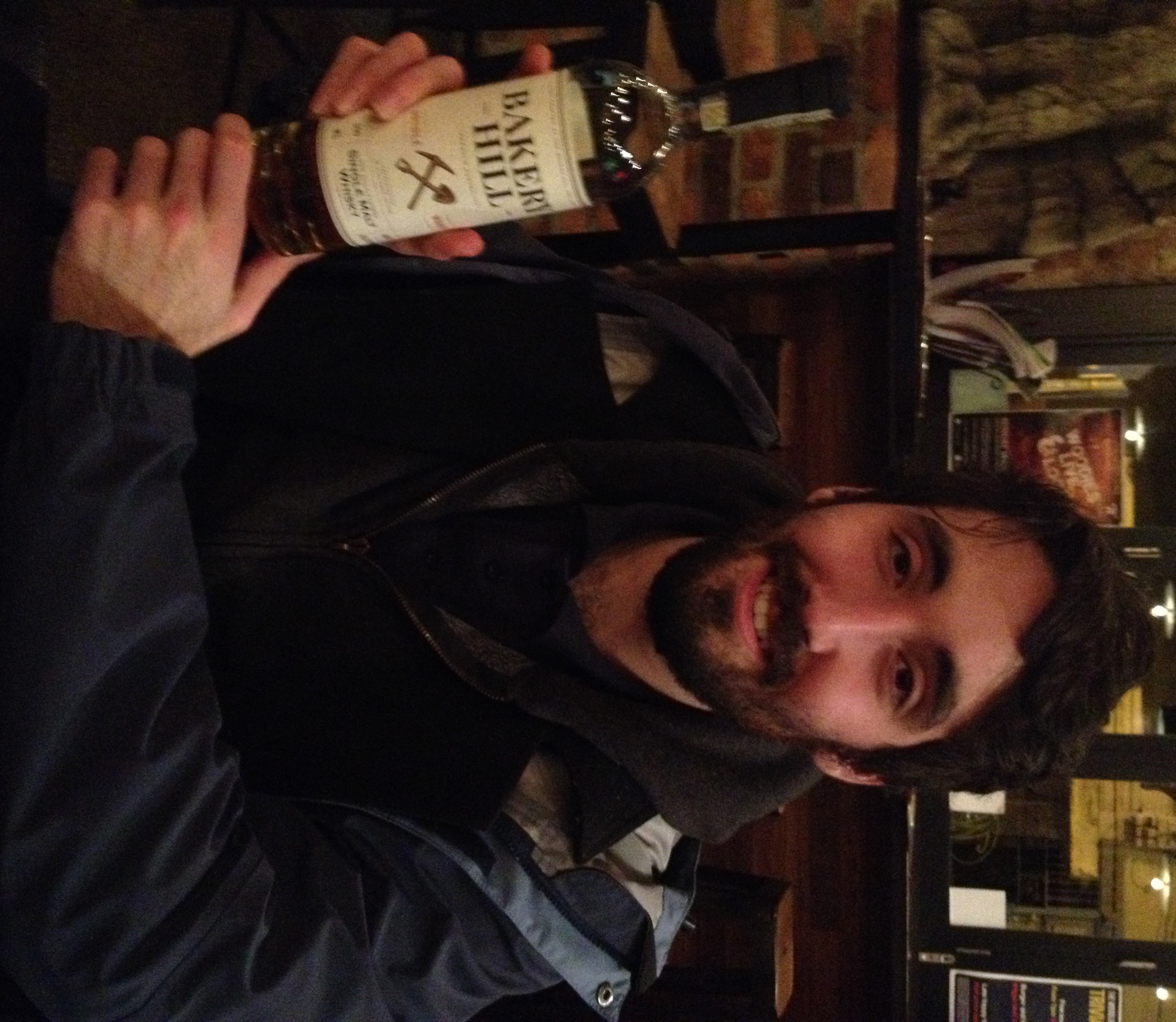
My drinking buddy Viv (sadly Ted was in the wrong state)

The four varieties were each as tempting as the next. There was the classically titled Classic Malt. Next to it was the doubly exciting Double Wood. I had a strong urge to try the Cask Strength. And finally, how could we resist the Peated Malt. One of each, we demanded.

One sip into the Classic Malt, I knew that I was onto something. It was an enormous revelation: an elation! Which was also my reaction upon trying it. Raisins, condensed milk, limes, dates. Deliciousness. Viv concurred, labelling it simply: “tasty” and admitting he could drink an entire bottle.

The Classic Malt smelt amazing, but the Double Wood smelt better with notes of vanilla, even dark rum! It was longer, more complex and nuanced. Viv decided it was “tastier”, and “what whisky should be like”.

The Cask Strength was next. And boy was the finish long. It was warm with caramel, spicy cinnamon – even garlic. Viv decreed it “tasty” and claimed that it was so smooth you would not think it 60%.

Finally came the Peated Malt. We possibly had saved the best til last. There was smoke and there was vanilla. There was smoke and there was fruit salad. There was smoke and there was… plenty. This was no Islay peat monster. It was subtle, without compromising on the smoke. Viv agreed: “tasty smoke”.

Bakery Hill Tasting 3

This is the one. Equal best. With three others…

We left the bar oblivious to the cold, kept warm by our whisky coats. It had been a fascinating night, tasting the range of Bakery Hill products vertically while not ending up horizontally. If you are ever near the Woodlands Hotel in Coburg, nip in for a nip. It is well worth it. I already had a huge level of respect for Australian whisky when I entered the bar. And I left it with even more.

Bakery Hill Tasting 1

Mmm… tasty…

Highland Park 12 Year Old

Reviewed by: NickHighland Park 12

Single malts. They’re a varied lot. Some people like peat monsters. Some like sherry bombs. Others enjoy their whisky light and floral. Others still prefer their drams sweet with hints of vanilla. Pleasing everyone with one drop, however, is a much harder task. Unless, of course, you happen to have a bottle of the Highland Park 12 Year Old on your shelf. This bottle truly is the great all rounder of Scottish whisky.

Highland Park also has the distinction of being Scotland’s northernmost distillery, located on the largest of the Orkney Islands, pipping its neighbour Scapa by under a mile. As the island group was settled long ago by Vikings, it should come as no surprise that the flavours on offer are a veritable smorgasbord.

Up first comes a nose with many varied elements: a whiff of grapes and malty biscuits. There is chocolate, so dark it is mostly cocoa, mingling with notes of pear and bubblegum. Finally is the smoke: far subtler than anything from Islay. It brings to mind smouldering vegetation, an attempt to create a fire from damp leaves on a drizzly day.

The palate is equally varied. It initially suggests a roast meal: beef, parsnips, even gravy, before giving way to mandarin, brown sugar and chocolate milk. The smoke lingers gently, now mostly burnt out and close to charcoal. Finally this all gives way to a long spicy finish with salt, tobacco and mint combining with flashes of caramel.

The Highland Park 12 Year Old is unlikely to be anyone’s number one whisky. It is not weighted in a particular direction to please one group of whisky fans over another. Instead, it sits squarely in the middle, a dram to be enjoyed by everyone no matter their preferences. This is a whisky that brings people together, and if that is not a glowing endorsement, I don’t know what is!

★★★

Bunnahabhain 12 Year Old

Reviewed by: Ted

Bunna 12

The world of whisky is a lexicological minefield, populated by distilleries and bottlings with all manner of weird and wonderful names. The birthplace of whisky in particular likes to play mind games with the innocent, wide-eyed bystander, the Scottish tongue bending words in ways you just wouldn’t expect.

A true prince of the pack is a distillery from Islay with a name that causes the unprepared mind to melt at the sight of it. Gather your wits dear reader and say hello to Bunnahabhain (phew!). Right, so just to be clear, that’s BOO-na-HAVen (but to really get it, here’s a helping hand from Brian Cox).

The Bunna, as it is more colloquially known, is one of the oldest distilleries on Islay, producing drams since 1881 in the village of the same name. Naturally, being from Islay means that Bunna drams are peated. Unlike other distilleries on the island, however, they aim for a far more subtle maritime nature, with the Bunna motto being ‘the gentle taste of Islay’.

Encased within a heavy black glass bottle emblazoned with the sailor logo and the Roman numerals XII (a numbering system used for their aged releases), the Bunnahabhain 12yo is the core release of the distillery. Made with water from the Margadale spring and bottled at that sweet spot of 46.3%, the 12yo brings forth a rich golden hue.

On the nose the 12yo is light, smooth, sweet and fruity, with ripe autumn apples, dates, plum jam, red grapes and raisins from the ex-sherry casking. Mixed in with the fruits are chestnuts, cashews, pistachios, dark chocolate, brine and rich oak. A veritable cornucopia indeed.

On the palate the liquid hits sharp, salty and dry, like taking a mouthful of seawater on a summertime dip. Underneath sits salted caramel, ginger, mixed peel, seaweed and a faint hint of driftwood smoke. The finish is again salty, and lingers on the tongue like the end of a day at the seaside, a mixture of brine, sweat and sunscreen.

Bunnahabhain is certainly not one of the Ileach peat monsters, choosing to keep that beast well chained in its cave. Instead it manages to sing an incredible song of its maritime environment, perfectly capturing the salt laden winds that blow in from the stormy Scottish coastal waters. The Bunnahabhain is indeed a whisky that is as complex in its nature as it is in its name.

★★★

Ardbeg Perpetuum

Reviewed by: Ted

Ardbeg Perpetuum

200 years might not be infinity, but it’s certainly a long time to be producing whisky. Ardbeg distillery, nestled on the coast of Islay, is to be heartily congratulated for reaching such a momentous milestone.

The distillers at Ardbeg love a good special edition release, and in celebration of their big birthday they have brought forth the Perpetuum. The whisky celebrates the love, dedication and skill of its creators, acknowledging that while times and technology change, no machine will ever be able to recreate the spark of the human touch.

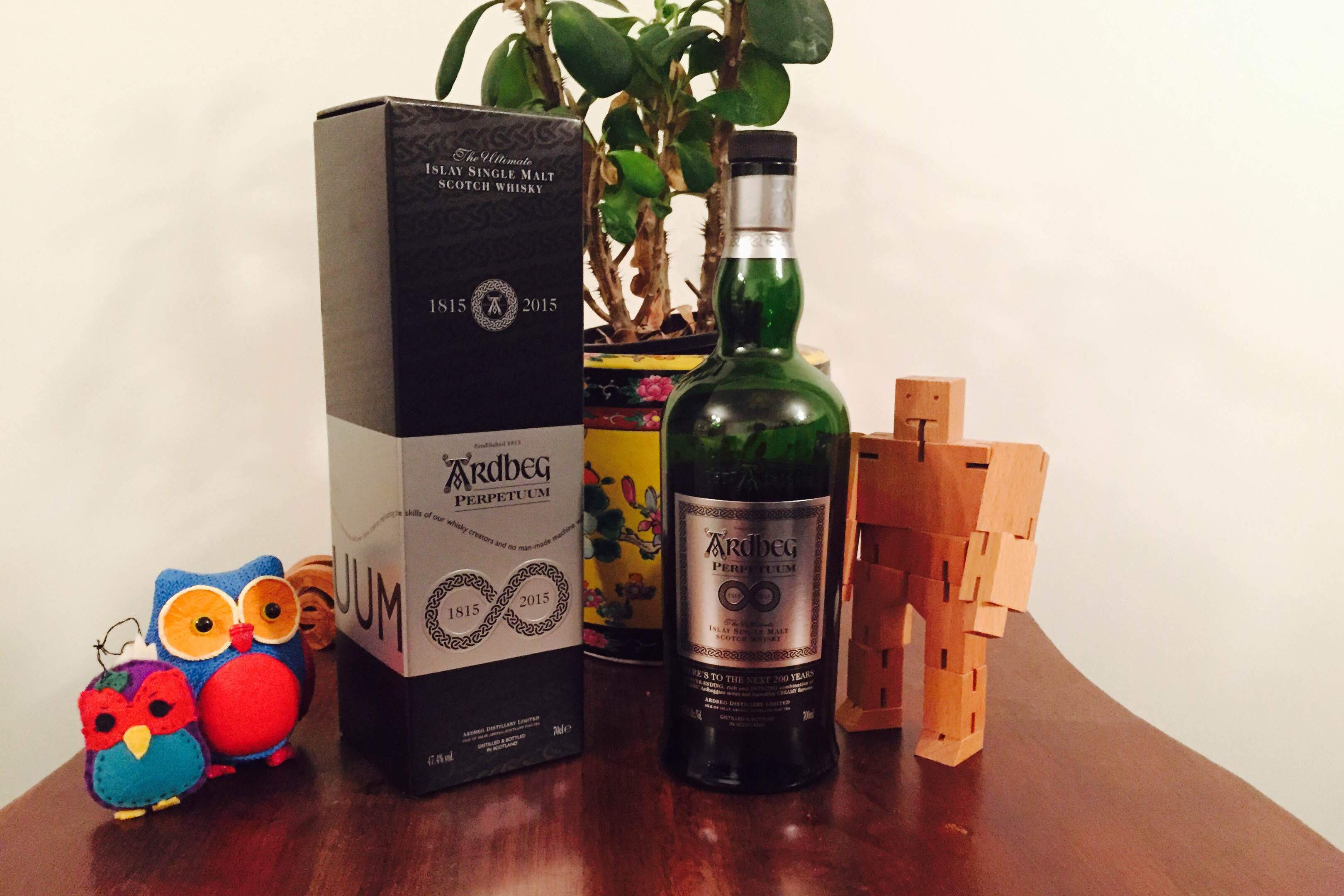
It’s certainly a beautiful object to gaze upon, with shiny silver labels, a Celtic braid infinity symbol and PERPETUUM surrounding the box in monolithic black letters. Oh my goodness the 47.4% spirit inside is a worthy representative of Ardbeg’s art. Just to look at it’s a gorgeous pale, silky gold with a subtle peach tinge.

The nose is delicate and creamy, and has delicious buttery shortbread infused with a hint of sea salt. Twining through is a touch of fine smoked meats, smouldering driftwood and hot malt. The first sip delivers rich, woody smoke to float over the tongue. Underneath sits a pool of salty mineral-rich water with the occasional mandarine bobbing around in it, counterpointed by a sharp bittersweet herbal finish that lingers on. As the bottle says, it almost seems to be never ending.

The Perpetuum is a snapshot of the last 200 years of whisky making at Ardbeg, and hints at the way forward into the next 200 years. Like the infinity symbol the represents it, hopefully we will be coming back to the Perpetuum, and indeed all Ardbegs, again and again for many years to come.

★★★

Talisker 57˚ North

Reviewed by: Nick

Talisker 57 degrees north whisky waffle

Whenever I pour one of my non-whisky drinking friends a wee dram (watching in amusement as they splutter noticeably and their face flushes a conspicuous shade of red) I tell them to picture themselves in a small rugged hut on the west coast of Scotland as a fierce Atlantic storm batters the walls and ceiling. That, I proclaim, is the ideal location to enjoy whisky. While a fireplace may sufficiently heat your extremities, a dram of whisky will warm you from the inside out. And if I were huddled in this rugged hut on such a night, the drop I would turn to first is the Talisker 57˚ North.

This whisky, made on the Isle of Skye’s sole distillery, is named for two reasons: firstly (and I may be biased, but I would claim foremostly) because the spirit is bottled at a practical 57%. Secondly (and perhaps more poetically) because the town of Carbost, home to Talisker, is found at 57˚ North of the equator. In this part of the world, your insides are quite often in dire need of warming.

To put it into perspective, Canada’s 2010 Olympic Winter Games host, Vancouver, is situated at a mere 47˚North while my often freezing home state of Tasmania is at just 42˚South. Talisker Distillery is only two degrees further south than notoriously icy Scandinavian capitals Stockholm and Oslo. So it stands to reason that a warming dram or two is created there.

On the nose, there’s no doubting this is an Island whisky. Smoke wafts liberally out of the glass, although possibly more subtly than some Talisker expressions. Other elements are noticeable too: pepper, chorizo, and cured meats. It is like inhaling deeply at a gourmet barbecue.

There is certainly a woodiness about this whisky on the palate – although not reminiscent of your standard oak notes. Instead the flavours are dustier, earthier, more akin to a tree’s bark than the wood underneath. Elements of honey and marmalade hint at typical Talisker sweetness, though it is more toned down than the 10 Year Old. Instead, wonderful new flavours are present such as bacon and buttery toast, as well as some less pleasant bitter sappy elements which give the impression of burning wood that is slightly too green.

The good news is, this whisky leaves the best until last: the finish is undoubtedly the highlight of the dram. It is long – so very long – and hot and lively. After the spiciness fades, the smoke returns gently, bringing your tasting full circle.

Drinking this whisky, I find that I take my own advice. I close my eyes and picture the howling gale, the bucketing rain and the crashing thunder. Scotland is no stranger to wild weather. And in the eye of the storm, the Talisker 57˚ North is the dram you need.

★★★★