Tasmanian

Linkwood 20 Year Old Côte-Rôtie Finish

Reviewed by: Mooresy

Linkwood Cote Rotie

There are a lot of distilleries out there many people have never tried because all their wonderful product is being snapped up by the blenders. This is a remnant of a bygone era where single malt – especially single cask – was rough and dirty. Blenders swooped in to save the day by watering down the volatiles and mixing young and mature scotches together to smooth it all out. However single malt and single cask only taste bad if the distiller doesn’t know or care about what is going into the bottles at the end of the process. If it’s all about getting drunk, why would anyone go the extra distance for a fine product.

Fortunately, people are changing and the market is changing. Single malt is here to stay, and single cask releases are the bastion of exclusivity and discernibility. This has allowed some of the bigger whisky families to experiment every now and again with small amounts of their product and sometimes that creates a pretty special drop. The Linkwood Côte-Rôtie fits this bill for two reasons. First, it is a distillery owned by the global secret council of big whisky owners and is predominantly used in blends, including as a nice addition to Johnnie Walker’s vatted malt, which means there are specific flavours that are not usually separated and given their own podium. Second, it has been bottled independently by Gordon & MacPhail, so the final product has been selected by people whose primary expertise with whisky is casks and maturation. There is going to be something unique coming from that combination.

This one has also been finished in a very specific type of red wine cask giving it a rich and fruity smell with something very special coming from the grape influence. There are caramels and sugary honey but dominated by the smell of wine and vine mixed in with the actual wood itself, which I assume is European Oak unless the spice of the fruit is engaged in deception and subterfuge.

On drinking this whisky for the first time I thought this will be the one I tell everyone to try. And while I still will tell everyone to try it, on reflection I’m sure it’s not for everyone. Which brings me nicely to the point regarding the cask. The more whisky someone drinks, one of two things happens; either the person will get closer and closer to deciding the one whisky they want to drink at the expense of all the others – what I like to call “the wrong thing” – or they get more and more adventurous and inquisitive about different types and flavours. A batch of a well-known favourite finished in an unusual cask is a great way to see how important aging really is.

This one has spent two and a half years in its finishing cask, which is quite a long time in absolute terms. It is also well matured in general and you would expect a higher level of wood as a result. On the palate, the Côte-Rôtie has a lot of wood. I think that’s a good thing and that it really works for this particular drop. Those who like the simpler and sweeter whiskies will probably think this one has too much tannin, which is often the result of red wine finishes and long oak maturations. Surprisingly though it has not lost some of that underlying sweet complexity. The honey and caramel transfers through with some tart apple and cinnamon/nutmeg in the background.

A vino bomb is not for the immovable whisky drinker who has found the one flavour they want and doesn’t like anything else but, for the intrepid explorer who wants to backpack through the Rhone Valley and pop the bung on a nice red every couple of hours, sit back and quaff with a woody wonder.

★★★★

Glenlivet Nàdurra 16 Year Old

Reviewed by: Ted

Glenlivet Nadurra 2

We are quite fond of The Glenlivet. The 12yo is a dependable drop that hits straight down the middle, perfect for when you just want to sit back and have a dram (although the introduction of the Founders Reserve may change all that). So what happens if you knock things up a notch?

If you think that your glass of Glenlivet needs a bit more punch, then look no further than the Nàdurra. Gaelic for ‘natural’, the Nàdurra is a cask strength release from the Speyside distiller. Glenlivet claims that it is a traditional 19th century style dram, evoking the character of the whiskies originally created by founder George Smith.

Using first-fill American oak casks, the Nàdurra is aged for 16 years and then bottled between 54-55%. My particular example stands at 54.7% and was bottled 06/13 from batch 0613X. As you would expect from a bourbon-aged whisky, the colour is fairly light, although the strength keeps it at a weak amber rather than straw-like.

The nose is fat and rounded, with melted brown sugar, vanilla, cinnamon, cloves, cocoa, peach, malt biscuits and apricot jam. It’s fairly direct on the nostrils too thanks to the strength, but the sweet, gooey nature means that it oozes seductively, like the smell of pudding wafting from the kitchen on a cold night.

On the mouth the Nàdurra is hot and slightly dry, with a nice spiciness. When you take a sip it zooms straight to the roof of the mouth before plonking down onto the back of the tongue. A bitter caramel finish lingers around the mouth, although I suspect it would be rather shorter at a lower strength.

The Glenlivet Nàdurra is no everyday dram to knock back after work. Instead it’s perfect for snuggling down on the couch at the end of the evening, or, and I speak from personal experience, keeping warm while gazing up at the stars on a perfectly clear night. If you’re looking for a friendly companion cask-strength dram, then the Nàdurra is a natural choice.

★★★

Whisky Tales: Stories to drink to

Posted by: Nick and Ted

We like drinking whisky. We also like writing about whisky. So when we heard that the Tasmanian Writers’ Centre was holding an event combining the two, we packed our bags and cruised off down the highway to hell Hobart to make an appearance.

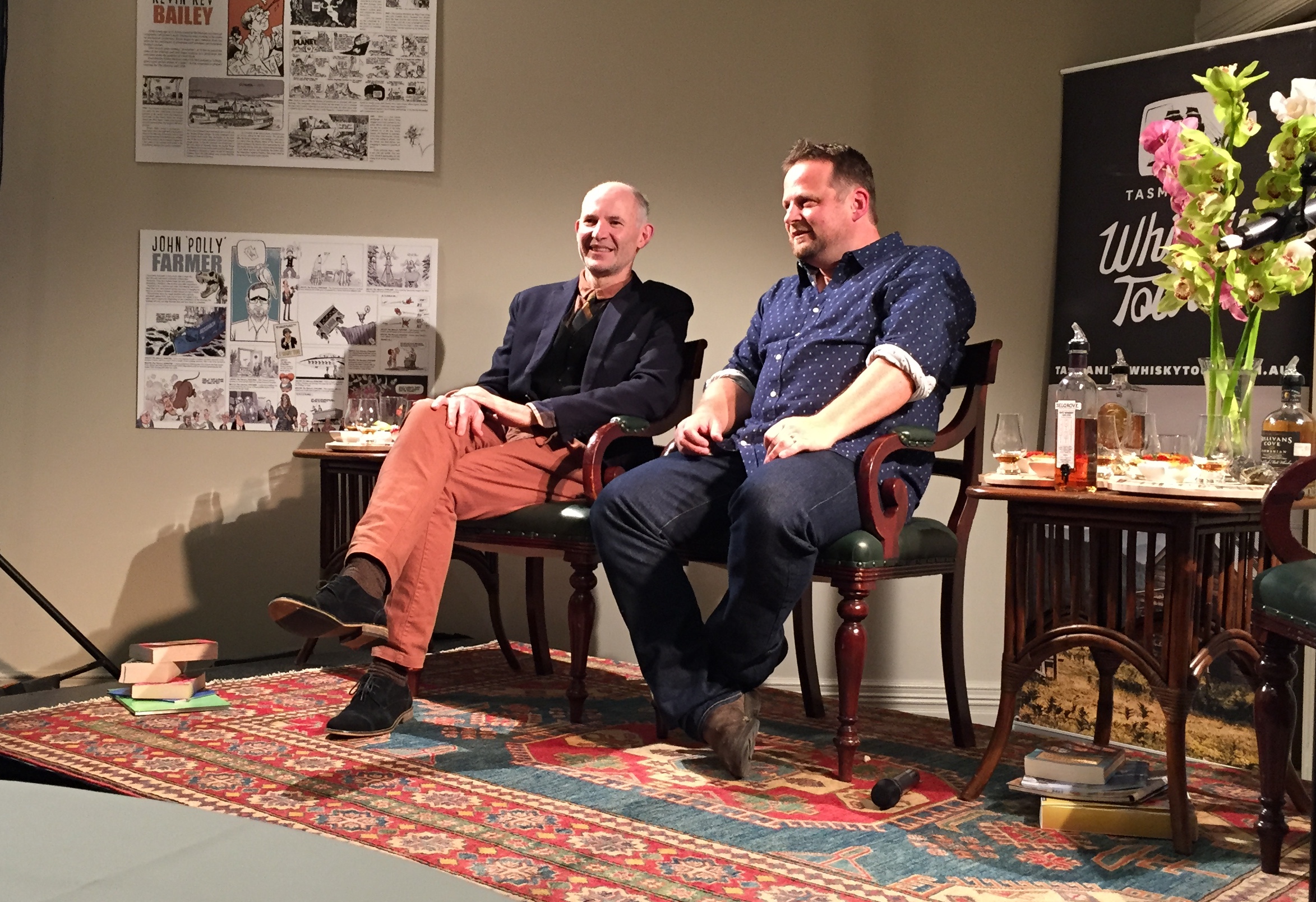
‘Whisky Tales: Stories You Can Drink To’ featured cartoonist-at-large Jon Kudelka, co-author of ‘Kudelka and First Dog’s Spiritual Journey’, and Bernard Lloyd, true waffler and author of the upcoming book ‘Tasmanian Whisky: The Devils Share’. The evening was hosted by Tasmanian Whisky Tours founder and quality beard grower Brett Steel.

1

Bernard and Jon: Whisky Writings answer to Statler and Waldorf

Of course, we must not forget the 50 strong audience, who bore witness to a night of sensational banter between the three protagonists as they discussed the history of Tasmanian whisky, the state of the State’s distilleries and just why Pete Bignell is such a good bloke.

Upon arriving we were disappointed to discover that our talk clashed with the intriguing sounding ‘Tasmania: A land of dregs, bogans and third generation morons’. It seemed that a bogans first policy was in swing too, as while patrons for the other talk waltzed straight in, we were forced to loiter in the lobby with Bob Brown. We came up with a number of theories as to the nature of the delay:

  1. A brawl had sparked up between whisky snobs and bogans, and all the bottles had been smashed to use as weapons.
  2. Jon Kudelka’s bicycle had got a puncture on top of Mt Wellington.
  3. Bernard Lloyd had offered to tell a staff member a brief anecdote.
  4. Brett Steel had tucked into a bottle of cask strength Lark to steady his nerves, and was found ‘napping’ under a table.
  5. There had been a rather bizarre incident involving an explosive pineapple and a Peruvian folk band who had wandered in from the market.

Finally we were permitted entry and made a rockstar’s entrance past the lone paparazzi lurking in the hall. We selected the closest table to the front and sat down to a platter of fine food and distilled beverages. We later discovered that the platters themselves were in fact barrel ends that had been specially made for the event that week.

2

Whisky Waffle and the Queen… Oh, and the wonderful Jon Kudelka!

Brett kicked off proceedings by announcing that the night would be filled with yarns, anecdotes and tall tales about the dirtier, grungier characters that make up the Tasmanian whisky industry (two of them being seated beside him). We learned about the beginnings of Tasmanian distilling from Bernard, when in the 1820s the Governor adopted an ‘if you can’t beat ’em, join ’em’ policy, allowing several land owners to start legally producing whisky.

Bear in mind that this was a similar sort of time to when famous Scottish distilleries such as Glenlivet, Laphroaig and Dalmore were being established, however the Tasmanians were shut down only several years later by decree of Governor Franklin. If they had been allowed to continue, who knows what they might have achieved.

3

Wafflers United

Jon discussed the Spiritual Journey, noting how Brett had bailed him out of what he described as a ‘massive cockup’ in the trips organisation. Turns out that Tasmanian distilleries like to have a well earned break on the weekends. Luckily, Brett was kind enough to provide an Audi and the offer to be designated driver on a week day.

Of course, the talk was only one highlight of the evening, the other being grain – of the distilled variety! There were three rare local drams on offer, and both of us were smugly able to identify each by smell alone. Each was paired with a delicious treat, although we debated whether the matchings might have worked better in a different order.

Stepping up to the crease as the opener was a cask strength Lark finished in the distillery’s own rum barrels, paired with a juicy oyster. Naturally there was plenty of vanilla, caramel and of course Lark’s signature orange, with a long warming finish.

Second drop was a Sullivans Cove bourbon wood single barrel paired with whisky soaked smoked salmon. In the Sullivans Cove we found lemon, toffee, salt and herbal notes, with a delicate zesty finish.

The last man standing was what Brett described as ‘fanboy whisky’. It was one of Belgrove’s mad creations, a 100% rye matured in Pinot Noir casks, paired with a hazelnut chocolate. It was a stark contrast to the other two, which pleasantly intrigued us. Lashings of plum jam, squashed strawberries, spice, wood and apparently a finish akin to sucking on a HB pencil (many thanks to our new friend Julian for that particular gem of a tasting note).

4 lads

Because all the cool people have slogans on the back of their t-shirts

As much as we like to think we know about Tasmanian whisky, nights like this prove there’s an awful lot we don’t. We left feeling enlightened, inspired and grateful to be a part of the whisky scene in our home state. After the talk came to an end we filtered out to grab a signature with Jon, a pint with Bernard and a dram with Brett… and later, many drunken selfies with our new friends.

Tasmanian whisky, bringing people together since 1820.

5

Exhibit A

Nant Homestead Reserve

Reviewed by: Nick

Nant Homestead Reserve

It’s no secret that Jim Murray, whisky writing’s answer to Simon Cowell, is a fan of Tasmania’s Nant Distillery. And that’s fine, he’s allowed to have favourite distilleries. Although, rarely does he offer to fly to the home country of said distillery to create an all-new product for them. But in the case of the Nant Homestead Reserve, a marriage of Nant’s bourbon, sherry and port matured whisky, that’s exactly what he has done.

Nant are makers of some fantastic drams, and Jim has praised their power, their full-bodied flavour and their uniquely memorable Tasmanian nature. But for some reason when offered the chance to create his own, he has failed to include any of the above characteristics. Instead he has created a whisky that proves it is possible to be too smooth.

The nose is familiar if you have ever had a Nant whisky before. It is fruity and candied with touches of vanilla. But it is understated and almost feels like it is missing an element. The palate displays subtle notes of orange, toffee and leafy vegetation. The finish dies away rapidly as if instead of drinking whisky you were simply sipping a glass of water. All together the final impression is that of dissatisfaction.

Of course, this is only one whisky drinker’s opinion. This may be an elegant easy drinking whisky to some. It may also be a viable starting point for non-whisky drinkers. Though for me it lacks the magic of some of Nant’s other releases such as the port, sherry and bourbon matured bottlings. They are all, without a doubt, more complex, interesting and flavoursome than the Homestead Reserve. This whisky is a case where the sum of the parts is greater than the whole.

★★

Glen Moray 12 Year Old

Reviewed by: Nick

Glen Moray 12 Year Old

It is quite often the case in the whisky world that what you pay for is what you get. It is usually a safe assumption that a $40 bottle will be inferior to one costing three figures. However, there are so many exceptions to this rule that I begin to wonder why us whisky fanatics spend the money we do.

Case in point is the Glen Moray 12 Year Old, a bottle that first caught my eye when I was a uni student and therefore always on the lookout for an alcoholic bargain. The Glen Moray was, quite simply, the cheapest single malt I could find in Australian bottle shops. However I was quick to discover it held a certain charm that saw it rise above many of the blends I could also afford.

There is no denying that it is a simple dram, bearing all the hallmarks of Speyside. On the nose there are notes of sweet biscuits and honey. Predictably from a whisky matured entirely in bourbon casks, there are also elements of vanilla. The palate is sweet, almost syrupy, with toffee, banana and heathery floral notes. The finish contains more vanilla, spice and Werthers-esque caramel.

The Glen Moray 12 Year Old is never likely to rack up a high score at any whisky awards shows. But in my opinion there’s absolutely nothing wrong with that. It is simply a straightforward and inoffensive whisky that punches above its weight against the larger players.

★★

A whisky book review: Kudelka and First Dog’s Spiritual Journey

Posted by: Nick and Ted

A day at the Whisky Waffle office usually involves drifting about sipping rare and expensive whiskies and confabulating to each other about them (that’s the story we’re sticking to at any rate). Well, for once we’ve actually sobered up and stopped rambling long enough to read a book. Not just a distillery booklet from out of a whisky tube either, but a whole volume on one of our most favourite subjects in the entire world. Luckily for us there were pictures too…

Bikie Book

“This is a ridiculous book,” Jon Kudelka firmly states with the opening sentence of the tome. He’s not wrong either. But when the story is about the odyssey undertaken by two cartoonists on electric pushbikes as they travel around Tasmania’s nine operating distilleries, what do you expect?

Kudelka and First Dog’s Spiritual Journey is a mad tale of discovery and comradeship, of long hill climbs and aching thighs, and of spotting local wildlife (or in Dog’s case, not spotting local wildlife). Firstly and foremostly however, it is a tale of whisky. The quest begins when two Walkley Award-winning cartoonists, Jon Kudelka and First Dog on the Moon decide they want to drink lots of Tasmanian whisky and get the internet to pay for it. One successful crowd-funding campaign later, the intrepid duo set off from Hobart on their electric bicycles, puncture repair kit at the ready.

Kudelka and First Dog’s chosen mode of transport turns out to be perfect for drinking in the beautiful Tasmanian scenery as the duo meander between distilleries, although they also learn the hard way about what happens when your electric bike runs out of juice (and we’re not talking about whisky – that stuff flows freely).

Over the course of two weeks they learn about whisky making from the horse’s mouth, spending quality time with industry greats such as Tim Duckett, Pete Bignell and Bill Lark, who personally cooks them a meal at his peat bog. As well as hanging out with the Tasmanian distilling pantheon, the boys also meet a lively cast of characters who variously offer them angry cheddar, yacht rides, stuffed foxes and advice on why you should always run over a Tasmanian Tiger if given the chance.

As well as being a rollicking yarn, the book is also highly educational. With the aid of informative cartoon infographics, Kudelka and First Dog give some valuable advice on how to drink whisky: “Step 1: put a bit of whisky in a glass. Step 2: Drink it. The end.” First Dog also offers a lengthy discourse on his theory about why all goat based products, or indeed anything to do with goats full stop, should be avoided at all costs. This is life changing stuff people; take heed fellow wafflers.

If you are interested in Tasmanian whisky, then this is the book for you. If you are interested in the drunken ramblings of two cartoonists, this is also the book for you. The hilarious anecdotes, friendly banter and whimsical illustrations are a truly laugh-out-loud combination.

Bike Waffle

We imagine the trip went a little like this…

We’d thoroughly recommend checking it out – the only real question is whether to buy it from Kudelka:  http://www.kudelka.com.au/kudelka-and-first-dogs-spiritual-journey/ or from First Dog: http://firstshoponthemoon.com/products/first-dog-and-kudelkas-spiritual-journey

Either way, you should look it up. After all, it’s recommended by two out of two cartoonists surveyed. And two out of two whisky bloggers as well.

anCnoc 16 Year Old

Reviewed by: Ted

anCnoc 16

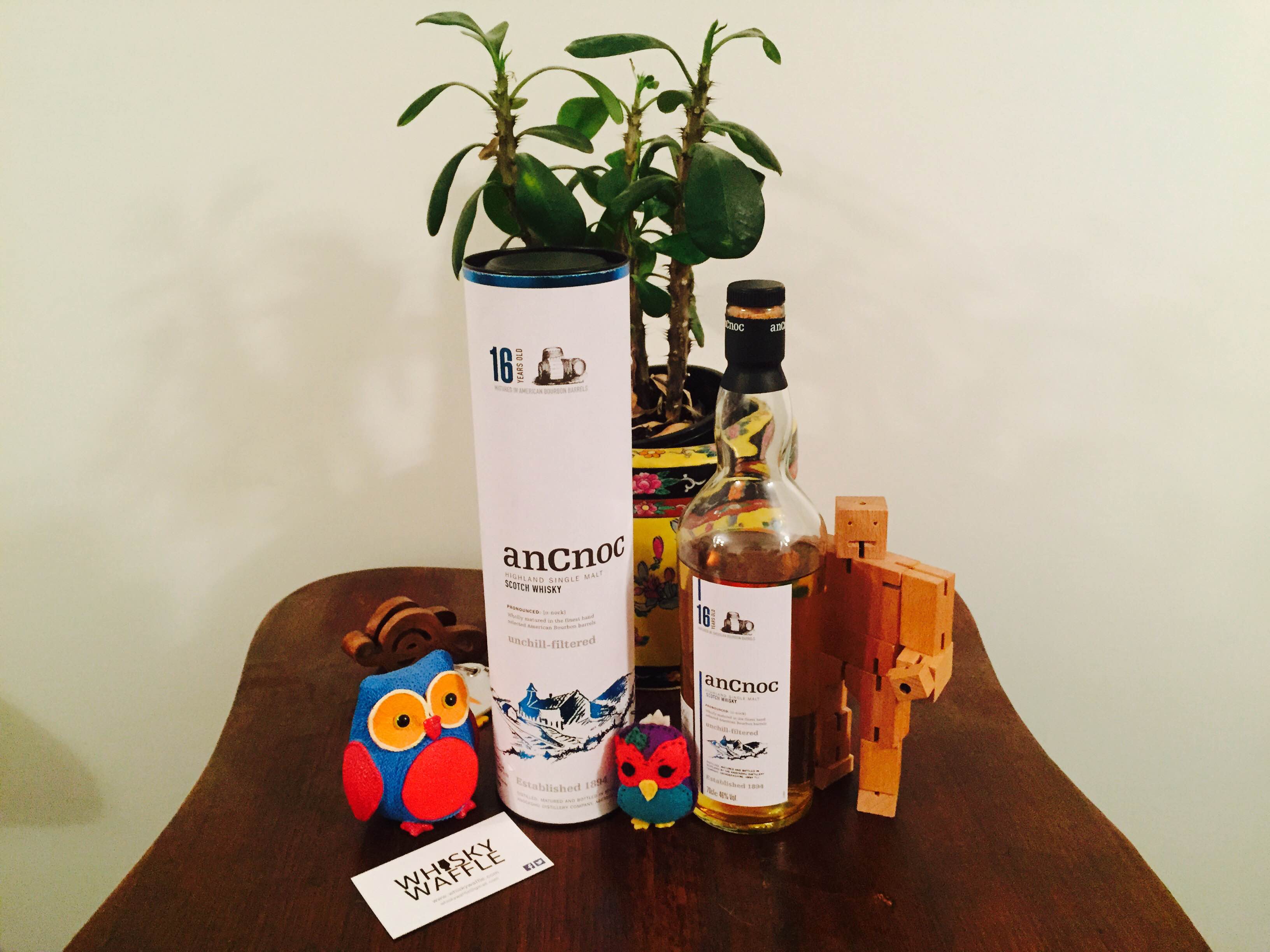
One of the fun things about whisky is that it can reveal to you a time and place as part of its character. If the anCnoc 12 Year Old is a summers day, then surely its older sibling, the 16 Year Old, is the evening.

Produced by Knockdhu Distillery, founded in 1894 and one of the smaller operating distilleries in the Scottish Highlands, the AnCnoc 16yo is a burnished gold in colour, darker than the straw-like 12yo.

On the nose the 16yo is smooth and sweet, with no hint at all of the occasional raw alcoholic jaggies lurking in the 12yo. Herbs, particularly mint, garnish a bowl of caramelised pears in syrup dolloped on Weetbix. The taste is sharp and bright, striking the upper palate. The finish is hot and bittersweet, drying the mouth and lingering for some time afterwards.

The AnCnoc 16yo is much better rounded than its younger kinsman, with maturity found through age. While the 12yo has the heat, dustiness and brashness of the day, the 16yo is the relaxing warmth of the evening. A perfect companion to watch the light fade on a clear summer night.

★★★

Henry’s Legacy continues: Hellyers Road release ‘Saint Valentines Peak’

Posted by: Nick

Hellyers Road St Valentines Peak Whisky Waffle

North West Tasmania boasts some of the most diverse and beautiful landscapes found in Australia. From Cradle Mountain to The Nut, there are no shortage of scenic vistas. Many of these landmarks were first discovered by the explorer that the state’s largest distillery is named after: Henry Hellyer. And it is this man who is honoured by Henry’s Legacy – a range of special release bottlings by Hellyers Road. The latest in the series is named after a local landmark discovered by Henry over 180 years ago: Saint Valentines Peak.

The release is limited to only 480 bottles and is a fiery 60.1% – reflecting the volcanic-like nature of the mountain. The single barrel that matured the spirit is an ex-port cask, imparting flavours of apricot, raisins and buttery dried fruit, or, in the words of head distiller Mark Littler: “delicious”.

Mark was rather pleased with his newest release when I caught up with him – and little wonder: the bottle has already received a silver medal at the World Whisky Masters. I couldn’t help but wonder however – with all this emphasis on the collectability of this bottle – will anyone actually dare to drink it?

“People will buy this bottle for a number of reasons,” admitted Mark. “Some people are looking to collect the whole Henry’s Legacy range, some are after a specific number bottle while some intend to hand it down to their children”. And of course others are pouring themselves the occasional dram and enjoying the flavours immensely!

St Valentines Peak Cordell Richardson

Saint Valentines Peak: the mountain of love…ly whisky     Image by Cordell Richardson

Saint Valentines Peak is rugged, windswept and not for the faint of heart. This whisky emphatically reflects this, bringing together a wonderful Tasmanian product with a spectacular Tasmanian landmark. It is, as the label claims, a dram “for those unafraid of experiencing great heights”.

You can find out more about the Henry’s Legacy range and purchase bottles at the Hellyers Road website.

Bakery Hill: the final frontier

Posted by: Nick

Bakery Hill Tasting 5

Many bakers. Many hills.

Lark? Check.

Nant? Yep.

Limeburners? Sure have!

Hellyers Road? Of course.

Starward? Been there, done that.

Bakery Hill? Ah.

There it was: the one black mark on my record of Australian whisky tasting. I had never tried anything from Victoria’s acclaimed Bakery Hill Distillery. This had to be rectified. But how?

I decided to employ the tactic used by whisky drinkers throughout the ages: I would go to a bar.

The bar in question was the Woodlands Hotel in Coburg. And despite not being near any trees, let alone woods, it was an excellent establishment. As well as providing me with multiple pints of locally produced cider and one of the best burgers I’ve had in my life, they also stocked not one, not two, not even three, but four (I know, FOUR!) different bottles of Bakery Hill.

I glanced across the table at my friend and drinking-buddy-of-the-moment Viv, and nodded. Either by telepathy or the fact that we had previously discussed doing a tasting, we both knew: tonight was the night.

Bakery Hill Tasting 2

My drinking buddy Viv (sadly Ted was in the wrong state)

The four varieties were each as tempting as the next. There was the classically titled Classic Malt. Next to it was the doubly exciting Double Wood. I had a strong urge to try the Cask Strength. And finally, how could we resist the Peated Malt. One of each, we demanded.

One sip into the Classic Malt, I knew that I was onto something. It was an enormous revelation: an elation! Which was also my reaction upon trying it. Raisins, condensed milk, limes, dates. Deliciousness. Viv concurred, labelling it simply: “tasty” and admitting he could drink an entire bottle.

The Classic Malt smelt amazing, but the Double Wood smelt better with notes of vanilla, even dark rum! It was longer, more complex and nuanced. Viv decided it was “tastier”, and “what whisky should be like”.

The Cask Strength was next. And boy was the finish long. It was warm with caramel, spicy cinnamon – even garlic. Viv decreed it “tasty” and claimed that it was so smooth you would not think it 60%.

Finally came the Peated Malt. We possibly had saved the best til last. There was smoke and there was vanilla. There was smoke and there was fruit salad. There was smoke and there was… plenty. This was no Islay peat monster. It was subtle, without compromising on the smoke. Viv agreed: “tasty smoke”.

Bakery Hill Tasting 3

This is the one. Equal best. With three others…

We left the bar oblivious to the cold, kept warm by our whisky coats. It had been a fascinating night, tasting the range of Bakery Hill products vertically while not ending up horizontally. If you are ever near the Woodlands Hotel in Coburg, nip in for a nip. It is well worth it. I already had a huge level of respect for Australian whisky when I entered the bar. And I left it with even more.

Bakery Hill Tasting 1

Mmm… tasty…

Bunnahabhain 12 Year Old

Reviewed by: Ted

Bunna 12

The world of whisky is a lexicological minefield, populated by distilleries and bottlings with all manner of weird and wonderful names. The birthplace of whisky in particular likes to play mind games with the innocent, wide-eyed bystander, the Scottish tongue bending words in ways you just wouldn’t expect.

A true prince of the pack is a distillery from Islay with a name that causes the unprepared mind to melt at the sight of it. Gather your wits dear reader and say hello to Bunnahabhain (phew!). Right, so just to be clear, that’s BOO-na-HAVen (but to really get it, here’s a helping hand from Brian Cox).

The Bunna, as it is more colloquially known, is one of the oldest distilleries on Islay, producing drams since 1881 in the village of the same name. Naturally, being from Islay means that Bunna drams are peated. Unlike other distilleries on the island, however, they aim for a far more subtle maritime nature, with the Bunna motto being ‘the gentle taste of Islay’.

Encased within a heavy black glass bottle emblazoned with the sailor logo and the Roman numerals XII (a numbering system used for their aged releases), the Bunnahabhain 12yo is the core release of the distillery. Made with water from the Margadale spring and bottled at that sweet spot of 46.3%, the 12yo brings forth a rich golden hue.

On the nose the 12yo is light, smooth, sweet and fruity, with ripe autumn apples, dates, plum jam, red grapes and raisins from the ex-sherry casking. Mixed in with the fruits are chestnuts, cashews, pistachios, dark chocolate, brine and rich oak. A veritable cornucopia indeed.

On the palate the liquid hits sharp, salty and dry, like taking a mouthful of seawater on a summertime dip. Underneath sits salted caramel, ginger, mixed peel, seaweed and a faint hint of driftwood smoke. The finish is again salty, and lingers on the tongue like the end of a day at the seaside, a mixture of brine, sweat and sunscreen.

Bunnahabhain is certainly not one of the Ileach peat monsters, choosing to keep that beast well chained in its cave. Instead it manages to sing an incredible song of its maritime environment, perfectly capturing the salt laden winds that blow in from the stormy Scottish coastal waters. The Bunnahabhain is indeed a whisky that is as complex in its nature as it is in its name.

★★★