Tasmanian

Waffling at Whisky Live

Posted by: Nick and Ted

Whisky Live 1

That’s right, we got Whisky Waffle shirts!

“If you love whisky, it’s the place to be”, said Colin, whisky enthusiast and fellow drunkard. It was 4pm. We’d been imbibing the amber nectar for three hours. To be honest, conversations about the merits of whisky were not exactly hard to come by at this end of the afternoon. We, the Whisky Waffle boys, knew that we had come to the right place. And where was that you may ask? It could only be Whisky Live 2015, Melbourne edition.

As semi-amateur whisky journalists (just go with it, ok!) we were keen to make it to Australia’s premier whisky event, despite Jetstar’s best efforts to delay us. Oh, and Public Transport Victoria didn’t help us much, either. As a consequence, it was remarkable that we wandered into the St Kilda Town Hall a mere 10 minutes late.

We were greeted with green shoulder bags, complimentary Glencairns and more whiskies than you could poke a valinch at (it’s a whisky thing, look it up). Our first port of call was to familiar faces: we kicked off our whisky journey sampling some new make spirit with Dean Jackson (and soon-to-be-solo distiller Robbie) from Redlands Estate and sampled some glorious Lark Classic Cask with Tas Whisky Tours’ Brett Steel. Good to hang out with the boys from back home.

Whisky Live 2

Nick, admiring Brett’s beard

We then hopped across the pond to visit Greg Petry, whose strong North American accent clearly revealed that his product was made by the NZ Whisky Company. Go figure. Incredibly, his youngest single malt was a mere 23 years old. After lamenting that we could not combine the initial flavour of the Doublewood with the finish of the 27 year old, we jetted off once more, this time landing in Japan. Here we learned how to pronounce Hakushu (Huck-shoo), and impressed a man in comedic Japanese sushi bar attire that we actually were interested in trying the Suntory Kakubin neat rather than in its traditional highball form (soda water, lemon, ice).

Using the stars, we returned to the New World to discover… cocktails? That’s right, the Lads from Starward were making Old Fashioneds, although it was their single malt we had come to try. Despite their wine cask being aimed at ‘real’ whisky drinkers, we both agreed that we still preferred the apera cask. Shows what we know (we’re semi-amateurs remember!). We then had a ‘Rich’ conversation with our friend from William Grant and Sons about the Balvenie. Ted was pleased about knocking back some 21 Year Old Port Wood without lowering the level of his own bottle! Fred, Independent Beverage Consultant at large, talked us through the range of Glenfiddichs and produced, to gasps of awe, a bottle of 26 Year Old from behind the bar. Yes please, we said. Our new friends Adam and Adam spied the gold lettering from the other side of the room and were more than happy to join us for a nip!

Whisky Live 3

26 year old whisky is best enjoyed in the company of Adams

Never being ones to turn down a free feed, we relined our stomachs to see us through the rest of the afternoon. Our next destination: India, and the distillery of Paul John. We mentioned our India-based whisky writing colleague, the Whisky Lady, to master distiller Michael John D’Souza – India’s a tiny country, not many people – they’re bound to know her, right? (Yeah right). “You mean Carissa?” he replied. The whisky world is a small place indeed.

Whisky Live 4

The newest converts to the Paul John phenomenon.

The whisky itself was a revelation. In fact, it was brilliant! Particularly the aptly named Brilliance, which tasted like nothing else that day. The peated varieties also tickled our fancy, which unfortunately could not be said of the Dry Fly wheat whisky, makers of the infamous Washington Wheat. Admittedly we spent as much time waffling as tasting at this end of the afternoon, the lubricant effect of the whisky loosening our tongues somewhat.

The moment of truth arrived. It was time to try the Glenlivet Founders Reserve, the replacement for our beloved Glenlivet 12 Year Old. And it tasted… well… decent. Maybe there’s hope yet. The rest of the range impressed us, too, in particular the Naddura Oloroso (plus: “they have dried banana here!” enthused Ted). We moved down the line to the mysterious Finlaggen, the dependable Bowmore and the classy Auchentoshan (where Nick drunkenly confessed his undying love for the distillery… repeatedly: “when I went there…” “…my FAVOURITE 12 year old…” “…did I mention I’ve been there?” etc etc).

Ted then whisked him away to attend a master class with master tweed wearer Dan Hutchins-Read to talk about the merits of a whisky that has definitely impressed us recently: the Glenrothes. As there were only four attendees to the session, we had ample time to wax lyrical and Ted may have fallen into the same trap as Nick (“I’ve written a lot of nice things about Glenrothes…” “…I love how you’re all about the vintages…” “…did I mention I’ve written a lot of nice things about you?” etc etc).

Whisky Live 5

Fashionable as our WW shirts were, we couldn’t match Dan for style!

After Nick had calmed Ted down, we staggered off on a mission to find the dram we’d been waiting all day for: the Laphroaig 15 Year Old. To our dismay, we were informed by Australia’s number one whisky fanatic, Dan Woolley, that they had long since run dry. But after seeing our sad little faces, he took pity and muttered that if we were to come back straight after the session finished he might be able to find a little something for us. We consoled ourselves by pairing a glass of Laphroaig 10 year Old with some oysters and a meeting with legendary bourbon distiller and maker of Russell’s Reserve: Eddie Russell. We may have been a little enthusiastic at this end of the day, but Eddie was a true southern gent and took us in his stride.

4.30 ticked over. The bottles began to vanish from the stalls. We wandered around dodging the polite requests of the security guards to leave. We had a mission to complete: and boy was the 15 Year Old worth it.

Whisky Live 6

Laphroaig’s man of steel, Dan Woolley

As we stumbled out of the St Kilda Town Hall amongst hordes of whisky fanatics, en route to the closest pub, we mused about our day. We had come to Whisky Live expecting to find many great whiskies and we had not been disappointed (46 times over, in fact!). But to be honest, the real joy of the day was to celebrate whisky with a bunch of fellow wafflers. That in itself was worth the price of admission.

Whisky Live 7

Whisky Live. Good times.

Starward Single Malt

Reviewed by: Nick

Starward

Regular readers of this blog would be forgiven for thinking that all of Australia’s world class whisky is produced in my home state of Tasmania. While I’ll still claim that most of it is, I will readily admit that some stellar drams are being produced on that tiny island up north, which some refer to as the Australian mainland.

One of the most exciting up-and-coming distilleries in the New World of whisky making is the appropriately named ‘New World Whisky Distillery’, which has been releasing whisky since 2013 under the name Starward. And there is a lot to like about it.

For a start, there’s the location. New World is based in Melbourne, the cultural hub of the country (sorry Sydney), and with a bar onsite at the distillery the city has gained a wonderful venue to sample spirits straight from the metaphorical horse’s mouth.

Secondly, there is the label. Starward is an alluring name for a whisky and the gold constellations streaking across a black background capture this image perfectly.

Thirdly there is the price. Australian whisky has the reputation for a remarkably full-bodied flavour, although at an equally remarkable full-bodied price. Starward bucks this trend, providing a local drop that will not break the bank (although perhaps dent the wallet a bit).

Finally, and unquestionably most importantly, there is the flavour. On the nose it is lively: this is a young whisky, but it is far from immature. There are notes of oranges, chardonnay and toffee. No doubting the country of this whisky’s origin.

On the palate there are certainly notes of the raisiny flavours emparted by sherry barrel maturation, although technically speaking, the barrels contained Apera: sherry made in Australia not Spain. Sweetness spreads across the tongue and the orange returns, this time with chocolate, giving a jaffa-like taste. I also picked up elements of glacé cherries and raspberry shortcake. As you do.

The finish is short, but not disappointingly so. There are hints of oak to be found as well as spicy, peppery elements. It is certainly pleasing enough to encourage a second sip!

While the Starward is not the most subtle or nuanced whisky you are ever likely to come across, it is undoubtedly really pleasant to drink. The distillery itself sums it up best with its claim: “Just like the country in which it is made, Starward is youthful, rich and bright”.

It is also just across the water. Whisky Waffle may have to pay it a visit sometime…

★★★

‘Big Peat’ or ‘The Perks of Random Conversation at the Bar’

Reviewed by: Ted

Big Peat

This story begins, as so many great stories do: m’colleague and I were at the bar. Admittedly not an unusual state of affairs. On this particular night we were chatting to our barman mate, and a friend of his that he’d just introduced us to. For the purposes of this story, let’s call him Doug. Doug was feeling in a rather celebratory mood as he’d just scored himself a job working as a pharmacist in sunny (and I mean that in the most ball-of-thermonuclear-fire sense of the word) Alice Springs, which is pretty much smack bang in the centre of Australia. Quite a change from little old Burnie on the NW Coast of Tasmania, which can occasionally be sunny if it really makes the effort.

After the usual necessary social preamble was out of the way, the conversation happily turned to that most mysterious, complicated and variable of subjects… women! No, wait, I meant whisky! Doug, as it turned out, was quite the connoisseur (and not just of whisky. On a side note he very charitably bought us a glass of Cognac from the highest extremity of the top shelf, an interesting experience to say the least). We all shared a common passion for peated whiskies, particularly those from what is arguably the spiritual home of the smoky dram: Islay.

These days people mostly talk about Islay in terms of its single malts, but historically the island’s distilleries injected popular blends with some much needed character (and they still do!). However, there is a theory that history works in cycles, and what was once old becomes new again (which probably explains the questionable return of scrunchies and chokers). Interestingly enough, what was getting Doug excited that evening wasn’t the single malts from one of the hallowed Islay distilleries, but a blend. An all-Islay blend. “It’s fantastic! You should track it down”. Fateful words readers, because a few cheeky drams relaxing the mind and the heady world of internet shopping instantly at ones fingertips is a dangerous combination. Let’s just say that I didn’t take much convincing, and moments later I was the proud owner of a bottle of this curious beastie.

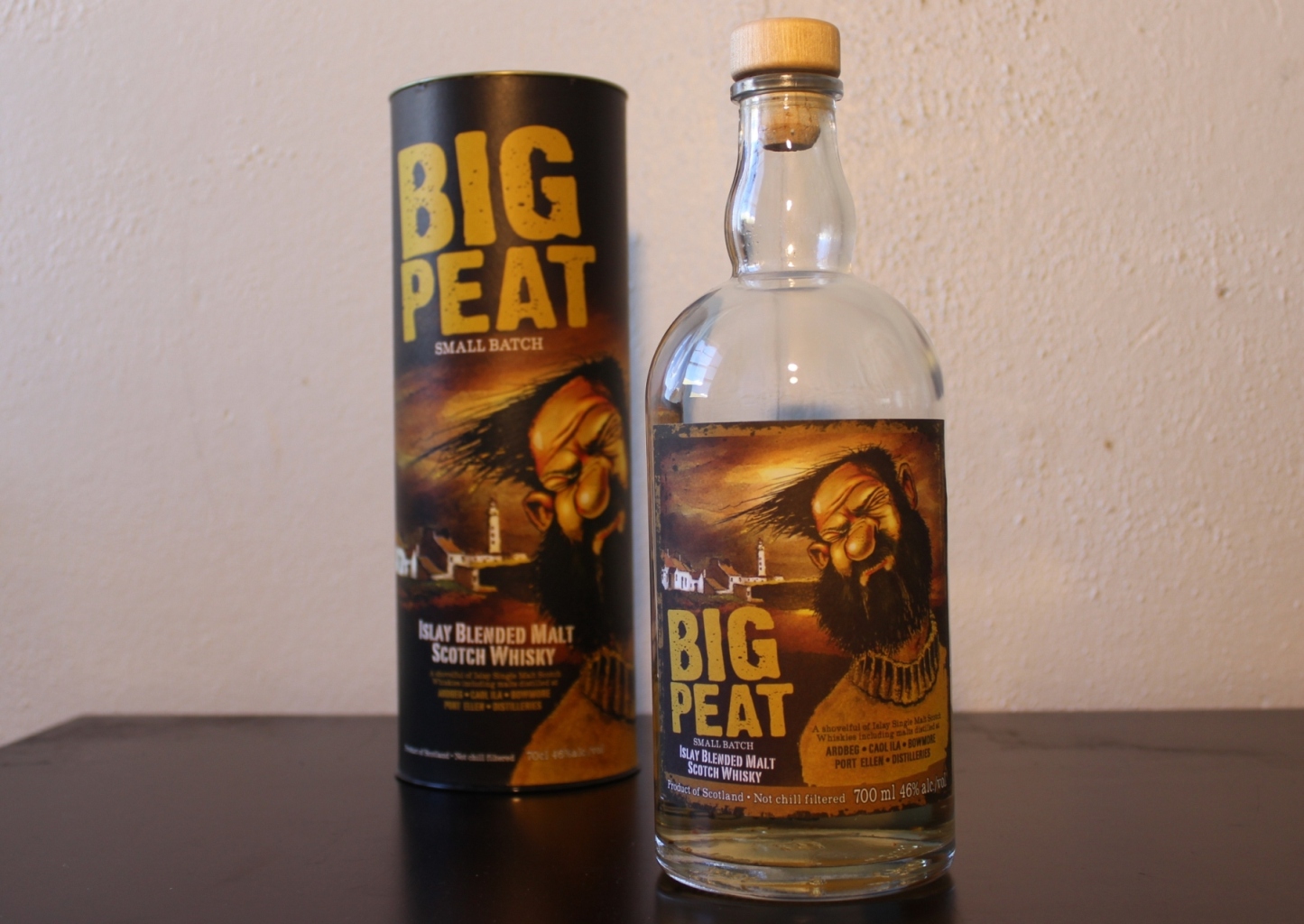
Cut to a few weeks later and m’colleague and I were staring with anticipation at a large post box that we had dubbed ‘The Bunker’. With no little ceremony (mostly involving the humming of the tune from the start of ‘2001: A Space Odyssey’) we cracked open the box, and were greeted by one of the coolest bits of tube artwork this side of Eilean Mhic Coinnich. Meet the Big Peat, an all-Islay blend purporting to contain ‘a shovelful’ of single malts from the distilleries of Ardbeg, Caol Ila, Bowmore, and Port Ellen. The aforementioned artwork is a brilliant graphic-style picture of a hirsute gentleman standing in front of what I can only assume is the Rhinns of Islay lighthouse on a beautiful island day (which is to say that the sky is the colour of tea, and our man has his face squinched up against the wind, which is trying its best to blow his hair away).

Chuckling with glee we popped the top and unsheathed our prize from its scabbard. Gasps of surprise met the sight before us (don’t worry, we hadn’t been ripped off and sent a bottle of JW Red instead). You see, normally we would picture the drams of Islay as being dark and brooding in hue, but the Big Peat was filled with bright spirit the colour of pale golden straw. Some people just like to mess with your mind. Of course, there was only one sensible recourse to meet the conundrum before us, and it wasn’t hiding under the table. Bust out the glasses and crack that sucker open good sir!

A generous splash of whisky later and we were ready to begin uncovering the secrets of the Big Peat. There was no denying that it lived up to its name. The smoke was there as soon as we poured it into the glasses, infused with plenty of dark chocolate, malt, rich earth and those medicinal notes that Ileach whisky is famous for. We were in no doubt about the heritage of the spirit sitting before us, whatever the colour. A closer snort revealed thick sweet notes and perhaps a bit of overripe fruit, like a squashy banana. We eyed each other off; curious, but not too bad a start.

Slurp! Hot, woody, ashy smoke poured into our mouths and then… not much else. Sure, there was a light, sweet after-taste, but it was gone in a flash, and all that was left was spicy, medicinal smoke coiling around the tongue. It was like being on the edge of a bush fire; plenty of smoke getting all up in your face, but no blazing heat to go with it. Hmmm…

We could see what Douglas Laing & Co, the makers, were trying to get at; surely crafting a vatted blend out of the great single malts of Islay should be as awesome a combo as haggis with tatties and neeps! Yet somehow they’d got a wee bit over excited with the whole BIG PEAT malarkey and forgotten that it isn’t just the smoke that makes an Islay dram exceptional, it’s the bricks and mortar and the shape of the fireplace too. The way that sweetness melts into savoury, medicinal tang challenges the tastebuds, dark flavours are shot through with light, seaside elements help wash everything across the palate, and then finally the smoke that sits over them all. It’s a complex ecosystem that requires careful balance to work well.

Sitting back we mused upon the Big Peat. By no means did we think that it was a bad dram, far from it, just that somehow it deserved to be better. Perhaps the mix wasn’t quite right, maybe a dash of Bruichladdich or Bunnahabhain could have rounded out the flavours working underneath the smoke. Who knows? What we did know though, was that the Big Peat had challenged us, and that a random discussion in a bar can lead to interesting and unexpected places. So go on, strike up that conversation, you might just find something new.

★★★


Talisker 57˚ North

Reviewed by: Nick

Talisker 57 degrees north whisky waffle

Whenever I pour one of my non-whisky drinking friends a wee dram (watching in amusement as they splutter noticeably and their face flushes a conspicuous shade of red) I tell them to picture themselves in a small rugged hut on the west coast of Scotland as a fierce Atlantic storm batters the walls and ceiling. That, I proclaim, is the ideal location to enjoy whisky. While a fireplace may sufficiently heat your extremities, a dram of whisky will warm you from the inside out. And if I were huddled in this rugged hut on such a night, the drop I would turn to first is the Talisker 57˚ North.

This whisky, made on the Isle of Skye’s sole distillery, is named for two reasons: firstly (and I may be biased, but I would claim foremostly) because the spirit is bottled at a practical 57%. Secondly (and perhaps more poetically) because the town of Carbost, home to Talisker, is found at 57˚ North of the equator. In this part of the world, your insides are quite often in dire need of warming.

To put it into perspective, Canada’s 2010 Olympic Winter Games host, Vancouver, is situated at a mere 47˚North while my often freezing home state of Tasmania is at just 42˚South. Talisker Distillery is only two degrees further south than notoriously icy Scandinavian capitals Stockholm and Oslo. So it stands to reason that a warming dram or two is created there.

On the nose, there’s no doubting this is an Island whisky. Smoke wafts liberally out of the glass, although possibly more subtly than some Talisker expressions. Other elements are noticeable too: pepper, chorizo, and cured meats. It is like inhaling deeply at a gourmet barbecue.

There is certainly a woodiness about this whisky on the palate – although not reminiscent of your standard oak notes. Instead the flavours are dustier, earthier, more akin to a tree’s bark than the wood underneath. Elements of honey and marmalade hint at typical Talisker sweetness, though it is more toned down than the 10 Year Old. Instead, wonderful new flavours are present such as bacon and buttery toast, as well as some less pleasant bitter sappy elements which give the impression of burning wood that is slightly too green.

The good news is, this whisky leaves the best until last: the finish is undoubtedly the highlight of the dram. It is long – so very long – and hot and lively. After the spiciness fades, the smoke returns gently, bringing your tasting full circle.

Drinking this whisky, I find that I take my own advice. I close my eyes and picture the howling gale, the bucketing rain and the crashing thunder. Scotland is no stranger to wild weather. And in the eye of the storm, the Talisker 57˚ North is the dram you need.

★★★★

5 Whisky Waffle Winter Warmers

Posted by: Ted

I said, brr, its cold in here, there must be some… low pressure systems, high precipitation rates and perhaps even the formation of snow caused by the seasonal polar tilt of the earth away from the sun, creating wintertime meteorological phenomena in the atmosphere. What, you weren’t expecting ‘Bring It On’ were you?

Yes folks, it’s winter in the Southern Hemisphere, and while for the most part that may not entail quite the same level of bone aching crazy cold that our Northern kin have to endure, it’s still enough to send us shivering. Well, what better way to beat the winter chills than a nice warming dram of whisky? And there’s one class of the amber stuff that does it better than any other: cask strength. So without any further ado, here are five cask strength whiskies that will help spread a warm glow inside your belly this winter:


5. Glenfarclas 105

glenfarclas-logo

If you need to get warm in a hurry, then why not have a giant gorilla sit on you? Well, not really, but that’s what the experience of drinking a drop of the Glenfarclas 105 is like. Bottled at 60%, this family-owned drop from Speyside is big, bold and will cause you to beat your chest like a silverback as its powerful sherry-driven flavours rampage through your veins. Drink while entertaining thoughts of scaling tall buildings.

4. Glenlivet Nàdurra

Glenlivet-Logo

Meaning ‘Natural’ in Gaelic, this 16yo dram from Glenlivet is the logical solution for warming up on a frosty night. Indeed, I can vouch for its efficacy, as I sipped a dram of it while watching a meteor shower on a cold, clear night (the shower was a bit of a damp squib, but the whisky was certainly good). The Nàdurra is taken from the barrel at a 54-55% strength guaranteed to put a rosy glow in the cheeks. Drink while pondering the natural order of the cosmos.

3. Nikka from the Barrel

Nikka logo

Japan certainly sees its share of cold weather, but not to worry, the gods saw fit to create a dragon spirit to fight the frost. It may come in a small package, but the Nikka from the Barrel packs a big dragony punch. Bottled at 51.4%, this fiery little blend is packed with hefty dollops of sweetness and spice backed up with a wicked sherry kick. Drink while watching ninjas fight in a snowy forest (well, at least it will keep you occupied as you fail to spot any of the combatants).

2. Talisker 57° North

Talisker logoWant hot coals to smoulder and smoke away inside you? Then what you need is some peated whisky, and what could be better than a ‘special strength’ release out of the wind-and-rain lashed Isle of Skye? As its name hints, the Talisker 57° North is bottled at… well… 57% and is full of Talisker’s trademark mixture of sweet and maritime flavours. Drink while wearing a blue knitted fisherman’s turtleneck in front of an open log fire.

1. Lark Port Wood Cask Strength

Lark logo

Need to feel your toes again on a chilly Tasmanian night (which to be honest, can happen in high summer. Thanks maritime climate!)? Well, how does drinking hot, spiced orange sound? That’s certainly what it feels like sipping some of Lark’s 58% Port Wood release. If Lark can revive the Tasmanian distillery industry, then it certainly shouldn’t have any trouble getting you back on your feet. Drink while huddled in a wooden hut in the Tasmanian highlands.

Slàinte mhath!

Ardbeg: a journey through time – the coming of age

Welcome back fellow Wafflers to the odyssey that is Ardbeg through the ages. We left our tale at a perilous standpoint, with our hero of a distillery surely doomed to closure and eternal obscurity. We resume the story in 1986 and Ardbeg has been shut for five long years. But the whisky community did not forget…

Ardbeg Day 2

Ardbeg: A journey through time – the coming of age…

Posted by: Nick

1987

Some hope emerges for our protagonist in the form of new owners, Allied Lyons. Could this be the salvation for the distillery and the wider community? Sadly, no. It is a false dawn, and Ardbeg is run merely to become one hundredth of a bottle in AL’s blends. No one has the foresight to recognise this was 99 parts too few…

1996

The distillery is neglected and once again it is unjustly left to dwindle to nothing. Surely this time, it really is the end for our hero.

1997

Finally, just when all seemed lost, someone sees the light! The folks at Glenmorangie realise that one day this quaint little establishment in Port Ellen could actually become one of the greatest distilleries in the world. It could even have a go at producing one of these new-fangled single malts! Or at least this is what Glenmorangie’s Dr Bill Lumsden, head of distilling and whisky creation believes. And when you have a title as impressive sounding as his, anything is possible.

The new owners open the creaky doors to the old bond store to reveal… barrels – housed there since the 1970s! We can only imagine the size of the grins on faces that day. This vintage product marks the beginning of many special one-off releases.

1998

The new owners begin work as if they want to make up for lost time. Progress is made remarkably quickly. Renovations to the visitor centre are duly carried out and the now famous Old Kiln Café is installed. More 1970s bottlings are released. And our hero is starting to get noticed. It doesn’t take long before there is a shiny award on the wall of the renewed visitor centre with the words ‘Distillery of the Year’ emblazoned on the plaque.

2000

One-off releases are doing their job. But what Ardbeg really needs was an identity; a main character. This arrives in the form of the 10 Year Old, young and fiery, peaty and heavy, and yet balancing seaside elements with oak and vanilla. It is quite unlike anything else on the market. And the world approves.

2001

With its standard bearer firmly realised in the form of the 10 Year Old, Ardbeg decides to push the boundaries further. The one-off bottlings have been very successful, so why not release one every year? This trend begins in 2001 and continues to this very day. First is the Lord of the Isles, followed by bottles such as the Airigh Nam Beist, Serendipity, Rollercoaster, Gallileo, and the much sought after (at least by us Wafflers) the Alligator.

2003

Another regular release joins the Ardbeg stable, this time an even more fascinating drop, the cask-strength Uigeadail (or Oogie as we Wafflers affectionately call it). Spending part of its maturation in sherry barrels adds another layer of complexity to this already multifaceted drop.

2007

The baton changes hands once again. From Duncan McDougall via fifteen others, Michael (Mickey) Heads becomes the latest distillery manager for Ardbeg.

2008

Worldwide recognition is only a matter of time for our hero. The famous Ardbeg 10 year old wins Jim Murray’s world whisky of the year award, and brings greater renown to the growing brand.

2009

Ardbeg makes it back-to-back when the Uigeadail follows in the footsteps of the 10 Year Old and reclaims the world whisky of the year award for the distillery!

Buoyed by this success, Ardbeg expand on their main range with the heavy and blazing Corryvreckan and the light and restrained Blasda.

The 2009 special release, even by Ardbeg standards, packs a peaty punch. It is appropriately titled the ‘Supernova’, and it goes on develop cult status among the ever-expanding legion of Ardbeg fans.

2014

Finally after years of yearning, this particular Waffler’s dreams come true, and Nick stumbles into Port Ellen, first stop: Ardbeg Distillery. He has a magnificent time, checking out the stills and the bond store before settling down in a comfortable chair to sample the wares and chat about the history of the great distillery. He could not be more pleased for the establishment that they near their 200th year as distillery and continue to make one remarkable drop after the other. He decides that Ardbeg truly is a hero and vows to one day chronicle the saga of its tumultuous, but ultimately highly successful life.

0182

2015

Ardbeg officially turns 200. The party begins.

Sláinte!

Click for part one

Ardbeg day 1

Overeem Port Cask Matured

Barrel Number: OHD-067

Reviewed by: Nick

Overeem Port Cask

Whiskies so often seem to reflect their creator. Bruichladdich whiskies display the passion and local ethos displayed by Jim McEwan. Variously finished Glenmorangie drams showcase that experimentation possessed by scientist Dr Bill Lumsden. Whiskies made at the Old Hobart Distillery, much like their creator, Casey Overeem, have true character. And much like Casey, this character is very likeable.

Old Hobart Distillery releases their whisky under the label ‘Overeem’ and is part of a growing collective of whisky makers from southern Tasmania consistently churning out a high standard of products. Overeem, like Lark and Sullivan’s Cove, use French Oak ex-port barrels cut down to 100 litres to mature a percentage of their whisky. The flavours created by this process, similarly to its contemporaries, are equally extraordinary. But there’s something a little extra special about the Overeem. It has an element of ‘handmade’ about it, something that suggests this whisky is crafted instead of distilled.

The nose is light but enticing. There are notes of berries and stewed apricots alongside faint traces of ginger and fennel. There are also some gloriously Tasmanian woody notes which call to mind a home-workshop stocked with Huon Pine.

The palate is richly flavoursome and offers many layers to discover. It is initially sweet and spicy, offering fizzy orange sherbet notes with a dash of pepper preventing it from becoming too sweet. There is also a degree of citrus and maltiness, combining to give the impression of a freshly baked sponge cake with lemon curd. The finish is lengthy and contains faint raisiny and caramel notes: finally, the much-vaunted fruitcake has made a subtle appearance!

This is a fantastic example of a Tasmanian Whisky in more ways than just flavour. It is the perfect illustration of a micro-distillery whose focus is on creating a well-crafted product. This is not done simply as a business venture, but instead as a way for one man to create the spirit that he loves. And Casey Overeem’s intent is certainly apparent when drinking the whisky which bears his name.

★★★★

Glendronach 12 Year Old

Reviewed by: Nick

Glendronach 12 Year Old

Now, be honest with me. Raise your right hand if you have bought, with your own money, in the last six months, a bottle of sherry? Anyone? I thought as much.

The once proud sherry industry is declining slowly, but surely. While on the surface this may not seem to really affect we drinkers of distilled barley, there is, in fact, much cause for concern. Because without sherry, specifically, without the barrels that once contained the stuff, many of the most wonderful whiskies in the world would not exist.

Case in point: the Glendronach 12 Year Old. And it is a great little drop. Vibrant, spicy, balanced and heavily sherried. The latter is not a subjective tasting note. The whisky does indeed possess a highly sherried character because it has been matured in a mixture of Pedro Ximinez and Oloroso sherry barrels.

The flavour this imparts is obvious on the nose in the form of sweet creamy raisin aromas. There is a golden syrup-like quality, too, alongside dried figs and orange peel.

On the palate the flavours are, surprisingly, not as sweet as the nose suggests. However it has a smooth mouth feel and the creaminess is still present. There is a nuttiness about it as well, and more dried fruit with perhaps a touch of glace cherries. Little wonder sherry-matured whiskies are regularly likened to fruitcake.

The finish is short, disappointingly, as up to this point I was immensely enjoying the ride. Wait – there it is, ever so subtly lingering at the back of the throat with the remnants of the grape flavours. I had to go searching for this one, but I found once discovered it glows faintly, like the last few embers of a campfire.

The sweetness of this whisky is nice, although it would probably discourage me from having too many drams of this in the one night. Instead, this is the perfect choice to directly follow a bourbon-aged malt at a tasting, to really show just how radically different sherry matured whisky is.

We may as well enjoy it for the time being. Because as time rolls on there will be fewer and fewer sherry barrels around to put whisky in.

★★★

Tasmanian Whisky Tours: a story worth telling

Posted by: Nick

Before there were convicts there was whisky.

But before there was Tasmanian Whisky Tours, there was a distinct lack of access to Tasmanian whisky distilleries.

Enter Brett Steel, a man with a vision. He realised that Tasmania was entering a “golden age” of whisky creation and wanted to give the public a chance to travel to these distilleries, meet the people that make the whisky and hear their stories. Thus Tasmanian Whisky Tours was born.

I caught up with Brett to find out a bit more about the tours.

WW1 TWT Brett

“From my first visit to Tasmania in 2008 I fell in love with the place”

Brett grew up, not among whisky makers, but instead with a strong wine background. This is hardly surprising, as he lived near the great wine region of McLaren Vale. He moved from South Australia to Hobart in 2011 with intentions of starting up a bar selling Tasmanian whisky, assuming that once he was in the state there would be easy access to the distilleries making the product he intended to sell. However, he quickly found this was not the case.

As more distilleries opened up, Tasmania rapidly became a join the dots puzzle. The state suddenly had a whisky trail! And Brett? Well he had a car! He realised that no one in their right mind wanted to drive themselves to distilleries and now there was a real touring opportunity. So Brett took the plunge and decided to become… a professional designated driver!

There is, of course, more to it than that. Brett is a man after our own hearts. He is a waffler. As well as tasting the flavours of the drink, he was passionate about hearing the tales told by the people behind the whisky.

WW2 TWT at Redlands

“I wanted this to be about storytelling, as much as whisky”

Brett’s aim for the tours is not so much to give an educational and scientific description of how whisky is made. Instead he is more interested engaging with the people who make the product and hearing about the struggles and adventures they have had along the way. After all, the whisky-makers are just ordinary people doing something they love and they certainly have a tale or two to tell. Brett believes that whisky and story-telling are “perfect bed-fellows” and his guests, after meeting the story-tellers themselves, cannot help but agree.

WW3 TWT at home base 2 bnw

“The trick is to try to cater to all levels and not to have anyone feel excluded”

Brett’s first tours began running in early 2014 and the business has been growing in popularity ever since. The rise in profile of whiskies made in the state has given the business a boost, and Brett has found himself chaperoning journalists, whisky experts, and even cartoonists!

The tours run on Wednesdays, Fridays and Sundays and visit a wide range of southern distilleries – and also get to taste some from further afield. Sessions begin at 9am at the Lark cellar door, and proceedings commence by reclining in comfortable chairs and chatting about the history of Tasmanian whisky. Guests are then loaded into the van and driven around the beautiful Derwent Valley or Tasman Peninsula.

There are many highlights on each tour for Brett: the picturesque setting at McHenry’s Distillery in Port Arthur, the paddock to bottle experience at Redlands Estate, and the unforgettable yarns spun by “renaissance moonshiner” and “champion sand-sculptor” Pete Bignell at Belgrove.

Of course, much like everyone has a favourite whisky (or gin, or brandy, or apple schnapps – which are also sampled on various tours) everyone has a favourite stop, and you won’t know which is yours until you travel there.

WW4 TWT at Nant

“To me whisky is the perfect social lubricant”

I absolutely adore this quote and cannot agree more wholeheartedly. Brett believes, as we do, that whisky is a very social experience, and when presented with context, such as the people who create it and the processes they use, guests will get so much more out of every sip.

He says that sharing the narrative of Tasmanian whisky, past, present and future, is half the experience of the tour. The characters that are met along the way and the real passion they exhibit, gives true meaning to the boutique hand-crafted product that we at Whisky Waffle love.

WW5 TWT at Bothwell

Brett, like all of us, confesses to loving Tasmanian whiskies and their rich flavour. But he is also fascinated by the history and stories behind each of the distilleries.

“When you put the two together and add the dynamic of a mix of different people, it’s pretty hard to beat that experience – no matter where in the world you travel.”

Find out more about Tasmanian Whisky Tours at their website.

Photos by Andy Wilson at  Everything Everything.

Springbank 10 Year Old

Reviewed by: Nick

Springbank 10 Year Old

Welcome to Campbeltown. I shall begin by clarifying to my fellow Tasmanians that I am referring to the town in Scotland, not the eternal toilet stop halfway between Hobart and Burnie.

Campbeltown is located at the tip of the suspiciously shaped Kintyre peninsula in the south of Scotland and was once known as the ‘whisky capital of the world’, being home to as many as twenty-eight distilleries. Sadly (at least for the sailors who make port there) this is comprehensively no longer the case. Several distilleries, however, are still going as strong as ever.

Springbank, Longrow and Hazelburn are all based in Campbeltown. In fact, they are all based at the same distillery. And despite being located at the same premises, all three make many varied and fascinating drams. Longrow whiskies are heavily peated, and often aged in unusual and quirky barrels. Hazelburn whiskies are triple distilled, and as smooth and creamy as their similarly produced Irish counterparts. Springbank, the biggest and most well known of the three, makes whisky with a maritime influence, harking back to drams made in the nineteenth century when the town was in its pomp.

Their entry level is the 10 Year Old and it is a perfect dram to demonstrate what they are about. The nose is oily and buttery with a sweet seaside edge. This is whisky doing salted caramel. There is also the faintest hint of smoke, of course nothing like the Islay peat monsters which linger only a small stretch of water away.

It is bottled at, in my opinion, the optimum level for whisky: 46%, and the slightly higher alcohol percentage gives this whisky a pleasantly light spice across the tongue. The flavour is slightly fishy, and I mean this literally, instead of labelling it ‘suspicious’ (although some people would take this claim to be very suspicious indeed).

The Springbank 10 Year Old has been matured in both ex-bourbon and sherry barrels, and the sherry in particular is notable on the finish where raspberry jam flavours mingle with the slightly smoky notes creating something memorable and completely unique to Campbelltown.

While the flavours in this dram are all fairly gentle and subtle they combine nicely to create a pleasant and easy drinking whisky. It therefore serves as a perfect introduction to the lost whisky region of Campbeltown and to the wonderful drops made there by Springbank and its two sister distilleries. Of course, if the 10 Year Old is a little light and inconsequential for your liking, you could always jump straight to the 15 Year Old – now there is a dram that means proper business…

★★★